 EN
Quick Answer
Compare bonded and sewn shapewear at the actual join, edge and garment level. Bonding can create a lower-profile connection, while sewing uses a stitch construction that must suit the material and movement. Neither method automatically guarantees invisible edges, comfort or durability after care.
Ask for identified materials, join design, manufacturing controls and appropriate prototype and after-care evidence. Evaluate the garment under relevant extension and outer clothing. A smooth new sample is not enough to approve a bond, and a strong-looking stitch is not enough to approve a seam. Choose the construction that meets the brief and can be reproduced in the first production order.
Where Would a Bond or Seam Actually Change Your First Product?
Mark the proposed waist, leg opening, abdominal panel, side join, lining attachment and closure as applicable. Each location has its own role and movement. A founder who asks for bonded shapewear without identifying the feature may receive a different construction from the one imagined.
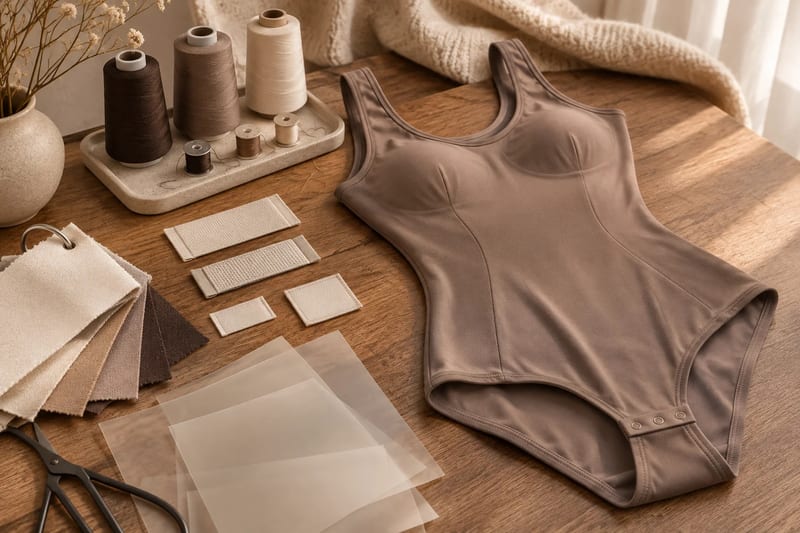
Start with a relevant S-Shaper garment reference and request an inside view. Identify which areas are bonded, sewn, knitted or otherwise finished. A hybrid garment can use different methods where they are useful. There is no reason to treat the entire style as a single all-or-nothing technology decision.
Write the desired benefit in terms the sample can address: reduced visibility beneath the chosen clothing, a comfortable opening during walking or an attachment that remains stable through the intended care routine. Avoid using premium as a substitute for a construction requirement. It does not tell the developer what to change or the inspector what to review.
Also identify constraints. A material may look suitable before bonding but behave differently after the proposed processing. A seam may extend adequately in one direction but restrict an opening. The first prototype should expose those issues rather than hide them beneath a general category claim.
Keep the actual wearer and use case in view. An edge that looks elegant on a flat sample may contact a moving part of the body or sit beneath a thin outer garment. Ask which location-specific review will determine whether the feature helps the product. Do not replace that review with a generic statement that bonding always feels smoother or sewing always lasts longer.
What Information Does a Bonding Proposal Need Before Sampling?
Bemis explains that its apparel adhesive films require selection for the textiles and appropriate sealing conditions. Its guidance identifies heat, pressure and time as process inputs, and discusses prototype bond-strength, elasticity and after-wash evaluation. That supports a controlled material-and-process review; it does not establish that every adhesive works on every shapewear fabric.
Source: Bemis: adhesive selection, sealing conditions and prototype/production testing
Ask the garment supplier to identify the substrate, adhesive or tape where used, join geometry and relevant process record. The startup does not need to publish confidential machine settings, but should know that the approved sample has a reproducible construction and that material changes will be reviewed.
Treat finishes and material variants as part of the question. Carvico’s dated Vita Power sheet recommends testing each dye bath before treatments or applications beyond cutting and sewing. That is a material-specific caution, not a universal rule for every textile. It illustrates why a familiar composition is insufficient permission to apply a new bonding process.
Source: Carvico Vita Power: dated technical sheet and treatment-testing caution
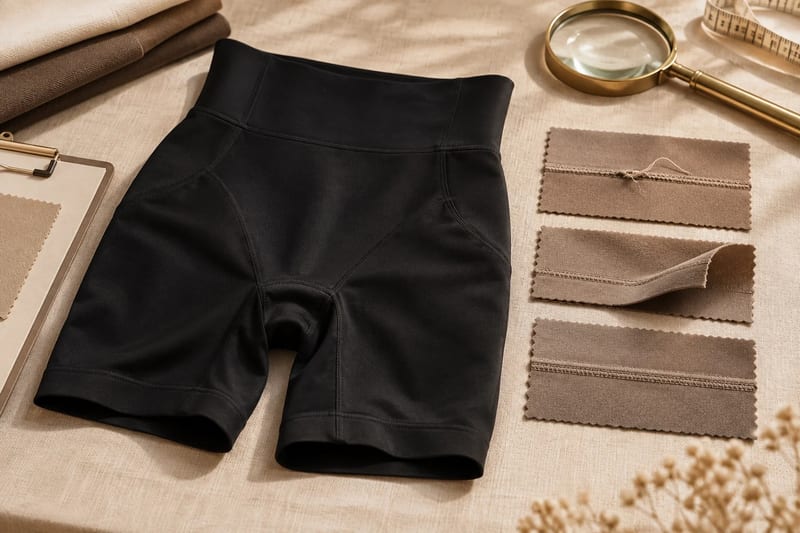
For sewing, ask for the actual seam and stitch construction, material orientation and relevant thread or elastic components. A photograph cannot establish extension compatibility or comfort. Review the join in the garment and preserve the approved construction reference rather than requesting only tidy stitching.
If the supplier proposes a substitute fabric, film, tape or thread, ask what changes and which checks must be repeated. A substitution may be workable, but it should be a reviewable decision. Keep commercial availability separate from technical approval: the option that is easiest to buy still needs to meet the product requirement.
Bonded vs Sewn Shapewear: Which Trade-Offs Should You Compare?
Compare equivalent garment objectives while acknowledging construction differences. Bonded and sewn versions may require different edges or overlap arrangements. Document those differences rather than pretending only one invisible variable changed. The buyer can choose between complete solutions without claiming a controlled experiment on every process input.
Use the customization discussion to ask what each construction would change in the actual style. A lower-profile edge may be attractive, but other requirements remain: dressing, movement, coverage, care and repeatability. A sewn option may fit the brief well when its placement and execution are appropriate.
Ask for separate prototype observations and production-control proposals. A sample tells you about the reviewed version; it does not prove every subsequent unit will match. Request the relevant checks, responsibilities and change process before release. Do not accept an unspecified durable bond or strong seam as a complete quality plan.
Compare failure descriptions without national or technology stereotypes. Lifting, opening, restricted extension, visible bulk and contact discomfort are observable issues to investigate. They should not become claims that an entire manufacturing country or method is low quality. The useful question is which proposed revision resolves the identified failure.
| Review point | Bonded version | Sewn version |
|---|---|---|
| Construction identity | Substrate, adhesive and join design | Substrate, stitch and seam design |
| Profile | Check actual edge beneath outer clothing | Check actual join placement and bulk |
| Movement | Review extension through the bonded area | Review extension through the stitched area |
| After care | Inspect relevant bond changes and garment behavior | Inspect relevant seam changes and garment behavior |
| Repeatability | Agreed process and production checks | Agreed assembly and production checks |
Illustrative sourcing and product-development scene. Click to continue the related buyer guidance.
How Can You Read Bond or Seam Numbers Without Creating a False Ranking?
A force value needs context. Specimen width, geometry, loading direction, method, rate and sample history affect interpretation. Ask the supplier or laboratory which comparison is valid for the actual join and whether the results were obtained under compatible conditions. A larger number from a wider specimen is not automatically a better result.
Consider an illustrative unit exercise: a chosen result of 6 N on a 25 mm width gives 0.24 N/mm, while 10 N on a 50 mm width gives 0.20 N/mm. The raw 10 N is larger, but the arithmetic per width is smaller. These are invented teaching inputs, not a product test, acceptance threshold or supplier result.
Even that normalization does not make incompatible tests comparable. If the join geometry, loading, material or method differs, dividing by width cannot resolve the difference. Use the calculation to detect a question and ask for an appropriate controlled comparison. Do not rank bonded and sewn constructions from these chosen numbers.
A simple extension illustration needs the same discipline. A selected 100 mm reference becoming 130 mm represents 30% extension relative to its original length. It does not establish an approved opening size, medical pressure or a required stretch level for shapewear. The laboratory and developer must agree relevant conditions for the intended application.
Keep the report’s original units and method details when creating a purchasing summary. A spreadsheet should preserve uncertainty rather than erase it. Mark a result non-comparable when necessary and request the missing evidence before approving a performance claim or substituting a construction.
| Illustrative input | Arithmetic | Meaning |
|---|---|---|
| 6 N across chosen 25 mm | 6 ÷ 25 = 0.24 N/mm | Unit exercise only |
| 10 N across chosen 50 mm | 10 ÷ 50 = 0.20 N/mm | Not a durability ranking |
| 100 mm becomes 130 mm | 30 ÷ 100 × 100 = 30% | Chosen extension example |
| Different geometry or method | No automatic conversion | Request comparable evidence |
What Should a Prototype and After-Care Review Include?
Build the review around the actual locations and proposed customer use. Observe relevant joins before wear, during dressing and movement, and after the agreed care routine. Keep the sample identifier, size, wearer and conditions in the record. Photographs are useful when they show the same location and state clearly.
Separate appearance, wearer feedback and laboratory evidence. A tester can describe a visible edge or discomfort, while a laboratory can report a defined mechanical result. Neither should silently stand in for the other. An initially acceptable bond-strength result does not independently establish that an edge is comfortable beneath the intended clothing.
Discuss the plan with S-Shaper’s quality-assurance team. Ask which product-specific observations and measurements will be used, what defines a revision and who approves the next version. Do not invent a universal number of wash cycles or a single force threshold without the appropriate method and product basis.
If a problem appears, preserve the sample and history before changing several variables. Ask whether the material, preparation, process or design needs investigation. A revised prototype should identify what changed so the next result is interpretable. Repeatedly replacing the sample without a change record can consume the development budget while leaving the original question unanswered.
Review the proposed care wording with the construction evidence. Marketing should not promise an easier routine than the approved product supports. Keep any limits explicit and request further work if the intended customer use is not covered. The review is complete when the garment, evidence and customer-facing instructions describe the same product.
Which Manufacturers Can Support Your Bonded-versus-Sewn Approval Plan?
Choose a sourcing model that can identify the join, preserve the approved materials and make production responsibilities clear. The examples below describe relevant published development models and their limits. They do not establish national expertise rankings, universal bonding availability or a standard price premium for either construction.
China Bonded and Sewn Shapewear Manufacturer: Coordinate the Join with the Garment
China bonded and sewn shapewear manufacturer comparisons should connect edge appearance with material, construction and production controls, so the approved sample can guide a repeatable first order.
Recommended supplier: S-Shaper
S-Shaper’s OEM/ODM offering includes material and style recommendations with design, production, QA and export specialists. Ask the team which joins or openings would benefit from each method and what sample evidence will support the choice. Its experience across several customer regions can help frame the brief, while the actual construction needs project-specific approval.
Factory coordination can simplify the handoff, but conditional small-order support does not establish one quantity for every adhesive, material or custom finish. Request the actual development and production terms. This route suits an own-label founder who wants a coordinated construction proposal and can provide precise feedback on visibility, movement and care rather than asking for bonding as a label alone.
Canada Bonded and Sewn Shapewear Manufacturer: Define Approval Across Development and Production
Canada bonded and sewn shapewear manufacturer routes can involve local development and overseas assembly; identify who approves the join and who controls changes before production.
Recommended supplier: Hertex
Hertex describes Montreal design, pattern development, grading and quality control, with manufacturing in China since 2006. A buyer can ask how a bond or seam reference is transferred and how the production version is checked against the reviewed prototype. Keep material and construction identifiers visible across the handoff.
The reviewed information does not establish Canadian fabrication, a standard bonding program or universal startup fees. Confirm actual capability and scope for the proposed design. This route suits a buyer who values the stated development interface and can agree approval responsibilities across locations. A local contact does not make an unreviewed construction substitution equivalent to the original sample.
Portugal Bonded and Sewn Shapewear Manufacturer: Scope the Evidence for a Construction Change
Portugal bonded and sewn shapewear manufacturer comparisons involving technical development should specify which join question needs evidence, rather than commissioning a broad investigation without acceptance criteria.
Recommended supplier: Impetus
Impetus describes research and development across garment constructions and quality work involving materials, elastics, accessories and finished parts. Ask whether the proposed project can investigate the relevant join, material compatibility and after-care behavior. The published capability is a starting point for a current technical proposal, not proof of every bonding application.
No fixed startup minimum, bond-test package or development price is established by the reviewed pages. Agree deliverables and sample scope before proceeding. This route suits a brand whose differentiation depends on resolving a defined construction issue. Research resources can support the investigation, while the final garment and relevant testing must establish whether the selected solution meets the wearer requirement.
Select the supplier whose proposal covers the actual join and garment evidence, then retain the approved sample and change process for reorders.
What Must Be Recorded Before Bonded or Sewn Production Is Released?
Keep the approved garment, material identifiers, join locations, construction reference and relevant evidence together. Identify which areas are bonded and which are sewn. A purchase order that simply says seamless finish can leave the actual assembly ambiguous and make receiving disagreements harder to resolve.
Agree product-specific production checks and a process for proposed changes. Do not infer that every unit has been laboratory tested unless the order actually requires and documents that work. State what inspection or verification is included and retain the records relevant to the first delivery.
Use the published order FAQ to prepare questions, then confirm material, sample and quantity conditions for this style. Connect the approved identifiers with packing and receiving arrangements. Receiving checks should refer to the chosen version and agreed criteria, not a buyer’s memory of a development call.
For the next order, ask whether the material, join and process remain as approved. A change can be reasonable, but request the appropriate evidence before acceptance. A good first sample should become a useful reference, not a permanent permission to substitute any similar-looking edge.
How Can S-Shaper Help Turn a Finish Preference into a Testable Product?
S-Shaper can be approached with the actual location, desired appearance and wearer observations together. Ask for a construction recommendation that explains the material, join and sample checks. This gives the team a clear product problem and gives the founder a result that can be reviewed before production.
Its published support includes recommendations and specialist communication across design, production, QA and export. Confirm the actual bonding or sewing capability, material program and approval work proposed for your project. Conditional low-quantity support must be verified for that scope rather than assumed from a general service description.
Send the garment reference and relevant outer-clothing use through a focused project inquiry. Request identified samples, actual commercial terms and evidence appropriate to the selected construction. The goal is a reproducible garment that meets the brief, with customer instructions and claims supported by what was actually reviewed.
FAQ: Bonded vs Sewn Shapewear: What a New Brand Should Test
Is bonded shapewear always more comfortable?
No universal result follows from the method. Evaluate the actual material, join location, edge profile, fit and movement. A lower-profile feature can be useful, but the garment must support the wearer requirement.
Will a bond survive every wash routine?
Do not make that assumption. Adhesive selection, substrate, process and intended care require an appropriate review. Ask for relevant prototype and after-care evidence and approve customer instructions for the actual garment.
Can I compare two bond-strength numbers directly?
Only after checking the relevant method, specimen, width, geometry, loading and history. The illustrative N/mm calculation explains units; it cannot make incompatible tests equivalent or establish a universal acceptance limit.
Should every part of a garment use the same method?
Not necessarily. A hybrid construction may use bonding and sewing in different locations. Ask why each method is proposed and preserve the identified materials and join details in the approved product record.