 EN
Quick Answer
Classify shapewear defects before production by defining the requirement, location, consequence and decision for each relevant scenario. Critical, major and minor labels need an agreed product-specific meaning; the name of a flaw alone does not determine its severity in every garment.
Use examples such as an exposed sharp component, a failed closure, incorrect size identification, an open seam or an appearance issue to discuss what must be contained, corrected or escalated. Keep the original observation separate from the suspected cause. Agree the sampling and release rules with a competent provider rather than inventing universal acceptance counts.
For a startup, the useful deliverable is a concise, illustrated defect dictionary linked to the live specification and accepted sample. It should state how findings are recorded, counted and closed, including unexpected cases. An accepted lot is not automatically defect-free, and classification should never be changed after inspection merely to obtain a favorable result.
What Should Critical, Major and Minor Mean for This Product?
Define the categories around the actual product and intended use. A potentially hazardous exposed component, a function that cannot be used and a small cosmetic departure create different questions. The brand, manufacturer and inspector need a shared basis for interpreting them.
Do not copy a severity label without its scenario. A stain’s location, visibility, size and agreed appearance requirement can matter. A label error can affect product identification or another important instruction rather than merely presentation. The consequence must be described.
Keep product-specific agreements separate from claims about a standard. ISO 2859-1:2026 provides an AQL-indexed sampling system; its name does not define every shapewear flaw or your preferred disposition. Select the actual inspection plan through a competent provider.
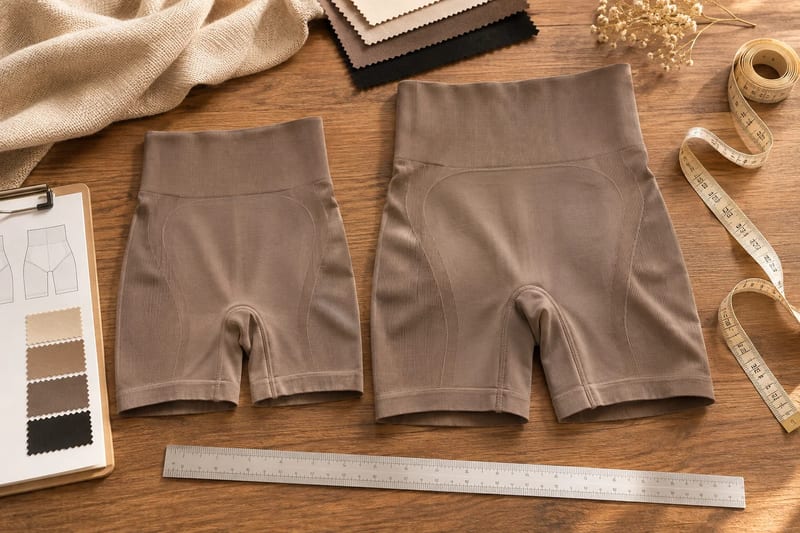
Use examples and photographs where they make the distinction clearer. Identify the acceptable reference and the departure, with scale or location information as relevant. A poor-quality image labeled bad stitching is difficult for another inspector to apply consistently.
The categories should support action. State which finding requires immediate hold and qualified assessment, which needs correction or further review and how other departures are handled under the agreed plan. This guide does not prescribe a universal critical count, severity label or acceptance threshold for every brand.
| Category discussion | Question to define | Agreement needed |
|---|---|---|
| Potentially critical scenario | Could the finding create an unacceptable consequence? | Containment, assessment and release authority |
| Potentially major scenario | Does it undermine intended function or product identity? | Product-specific examples and action |
| Potentially minor scenario | Is it a limited departure under the agreed requirement? | Location, extent and decision criteria |
| Unexpected finding | What information or expertise is missing? | Escalation; do not improvise a pass rule |
Defect Name vs Product Consequence: Which Should Drive Classification?
A short name helps organize reports but does not finish the assessment. Broken thread, stain and wrong label can describe several different situations. Classification should connect the observed condition with its effect on the actual garment and customer information.
For example, a loose thread end and an opening seam are not necessarily equivalent. One may require a finishing correction while the other raises a joining or functional question. ASTM D6193 can help the technical team use stitch-and-seam terminology, but it does not assign every brand’s severity category.
An appearance issue under a visible outer layer may have another consequence from a similar mark in a different location. Define the actual requirement rather than leave inspectors to substitute their personal aesthetic preference.
An incorrect size identifier can create a selection and fulfillment problem even when the garment’s measurements are correct. Moving it automatically into a minor label bucket can conceal that consequence. The live specification and variant mapping should inform the decision.
Discuss these distinctions with S-Shaper’s quality-assurance team. Ask how the factory and any outside inspector will identify the same scenarios. A shared dictionary is useful when it prevents ambiguity, not when it gives every possible flaw a rigid label without considering the product.
| Observation name | Context to clarify | Why the name is insufficient |
|---|---|---|
| Broken thread | Loose end or an opening joint? | Function and construction can differ |
| Stain | Location, visibility and agreed appearance | Extent and use matter |
| Wrong label | Size, care, brand or another identifier? | Customer and order consequences differ |
| Sharp component | Exposure and actual contacting position? | Needs defined containment and assessment |
| Dimension deviation | Point, method and requirement? | Different tape path is not the same as wrong making |
How Can a Startup Write Useful Shapewear Defect Examples?
Begin with the features of the chosen platform. A closure, strap, grip area, gusset or bonded panel may need specific examples that a generic apparel checklist misses. Use S-Shaper garment references to identify the construction, then document the actual accepted version.
Describe the observation in a repeatable form: what is visible or measurable, where it occurs and under which defined check. State the requirement it departs from. Keep a suspected cause in another field until investigation supports it.
The table below is a discussion template, not a prescribed industry classification. The parties should confirm the actual severity and action for their product with appropriate technical input. It deliberately avoids attaching universal numerical acceptance counts to the scenarios.
Include an escalation example for uncertain cases. A potentially hazardous exposed part or another serious concern should not be quietly assigned a convenient category to meet a schedule. Identify the person or role that can assess and authorize the relevant next step.
Keep the dictionary short enough to use during inspection. Add examples when they resolve a real ambiguity, and revise obsolete entries when the product changes. An enormous generic defect list can make a small collection harder to inspect if the important platform-specific cases are buried.
| Illustrative scenario | Requirement to identify | Disposition to agree |
|---|---|---|
| Exposed sharp hardware at a contact point | Actual component and safety-related review | Hold affected scope for qualified assessment |
| Closure cannot operate as intended | Approved function and check | Record, investigate and define correction |
| Garment carries another size identifier | Accepted variant mapping | Contain and reconcile affected identification |
| Seam opens under the agreed check | Specified construction and method | Investigate joint and affected work |
| Appearance mark | Location, extent and visual requirement | Classify under agreed product criteria |

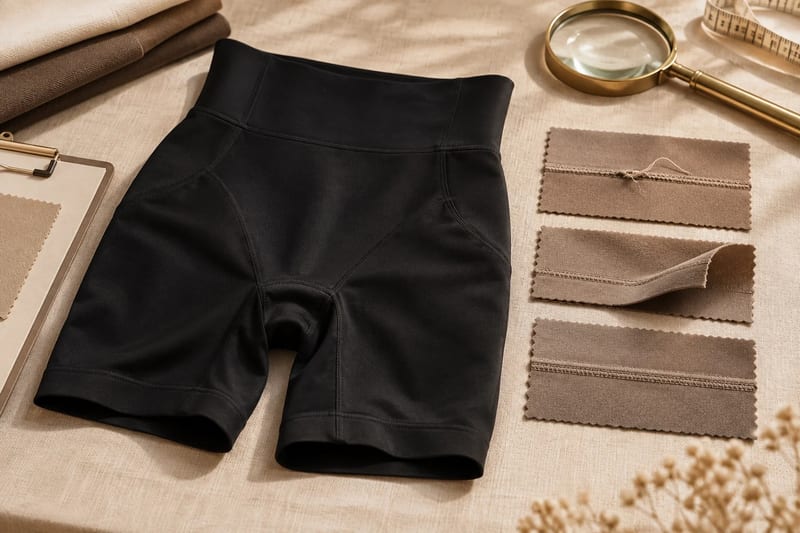
Illustrative sourcing and product-development scene. Click to continue the related buyer guidance.
How Should Multiple Findings and Affected Garments Be Counted?
Agree the reporting basis before inspection. One garment may have several findings, possibly in different categories. A finding count and a count of affected garments therefore answer different questions. The actual sampling plan must specify how the relevant counts are used.
For a deliberately hypothetical log, imagine 20 inspected garments. Garment A has an incorrect size label and an appearance mark; B has an opening seam; C has two separate recorded appearance findings. The log contains five findings across three garments.
The affected-garment proportion in that invented sample is three divided by 20, or 15%. The finding frequency is five divided by 20 times 100, or 25 findings per 100 inspected garments. The latter must not be reported as 25% defective garments.
These are arithmetic examples only. Twenty is not an ISO-selected sample size here, the scenario classifications remain subject to the actual agreement and no acceptance or rejection decision is proposed. The numbers are not actual factory data or a lot-quality estimate.
Retain the unit identifier, location, category and evidence for each finding. If the report summary changes after clarification, preserve the original observation and reason. A transparent log lets the team reconstruct the decision without guessing whether several photographs show one garment or many different ones.
| Hypothetical garment | Recorded findings | Count |
|---|---|---|
| A | Wrong size identifier + appearance mark | 2 |
| B | Opening seam | 1 |
| C | Two appearance findings | 2 |
| Summary | 3 affected garments / 20 inspected | 15% in this invented sample |
| Event frequency | 5 findings / 20 × 100 | 25 per 100; not defective-unit rate |
How Should the Dictionary Connect Production Checks and Outside Inspection?
Issue the current defect dictionary with the live specification and accepted sample. Factory staff and an independent inspector should know which version applies. A revised label, closure or material can make an old example inaccurate.
Use the S-Shaper development and production discussion to identify where a finding could be prevented or contained before final inspection. A repeated label error may require identifier control, while an opening joint needs another construction investigation. The response should follow the mechanism.
Keep inspection criteria separate from root-cause analysis. An inspector can record a departure without knowing why it occurred. The factory’s investigation should not erase the original evidence, and a plausible explanation should not automatically close every affected unit.
Discuss substitutions through the customization record. A new trim or application may introduce another relevant scenario. Identify whether the dictionary, measurement schedule or sample needs updating before the new component reaches production.
Arrange a clear escalation path for unanticipated findings. The report should state what was observed and what remains unresolved. Do not allow the absence of a prewritten category to become an automatic pass, or let staff invent a stricter or looser plan without agreement.
Which Shapewear Manufacturers Can Help Agree a Product-Specific Defect Dictionary?
Compare the ability to explain the garment and respond to findings, not a national assumption about defect rates. Original manufacturing, technical coordination and existing-stock supply offer different access to construction and correction decisions.
China Shapewear Manufacturer: Tie Examples to the Actual Construction
China shapewear manufacturers coordinating design, components and production can help make defect examples concrete when the buyer links them to the accepted platform, relevant functions and the actual version being made.
Recommended China Supplier: S-Shaper
S-Shaper’s design, production, QA and export specialists provide a route for connecting a defect discussion with the materials and process behind the article. Ask the quality team how examples will be shared with making staff and any outside inspector, and who closes findings. Global-brand experience can inform product questions but does not assign universal severity or prove a lot’s defect percentage. Applicable small-order programs still need clear requirements. Confirm component readiness, sample identity and release conditions before dispatch, rather than treating classification as an administrative afterthought.
Canada Shapewear Manufacturer: Separate Making Departures from Design Questions
A Canada-based shapewear manufacturer comparison can prioritize technical interpretation when a founder needs to distinguish a wrong sample measurement, an unsuitable pattern relationship and a local construction defect before defining the response.
Recommended Canada Supplier: Hertex Lingerie
Hertex identifies Montreal design, pattern, grading and QC with production in China. Ask who will clarify the requirement, review the evidence and keep the accepted dictionary aligned with the factory specification. The hybrid route may help where technical interpretation is the gap, but deliverables and startup eligibility need confirmation. Canadian involvement does not imply locally made replacement stock or automatic correction capacity. Confirm sample availability and how revised criteria reach the actual production team before relying on them for inspection.
USA Shapewear Manufacturer: Define Findings Against the Wholesale Article
A USA shapewear manufacturer shortlist should separate US-facing wholesale distribution from domestic fabrication when the startup’s immediate concern is incorrect variants, damaged goods or product discrepancies in an existing assortment rather than an original making process.
Recommended USA Supply Partner: Vedette
Vedette describes wholesale catalogue selection, B2B support and delivery. Ask which product information, order identifiers and findings process apply to the actual goods. Confirm available stock, where it is held and replenishment terms. US-facing service does not establish US manufacture, private-label permission or access to internal factory corrections. This route suits a resale model if the supplied article meets the audience’s needs. Define the relevant receiving and product-departure examples without assuming an original development program is included.
Turkey Shapewear Manufacturer: Include Process-Specific Junction and Finish Examples
Turkey shapewear manufacturers using seamless production can be assessed through whether the dictionary describes the real knit, finishing, joining and component details of the product instead of only cut-and-sew examples copied from another platform.
Recommended Turkey Supplier: SML Seamless
SML describes private-label shaping products and integrated yarn-to-packed facilities. Ask which process-specific observations need clear examples and how a new material or finish changes the inspection reference. Integration can simplify communication but does not assign severity or guarantee a defect-free run. Confirm yarn, color, component and sampling conditions and which findings block dispatch. It suits a compatible seamless order whose actual construction can be described and checked, with action criteria agreed before the lot is completed.
Choose the route that can explain the relevant departure and support its agreed action, while keeping observed evidence separate from assumptions about cause or country.
How Should Classification Affect Rework, Release and Future Orders?
Give each finding an owner, affected scope and required evidence for closure. Depending on the issue, the action may involve containment, clarification, sorting, rework, another sample or an appropriately scoped review. The severity label should lead to a defined decision, not only a colored cell.
Keep the sampling and acceptance basis explicit. An accepted lot can still contain defects, and the dictionary does not itself select an AQL plan. Do not change categories after counting merely to obtain a favorable outcome or repeatedly inspect unrelated new samples without addressing the original findings.
Use the S-Shaper supply and logistics handoff to preserve hold and release status for the actual goods. A corrected sample or revised wording does not automatically authorize every carton for dispatch. Record who may release which lot and under what conditions.
For recurring issues, investigate the process or specification rather than only adding another photograph to the dictionary. A component identity, label mapping or joining instruction may need correction. Preserve the reason and approved change for reorders.
Keep old versions internally so earlier reports remain interpretable. A product change can make a former example obsolete, but should not erase the evidence behind a past shipment. The brand needs enough continuity to understand actual customer feedback and make the next technical decision responsibly.
How Can S-Shaper Help Clarify Defect Examples Before Production?
S-Shaper’s shaping range and OEM/ODM, customization and quality services provide a starting point for making a generic inspection checklist specific to one product. A startup can ask the team to identify relevant functions, construction details and evidence needed to close findings. The agreement should define actual criteria and responsibilities.
Send the live specification, accepted sample, proposed defect examples and planned inspection scope. Ask which examples are ambiguous and what should happen when an unexpected issue appears. Review the S-Shaper order FAQ for preliminary conditions, then confirm the selected item’s materials and production requirements.
To begin, request a product-specific defect and QC discussion. Seek shared, repeatable definitions with an explicit release process, rather than assuming a universal severity list can replace understanding the garment being ordered.
FAQ: Classifying Shapewear Defects Before Production
Are critical, major and minor labels universal for shapewear?
The actual examples and actions need agreement for the product and intended use. Location, extent and consequence can matter. A standard name or a familiar defect term does not automatically classify every scenario or supply a universal acceptance count.
Is every broken thread a major defect?
Clarify whether it is a loose end, an opening joint or another condition and compare it with the actual requirement. The observation’s effect matters. Use a technical description and agreed examples rather than classify by the short name alone.
Should wrong size labels be treated as appearance only?
Not automatically. They can affect selection, fulfillment and product identification even if the garment measurements are correct. Define the actual scenario and action against the accepted variant mapping before production.
Can multiple findings be counted as multiple defective garments?
A finding count and affected-unit count differ. Preserve unit-level records and apply the agreed plan. The hypothetical log contains five findings across three of 20 garments; it does not select an ISO sample size or acceptance decision.
What happens if an issue is not in the dictionary?
Record it clearly and use the agreed escalation path. Do not treat missing wording as an automatic pass or invent a private acceptance rule. Clarify the requirement, preserve the evidence and identify who can authorize the next action.