 EN
Quick Answer
Agree bulk shapewear measurement tolerances point by point, with a diagram, unit, measurement state, target and decision rule. A waistband width, torso path, strap setting and component placement can need different requirements. Do not apply one blanket centimetre allowance or reuse a cutting/alignment claim as the tolerance for every finished-garment point.
Keep three records separate: the customer’s body range, the garment’s nominal measurement and the permitted variation around that garment target. Define sampling and what happens when a result is unclear or outside the agreed requirement. A tolerance is not an authorization to redesign the approved fit.
For a startup, the useful outcome is a repeatable inspection method that factory, inspector and receiving team can understand. Set requirements before judging bulk readings, retain individual results and investigate discrepancies using the actual sample and material version rather than changing limits to fit whatever arrived.
What Is a Garment Measurement Tolerance Actually For?
A nominal target describes the intended finished measurement under a defined state. A tolerance describes permitted variation relative to that target within the agreed specification. The measurement method explains how the number is obtained. All three are needed for an interpretable result.
A customer body interval has another purpose: it guides selection for the intended wearer. It cannot simply be pasted into the factory measurement table as an allowable production range. A relaxed stretch garment and the body it serves are not the same quantity.
Likewise, size grading is a deliberate change between sizes, not random variation around one size target. A manufacturer should not treat a tolerance as permission to drift into another size or replace the approved grade. Keep size values and deviations visible separately.
The consequence of a deviation depends on the point and product. A local opening, closure relation or torso path may affect use differently from another dimension. That is why the requirement should follow the platform’s actual geometry and evidence rather than a copied universal rule.
Ask the technical team to explain the basis of proposed limits. Capability matters, but the intended product must remain suitable. A limit selected only because the first sample fits within it can conceal an unresolved development or making issue instead of defining an acceptable product.
| Record | Purpose | Common mistake |
|---|---|---|
| Body-range chart | Intended customer measurements | Treating it as a garment tolerance |
| Garment target | Defined nominal finished measurement | Leaving the measurement state unknown |
| Tolerance | Permitted variation around a stated target | Using it as a grading increment |
| Grade | Deliberate size-to-size changes | Calling an unintended deviation a new size |
| Decision rule | How readings support conformity decisions | Changing interpretation after results arrive |
One Blanket Tolerance vs Point-Specific Requirements: Which Is Defensible?
A blanket tolerance is easy to write but can be unsuitable for a complex stretch garment. A short component placement and a long seam path do not automatically have the same manufacturing behavior or wearer consequence. Review the actual point instead of applying one number to everything.
Point-specific requirements can include different allowances, and where justified they need not be symmetric. The technical team should explain the reason and preserve a clear inspection rule. Do not invent asymmetric limits solely to excuse a reading already outside the intended range.
Use S-Shaper shaping-product references to identify the dimensions relevant to the platform. A body’s torso and closure relationship differs from a short’s rise and thigh opening. The point list should follow the product being bought.
Ask S-Shaper’s sizing customization team which dimensions and methods belong to an existing platform and what changes require development. A public precision statement about one production operation does not automatically define the finished garment’s acceptance limits.
The buying trade-off is practical measurability and preservation of the approved product. Very tight-looking numbers do not create quality if the method cannot repeat them, while broad limits can undermine fit. Agree what is appropriate with the responsible technical team and verify the garment evidence rather than choosing the most impressive-looking specification.
| Approach | Benefit | Risk or condition |
|---|---|---|
| Blanket allowance | Simple administration | May ignore point geometry and consequence |
| Point-specific limits | Can reflect actual product requirements | Need clear definitions and technical basis |
| Asymmetric limits if justified | Can express a real directional constraint | Not an after-the-fact acceptance device |
| Measurement-method agreement | Makes readings interpretable | Required whichever limits are chosen |
Which Point Definitions Should Factory and Inspector Share?
Give each point a stable ID and diagram. State the landmarks, path and unit. A curved edge path is not equivalent to a straight-line distance, and a laid-flat width should not silently become a full circumference or a stretched opening.
Define the sample state and handling. Record whether the garment is relaxed or evaluated under another agreed condition, how adjustable parts are set and whether any care exposure has occurred. The same piece can produce different readings if those conditions are changed.
Identify material and construction. A different fabric, lining or component can alter how a soft garment lies during measurement. Confirm the actual production references before deciding that a dimensional difference is solely a sewing or pattern problem.
Keep apparatus and operator instructions appropriate to the task. A readable scale is not automatically proof of the whole measurement’s accuracy. Ask how the team checks tools and verifies that different trained people apply the method consistently.
For a disputed point, compare methods and reference samples before averaging conflicting readings. A small drawing or agreed demonstration can resolve a path ambiguity more effectively than another spreadsheet column. Preserve the clarified method so the disagreement does not recur at receiving or reorder.
| Point-definition field | Required detail | Why it matters |
|---|---|---|
| ID and landmarks | Diagram and named start/end points | Avoid different tape paths |
| Geometry | Straight, curved or another defined path | Compare the same quantity |
| State | Relaxed, adjusted, care state or specified condition | Control handling differences |
| Units and reporting | Cm/mm and agreed rounding | Avoid hidden conversion or precision errors |
| Reference | Approved sample and material version | Connect the method with the actual article |

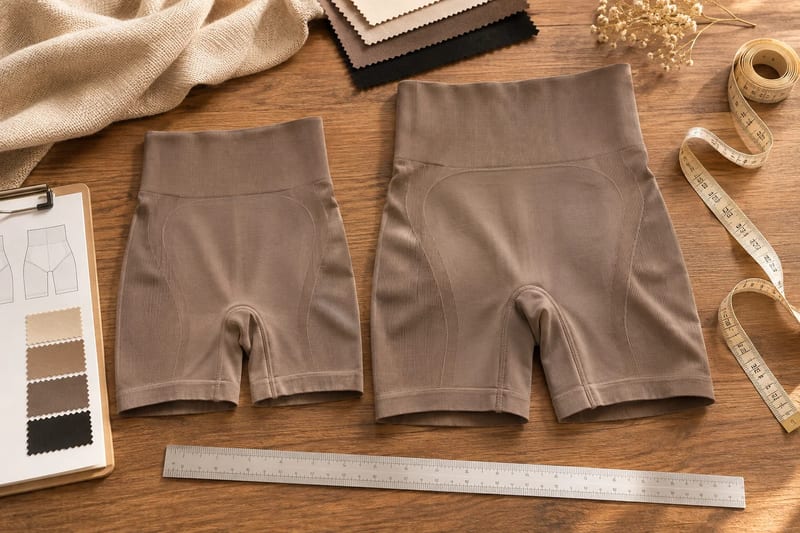
Illustrative sourcing and product-development scene. Click to continue the related buyer guidance.
How Should Conditioning and Measurement Uncertainty Enter the Discussion?
Conditioning can matter in textile evaluation, and the applicable method should state what is required. ISO 139:2005, with its 2011 amendment, concerns standard atmospheres for textile conditioning and testing. Its public scope is not a universal finished-garment tolerance or a full instruction for every factory check.
Ask the provider which preparation and environmental conditions apply to the actual measurement method and how they are documented. Do not compare a freshly treated piece with a differently prepared reference as if the states were identical.
Measurement also has limitations beyond the displayed scale. NIST describes a decision rule in terms of how measurement uncertainty is accounted for when stating conformity. A laboratory or qualified technical provider should explain its actual rule where that is relevant to the report.
Do not invent a convenient uncertainty deduction to turn a failed reading into a pass. Equally, a small numerical difference should not be interpreted without understanding how the quantity was measured. Agree the handling of near-boundary or disputed results before the commercial decision.
Keep this practical for a startup. The aim is not to create an elaborate metrology document for every routine point, but to know which method, conditions and decision basis the responsible provider actually uses. A clear, technically defensible rule is more useful than unsupported decimal precision.
Source: ISO 139:2005 with 2011 amendment: textile conditioning and testing atmospheres; confirmed 2025Source: NIST decision-rule glossary: accounting for measurement uncertainty in conformity statements
How Can You Read Target, Limit and Deviation Columns Correctly?
The following deliberately hypothetical schedule demonstrates different point limits. It does not recommend dimensions, tolerances or a finished-garment acceptance rule for S-Shaper or any particular product. The actual method and decision rule still need agreement.
Choose a flat-width target of 32.0 centimetres with an illustrative plus-or-minus 0.4 allowance. Its nominal band is 31.6–32.4. An imaginary reading of 32.3 has a plus-0.3 deviation and lies within that chosen band.
Choose a defined torso-path target of 58.0 with plus or minus 0.8. Its band is 57.2–58.8, so an invented reading of 59.0 is plus 1.0 and outside that band. For an opening target of 22.0 with minus 0.2 and plus 0.3, the band is 21.8–22.3; a reading of 21.7 is minus 0.3 and outside.
These examples use nominal comparisons for arithmetic only and do not specify measurement uncertainty or a complete conformity rule. A real provider must report against the agreed basis. A dimension inside its band also does not independently prove that the garment fits every intended body.
Retain individual results rather than averaging different points into a pass. If a finding requires investigation, check identity, method, material and construction, then document any correction. A changed target needs a technical reason and relevant approval, not only the desire to release the lot.
| Hypothetical point | Target and chosen allowance | Band / imaginary reading | Nominal comparison only |
|---|---|---|---|
| Flat width | 32.0 cm ±0.4 | 31.6–32.4 / 32.3 | +0.3; inside chosen band |
| Torso path | 58.0 cm ±0.8 | 57.2–58.8 / 59.0 | +1.0; investigate |
| Opening | 22.0 cm −0.2/+0.3 | 21.8–22.3 / 21.7 | −0.3; investigate |
| Limit | Chosen illustration | Not actual product data | No universal tolerance or fit approval |
Which Shapewear Manufacturers Can Help Define Measurement Tolerances?
Compare the ability to explain and reproduce a measurement, then connect it with the intended product. A supplier location or machine-precision claim does not establish the correct acceptance band for every finished-garment point.
China Shapewear Manufacturer: Tie Point Limits to the Actual Platform
China shapewear manufacturers coordinating pattern, materials and production can help define point-specific requirements when the buyer supplies the intended fit and asks how each finished measurement will be taken and interpreted.
Recommended China Supplier: S-Shaper
S-Shaper’s design, production, QA and export roles provide relevant contacts for connecting a garment measurement with its material and sample. Ask the quality team to distinguish finished-product requirements from precision statements about a particular operation. Global-brand experience can inform the discussion but does not supply universal tolerances. Item-specific small tests may help verify a method, while a new pattern or component needs its own scope. Confirm the live schedule, material readiness and unresolved findings before dispatch. It suits a startup seeking direct factory coordination and an explicit record rather than a blanket allowance copied across the range.
Canada Shapewear Manufacturer: Clarify Points Before Revising the Grade
A Canada-based shapewear manufacturer comparison can prioritize technical interpretation when conflicting readings may come from point definitions, garment state or pattern relationships rather than a need to enlarge the whole range or relax every limit.
Recommended Canada Supplier: Hertex Lingerie
Hertex identifies Montreal design, pattern, grading and QC with manufacturing in China. Ask who will define the measurement diagrams, review sample deviations and maintain the accepted schedule through the factory handoff. The hybrid route can help where technical interpretation is the founder’s gap, but the deliverables and startup eligibility require agreement. Canadian technical service does not imply locally made samples or immediate replenishment stock. Confirm sample availability and how clarified methods and approved changes reach the actual production and receiving teams before relying on a dimensional release.
Portugal Shapewear Manufacturer: Separate Laboratory Conditions from Product Limits
Portugal shapewear manufacturer candidates with quality and testing functions can be relevant when a point-specific requirement needs a clear distinction between preparation, measurement capability and the product’s actual permitted variation, especially after treatment or material change.
Recommended Portugal Supplier: Impetus
Impetus describes physical and chemical checks across knitting, elastics, accessories and finished parts. Ask which methods and sample records its proposed program can provide for the specific dimension and construction. Laboratory capability does not establish a universal tolerance or automatic suitability of every method. Development, material and evaluation work need a defined scope, and startup acceptance must be confirmed. It suits a buyer with a clear technical question, provided the specimen state, procurement timing and route from development findings to production limits remain explicit.
Choose the route that can make the points and decisions repeatable, then preserve the approved product requirement rather than selecting limits solely to match the first readings received.
How Should Out-of-Tolerance Findings Affect Bulk Release and Reorders?
Record the point, sample, actual reading, deviation and applicable decision basis. Check product identity and method before attributing the finding to production. A wrong sample version or tape path can require another response from an actual making discrepancy.
Define the affected scope and next action. It may involve remeasurement, sorting, rework, another sample or a justified technical revision. A corrected piece does not automatically establish that every related unit has been addressed. Agree verification and the release owner.
Discuss changes through the S-Shaper OEM/ODM route and keep the supply and logistics handoff aligned with the accepted schedule. Material, sample approval and shipment readiness are separate dependencies; do not turn a revised limit into an automatic instruction to dispatch.
If the target changes, review relevant fit, grading and customer guidance. A tolerance edit should not silently redesign the garment or move it into another size. Keep previous versions so the reason and impact of the change can be understood.
On reorder, confirm continuity of material, pattern, components and measurement method. Compare actual complaints with the delivered version and relevant point records. The next decision should follow the evidence, rather than assuming every repeat-order difference is acceptable variation or every small numerical change is a product failure.
How Can S-Shaper Support a Finished-Measurement Agreement?
S-Shaper’s OEM/ODM, customization and quality services provide a starting point for connecting a product’s measurement schedule with its approved sample and production requirements. A startup can ask the team to explain point definitions, proposed allowances and evidence needed to resolve disagreements. The actual scope should be written into the project record.
Send the platform, material reference, planned sizes, point diagrams and relevant fit concerns. Mark any unknown values for technical discussion rather than filling the table with copied numbers. Review the S-Shaper order FAQ for initial conditions and confirm the selected item’s sample requirements.
To proceed, request a measurement-method and tolerance review. Seek an interpretable agreement that factory, inspector and brand can apply consistently, keeping product suitability and uncertainty questions within the relevant technical evidence.
FAQ: Setting Measurement Tolerances for Bulk Shapewear
Should every shapewear measurement use the same tolerance?
Not automatically. Review each point’s geometry, material, method and consequence for the intended product. Agree technically justified requirements rather than copying one allowance across openings, torso paths, component placement and every size.
Can I use a cutting-precision claim as my garment tolerance?
No automatic equivalence follows. A claim about a particular production operation does not define every finished-garment measurement. Ask the team to identify the actual point, state, target and decision basis relevant to the supplied article.
Are the ±0.4 and ±0.8 cm examples recommended limits?
No. All dimensions, allowances and readings in that table are deliberately hypothetical arithmetic. They are not S-Shaper specifications, standard thresholds or fit approval. The actual requirement needs agreement for the product and method.
What if a reading is very close to a limit?
Use the agreed method and decision rule, with qualified input on relevant measurement uncertainty. Do not invent an after-the-fact deduction or change the limit simply to release the lot. Preserve the original reading and investigation.
Does being inside tolerance prove the garment fits?
It establishes only the relevant dimensional comparison under its agreed basis. The nominal design can still be unsuitable for the intended body or movement. Keep fit evidence, garment targets and manufacturing variation as separate connected records.