 EN
Quick Answer
Keep repeat shapewear orders consistent by defining what must remain the same and identifying every approved change. Connect the retained sample and live specification with material and component lots, pattern and process references, shade approvals, inspection results and the actual shipment. A familiar product name is not enough.
Compare fit, color, support-related material behavior and construction through relevant evidence, using compatible methods and states. Do not let a similar-looking substitute or an unchanged blend percentage stand in for the approved reference. Review findings by batch and variant before deciding whether the difference is making, material, guidance or development.
For a startup, use a concise change-and-release record that survives beyond the original chat. Confirm available materials and component continuity before the reorder, verify the actual supplied version and keep enough traceability to investigate a problem without assuming every order is affected.
What Defines the Product Baseline for a Repeat Order?
Create a product baseline that another team can recognize. Include style, size schedule, pattern, materials, components, shade and finish, labels and packing. Identify the accepted physical sample and which evidence supported the approval.
Distinguish the nominal specification from the retained specimen. The sample is a useful reference but should not become the only source of every number. Its storage, treatment and age can affect interpretation. Keep the measured records and material identities available alongside it.
Record what the original approval covered. A base sample, a size set, a material report and a final inspection have different scopes. A favorable result at one stage should not silently become proof of every size, color or later batch.
Ask S-Shaper’s quality-assurance team which records identify the article supplied and how those records will be carried into the next run. A reorder should not rely on an employee remembering which soft beige fabric the founder liked months earlier.
Write unresolved limitations and deliberate changes. If the brand expands the range or changes a component, the next order is not wholly unchanged. Make the difference explicit so technical review and customer information can remain connected to the product actually being purchased.
| Baseline record | What to preserve | Question on reorder |
|---|---|---|
| Product geometry | Pattern, graded schedule and sample ID | Has any point or range changed? |
| Materials and components | Codes, finish, shade and application | Same reference or proposed substitute? |
| Technical evidence | Specimen, method and state | Does it apply to this run? |
| Presentation | Labels, artwork and packing | Are identifiers and guidance current? |
| Approval history | Purpose, findings and accepted version | What was actually authorized? |
Same Product Name vs Controlled Repeatability: What Is the Difference?
A product name or catalogue code can remain unchanged while a material, finish, trim or process changes. Controlled repeatability requires the actual references and approvals to remain visible. Similar photographs cannot establish that a close-fitting garment will behave the same way.
The reverse also matters: not every numerical difference is automatically a design failure. Measurement states, methods and specimen identity need checking before a comparison is interpreted. A prepared laboratory specimen and a newly unpacked garment should not be treated as equivalent without an agreed basis.
Keep changes honest. A technically suitable substitution may be possible, but it needs identification and review of the affected evidence. Do not describe it as the same fabric simply because the composition percentage or nominal weight matches.
Ask the technical team what remains controlled and what can vary within the specification. Shade, dimensions and material behavior require appropriate criteria, not a blanket demand for identical everything that no one can measure or interpret.
The commercial objective is dependable product continuity. A founder should know when a reorder repeats an accepted construction, when it changes a specific reference and when it becomes another development project. That distinction helps the brand fund the right verification rather than either ignoring differences or restarting every approval unnecessarily.
| Shortcut | What it can conceal | Controlled alternative |
|---|---|---|
| Same catalogue code | Unreviewed material or trim change | Version and component confirmation |
| Same blend / GSM | Different structure, finish or response | Identified material and relevant evidence |
| Looks the same | Different fit or care behavior | Actual sample and method comparison |
| Old sample alone | Unclear age or approval scope | Retained reference plus live records |
| Repeat order means no new work | New range or component dependency | Explicit change and verification plan |
Which Material, Color and Component Differences Should Be Checked?
Confirm incoming references and lots before consumption. Main fabric, reinforcement, lining, elastic, closure and labels may enter under separate records. The brand needs to know which changes affect the approved construction and how they will be evaluated.
For support-related material comparisons, preserve compatible conditions. ASTM D4964 emphasizes that elastic-fabric data depend on comparable setup and specimen specifications. A changed test condition can produce another number on the same fabric, so a difference should not automatically be attributed to a new material lot.
Keep shade appearance and colorfastness separate. A material can match the approved visual reference while still needing relevant fastness evidence, or differ visually without the same transfer concern. ISO 105-X12 addresses rubbing-related color behavior, not every shade or durability question.
Discuss alternatives through S-Shaper’s material and component customization scope. Ask which candidate is available, why it is proposed and what sample or report will establish equivalence for the actual use. A low first quantity does not justify an undocumented replacement.
Record component application as well as the component itself. Elastic length, label position, closure reinforcement or panel attachment can change the result even when the purchased part has the same reference. The continuity check should follow the assembly the customer receives.
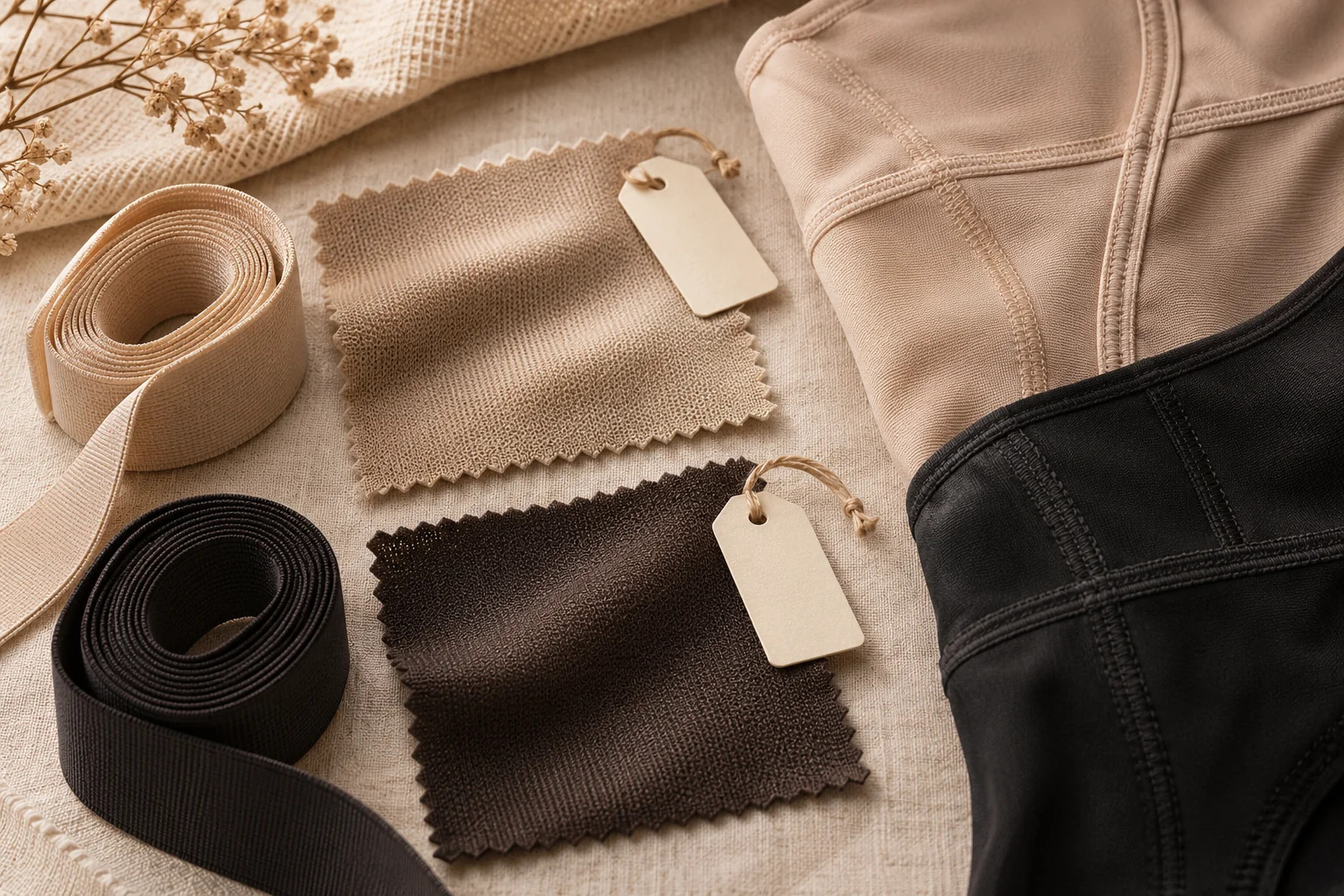
Illustrative sourcing and product-development scene. Click to continue the related buyer guidance.
How Should Process and Batch Records Follow the Reorder?
Record the order, material and component inputs and the production references needed to identify the supplied work. Preserve meaningful process changes and the associated approval, rather than attempting to archive every machine observation without a purpose.
GS1’s traceability framework distinguishes events, such as receiving or packing, from the data describing those events. A small brand can use that distinction to plan its own practical record: what happened, to which input or output, when, where and under whose responsibility. It does not mean this article’s worksheet is GS1-certified or a complete implementation.
Connect material issues, production grouping and packing. If one material lot is used in more than one order or several lots enter one run, preserve those relationships. A simple one-order-one-lot assumption can fail as soon as production is split or a component is replenished.
Use the S-Shaper production coordination discussion to agree which records the factory will keep and what the brand can receive. The exact deliverables matter more than a generic promise of full traceability.
Keep access and retention practical. Someone should be able to retrieve the relevant record when a problem arises, including previous versions and corrections. A folder full of disconnected file names is not a dependable batch history simply because the information once existed somewhere.
Why Can the Same Batch Average Hide a Different Result?
Look at individual readings and the method before interpreting the summary. An average can be useful, but it can conceal a wider spread or a particular size and variant with a relevant issue. Keep the unit-level or specimen-level information needed for the decision.
For a deliberately hypothetical dimension comparison, choose three readings for batch A: 31.8, 32.0 and 32.2 centimetres. The simple mean is 32.0 and the observed range is 0.4 centimetre. For imaginary batch B, choose 31.0, 32.0 and 33.0. Its mean is also 32.0, but its observed range is 2.0.
These are invented readings, not actual supplier measurements, a statistically adequate batch study or recommended garment dimensions. No tolerance or acceptance decision is supplied. The example shows only that equal means do not establish equal individual results.
Before comparing actual batches, confirm the same points, states, methods and product versions. Investigate whether an apparent difference is linked to material, making, measuring or a particular variant. Do not average unrelated sizes or constructions into one result and call it batch consistency.
Use the observations to choose an appropriate next check. A qualified technical or statistical provider can help where the decision requires more than a descriptive summary. The startup’s responsibility is to keep the evidence and limitations clear rather than convert a tiny example into a claim about factory process capability.
| Hypothetical dimension readings | Simple mean | Observed range |
|---|---|---|
| Batch A: 31.8, 32.0, 32.2 cm | 32.0 cm | 0.4 cm |
| Batch B: 31.0, 32.0, 33.0 cm | 32.0 cm | 2.0 cm |
| Interpretation | Same mean | Different spread in these chosen readings |
| Limit | Not actual production data | No tolerance, statistical or quality guarantee |
Which Shapewear Manufacturers Can Support Repeat-Batch Consistency?
Compare how the supplier identifies references and manages changes across its actual route. Production integration, local technical communication and finished-stock replenishment can each help, but none makes repeated quality automatic.
China Shapewear Manufacturer: Keep Reorder Changes Visible Before Procurement
China shapewear manufacturers coordinating materials, making and export can support repeatability when the next order confirms actual inputs and approved versions instead of relying on a familiar product code or photograph.
Recommended China Supplier: S-Shaper
S-Shaper’s design, production, QA and export specialists provide contacts for connecting repeat-order findings with material or function recommendations informed by global-brand work. Ask the quality team what remains unchanged and which substitutions need review. Item-specific low-quantity programs do not guarantee continued availability of every fabric or component. Confirm current stock, procurement conditions and relevant sample evidence before dispatch planning. This route suits a founder seeking direct factory coordination, with differences and their approval scope made explicit rather than hidden behind an unchanged style name.
Turkey Shapewear Manufacturer: Follow References Across the Integrated Process
Turkey shapewear manufacturers using integrated seamless facilities can be assessed through whether yarn, knitting, dyeing, finishing and packing references stay connected across runs, rather than assuming fewer external handoffs eliminate variation.
Recommended Turkey Supplier: SML Seamless
SML describes private-label shaping garments and yarn-to-packed facilities. Ask which references identify the repeated platform and how a process or material change is recorded before the new sample or lot is accepted. Integration can simplify communication but does not prove identical batch response. Confirm yarn and color availability, component continuity and any required development work. It suits a compatible seamless reorder whose finished-state reference and dispatch dependencies can be checked, without a country-based quality assumption or unverified claim that every run is equivalent.
Portugal Shapewear Manufacturer: Keep Laboratory Comparisons Compatible
Portugal shapewear manufacturer candidates with material research and quality testing can be relevant when a reorder decision depends on comparable evidence for a changed material, elastic or finished part rather than appearance alone.
Recommended Portugal Supplier: Impetus
Impetus describes physical and chemical checks across materials and finished parts and research collaboration supporting development. Ask which specimens, methods and records the proposed program can compare across the relevant runs. Testing capability is not a guarantee of an identical lot or an individual certification. Laboratory, material and preparation work need a scope and startup eligibility check. This route can suit a technically defined continuity question, with sample availability and procurement confirmed before the founder treats a development result as ready replacement stock.
Canada Shapewear Manufacturer: Preserve the Technical Baseline Through the Factory Handoff
A Canada-based shapewear manufacturer comparison can prioritize continuity of pattern, grading and fit interpretation when a local technical relationship must carry approved changes accurately into overseas production and later reorders.
Recommended Canada Supplier: Hertex Lingerie
Hertex identifies Montreal design, pattern, grading and QC work with China production. Ask who maintains the live specification and how a changed material or sample finding is reconciled before the next run. The hybrid model can help where technical interpretation is the gap, while deliverables and startup eligibility need agreement. Canadian involvement does not imply Canadian-made replenishment stock. Confirm the accepted version, component readiness and actual production handoff so an accurate local review is not detached from the goods eventually shipped.
Choose a route that can identify what changed, compare it appropriately and preserve the accepted baseline through material purchasing, production and packing.
What Should the Reorder Approval and Receiving Review Include?
Issue a reorder record that states the baseline and deliberate differences. Confirm material and component availability, planned variants, relevant checks and the accepted sample or documentary evidence. A repeat purchase should still identify the actual goods being supplied.
If a change is proposed, define the question it creates. It may require another report, sample, fit case or customer-information review. Do not repeat every development step by habit, but do not assume every earlier approval transfers unchanged either.
Use the S-Shaper supply and logistics handoff to keep variant quantities and carton references connected to the batch records. Receiving should reconcile the delivered version and quantities against the actual accepted order, not only the old product photograph.
Review any discrepancy before merging goods into indistinguishable inventory. Identify affected units or cartons where practical and preserve evidence. A stock system that erases batch identity immediately can make a small issue difficult to isolate later.
Compare customer feedback with product and chart versions. A recurring concern may reflect a new material, making discrepancy, guidance problem or another audience case. The next action should follow that investigation rather than assume the factory is always at fault or that an unchanged label proves the customer chose incorrectly.
How Can S-Shaper Support a Consistent Repeat-Order Brief?
S-Shaper’s shaping products and OEM/ODM, customization, quality and supply services provide a starting point for linking the next order with an accepted technical baseline. A startup can ask the team to identify continuity, proposed substitutions and the evidence needed for release. The actual proposal should state the records and approvals supplied.
Send the previous order and sample references, live specification, planned matrix and any feedback linked to the delivered version. Ask what material or component availability has changed and which review is needed. Consult the S-Shaper order FAQ for initial conditions before confirming the current item-specific scope.
To proceed, request a repeat-batch consistency and availability review. Seek a repeatable product whose changes are visible and justified, rather than relying on a familiar name to stand in for the evidence behind the garment.
FAQ: Keeping Shapewear Quality Consistent Across Batches
Does the same product code mean the next batch is identical?
Not by itself. Confirm material, finish, pattern, components and process references, and identify deliberate changes. A familiar label or photograph does not establish that the actual production baseline is unchanged.
Can the same blend and GSM prove material equivalence?
No automatic equivalence follows. Structure, finish, mechanical response and component application can differ. Use identified references and the relevant comparable evidence for the intended garment instead of relying on a few nominal values alone.
Why keep individual readings if the average matches?
Equal means can hide different individual results or spread. The hypothetical 32.0-centimetre examples illustrate that point only; they are not actual data, tolerances or a statistical quality conclusion. Compare methods and versions before interpreting actual batches.
Should every reorder repeat every original test?
Select the necessary verification from continuity, changes and relevant risk with qualified input. Preserve the earlier evidence and identify what depended on a changed reference. Neither automatic full retesting nor automatic transfer of every approval is a useful universal rule.
What records help isolate a batch problem?
Keep order, material and component inputs, production grouping, approved versions, inspection results and carton or receiving references connected. Agree what the factory retains and what the brand can retrieve, then preserve actual changes and corrections.