 EN
Quick Answer
The cost to start a shapewear brand includes product development, samples, inventory, brand components, delivery and the work needed to acquire and serve customers. Compare the observed Amazon, B2C brand, TikTok Shop and B2B ranges below by product family and scope. They establish market context for selected listings, not one supplier’s tariff or a complete startup budget.
Build the remaining budget from actual provider quotations and a defined first product rather than an invented universal launch total. Record what is included, what remains unquoted and when each commitment becomes payable. A lower unit price is useful only when the larger inventory decision is justified by customer evidence and cash capacity.
Which Costs Belong in a Shapewear Startup Budget?
Begin with the product and customer promise. A startup selecting a suitable existing platform needs a different development budget from one changing fit, materials or construction. Use S-SHAPER’s catalogue to identify the reference, then describe what must change. The budget should explain that work before assigning amounts to it.
Organize costs by activity and provider. Product work may involve samples, revisions, technical documents and approved references. The order may involve garments, labels, tags or packaging. Delivery can involve transport and receiving arrangements. Selling operations may involve product content, customer support and channel services. Confirm the actual tasks your launch requires rather than treating every possible service as mandatory.
For each line, record the amount, currency, provider, date, validity, inclusions, exclusions and payment trigger. Mark unquoted work clearly. Zero is an amount; pending quotation is an unresolved decision. A spreadsheet should not make the launch look funded by silently treating unknown costs as free.
Separate one-time preparation from repeated operating commitments when the provider’s scope supports that distinction. A service used to prepare the first product may not repeat unchanged on each order. A per-order or recurring service may continue even when garment production pauses. Ask the provider instead of assuming the pattern.
Link the budget to the approved product version. If a sample revision changes the material or branding method, review the relevant amounts. A technically updated garment with an obsolete quotation can make a careful-looking budget unreliable. Keep the commercial and product records aligned as the project develops.
| Budget area | Evidence required | How to record an unknown |
|---|---|---|
| Development and samples | Scoped provider proposal | Awaiting sample/development quote |
| Garments | Product and quantity-specific quotation | Awaiting confirmed specification |
| Brand components | Artwork, method and quantity scope | Awaiting component proposal |
| Transport and receiving | Destination and handoff quotation | Awaiting provider quote |
| Sales operations | Defined services and channel assumptions | Unverified operating input |
How Do You Budget for Samples and Product Development?
Ask what the next sample is intended to establish. It may demonstrate an existing platform, compare materials or validate a revised fit. The number and purpose of samples should follow the product questions, not a guessed standard development allowance. Request the scope and price for the actual route.
The S-SHAPER OEM/ODM page distinguishes manufacturing from client designs and supplier-assisted concept development. Use that distinction to ask who prepares the technical records, what revision work is included and which approvals remain yours. A general development service does not prove that all assistance is free or included in the garment unit price.
Include the work your team or external specialists must provide. A founder may need help translating fit comments into specifications, preparing artwork or evaluating a difficult grading issue. Define the deliverable before hiring the service. Paying for an undefined consultation does not automatically resolve the product decision blocking the order.
Set review gates for further spending. After a sample round, decide whether the platform is suitable, needs a specific revision or should be replaced. Record the evidence supporting another round. Repeated revisions without a clearer requirement can consume budget while producing little progress.
Keep a sample and revision register with version, material, size, change request and approval. This record is a practical budget control because it prevents the team from ordering another sample to answer a question already tested or approving the wrong version. It also links later customer feedback to the product the startup actually developed.
What Inventory Price Benchmarks Can a Startup Research Across Four Channels?
A startup budget needs both a realistic acquisition scope and evidence about the consumer market. The table separates basic seamless products from more structured shaping garments so an inexpensive stock piece is not presented as the cost of a developed faja. These observed channel ranges describe selected listings, not the total amount needed to start the business.
| Channel | Basic seamless bodysuits: USD/piece | Structured body shapers/fajas: USD/piece | Observed scope |
|---|---|---|---|
| Amazon | $12.38–$19.99 | $34.88–$43.99 | Selected variants; dated tracker offers |
| B2C brand websites | $29.99–$78.00 | $69.00–$148.00 | Basic: Shapermint/Shapellx/SKIMS; structured: Shapellx/SPANX |
| TikTok Shop | $21.99–$46.99 | $39.99–$54.99 | FeelinGirl/YIANNA selected offers; campaigns vary |
| B2B finished/platform offers | $2.50–$12.85 | $14.00–$27.42 | Multiple suppliers; quantity/brand terms vary; development separate |
B2B prices are generally lower than consumer tickets because the buyer assumes inventory and downstream operations. The retail-to-wholesale difference also reflects product specifications, promotions, brand positioning, content and service; it cannot simply be booked as brand premium or profit. Amazon and TikTok Shop promotions can change the visible comparison, while B2C brand sites can show both original and sale prices.
Choose the garment first, then obtain the development, component and delivery quotations required for your actual route. Keep marketing, fulfillment and customer-support assumptions in their own lines. Use the hypothetical cash scenarios only to understand commitment size, replacing their chosen unit inputs with a confirmed supplier offer before payment.
US-facing USD per single garment, reviewed November 10, 2026. Amazon uses dated May–October 2026 third-party PriceHistory snapshots, not live November checkout. These selected-seller observations are not industry averages or matched-quality comparisons. Variants and promotions change; shipping and tax are not normalized. B2B bands describe advertised garments, not landed costs or a final custom-development quote. Sources: dated PriceHistory Amazon records, official brand/TikTok Shop pages and Made-in-China supplier listings.
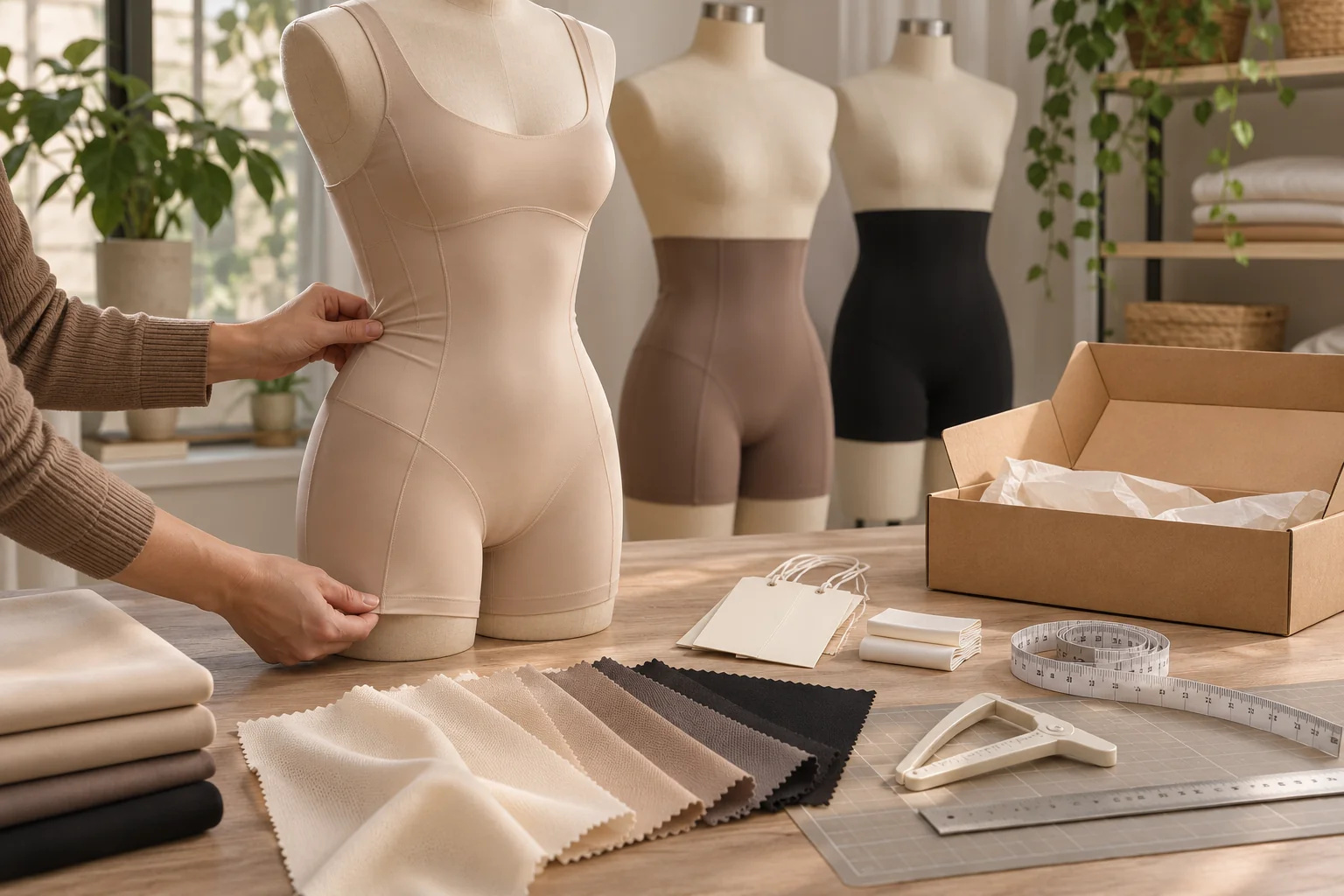
Illustrative sourcing and product-development scene. Click to continue the related buyer guidance.
Which Branding and Delivery Costs Are Easy to Leave Out?
Branding can involve more than a logo file. Ask which label, tag or package is proposed, the quantity that must be purchased, any setup work and the approval proof. Discuss the options through S-SHAPER’s customization service and request the scope for the selected garment rather than assuming every method is included.
If component quantities exceed the garments, record the full commitment. Ask who owns the remainder, where it is stored and whether it can be used on another order. A startup should not treat unused branded materials as a guaranteed future saving when the product or artwork may change.
Transport and receiving also need explicit responsibility. Review the S-SHAPER logistics overview to prepare the discussion, then identify the destination, transport arrangement, packing information and handover point. Obtain the relevant provider quotations for the work not covered by the garment supplier.
Keep inspection and acceptance needs visible. The quality-assurance overview can help frame questions, but your order needs its own criteria and any inspection service scope. If you appoint an independent inspector, request its actual proposal rather than assuming the activity is free or unnecessary for a small run.
Compare quotes using the same delivery responsibilities and currency. An offer at factory handover and a proposal covering additional delivery work are different scopes. Do not infer overpricing from the gap until the missing work is identified. The budget should show who is responsible for completing the journey from approved garment to received inventory.
How Should You Budget Customer Acquisition and Sales Operations Without Invented Benchmarks?
Define how the customer will discover, understand, choose and receive the product. That process creates the operating tasks your budget needs to consider. A content-led launch, a boutique route and a paid campaign can involve different services and commitments. The channel name alone is not enough to estimate the work.
Request quotes for the services you actually plan to buy, such as product photography, store preparation or fulfillment support. Identify which tasks the founder will perform and whether the plan depends on outside help. Keep time and cash planning distinct; doing the work yourself can change the cash outlay without making the work disappear.
Do not insert a universal acquisition-cost or conversion benchmark as if it predicts your startup. Measure the response to your own offer with the audience and channel identified. Interest, purchases and post-purchase product outcomes answer different questions. A test budget should explain what decision the result will support.
Keep customer service information in the launch scope. A usable measurement chart, care guidance and answers about coverage can require preparation. Use the approved product data so the content budget does not pay for assets that must be redone after a fit revision. Finalize dependent materials at an appropriate stage.
Review channel spending alongside product readiness. A campaign can generate attention before the garment is ready to fulfill the promise, creating pressure instead of useful demand evidence. Align the offer with the product stage and delivery information you can support. The budget should fund a coherent first buying experience, not just traffic to an unfinished proposition.
Which Shapewear Manufacturers Should You Consider for Your Startup Budget?
Compare shapewear manufacturers in China, the USA, Portugal and Turkey for a complete startup sourcing budget. The recommendations below connect country-level capabilities with specific suppliers and the work your brand needs.
China Shapewear Manufacturer: Start with factory goods values and scope the support
China shapewear manufacturers can provide a factory goods benchmark, but the startup budget must separately identify development, components and delivery work required by the chosen first product.
Recommended China Supplier: S-Shaper
S-Shaper can help define a product-specific manufacturing budget through design, QA and export support. Ask for the selected platform, matrix, component work and development deliverables in the actual proposal. Its international-brand experience can inform material or function recommendations, but it does not establish the total cost of launching the business or a guaranteed retail premium. The four-channel observations in this guide provide independent market context; current provider quotations must establish the commitments your brand will actually fund.
The advantage is a direct manufacturing benchmark with item-specific small-order possibilities. The limit is that sample development, components and delivery cannot be assumed included. Ask for the exact matrix and service quotation. This route suits a founder who wants expert product communication while keeping the known garment cost separate from the unquoted launch commitments. See S-SHAPER OEM/ODM and global-brand support, S-SHAPER item-testing MOQ and stock/bulk conditions.
USA Shapewear Manufacturer: Compare a stock-led operating budget
For a USA shapewear manufacturer shortlist containing stock distributors, budget the confirmed assortment and replenishment route without treating US-facing service as evidence of domestic manufacture.
Recommended USA Supply Partner: Vedette
Vedette’s wholesale catalogue and B2B support can suit a business budgeting a curated first assortment. Confirmed available stock and useful replenishment arrangements may reduce the need to fund a new garment platform before testing the sales and service proposition. The budget should reflect the actual offered goods and dispatch location.
This is not a verified US factory-cost comparison. Wholesale access does not establish domestic manufacture or own-label rights, and current order conditions require confirmation. Ask what resale presentation and product support are included, then add the services your business still needs. It suits a stock-led route rather than a brand promise dependent on proprietary construction. See Vedette US-facing wholesale program.
Portugal Shapewear Manufacturer: Quote the technical differentiation explicitly
Research-oriented Portugal shapewear manufacturer proposals should show the technical work a startup must fund, distinguishing necessary differentiation from development an existing suitable platform could avoid.
Recommended Portugal Supplier: Impetus
Impetus describes research, technical partnerships, seamless and cut-and-sew development, and quality-testing functions. A founder whose proposition needs new material or construction work can investigate those capabilities as budgeted deliverables rather than pretending that garment-only supply includes all missing expertise.
No verified startup minimum or national price premium is available. Request the development stages, relevant tests, material commitments and sample outputs. The benefit is potential technical depth; the trade-off is an expanded preparation scope that must justify itself through the product requirement. Compare an existing platform if the wearer benefit does not actually require research-led development. See Impetus research and development, Impetus quality control.
Turkey Shapewear Manufacturer: Identify what integrated production includes
An integrated Turkey shapewear manufacturer proposal should identify the yarn-to-packed scope and remaining material commitments, so the budget reflects the actual production arrangement rather than a country-level assumption.
Recommended Turkey Supplier: SML Seamless
SML’s integrated yarn-to-packed private-label seamless model offers a different way to organize the production budget. For a compatible garment, the founder can ask one supplier to explain knitting, color, finishing and packing responsibilities instead of estimating multiple separate handoffs without evidence.
The actual minimum, yarn and color commitments still need a quotation, and integration does not prove a lower national cost. Validate the proposed material, finish and grading before accepting a cheaper version. This route merits comparison when the construction fits the offered capability and the complete scope can be set beside the China-based manufacturing and research-led alternatives. See SML Seamless integrated private-label manufacturing.
Fund the route that supplies the missing capability your product needs, while keeping goods value, technical services and customer-launch costs distinct.
Quoted Budget vs Actual Cash Plan: What Must Be Reviewed Before Payment?
A total budget does not explain when money leaves the business. Place each confirmed payment against the project milestone that authorizes it. Development, components, garments and delivery may be payable at different stages. Ask providers for their actual terms instead of assuming a standard deposit percentage.
Use the S-SHAPER FAQ as preliminary context for order and timing questions, then request the conditions for your item. Public sample or production durations are not a complete cash calendar. Buyer review, revisions and receiving can occur outside those stages and affect when later commitments make sense.
Build a delayed-learning case. If the first offer needs more testing or a sample requires revision, identify which payments still occur and which decisions can wait. Keep sales assumptions visibly uncertain until operating evidence supports them. Do not present projected receipts as cash already available to fund a committed order.
Before each payment, reconcile the current product version, quotation and approval record. Confirm what the payment authorizes and what remains conditional. A sample approval may be a technical decision, while a material purchase can create a separate commercial obligation. Avoid allowing one informal message to stand for both without clarity.
After the pilot, compare quoted and actual amounts and explain the differences. Update the next budget using evidence from the specific product and partners. The first plan becomes useful experience when it records which assumptions were wrong and how the next order will address them.
How Can S-SHAPER Help Make Your Product Budget More Concrete?
S-SHAPER offers shapewear product references, OEM/ODM development, customization and manufacturing-related support. Its public listings provide dated garment-price starting points, while your startup’s exact budget needs a proposal for the selected product, changes, quantities and destination.
Send the team a brief identifying the wearer problem, reference style, size-color matrix and required branding. Ask for the sample route and a quote separating the work included from the items needing further confirmation. Request the payment triggers and documents required to authorize each stage.
Then contact S-SHAPER for a product-specific budget discussion. Use its response alongside other provider quotations and your own customer evidence. A manufacturing proposal can strengthen the product and sourcing portion of the budget; the complete business plan must also account for the selling and service process your startup intends to run.
FAQ: What Does It Cost to Start a Shapewear Brand?
What does it cost to start a shapewear brand?
Use the observed Amazon, B2C brand, TikTok Shop and B2B ranges as construction-specific market context, then budget the actual product and development scope. A complete launch also needs components, delivery and selling operations. No public product band is a universal startup total.
Can I use a public unit price as my whole startup budget?
No. It describes a particular product and quantity tier, with inclusions needing confirmation. Your actual scope may include additional development, labels, packaging, transport, receiving or customer-facing work. Keep unquoted items visible instead of assuming the garment price covers them.
Should I order bulk to reduce the budget?
Bulk can reduce unit price while increasing total commitment. Evaluate the additional stock against customer evidence, size allocation and cash capacity. The larger tier is a separate inventory decision, not automatic proof of a more affordable launch.
How much should I reserve for marketing?
The sources do not establish a universal amount for every startup. Define the channel test, services and customer journey you plan to use, then obtain actual provider proposals. Measure your own offer response and keep unverified conversion or acquisition assumptions labeled.
When is the budget ready for an order?
When the current product, allocation, quote inclusions and payment conditions are clear, and important unresolved costs have owners and a resolution plan. Confirm what the next payment authorizes. The budget should support a specific buying decision rather than hide incomplete scope behind a single total.