 EN
Quick Answer
To negotiate shapewear MOQ, ask which part of the proposed order creates the minimum, then discuss a simpler scope that preserves the product’s essential fit and function. Options may include fewer colors, available fabrics, an existing garment platform, simpler packaging or a staged development decision. The supplier must confirm whether any option changes the threshold; none guarantees acceptance.
Present a specific product, size-color allocation and intended test instead of asking only for a lower number. Compare total cash commitment and what remains included. A smaller garment order is not necessarily a better agreement if it removes necessary fit work or creates a larger separate component purchase.
What Should You Understand Before Asking a Factory to Lower MOQ?
Find out what the supplier is being asked to organize. Your quantity may be below a garment production threshold, a material purchase requirement, a custom color program or a branded-component minimum. These are different constraints. Asking for a discount on the total without understanding the cause can lead to an answer that changes the wrong part of the product.
Ask the team to identify existing resources: suitable platforms, available colors, current materials and standard packaging. Then identify what your request adds. A new pattern, a special fabric or a coordinated custom color may introduce separate purchasing or approval work. The purpose of the discussion is to distinguish essential product requirements from optional development.
Use S-SHAPER’s catalogue to name the actual garment. Include the intended wearer, use case and changes from the reference. A supplier can make a more useful proposal when it understands why a feature matters. “Smallest quantity possible” provides little guidance about which compromise would still create a credible product.
Request the unit in which each minimum is measured. Garment pieces, fabric quantities, color lots and component counts are not interchangeable. If the supplier gives a combined figure, ask for the scope behind it. Keep any unconfirmed figures out of the production instruction until the practical arrangement is clear.
Finally, establish your own constraint. Is the problem total cash, optional assortment breadth, development uncertainty or storage capacity? A lower quantity may not resolve a large unquoted setup commitment. State the decision you need to make so the supplier can propose a relevant route rather than simply another headline number.
| Possible constraint | Question to ask | Potential discussion route |
|---|---|---|
| Garment platform | Does this change require a new production setup? | Compare an existing suitable style |
| Material | Is the requested fabric already available? | Review available-material alternatives |
| Color | Which part requires a separate color commitment? | Compare existing colors |
| Branding component | Does this component have its own minimum? | Compare a simpler presentation method |
| Variant allocation | Can sizes mix within a confirmed total? | Submit a complete allocation matrix |
Which Requirements Should You Protect During MOQ Negotiation?
Protect the requirements that define the customer benefit. If the product must solve a torso-length problem, dropping the relevant fit work to reach a small order undermines the test. If it must sit discreetly under a particular outfit, removing the needed construction or coverage can make the resulting garment unsuitable even if the purchase is cheaper.
Create a three-level brief: essential, preferred and optional. Give every essential requirement a reason and a way to verify it. Mark presentation choices separately from functional requirements. This allows the supplier to suggest alternatives without guessing what your brand can accept.
Preserve appropriate size coverage for the intended audience. A supplier may propose an easier size pack, but the founder must decide whether it still serves the customer and produces useful evidence. Do not silently substitute a convenient size distribution for the one your research supports. Record any gap and the effect on your pilot claim.
Avoid bargaining away approval records. A small order still needs a defined product, appropriate sample review and written scope. If the proposed arrangement reduces testing or documentation, understand what evidence would be missing and whether another party can provide it. Informality is not an adequate substitute for a manageable development route.
Be open about what can change. If the exact brand shade is optional for the pilot, say so. If a simpler package would allow a clearer first test, investigate it. A productive negotiation preserves the purpose of the product while removing work that does not yet justify its commitment.
Fewer Colors vs Fewer Sizes: Which Simplification Is More Useful?
Compare simplifications by the requirement they affect. Reducing optional colors may decrease material or component complexity if the supplier’s rule is color-dependent. Reducing sizes may change the audience the test can represent. Neither action should be chosen only because it makes the spreadsheet look smaller.
The example below is a planning illustration, not a confirmed supplier rule or a recommended allocation. One style with three colors and five sizes has 15 SKUs. Reducing to one color preserves five sizes and leaves five SKUs. Keeping three colors but reducing to three sizes leaves nine SKUs while narrowing fit coverage.
The arithmetic does not prove that either structure qualifies for a lower minimum. If the constraint is a fabric program shared across those colors, the supplier may explain another rule. If the constraint is the style total, fewer variants may change allocation without changing the minimum. Ask what the proposed simplification actually solves.
Use the customer context to choose. An occasion product may need an appropriate shade under the intended outer clothing. A fit-led brand may need a particular size range. Write the effect of each option before accepting it, then obtain the revised commercial scope. A negotiation is successful when the smaller order remains a valid product test.
| Illustrative structure | SKU count | Decision implication |
|---|---|---|
| 1 style × 3 colors × 5 sizes | 15 | Broad optional color range |
| 1 style × 1 color × 5 sizes | 5 | Preserves the stated sizes |
| 1 style × 3 colors × 3 sizes | 9 | Reduces fit coverage |
| Commercial qualification | Supplier confirmation required | SKU arithmetic alone is not an MOQ agreement |

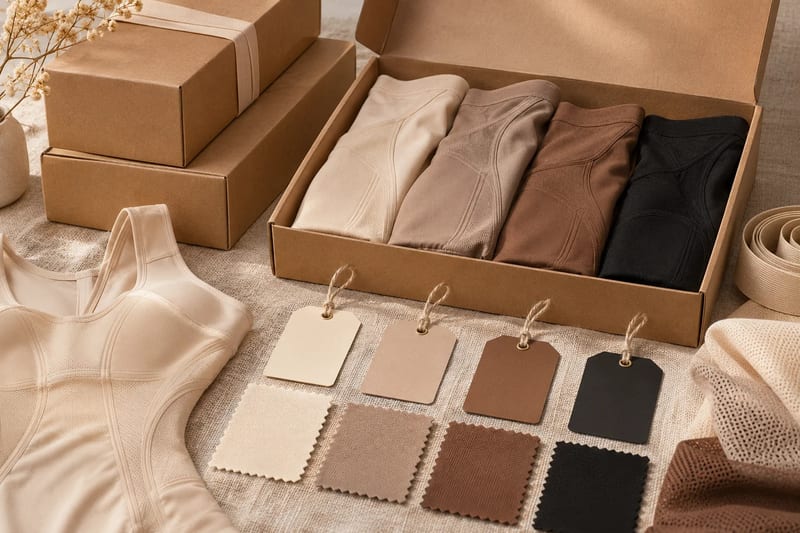
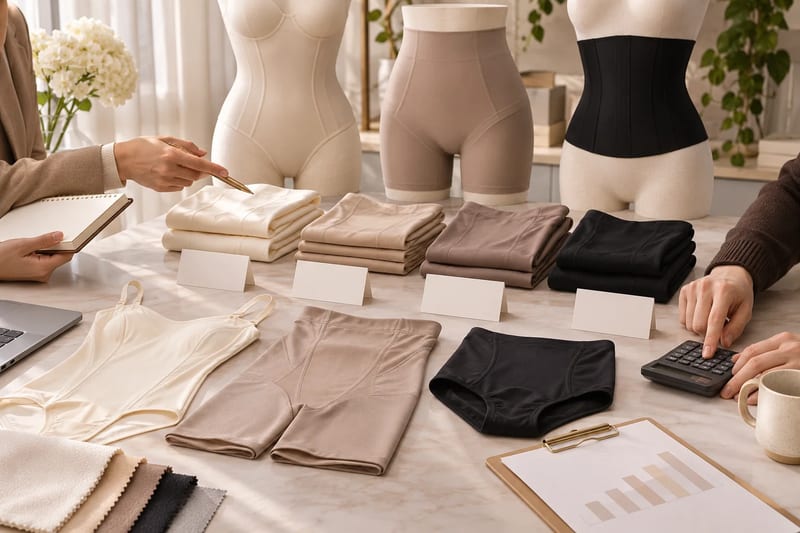
Illustrative sourcing and product-development scene. Click to continue the related buyer guidance.
Lower MOQ vs Lower Unit Price: How Should Channel Evidence Inform Negotiation?
Use channel evidence to understand selling layers, then negotiate the actual constraint behind the order. A low B2B listing is not proof that every material, color or private-label request can meet the same minimum. Consumer ranges provide positioning context; the accepted product and matrix determine the proposal your startup can approve.
| Channel / buying model | Observed USD per garment | Product and order basis |
|---|---|---|
| Amazon US retail bodies | $12.38–$35.14 | Seamless/lighter bodies $12.38–$19.99; Structured bodies $35.14–$35.14. |
| Value/mid-tier brand DTC bodies | $29.99–$49.00 | Shapermint/Shapellx sale prices; no multi-pack or order code |
| TikTok Shop US bodies | $21.99–$54.99 | Seamless/lighter bodies $21.99–$46.99; Structured bodies $39.99–$54.99. |
| B2B small-order platform bodies | $3.18–$10.00 | Tianchen, Junmao and S-Shaper; listed minimums 5/2/10; not deep-custom eligibility |
| B2B higher-volume platform bodies | $2.50–$12.85 | Listed minimums 100–600; different garments, not a same-SKU volume discount |
US-facing USD single-garment observations reviewed November 10, 2026; variants, retail promotions and shipping/tax differ. Amazon uses May–October 2026 tracker snapshots, not live November checkout. These selected samples are not industry averages or matched constructions. B2B advertisements are not landed costs or final custom quotes. Deeper development needs separate specifications, deliverables and an itemized quotation.
B2B is generally below B2C per piece because the buyer accepts more inventory and selling work, but a smaller scoped run can still require less total cash than a cheaper larger order. Brand premiums and marketplace promotions cannot decide that trade-off for you. Ask S-Shaper which optional change could reduce the commitment without removing the tested benefit, and obtain the revised matrix and quote. Keep component and development work visible. Negotiate a feasible learning purchase rather than promising future volume simply to reach a wholesale amount observed under another seller’s conditions.
This profile concerns everyday platforms. Structured fajas require a separate specification; new patterns, materials and deeper customization are not assumed included in ready-made bulk supply.
How Can Available Materials and Simpler Branding Change the Discussion?
Ask to review available materials that could meet the brief. Compare feel, opacity, recovery and garment behavior physically. An existing material may reduce sourcing work, but it is only an alternative when it supports the required product result. Request its identifier and an appropriate sample so the choice is traceable.
Discuss branding methods through S-SHAPER’s customization service. The page lists several options, but the applicable technique depends on the garment, placement and commercial scope. Ask whether a simpler label or packaging arrangement could suit the pilot, and what proof would be required before production.
If the supplier proposes a standard box or existing color, decide whether the first collection can honestly use that presentation. The brand may still provide useful fit guidance and service. Private label does not require every physical component to be newly developed, but your claims should describe the actual product and arrangement.
Clarify unused components and material responsibility. A proposal may reduce finished garments while requiring you to purchase a larger quantity of fabric or labels. Ask what remains, who owns it and whether it can be used later. The negotiation should make these commitments more visible rather than moving them into another quote line.
Review any proposed substitution with the relevant product checks. Use S-SHAPER’s quality-control overview to discuss the order-specific acceptance record. A smaller minimum does not justify an unapproved fabric change or label that affects comfort. Accept the revised route only when you understand both its commercial benefit and product effect.
Which Shapewear Manufacturers Should You Consider for Your MOQ Negotiation?
Compare shapewear manufacturers in China, Turkey, France and Canada for negotiating a feasible first quantity. The recommendations below connect country-level capabilities with specific suppliers and the work your brand needs.
China Shapewear Manufacturer: Ask specialists to simplify the right part of the brief
Negotiating with China shapewear manufacturers is more productive when the buyer distinguishes essential fit from optional material, color or presentation work and requests a clearly revised scope.
Recommended China Supplier: S-Shaper
S-SHAPER’s design, production, QA and export roles can help identify whether the barrier is the garment platform, material choice or brand presentation. Its recommendations on materials and functions, informed by work with international markets, create a basis for proposing alternatives that preserve the customer use case.
Ask which existing platform and item-testing conditions apply, then request a revised matrix and quote for the agreed simplification. A revised product-specific proposal makes the inventory commitment tangible, without guaranteeing that every requested minimum can be lowered. Confirm material availability and the approvals that start production before using the smaller order to set a dispatch target. This route suits founders who can distinguish essential fit requirements from optional colors and components. See S-SHAPER OEM/ODM and global-brand support, S-SHAPER item-testing MOQ and stock/bulk conditions.
Turkey Shapewear Manufacturer: Discuss the commitment inside the integrated process
With Turkey shapewear manufacturers operating integrated seamless processes, investigate which yarn or color commitment drives the minimum before assuming fewer finished pieces will reduce every obligation.
Recommended Turkey Supplier: SML Seamless
SML describes private-label seamless production from yarn through packing. For a compatible garment, that gives the buyer a practical route to ask which yarn, color or finishing requirement drives the proposed quantity and whether an alternative within the existing platform would change it.
Integration does not imply unlimited small-order flexibility. Ask for the actual conditions and trial the suggested material, finish and grading before accepting a lower-commitment version. The route can be valuable when it removes unnecessary production handoffs; it should not be judged by an assumption that Turkish manufacture is automatically cheaper or technically weaker. See SML Seamless integrated private-label manufacturing.
France Shapewear Manufacturer: Protect the outfit solution while simplifying presentation
France shapewear manufacturers and occasion-design partners should understand which coverage features are essential, so an easier minimum does not produce a garment unsuitable for the intended outfit.
Recommended France Supplier: Gilsa Paris
Gilsa’s invisible-lingerie and occasion focus can help identify which features are necessary for a backless, bridal or neckline-sensitive application. With adaptation and own-label development available, a negotiation can begin by asking whether an existing model solves the problem before commissioning new features or packaging.
Its own-label minimum is product-dependent, and development needs a specific quote. A smaller request may still require materials and components to be prepared. This is a relevant option when design suitability matters; keep the essential coverage or support result intact rather than accepting an easier garment that no longer works under the intended outfit. See Gilsa Paris professional resale and own-label development.
Canada Shapewear Manufacturer: Negotiate the technical and production scopes separately
A Canada-based shapewear manufacturer discussion may involve technical work before overseas production, so negotiate the garment count and necessary pattern or grading support as separate commitments.
Recommended Canada Development Partner: Hertex
Hertex’s Montreal technical work and China production illustrate why a lower garment count may not remove the development effort behind a fit-led project. Ask which pattern, grading or QC activities remain necessary and whether an existing platform can answer the first customer question with less new work.
The benefit is a defined technical communication bridge. Its cost and startup eligibility need confirmation, and local contact does not create a local-production promise. Compare any revised offer with the responsibilities your own team would otherwise perform. A successful simplification reduces optional scope without leaving important fit decisions undocumented between the office and factory. See Hertex Montreal development with China production.
Ask for the revised deliverables, matrix and payment scope together; accept a lower quantity only when the product remains a credible test.
What Should the Revised MOQ Agreement Record Before Payment?
Ask the supplier to issue the accepted product version, quantity matrix and quote together. Record which changes made the smaller order possible and what has been excluded. A conversation about flexibility is not the final production scope until both sides have acknowledged the same files.
Use the S-SHAPER FAQ as preliminary context, then obtain confirmation for your item. If the team offers initial testing support, ask which materials, branding and size combinations qualify. Keep a general website statement separate from the order you are approving.
Confirm the schedule and delivery responsibilities for the revised route. Review the logistics overview to prepare questions, but request project-specific timing. A lower quantity does not automatically guarantee an earlier production slot, and an available-material option may still require branded-component work.
Set the review point after the pilot. Specify what customer and quality evidence will inform the next order, and keep the larger-volume proposal provisional until that review. The resulting relationship should allow a founder to learn from a manageable purchase without confusing an expression of future ambition with a confirmed buying commitment.
How Can S-SHAPER Help You Discuss a Feasible First-Order Scope?
S-SHAPER presents existing shapewear products alongside OEM, ODM and customization support. That makes it a relevant supplier to ask about the difference between selecting an available platform and commissioning additional development. Review the OEM/ODM service scope and identify the work your startup actually needs.
Send the team your essential product requirements, reference garment, target market, desired allocation and total commitment constraints. Ask it to explain which part of the proposal drives the minimum and whether an alternative material, color or presentation can meet the same wearer need with a more manageable scope.
Then request an item-specific MOQ discussion with S-SHAPER. The useful outcome is a feasible proposal with clear limits and approvals, not a promise that every threshold can be reduced. Compare the offered compromise with your customer evidence before authorizing production.
FAQ: How to Discuss MOQ with a Shapewear Factory
How do I negotiate shapewear MOQ effectively?
Explain the selected garment, essential requirements, pilot purpose and quantity matrix. Ask which constraint drives the minimum and discuss specific alternatives. The supplier must confirm whether those changes create a feasible program; negotiation does not guarantee acceptance.
Should I ask for fewer sizes or fewer colors?
Evaluate what each choice changes for the customer. Fewer optional colors may preserve necessary size coverage, but the supplier’s actual rules determine the commercial effect. Do not remove the fit coverage central to the brand just to reach a smaller total.
Can I use stock fabric to reduce the minimum?
It may be worth discussing if the material meets the product requirements and is available. Review a sample and identify the material precisely. A sourcing simplification should not become an unapproved change to fit, opacity or the promised wearing experience.
Is a higher unit price acceptable for a first test?
Compare the complete commitment and learning value. A smaller feasible run can require less cash even with a higher piece price. Include components, development and delivery costs, and do not infer demand from the discount available at a larger quantity.
What should I obtain after the negotiation?
A revised written quote linked to the exact specification, matrix, branded components, sample approvals and delivery scope. Record any excluded work and unused-material arrangement. Confirm the final records before payment instead of relying on an informal agreement about flexibility.