 EN
Quick Answer
Specify long-torso shapewear bodysuits through a defined body-measurement route, the garment’s vertical geometry, bust and waist positions, closure placement and material response. Height alone does not describe torso proportion, and longer straps alone do not necessarily create a suitable long-torso pattern.
Ask the manufacturer to show where additional length is proposed and which features remain aligned. Compare identified prototypes on the intended body cases, checking dressing, closure access, seated movement, reaching and coverage. Include relevant sizes and care states before approving the range.
For a startup, the decision is whether a particular platform can provide the intended proportion with a repeatable specification. Request a project-specific sample and commercial scope rather than treating a tall label, a stretch percentage or a closure extender as proof of an original long-torso development program.
What Should a Long-Torso Bodysuit Brief Measure and Explain?
Describe the customer’s problem precisely. Pulling between shoulder and closure, waist placement that sits too high and inadequate bust coverage are different observations. They may interact, but the supplier needs to know what happens and during which task before deciding how to change the garment.
Record relevant body girths and vertical relationships independently. ISO 8559-1 offers a body-measurement vocabulary; agree the particular torso route with the technical team and illustrate it. An unqualified torso-length number can mean a front path, back path or loop and is therefore difficult to use.
Identify the garment style: open bust or integrated bust, thong or brief lower coverage, closure type and intended neckline. A long-torso solution must preserve the complete wearing proposition, not only close with less pulling. Bust, waist and leg placement remain part of the brief.
Ask S-Shaper’s sizing customization team for the existing platform’s defined dimensions and adjustment range. Explain which body cases are missing from the current fit. The team can then distinguish a feasible adaptation from work needing another pattern or construction.
Keep customer and garment measurements in separate records. Body length does not directly prescribe a relaxed fabric path because extension, panel geometry and fit interact. The brief should make the technical question clear without pretending a one-to-one subtraction is a finished pattern instruction.
| Brief field | Information to supply | Decision it supports |
|---|---|---|
| Wear issue | Location, activity and sample version | Identify likely development question |
| Body profile | Relevant girths and defined torso path | Recruit meaningful fit cases |
| Product geometry | Bust, waist, leg and closure relationships | Preserve intended placement |
| Material and components | Identified fabric and adjustment details | Assess assembly compatibility |
| Range | Planned sizes and proportion limits | Define sampling and customer guidance |
Longer Straps vs a Longer Torso Pattern: What Changes the Fit?
A strap changes the connection at the shoulder and its relationship to the upper body. A torso-pattern change can redistribute length within the garment. Those are different mechanisms. A product may use both, but the sample should show why each is needed.
If the waist and lower panel are misplaced, a strap extension may not correct their relative geometry. If bust coverage is already insufficient, lowering the entire upper garment can introduce another problem. Ask the technical team to explain the result rather than assuming the easiest component adjustment solves every pull.
A closure extender also changes a localized connection. It may be useful in a particular existing product, but it does not automatically establish the intended bust, waist or leg relationship. Compare the complete garment and clarify whether the proposal is an accessory solution or a new pattern.
Material extension is not a substitute for a proportion decision either. ISO 20932-1 concerns fabric elasticity, but a strip result does not establish an acceptable shoulder-to-closure wearing experience. Request the relevant material evidence and verify its role in the actual assembly.
The commercial distinction matters. Adapting a component, revising the pattern and developing a new platform can involve different samples and procurement conditions. Ask for those scopes explicitly. A startup should know what the next payment authorizes and which question the delivered sample will answer.
| Proposed route | What it changes | What still needs checking |
|---|---|---|
| Longer strap / adjustment | Upper connection and setting | Bust, waist and closure relationships |
| Localized closure solution | Connection at lower opening | Whole-body geometry and usability |
| Torso-pattern revision | Defined panel lengths and placement | Material balance and relevant sizes |
| Different fabric | Mechanical response of an assembly | No automatic correction of feature positions |
How Can Equal Added Length Produce Different Bodysuit Results?
Use segmented measurements to explain where length is placed. For a deliberately hypothetical sample-room exercise, define a body-panel reference path excluding straps, divided at a marked waist line into an upper and lower segment. The original uses 24 and 34 centimetres, totaling 58.
Candidate P keeps the upper segment at 24 and increases the lower to 38, totaling 62. Candidate Q uses 26 and 36, also totaling 62. Both add four centimetres to this chosen garment path, approximately 6.9% of 58, but place that addition differently around the waist landmark.
These invented dimensions are not recommended bodysuit specifications, body measurements or an instruction to add four centimetres to every long-torso design. They demonstrate that equal total length does not establish equal feature placement. A real technical team needs pattern and material evidence to determine the appropriate geometry.
Record the marked reference points and measurement state so the comparison can be repeated. A relaxed seam path must not be compared with a stretched body path as if they described the same quantity. Ask whether any curved seam, panel join or component position changes with the alternative.
Fit the alternatives on the relevant cases and inspect the actual waist, bust and closure behavior. If one version solves pulling but moves another feature incorrectly, retain that finding. A single total-length target cannot replace the local decisions that make the complete garment usable.
| Hypothetical panel path | Upper segment | Lower segment | Total excluding straps |
|---|---|---|---|
| Original | 24 cm | 34 cm | 58 cm |
| Candidate P | 24 cm | 38 cm | 62 cm |
| Candidate Q | 26 cm | 36 cm | 62 cm |
| Meaning | Different allocation | Same +4 cm total | Not a body chart or recommended grade |
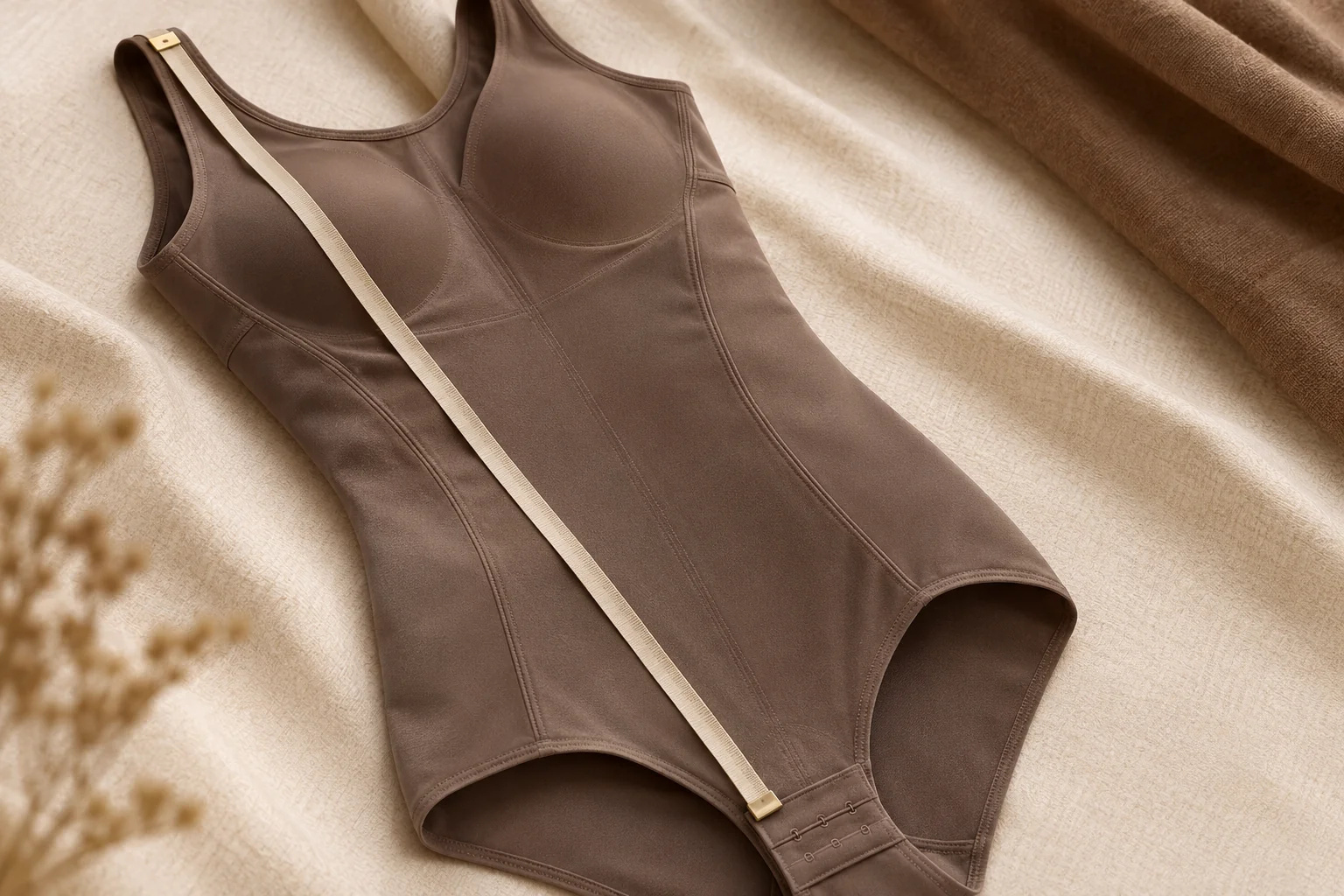
Illustrative sourcing and product-development scene. Click to continue the related buyer guidance.
What Material and Component Details Belong in a Long-Torso Specification?
Identify material orientation within the garment. The direction supporting vertical movement and the direction responding around the body may not behave identically. Request relevant mechanical evidence with defined conditions rather than relying on the words four-way stretch alone.
List control panels and linings with their coverage and attachment. A main fabric may extend while another layer restricts the assembly. Ask whether a longer panel requires corresponding changes to reinforcement, seams, bindings or the gusset rather than extending only the outer piece.
Record strap construction, usable adjustment endpoints, attachment positions and hardware. The longest possible setting is not necessarily the intended fitting position. Evaluate whether the component remains comfortable and visually suitable at the settings used by the target cases.
Review closure type, location and reinforcement. Access and removal are part of daily usability, not minor finishing details. An alternative closure can change procurement and testing needs, so preserve its reference in the bill of materials.
Use S-Shaper’s bodysuit and shaping references and the OEM/ODM development route to discuss a controlled proposal. Confirm what remains shared with an existing platform and what becomes new work. A longer style name should not conceal changes that require another sample or component order.
Which Fit Cases and Movement Tasks Should Test a Long-Torso Sample?
Recruit by the defined body profile and relevant girths, not height alone. Include the intended torso cases at important size locations and record any gaps. Do not describe a small targeted group as proof that the product fits every tall customer.
Review dressing and adjustment first. Record the actual strap or closure settings used and whether the participant can position the garment according to normal instructions. Unusual pulling or a forced closure should be investigated rather than accepted because the final photograph looks smooth.
Check standing, sitting, reaching and ordinary movement relevant to the brief. Ask where pulling occurs and whether the bust, waist or leg opening moves. An upper-body complaint may involve a lower connection, so keep observations separate from the technical diagnosis.
For a hypothetical plan, two size locations, two torso cases per location and two prototypes create eight fitting sessions: two multiplied by two multiplied by two. That is a planning example, not eight independent participants, a required minimum or statistically representative coverage.
Review after the intended care exposure as appropriate. Preserve sample dimensions, method and state before comparing results. A garment can pass a first standing fitting and later change in a way relevant to the product promise. If another sample is needed, identify exactly which dimension or component will change and what observation would resolve the question.
| Fit-review item | Record | Reason |
|---|---|---|
| Entry and adjustment | Method used / actual settings | Assess ordinary usability |
| Movement | Task / pulling location / feature movement | Diagnose the geometry |
| Range | Size and torso cases completed | Keep validation limits visible |
| Care state | Procedure and sample measurements | Compare the same product state |
| Revision | Changed points and new sample ID | Prevent ambiguous approvals |
How Do You Control Long-Torso Samples and Size-Set Approval?
Give each prototype an identifier and retain its material, pattern and component versions. Mark whether it is an exploratory fit sample or the proposed production construction. A sample made with substitute fabric can support a limited question without approving final material behavior.
Measure the defined paths and feature positions consistently. Keep target values, actual readings and tolerances separate. If the sample differs unexpectedly, investigate its identity before changing the pattern to compensate for a making error.
Discuss S-Shaper’s quality-assurance process in terms of the actual long-torso version. Agree which sizes need physical samples, what the inspection points mean and which findings block release. A familiar standard-length product is not evidence that the adapted grade has already passed.
Reconcile local revisions with adjacent sizes and components. Moving the waist line may affect panel height, seam joins and the intended customer guidance. Ask the technical team to list these dependencies so they are not left to production interpretation.
Release one live specification and archive superseded versions. The brand should know which body profiles and tasks supported the approval and which limitations remain. That clarity is particularly useful on reorder, when a supplier’s memory of a longer sample is not a dependable production instruction.
Which Manufacturers Should You Compare for Long-Torso Shapewear Bodysuits?
Compare development models through their ability to maintain vertical geometry and component balance. A country’s average height is not a pattern specification, and wholesale access does not automatically provide a long-torso adaptation service.
China Long-Torso Bodysuit Manufacturer: Coordinate Pattern and Component Changes
China long-torso shapewear bodysuit manufacturers offering development and production can help distinguish a strap adjustment from a change in panel geometry, provided the intended body paths and feature positions are defined.
Recommended China Supplier: S-Shaper
S-Shaper describes design, production, QA and export specialists and recommendations informed by international-brand work. Ask the customization team to identify a suitable base platform and explain which torso, bust, waist or closure changes require samples. Its applicable small-order tests depend on the item and scope, not a universal long-torso custom minimum. Confirm material and component availability and the approvals needed before dispatch. This route suits a startup needing technical coordination with direct factory communication, while keeping its own target fit cases and approval responsibilities explicit.
Canada Long-Torso Bodysuit Manufacturer: Focus on Vertical Pattern Interpretation
A Canada-based long-torso shapewear bodysuit manufacturer comparison can prioritize pattern interpretation when the founder needs to locate added length and preserve the relationship between bust, waist and lower closure.
Recommended Canada Supplier: Hertex Lingerie
Hertex identifies design, pattern, grading and QC in Montreal with manufacturing in China. Ask whether its proposed work covers the particular vertical changes and size-set records required, and who carries the accepted version into production. The hybrid model can help where technical interpretation is the main gap. Development, coordination and startup eligibility still require confirmation. Canadian involvement does not establish Canadian-made stock or rapid local replenishment; agree sample, material and factory handoff dependencies rather than treating the local contact as a delivery guarantee.
Turkey Long-Torso Bodysuit Manufacturer: Examine Seamless Platform Limits
Turkey long-torso shapewear bodysuit manufacturers using seamless facilities can be assessed through the vertical architecture available on the actual knitting platform and its compatibility with the required panels and openings.
Recommended Turkey Supplier: SML Seamless
SML describes private-label shaping products and integrated yarn-to-packed facilities. Ask which proportion changes the proposed platform can support and how finishing affects the final sample dimensions. Integration does not establish that a new torso length is available at the same conditions as an existing article. Confirm yarn, color, component and sample requirements before dispatch planning. This route suits a compatible seamless design; the relevant evidence is the identified long-torso sample and approved range, not a national assumption about technical quality.
Colombia Long-Torso Bodysuit Manufacturer: Check Existing Styles Before Assuming Adaptation
Colombia long-torso shapewear bodysuit manufacturer comparisons can include specialist finished shaping products, but the buyer must verify each style’s torso suitability and separate wholesale availability from original pattern development.
Recommended Colombia Supplier: Leonisa
Leonisa identifies Colombian manufacturing and an international wholesale program. An existing bodysuit can be relevant to a resale assortment if its actual fit and coverage serve the audience. Request current style availability, relevant measurement guidance and replenishment conditions. The public wholesale route does not establish custom torso adaptation or private-label rights. This route suits a founder willing to validate a finished product, while a business requiring original vertical geometry must confirm that separate service rather than assume it accompanies wholesale supply.
Select the partner that can sample the proposed geometry and explain its material, size and component conditions before you fund a long-torso range.
How Can S-Shaper Support a Long-Torso Bodysuit Development Checklist?
S-Shaper’s shaping range, customization, OEM/ODM and quality services provide a starting point for a defined long-torso discussion. A startup can ask which existing platform can be adapted and how material, pattern and component work will be coordinated. The actual proposal should identify deliverables and approval points rather than relying on a tall label.
Send the intended body measurements and measuring diagram, product reference, wearing problem and planned range. Ask for a controlled sample route and the records needed to verify feature placement and movement. Consult the S-Shaper order FAQ for initial conditions, then confirm project-specific quantities, material availability and the supply handoff.
To begin, request a long-torso bodysuit sample proposal. Seek a repeatable construction and honest customer guidance based on the actual approved product, with unresolved proportion cases kept visible.
FAQ: Long-Torso Shapewear Bodysuits: A Development Checklist
Does a tall customer always need a long-torso bodysuit?
Height alone does not determine torso proportion. Use the product’s relevant body-measurement route, girths and fit evidence. A taller person may have a suitable torso relationship for one platform while another customer needs a different vertical proportion.
Can longer straps solve shoulder-to-closure pulling?
They may help a specific adjustment question, but do not necessarily correct waist position, bust coverage, panel length or closure geometry. Ask the technical team to identify the source of the issue and sample the actual proposed solution.
How much length should I add?
There is no universal addition in this guide. Define the audience and measurement paths, then develop and compare the platform. The hypothetical four-centimetre example demonstrates allocation and is not a recommended pattern adjustment.
Should the material stretch more vertically?
That is a technical question for the actual construction. Request relevant mechanical evidence and test the assembled garment. More extension alone does not guarantee positioning, coverage or comfortable support, especially when layers and components respond differently.
What should be approved before bulk production?
Keep an identified pattern, material and component record, relevant size-set and fit findings, agreed measurement checks and customer guidance. Confirm the available production materials and remaining approvals. Do not release the range solely because one long sample closes successfully.