 EN
Quick Answer
Source a private-label wireless shaping bra by specifying the underband, cup coverage, straps, closure, lining or pads, material and intended wearer range. Wireless describes the absence of an underwire in the proposed construction; it does not independently establish fit, support or comfort.
Ask for an identified platform and evaluate representative underbust, bust and body-proportion combinations rather than one founder’s size. Review dressing, movement, coverage, strap adjustment and after-care behavior. Use wireless-bra-specific price evidence, confirm the actual development scope and approve the size-selection information with the garment before production.
Who Must the First Wireless Shaping Bra Fit?
Define the intended wearer and use before choosing a size system. Record relevant measurements and proportions, desired coverage, clothing and everyday movements. A soft leisure style and a product intended for a particular activity create different briefs. Do not promise activity-specific performance unless the actual product has relevant evidence.
Start from S-Shaper’s product catalogue and ask whether a suitable wireless platform is available. Confirm its actual size range and the basis for size selection. A letter size on one supplier’s product is not proof that another product has the same dimensions or wearer coverage.
Discuss underband fit and cup coverage separately. Two wearers may need similar band dimensions but different front coverage, or similar bust measurements with different proportions. A small first size range should identify these limits rather than imply that one stretch garment fits every combination equally well.
Choose representative testers with the developer and preserve the garment version used. The founder can contribute useful feedback, but is not the complete target population. Keep remaining coverage gaps visible and ask what additional size or proportion review is needed before release.
Make the customer promise specific enough to evaluate. Comfortable support for the intended everyday use is a question for material, fit and wearer evidence; it is not established by a wireless label or a smooth product photograph. Avoid adding an unverified high-impact or clinical claim because another seller uses one.
| Brief field | Define | Ask the supplier |
|---|---|---|
| Wearer range | Relevant underbust/bust information and proportions | Actual size-selection basis and limits |
| Use | Everyday context and movement | Suitable platform and evidence |
| Coverage | Front, side and back requirements | Proposed cup and wing construction |
| Fit system | Intended labels and customer guidance | Measurements and review plan |
How Do Underband, Straps and Cup Coverage Work as One Product?
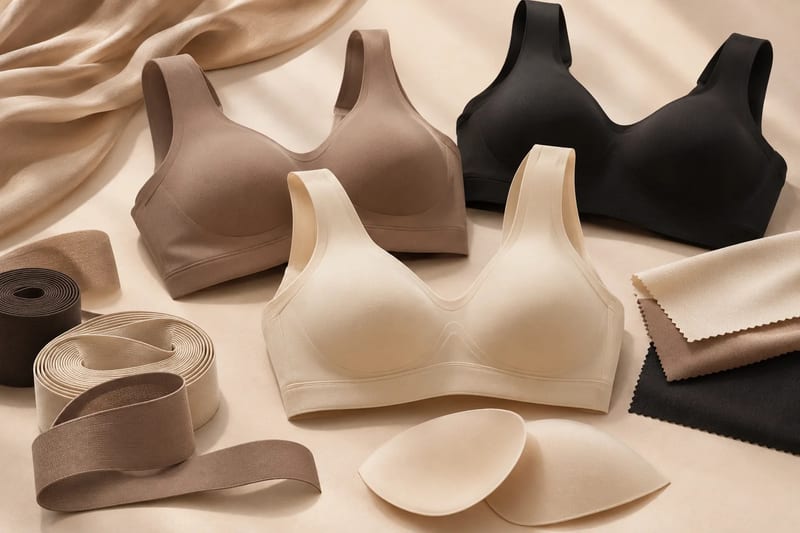
Request a component drawing or an inside sample view. Identify the underband, cup area, wings, straps, closure, lining and pads where used. Ask which feature is intended to provide each part of the wearing result. The buyer should understand the actual construction rather than assume stretch fabric alone performs every role.
Review the band’s position and behavior during dressing and movement. If it shifts, folds or creates unwanted contact, document the task and location. Do not immediately prescribe a smaller label or more elastane across the entire garment. Ask the developer which dimension or construction feature should be investigated.
Straps require adjustment and contact review. Record the setting used and whether the tester can reach or operate the adjustment as intended. A broad strap can look substantial while still needing a different position or attachment. Do not use width as a universal support score.
Examine cup and side coverage together with the intended neckline. If removable pads are proposed, identify their shape, retention and care implications. If the design is unpadded, preserve that distinction in the sample and quote. A photograph of one styled version does not approve a different internal construction.
Ask how these components change across sizes. Scaling every part by one ratio may not be the proposed development approach, so request the actual grading explanation and size-set evidence. The approved bra should have a reproducible relationship between its components, not merely a collection of attractive individual features.
Pull-On vs Back-Closure Wireless Bras: Which Should a Small Brand Develop?
Compare dressing, adjustment and fit objectives before choosing the closure route. A pull-on garment and a back-closure garment can offer different user experiences, but neither is automatically more comfortable or more suitable for every proportion. Evaluate the complete construction with the intended wearer.
For an illustrative review, choose three underband-related fit groups, two coverage profiles and two closure concepts. That creates 12 review cells. These are chosen planning categories, not a universal bra size chart or a requirement to launch 12 products. Agree which actual garments and testers address the questions and which combinations are relevant.
If one route needs a different pattern or material, document the difference. The founder can compare complete solutions without claiming the closure alone caused every result. Ask whether the customer can dress, adjust and move as intended, then decide which proposal best supports the specific first collection.
| Decision | Pull-on concept | Back-closure concept |
|---|---|---|
| Dressing | Review the actual donning/removal sequence | Review access and fastening use |
| Adjustment | Identify what can be adjusted | Identify closure and strap options |
| Fit | Observe band, cup and coverage together | Observe the same requirements at chosen settings |
| Specification | Opening, material and construction | Hardware, attachment and construction |
| Chosen review matrix | 3 × 2 × 2 = 12 cells | Not a prescribed assortment or size system |
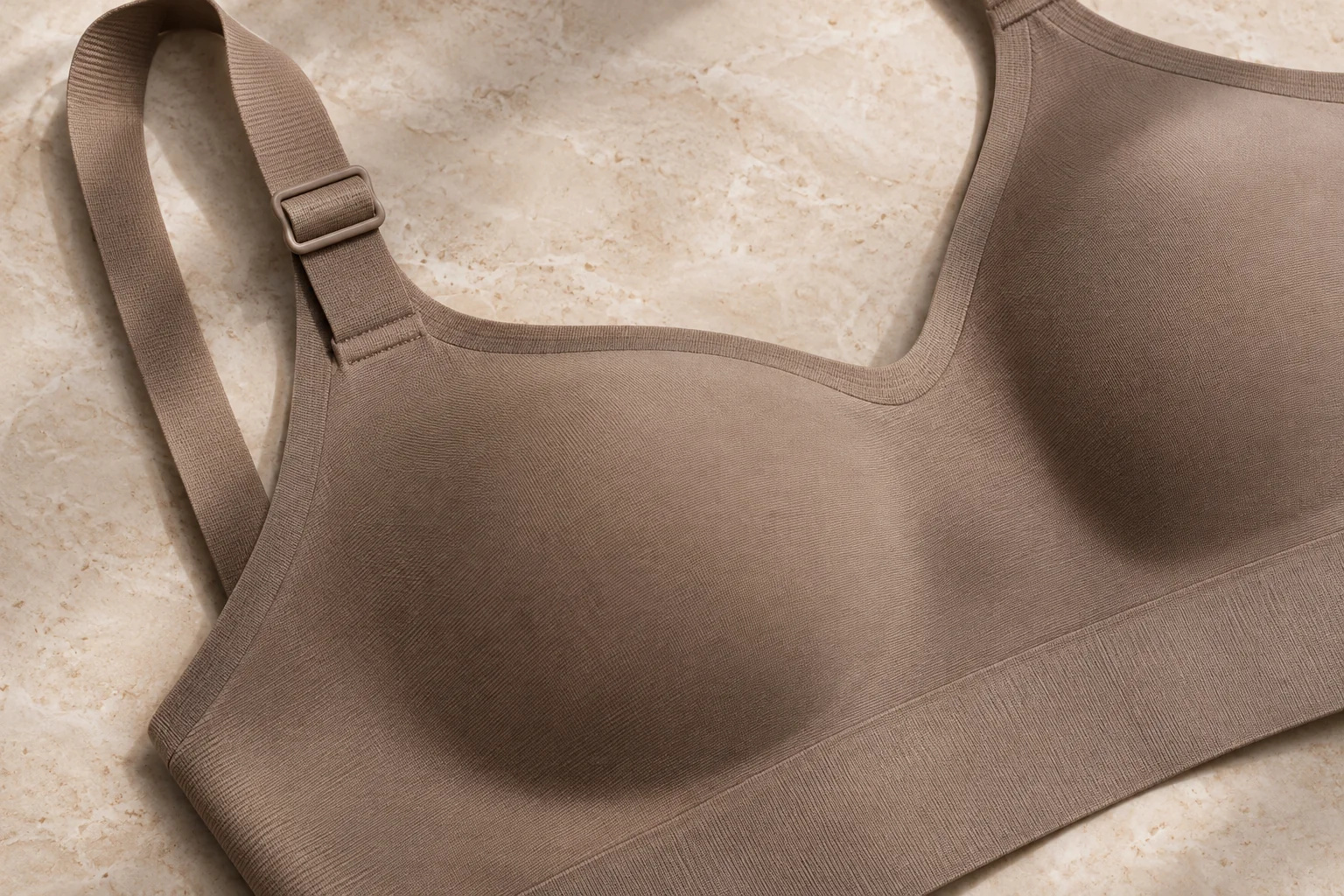
Illustrative sourcing and product-development scene. Click to continue the related buyer guidance.
What Do Wireless Shaping Bras Cost Across the Four Buying Channels?
Use wireless-bra observations rather than a generic shapewear-body price. The construction still matters: cup treatment, padding, band, straps, closure and labeling can differ. A small sample of offers helps frame questions, but cannot establish that a custom bra can be developed at a storefront’s lowest amount.
Product-specific price check: wireless shaping bras. US-facing USD per single garment. Research reviewed November 10, 2026; underlying snapshot dates differ. These selected listings show channel positioning, not an industry average or a matched-quality price experiment. Single observations are marked as examples.
| Channel / model | Observed USD per garment | Scope and order basis |
|---|---|---|
| Amazon US | $21.99–$23.99 | Two Bali wireless styles; September/October dated tracker snapshots |
| Brand DTC | $32.99–$35.99 | Truekind/Shapermint shaping styles; sale prices, MSRP excluded |
| TikTok Shop US | $30.99–$46.79 | Two Shapermint US wireless/shaping single-item snapshots |
| B2B garment offers | $3.08–$3.50 | Two wireless-bra listings; confirm band/cup construction and private-label MOQ |
Wireless comfort, bust shaping and sports support are different promises. These are everyday wireless examples, not evidence of equal lift, support or cup coverage. Compare the underband, cup geometry and strap adjustment on target bodies.
B2B normally spreads ordering or production work across a quantity and leaves the consumer-brand layer to the buyer. Retail also funds customer acquisition, content, platform or creator fees, fulfillment, returns and overhead. The startup still pays for samples, development, quality checks, freight, tax and inventory. The retail–factory gap is neither pure brand premium nor net profit; a small custom run can cost more than a retail promotion. Existing-stock, light-label and full OEM development must be quoted separately.
Prices are indicative public observations, not final S-Shaper quotations. Confirm material, variant, MOQ, customization rights, packaging and delivery terms through a product-specific S-Shaper inquiry. Tax and shipping are not normalized; US examples are not local UK/EU/Australian tax-inclusive prices.
View the price observations and dates
- Bali / Amazon.com — Bali Double Support Comfortsoft wireless full-coverage DF3820: $21.99; 2026-10-02; dated third-party Amazon tracker indexed record; not live Amazon checkout; ASIN B000MX3RDW; selected black variant; crossed-out $48 excluded..
- Bali / Amazon.com — Bali Comfort Revolution Modern Seamless wireless DF3380: $23.99; 2026-09-23; dated third-party Amazon tracker indexed record; not live Amazon checkout; ASIN B0CMDHZZ7Y; Sandshell; $50 comparison price excluded; two Bali styles, not a representative Amazon sample..
- Shapermint — Truekind Supportive Comfort Wireless Shaping Bra: $35.99; public snapshot reviewed November 10, 2026 (checkout not verified); public official/seller page snapshot; Single garment sale price; MSRP $55 and installment amount excluded..
- Shapermint — Shapermint Essentials Everyday Comfort Straps Wireless Shaping Bra: $32.99; public snapshot reviewed November 10, 2026 (checkout not verified); public official/seller page snapshot; Single garment sale price; MSRP $48 excluded; two styles in one brand storefront..
- Shapermint US — Supportive Comfort Shaping Wireless Bra: $46.79; public snapshot reviewed November 10, 2026 (checkout not verified); public official/seller page snapshot; Selected single-garment flash-sale listing; public snapshot crawled about three weeks before review; not authenticated checkout..
- Shapermint US — Everyday Comfort Straps Wireless Bra: $30.99; public snapshot reviewed November 10, 2026 (checkout not verified); public official/seller page snapshot; Selected single-garment flash-sale listing; not a two-pack or coupon-price calculation..
- Shantou Junying Clothing Co., Ltd. — OEM jelly-strip wireless seamless invisible bra: $3.34–$3.50; 2026-09-22; public official/seller page snapshot; Advertised garment price per piece. MOQ10 on listing does not establish custom fabric/development MOQ, packaging fees or landed cost.; listed MOQ 10.
- Shantou Wenmei Weaving Co., Ltd. — Wire-free molded padded longline seamless full-coverage bra: $3.08–$3.43; public snapshot reviewed November 10, 2026 (checkout not verified); Manufacturer storefront garment offer; listed MOQ10; custom materials, development, packaging and delivery require a separate quote.; listed MOQ 10.
Request the quotation for the approved bra and size system, stating whether pads, closure hardware, labels and packaging are included. Separate an available garment from a new material or pattern project. The buyer still needs to fund relevant fit work and returns planning; the observed channel gap is not the amount available as profit.
What Material and Wearer Evidence Should You Request Before Release?
Ask for identified elastic components and the relevant material evidence. ASTM D4964 addresses tension and elongation of elastic fabrics and notes applications involving brassieres. Its published guidance also emphasizes compatible conditions for comparing tension-extension results. A laboratory should select and document the appropriate method; a code alone is not a finished-bra support claim.
Source: ASTM D4964: elastic-fabric tension and elongation; brassiere applications
Use S-Shaper’s customization service to compare feasible material and construction alternatives. If the band feels unstable or a strap contacts poorly, ask what change is proposed and why. Preserve the old and new versions so the next trial tests a clear revision.
Observe dressing, reaching, sitting and the movements relevant to the intended use. Record cup coverage, band position, strap setting, contact and appearance beneath the chosen clothing. These are proposed product-review tasks, not a universal protocol or proof of sports performance.
Discuss care and product checks with the quality-assurance team. Review relevant dimensions, component behavior and appearance after the agreed routine. Keep laboratory measurements separate from wearer observations and do not turn a comfortable initial trial into a claim about every size or long-term use.
When feedback differs, investigate rather than averaging it away. Body proportions, size selection, adjustment or sample history can explain different observations. A useful record identifies the unresolved question and the next sample or evidence needed. The preferred campaign image should not decide the technical approval.
Which Wireless Shaping Bra Manufacturers Fit Your First Development Scope?
Compare the work offered around fit: a feasible factory platform, development across locations or a scoped technical investigation. The examples below describe published models and their limits. They do not establish national bra-fit rankings, universal startup quantities or a guaranteed support level.
China Wireless Shaping Bra Manufacturer: Coordinate the Platform and Fit Brief
China wireless shaping bra manufacturer comparisons should establish the available cup, band and closure platform before customization, so the first sample addresses the actual wearer range.
Recommended supplier: S-Shaper
S-Shaper’s OEM/ODM offering describes material and style recommendations with design, production, QA and export specialists. Ask the factory team which wireless platform can address the target coverage and size-selection plan. Experience across several customer regions can inform the inquiry, while specific sample evidence must establish the result.
Conditional small-order possibilities depend on the actual material, components and customization. They do not establish one minimum for every new cup concept or closure. This route suits an own-label founder seeking coordinated product advice and practical sample alternatives. Request an identified bra proposal and confirm which fit, grading and documentation work is included before comparing production quantities.
Canada Wireless Shaping Bra Manufacturer: Preserve the Fit Decision Across the Handoff
Canada wireless shaping bra manufacturer routes involving local development and overseas production should preserve band, cup and strap decisions in an identified garment record before manufacturing begins.
Recommended supplier: Hertex
Hertex describes Montreal design, pattern development, grading and quality control, with manufacturing in China since 2006. Ask whether the proposed wireless product fits its current development scope and how tester feedback, size changes and component references are transferred into production.
The reviewed background does not establish Canadian manufacture, a ready startup bra program or a fixed development fee. Obtain a current scoped proposal and clarify approval ownership. This route suits a buyer who values the stated development interface and can define responsibilities across locations. A local point of contact does not establish that a substituted elastic, pad or closure preserves the approved fit.
Portugal Wireless Shaping Bra Manufacturer: Scope the Material-and-Construction Investigation
Portugal wireless shaping bra manufacturer comparisons involving technical development should identify the band, cup or material question that needs evidence before expanding the project into multiple styles.
Recommended supplier: Impetus
Impetus describes research and development across seamless and cut-and-sew products and quality work involving materials, elastics, accessories and finished parts. Ask whether the proposed program can address the specific wireless-bra construction and how the material evidence would connect with garment trials.
The reviewed information does not establish a universal startup minimum, bra-specific package or included number of samples. A defined technical investigation needs a current proposal. This route suits a founder whose product differentiation justifies scoped development and who can identify the question to resolve. Research capability provides a resource; the approved garment and representative fit evidence must still support the wearer promise.
Choose the route that can preserve component and size decisions through sampling and production, with evidence for the intended wearer range.
What Must the Size Guide and Production Record Say Before Launch?
Keep finished measurements, material and component identities, cup coverage, band, straps, closure, pads or lining and care proposal with the approved garment. Identify the reviewed sizes and relevant wearer profiles. Retain the sample and explain any limits rather than implying universal coverage.
Write size-selection guidance from the actual approved product and evidence. A competitor’s letter-size chart is not a substitute. Ask the developer to review how measurements and fit advice connect with the intended labels, and keep unresolved between-size questions visible before release.
Use the general order FAQ as context and confirm item-specific sampling, minimums and timing. Ask how component changes, material substitutions and reorders are reviewed. The first approved version should remain distinguishable from development samples with similar appearance.
Connect those identifiers with packing and receiving records. Size marking and component control matter when another person receives or reorders the product. A generic purchase description saying wireless shaping bra leaves too much room for an unreviewed material, closure or internal-construction change.
How Can S-Shaper Help Turn Wireless-Bra Feedback into Product Decisions?
S-Shaper can be approached with the intended wearer measurements, use and an annotated reference. Ask its team to explain a feasible platform and a sample plan that distinguishes band, cup, strap and closure questions. Specific feedback gives the developer a clearer revision than a broad request for more support.
Its published support includes recommendations and specialist communication through design, production, QA and export. Confirm the exact material, grading, sampling and documentation work proposed for the bra. Conditional low-quantity support should be checked for the actual components and development scope.
Send a focused brief through S-Shaper’s project inquiry. Request identified samples and an accurate quotation for the approved version. The useful outcome is a bra with clear size-selection information and relevant evidence, supported by a record that can guide production and future changes.
FAQ: How to Source Wireless Shaping Bras for a Small Brand
Does wireless mean unsupported?
The absence of underwire does not independently establish support or its absence. Ask how the actual band, cup, straps, material and construction work together, then evaluate the garment for its intended use.
Can one tester approve the first size range?
One tester provides useful observations, not complete coverage. Plan representative measurements and proportions with the developer and identify which sizes or combinations remain unreviewed.
Is a low-MOQ wireless bra a full custom-development offer?
Not automatically. An available garment and a new pattern, material or component project have different scopes. Confirm rights, sample work, quantity basis and actual quote for the selected version.
What should be reviewed after care?
Agree product-specific checks for relevant dimensions, band, straps, closure, pads or lining and appearance. Keep conditions and sample identity documented; do not invent a universal wash count or support threshold.