 EN
Quick Answer
Review a digging leg opening as an interaction between opening geometry, elastic response, edge construction, coverage position and the wearer’s proportions. Do not assume the only remedy is a larger opening or a softer main fabric. Locate the complaint, confirm the sample and compare a controlled alternative.
Ask the manufacturer to identify the opening’s measurement method, elastic or binding reference, application and relationship to the panel. Test dressing, sitting and movement on the intended body cases, including the sizes and proportions that could change the decision. Record when and where discomfort appears rather than collecting only a general fit score.
For a startup, the useful outcome is an approved edge-and-pattern combination with clear material and dimensional records. Avoid claiming that one trim is universally comfortable or that an ordinary elastic test establishes skin pressure. A painful or unsuitable sample should be removed and investigated rather than treated as normal shaping.
Where Does the Leg Opening Dig, and What Should You Record First?
Separate location from assumed cause. A front crease, inner-leg junction and back coverage edge can behave differently. Mark the reported area on a drawing and record the activity that reveals it. A whole-opening complaint can also come from a localized seam or component end.
Confirm style, size, material, pattern and trim versions. If the article differs from the proposed specification, investigate that discrepancy before redesigning the platform. A narrower elastic or an altered application can change the sample without changing the size label.
Record the relevant body information and how the garment was selected. Hip circumference alone may not explain the opening’s relationship to the upper thigh or lower coverage. Keep observations anonymous where practical and do not infer a medical condition from a mark or comfort comment.
Ask S-Shaper’s fit and component customization team to separate pattern position, trim response and assembly questions. The next prototype should answer a specific uncertainty rather than replace every material at once.
Review the intended outer clothing and movement. An edge that looks acceptable in a standing photograph can shift during sitting or walking. If the customer must repeatedly reposition it, document the action instead of declaring the garment successful once it has been manually arranged for an image.
| Observation to record | Possible technical question | Evidence to seek |
|---|---|---|
| Localized junction discomfort | Seam, trim end or overlap? | Inside detail and component application |
| Whole opening feels restrictive | Geometry or elastic response? | Defined opening and trim measurements |
| Edge moves into a crease | Coverage placement or movement? | Task-linked fit observations |
| Only one supplied sample differs | Making discrepancy or wrong trim? | Identity and specification comparison |
Larger Opening vs Softer Edge: Which Revision Addresses the Actual Issue?
A larger opening changes geometry and potentially coverage. A different elastic or finish changes the edge assembly. They can produce different benefits and new trade-offs, so the choice should follow the finding rather than a general comfort slogan.
If an edge sits at an unsuitable body location, reducing trim resistance may leave the placement issue unchanged. If the geometry is suitable but a component junction is uncomfortable, increasing the whole opening can create gaping elsewhere. Review the specific mechanism before asking for a universal size increase.
A wider or softer-feeling trim is not automatically a lower-resistance assembly. Its construction, application and extension behavior matter. Likewise, a clean-looking bonded edge still needs evaluation of its material compatibility, recovery and care behavior. Compare the actual proposed assembly.
Keep feasible variables controlled. For example, assess a pattern alternative using the same identified trim, then a trim alternative on an agreed pattern. If the factory needs several simultaneous changes for compatibility, record them and interpret the result as a broader assembly comparison.
Ask which change affects procurement and grading. A new trim may have its own minimum, while altered coverage may need another review across sizes. A small visual change can therefore create real sample and component work. The buying decision should reflect the complete accepted version, not only the apparent simplicity of the requested edit.
| Revision route | Potential benefit to investigate | Trade-off to check |
|---|---|---|
| Opening geometry | Different entry or local position | Coverage, gaping and adjacent seams |
| Elastic or binding | Different response at the edge | Application, recovery and sourcing |
| Seam or junction | Remove a localized contributor | Security and stretch compatibility |
| Edge technology | Another construction approach | Material, process and care evidence |
How Can You Compare Elastic Response Without Calling It Skin Pressure?
Use a qualified laboratory to choose an applicable method and report the conditions. ASTM D4964 covers tension and elongation of elastic fabrics, including wide or narrow constructions, with defined machine conditions. The ISO catalogue also lists ISO 20932-3 for narrow-fabric elasticity and a 2025 amendment. These references do not prescribe one comfort value for every opening.
A deliberately hypothetical comparison shows why conditions and units matter. Suppose two identified trim specimens each have a chosen 200-millimetre reference length and are compared at 260 millimetres in an agreed demonstration setup. The imposed extension is 60 divided by 200, or 30%.
If imaginary force readings are 2.4 and 3.0 newtons under that same setup, the second is 25% higher relative to the first. These invented readings demonstrate arithmetic, not actual supplier data, a recommended test condition or a comfort ranking. They must not be relabeled as pressure against the body or converted casually into medical units.
The assembled opening can behave differently because the trim is attached to another material and follows a curved path. Application, seams and local placement still need garment review. A technically lower force does not automatically establish adequate stability or a comfortable edge.
Retain the material ID, direction, specimen form, conditions, care state and results. Ask what the report represents and how it relates to the approved opening. A single percentage without that context cannot distinguish a meaningful material change from a different measurement setup.
| Hypothetical comparison | Calculation | Interpretation |
|---|---|---|
| Reference to extended length | (260 − 200) ÷ 200 | 30% imposed extension |
| Imaginary trim forces | 2.4 N versus 3.0 N | Defined setup only |
| Relative force difference | (3.0 ÷ 2.4 − 1) × 100 | 25% higher, not skin pressure |
| Status | Illustrative values | No pass limit or supplier result |
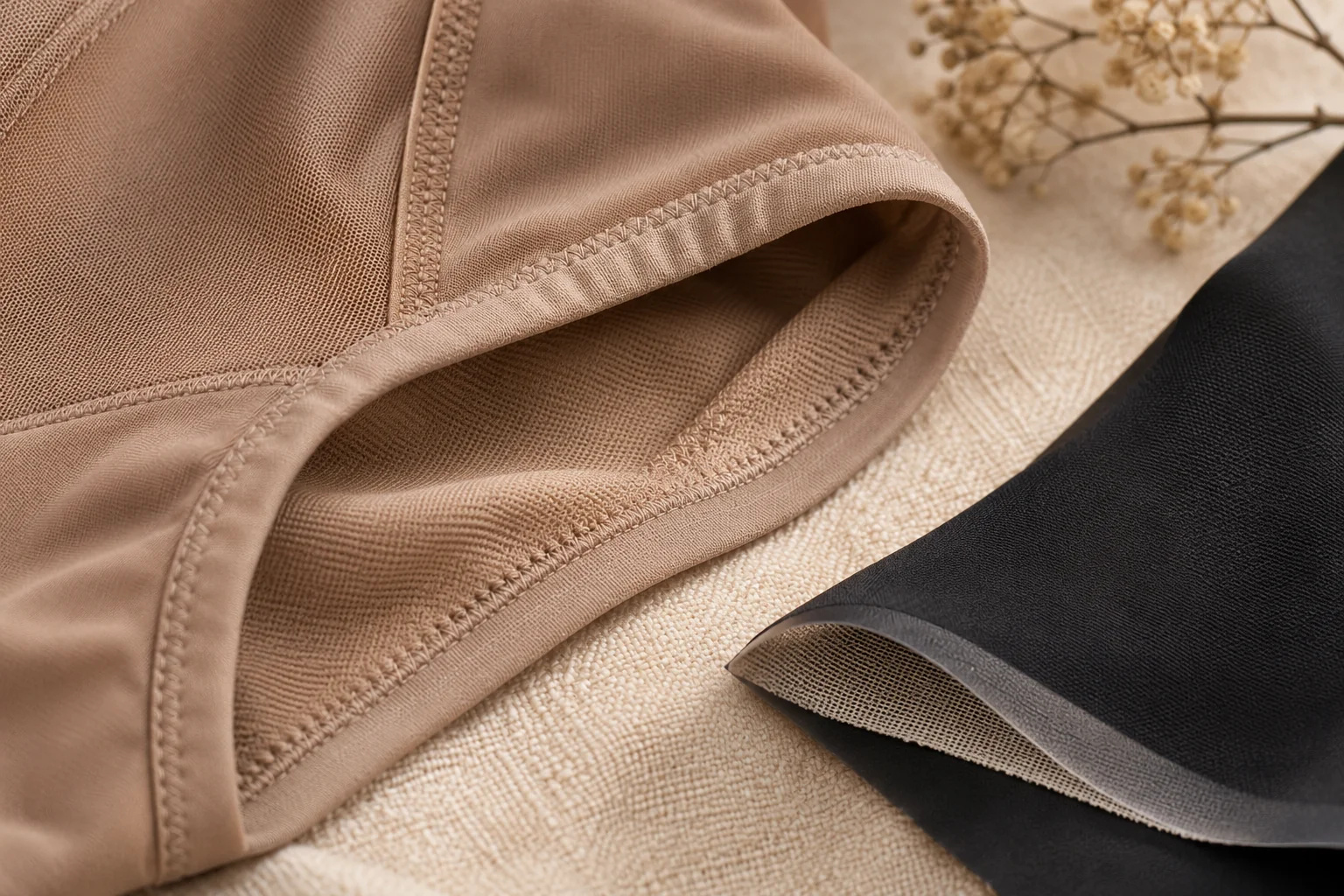
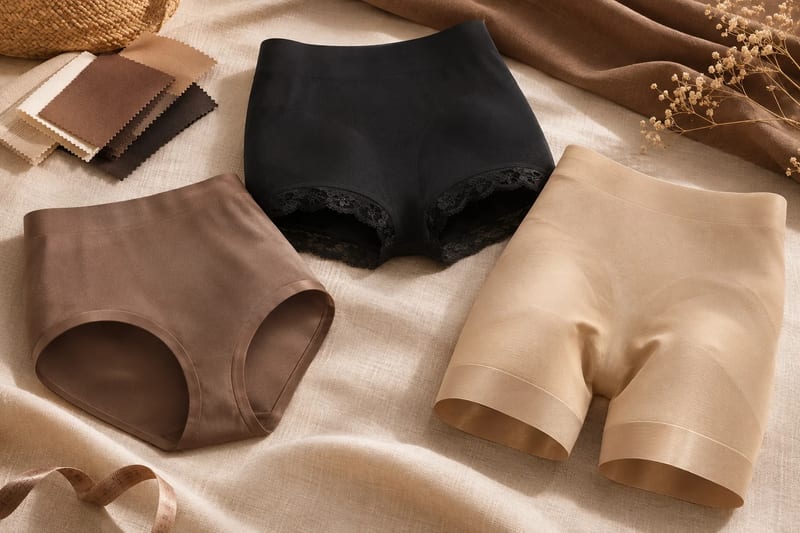
Illustrative sourcing and product-development scene. Click to continue the related buyer guidance.
How Do Coverage and Grading Affect the Leg-Opening Decision?
Map the opening in relation to the rest of the garment. Front coverage, back coverage, gusset and side height influence where the edge travels. The technical team should show how a proposed change affects those relationships rather than adjusting a circumference in isolation.
Check the relevant sizes. A satisfactory base opening does not establish every graded location, and equal increments can create another result as body proportions change. Ask which points and component references vary across the range and which samples will verify the critical cases.
Separate body dimensions from relaxed garment readings. The opening’s measured path and the body region it encounters are related through construction and extension, not a universal subtraction rule. Do not create a comfort specification by choosing an arbitrary percentage smaller than a thigh measurement.
Use S-Shaper’s briefs and shaping-product references to identify the platform and its intended coverage. A brief-style body, thong construction and short do not share one opening question simply because all are shapewear.
Keep the customer promise accurate. If an existing platform cannot serve the intended proportion with acceptable coverage and movement, another platform may be a better development route. Asking every affected customer to move to a looser size can conceal the pattern limitation and create a different fit problem elsewhere.
Which Wear and Care Checks Should a Revised Opening Receive?
Plan tasks around the use case. Review dressing, standing, seated movement, walking and removal where relevant. Let participants follow the intended instructions and record adjustment or repositioning. A garment that requires an improvised fold should not pass merely because it can be made to look smooth.
Use the same observation questions for each version. Ask location, timing and whether coverage or movement changes. Record the actual sample, relevant body case and care state so a positive result can be connected to the product that produced it.
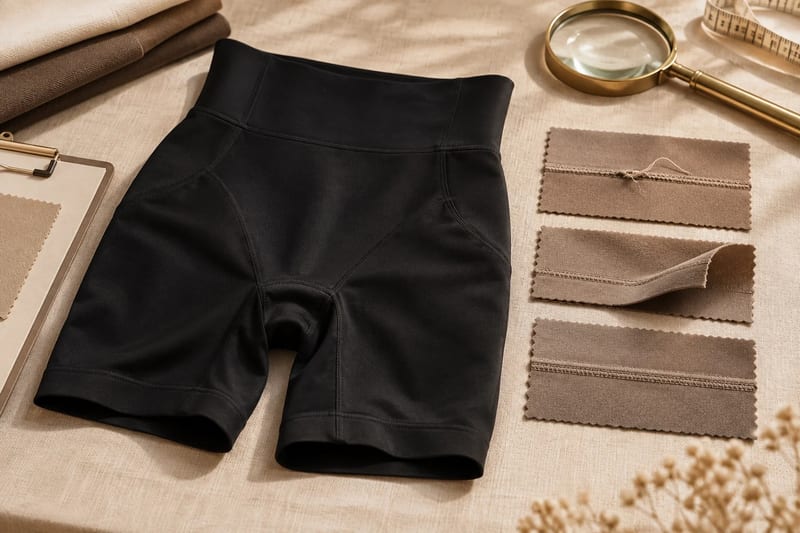
Inspect the inside as well as the exterior. Component ends, seam allowances, reinforcement and overlaps can contact the body even when the outward edge looks clean. Check whether a revision moves the original problem rather than resolves it.
Discuss S-Shaper’s quality-assurance process and the appropriate care comparison for the assembly. Inspect dimensions, recovery, attachment and surface changes after the agreed treatment. The project should define what is acceptable; this guide supplies no universal wash count or edge tolerance.
If the sample causes discomfort, stop the session and investigate. Product development does not require a wearer to tolerate painful restriction. Keep the conclusion limited to the cases and tasks completed, and request another controlled sample if the relevant opening question remains unresolved.
Which Shapewear Manufacturers Can Help Review Leg-Opening Comfort?
Compare the ability to connect a localized complaint with a controlled pattern or trim change. Different supplier models can help with development or existing assortment selection, but geography does not establish comfortable edges by itself.
China Shapewear Manufacturer: Connect Edge Findings with Factory Revisions
China shapewear manufacturers offering development and production can investigate the relationship between opening geometry, trim application and coverage when the buyer supplies an identifiable sample and a precise wear observation.
Recommended China Supplier: S-Shaper
S-Shaper brings together design, production, QA and export roles and describes material or function recommendations informed by international-brand work. Ask the customization team to distinguish an existing-platform adjustment from a newly sourced trim or pattern change. Small-order opportunities remain item-dependent; they do not promise every revised opening under a stock minimum. Confirm component availability and the sample that must be accepted before dispatch planning. This route suits a founder who needs the edge decision translated into both technical instructions and an actual manufacturing scope.
Canada Shapewear Manufacturer: Interpret Localized Fit Before Changing the Grade
A Canada-based shapewear manufacturer comparison can focus on pattern interpretation when a founder needs to determine whether digging reflects local coverage geometry, a size recommendation or a component rather than enlarge the whole range.
Recommended Canada Supplier: Hertex Lingerie
Hertex identifies Montreal design, pattern, grading and QC functions with manufacturing in China. Ask who will review the relevant body cases, mark the affected points and control the revised sample record. Technical coordination may be useful where diagnosis is the main gap, but its deliverables and startup eligibility need agreement. Canadian involvement does not establish Canadian-made stock or instant replacement supply. Confirm how the accepted opening and trim references reach production and what sample availability allows the review to proceed.
France Shapewear Manufacturer: Balance Invisible Coverage with Edge Placement
France shapewear manufacturer and adaptation proposals can be relevant when the opening must remain discreet under occasion clothing while avoiding an unsuitable coverage position during the intended movement and seated use.
Recommended France Supplier: Gilsa Paris
Gilsa’s invisible-lingerie and occasion context offers a relevant starting point for defining the outfit and coverage question. It describes professional resale and own-label adaptation or development. Ask whether the actual platform can be changed and how the opening would be sampled; an invisible appearance does not prove comfort. Product-dependent minimums, component work and development require a quote. Existing stock and an adapted article have different replenishment needs, and French service does not prove French manufacture for every style.
Turkey Shapewear Manufacturer: Review the Finished Seamless Edge
Turkey shapewear manufacturers using integrated seamless production can be assessed through how an opening is knitted, finished and joined to the garment, rather than judging it only from the main fabric specification.
Recommended Turkey Supplier: SML Seamless
SML describes private-label shaping garments and yarn-to-packed facilities. Ask which edge construction and finished-state sample represent the proposed order and what changes require another development run. An integrated process can reduce handoffs but cannot substitute for the relevant wearer and material evidence. Confirm yarn, color, component and quantity conditions before expecting dispatch. It suits a compatible seamless platform where the buyer can verify the actual opening rather than assume national production capability guarantees comfort.
Choose the route that can explain the localized mechanism, provide the relevant alternative and preserve the approved edge in the production record.
What Should Be Approved Before the Revised Leg Opening Enters Bulk?
Record the final pattern, opening measurements, trim, application and sample version together. Keep target values and tolerances separate from the observed wearer feedback. Both contribute to approval, but neither should be used to hide a failure in the other.
Identify the sizes and proportions checked and any limit on the conclusion. A successful base sample may authorize a size-set request rather than bulk. State the next stage clearly so supplier and brand do not interpret the same approval differently.
Confirm that production will use the accepted material and components. A similar-looking replacement elastic may respond differently. Require substitutions to be identified and reviewed before they enter a supposedly unchanged opening.
Use the S-Shaper supply and logistics handoff to connect component readiness, sample approval and the actual order. A corrected sample does not reserve bulk trim or establish warehouse arrival. Obtain current dependencies from the responsible team.
On reorder, compare recurring opening complaints with the delivered version. Distinguish a different component, application discrepancy or new audience case before changing the whole style. Preserve the reason for the accepted revision so the next order can repeat it accurately.
How Can S-Shaper Support a Leg-Opening Sample Review?
S-Shaper’s shaping range and customization, OEM/ODM and quality services provide a route for discussing a particular edge problem with the people responsible for the product. A startup can request a defined comparison rather than a general promise of softer shapewear. The agreed project should identify samples, component work and approval responsibilities.
Send the garment reference, relevant measurements, inside-detail photographs where appropriate and a task-linked description of the complaint. Ask what change is proposed and what it may affect elsewhere. Review the S-Shaper order FAQ for initial conditions, then confirm the selected item’s material and quantity requirements.
To begin, request a leg-opening fit and construction review. Seek a repeatable solution with an honest scope, preserving coverage and movement while resolving the actual issue found in the sample.
FAQ: How to Review Shapewear Leg Openings During Sampling
Should I make every digging opening larger?
Not automatically. Locate the issue and review geometry, trim response, application, seams and coverage. A local junction problem needs another response from an unsuitable overall opening. Use controlled samples to avoid solving one issue while creating gaping or lost coverage.
Does softer elastic always mean more comfort?
Hand feel alone does not establish the assembled edge’s response. Ask for an identified trim, relevant evidence and garment trials. Application and placement can matter alongside the material, and stability must remain suitable for the product.
Can elastic-force data be reported as skin pressure?
No direct pressure or medical rating follows from an ordinary trim-force comparison. Preserve the method, units and conditions and evaluate the actual garment. The newton values in this article are hypothetical arithmetic, not measured product performance.
Which sizes should I check?
Review the base, relevant grading transitions and range limits together with important body proportions. Agree the sample scope for the actual platform. One successful opening on one wearer does not validate every size and coverage relationship.
What should change on the final specification?
Link the accepted pattern, opening points, trim reference, application, sample and relevant fit findings. Record tolerances and substitution approvals separately. Make sure production and receiving can identify the version actually approved.