 EN
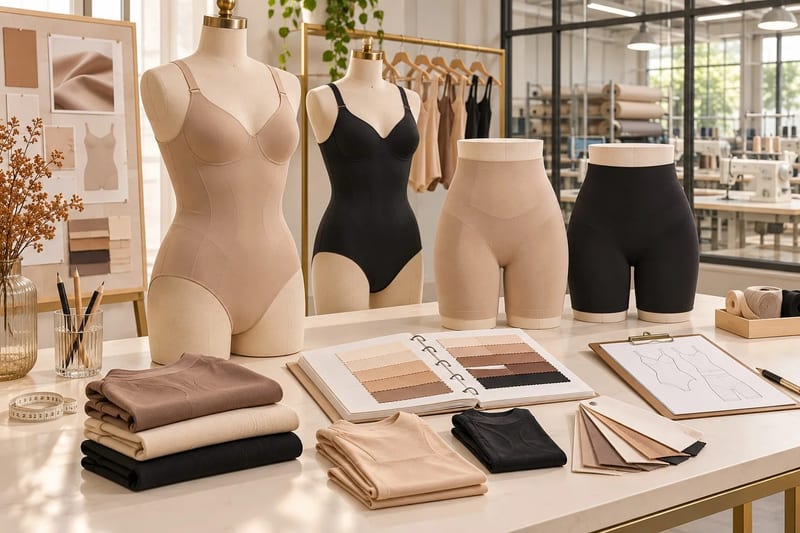
Quick Answer
A shapewear manufacturer for startups should help you turn a product idea into a defined sample, quotation and production approval process. The support you need may include platform selection, material recommendations, fit and sizing discussion, branding, a manageable first-order scope and clear quality and delivery responsibilities. Ask which services are included and what the founder must provide or approve.
Compare manufacturers by their ability to explain a product-specific workflow, not only a low MOQ or a long service list. A useful proposal identifies the garment, development route, sample deliverables, quantity conditions, price scope and next approval. Manufacturing support can reduce uncertainty in product development; your customer research still has to establish demand.
What Support Should a Shapewear Manufacturer for Startups Actually Provide?
Begin with a diagnosis of what is missing from your project. One founder has a customer audience but no garment reference. Another has a sample but no size strategy. A third has a detailed design and needs production. These buyers do not need the same package, even if all three are starting their first brand.
Ask the manufacturer to connect its proposed work to your next buying decision. Product-selection help should lead to an identifiable platform. Material advice should lead to comparable sample options. Development support should lead to a revised garment and specification. General encouragement is useful communication, but it is not a technical deliverable.
The S-SHAPER OEM/ODM service page presents both manufacturing from a client design and supplier-assisted concept development, alongside support for emerging brands. That provides relevant service categories to discuss. Confirm which people, files, sample rounds and approvals the proposal for your project actually includes.
Expect clear boundaries. A manufacturer may prepare technical information, but the founder must approve the customer proposition and final product. A supplier may advise on quantity, but it cannot guarantee your sell-through. The best startup support makes responsibilities explicit so neither party assumes the other has completed an important task.
Write a support map before comparing quotations. For each need, name the deliverable, provider, founder input and approval record. This prevents a lower-priced proposal from appearing equivalent when it leaves more work to you. It also helps a small team decide where outside technical or logistics expertise is still required.
| Startup need | Useful supplier deliverable | Founder input |
|---|---|---|
| No selected product | Relevant platform options | Wearer and use case |
| No technical pack | Defined development/specification scope | References and approval decisions |
| Uncertain materials | Comparable options and identifiers | Desired feel and trial feedback |
| Own-label presentation | Branding proof and component scope | Final artwork and brand requirements |
| First production order | Written quantity, quality and delivery proposal | Approved version and buying decision |
Ready-Stock Supplier vs Private-Label Partner vs ODM Manufacturer: What Changes?
A ready-stock supplier can be useful when an available product already suits the test. Confirm the exact item, quantities and whether branding changes are permitted. Do not assume stock availability means the product is appropriate for your audience or that the same version will remain available indefinitely.
A private-label partner adds your brand presentation to a suitable platform under an agreed scope. Ask what labels, packaging and product adjustments are offered. Branding an existing style does not automatically create an exclusive pattern. If uniqueness or territorial restrictions matter, discuss them explicitly rather than inferring them from the phrase private label.
An ODM manufacturer can help develop an idea or modify a platform more deeply. The S-SHAPER customization page provides examples of material, color, logo and labeling options to discuss. Identify which changes require sampling, sourcing or different order conditions. A broad options list does not establish that every change is feasible at the smallest quantity.
Choose the least complex route that can genuinely meet the wearer need. A founder without technical experience may benefit from an established platform with scoped modifications. A distinctive fit issue may justify deeper development. The right route follows the product requirement and available evidence, rather than a belief that maximum customization always creates the strongest brand.
| Route | Starting point | Support to confirm | Main limitation to examine |
|---|---|---|---|
| Ready stock | Available existing item | Product data and order handling | Fit suitability and continuity |
| Private label | Existing platform under your brand | Artwork, components and permitted changes | Shared underlying design and component minimums |
| ODM | Concept or development changes | Design proposal, samples and specifications | Revision work and development dependencies |
| OEM | Defined buyer design | Manufacturing interpretation and production | Completeness of client technical input |
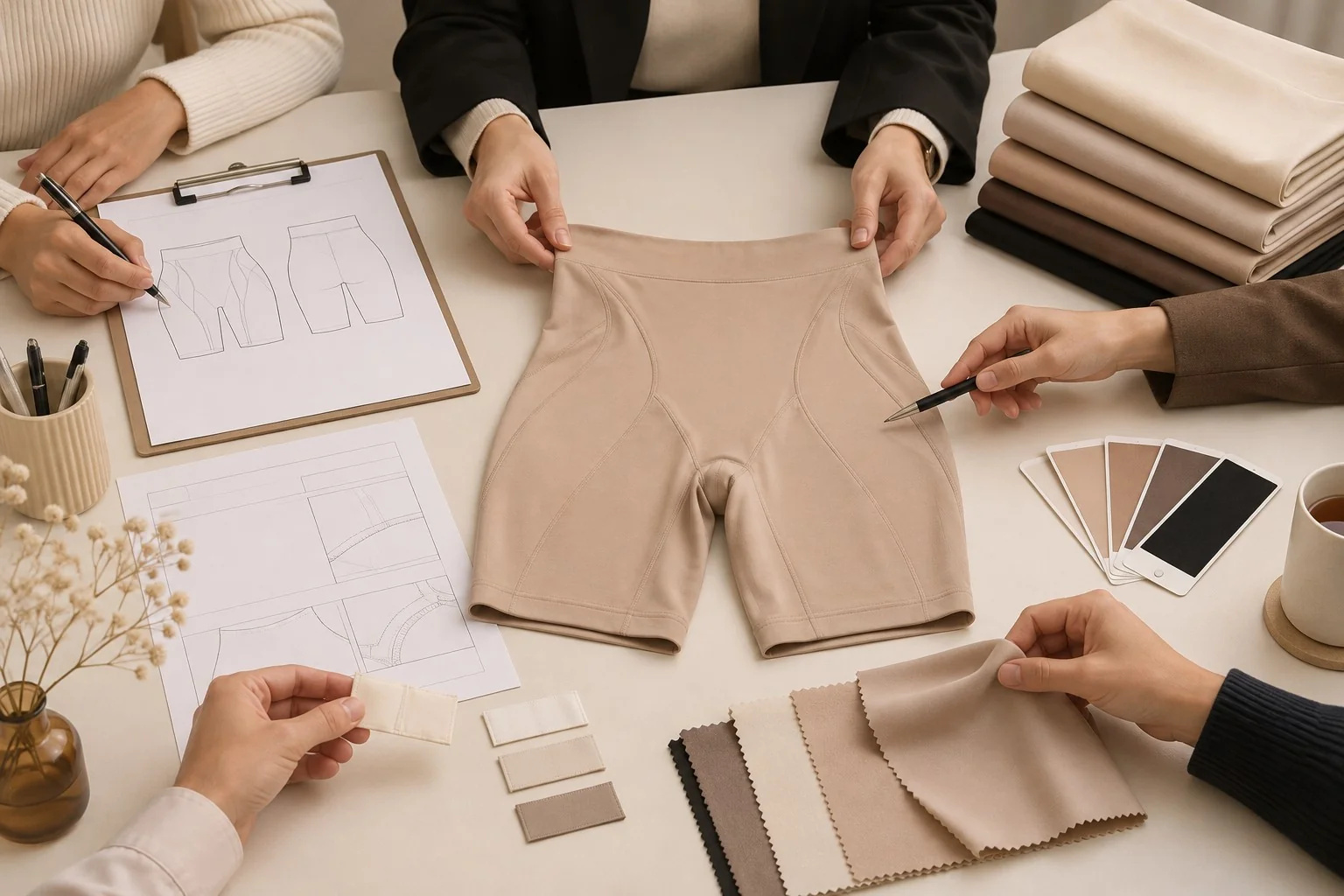
Illustrative supplier collaboration. Identify the sample and technical records your startup needs.
Which Sample, Fit and Technical Documents Should a Startup Request?
Ask what the first sample represents. It may demonstrate an existing platform, a material option or a proposed development change. Those are different purposes. The sample should have an identifier, size, material reference and explanation of any difference from the intended production version.
Request the measurement chart and method. Separate body measurements from finished-garment measurements, and clarify which points are measured flat or under a defined stretch method. For a bodysuit, torso length and closure position may matter as much as the waist. For shorts, rise, inseam and leg opening deserve their own review.
Define how fit comments become a revision. Send a numbered list with photographs, measurements and observed use conditions. Ask the developer to respond point by point and identify the next version. Scattered feedback makes it difficult to establish whether the sample actually addresses the original problem.
Review more than appearance. Use relevant sitting, walking, dressing and outerwear tests, followed by the intended care routine. Choose testers representing the measurements your product claims to serve. Discuss which sizes need physical verification rather than assuming one mid-size fitting proves the entire range.
Before production, preserve the final specification and approved reference. Confirm who holds each record and what happens if a material or component becomes unavailable. A startup-friendly manufacturer should be able to explain the approval path clearly, even when the founder needs help understanding the technical vocabulary.
How Should Startup Manufacturing Support Be Reflected in a Channel Price Comparison?
Compare what a new brand must still do after paying for the product. Consumer offers include access to an existing seller’s assortment and presentation, while a standard B2B garment offer can leave technical preparation, branding or customer support outside the price. The channel table provides context for that distinction; it does not price every manufacturing service a founder needs.
| Channel / buying model | Observed USD per garment | Product and order basis |
|---|---|---|
| Amazon US retail bodies | $12.38–$35.14 | Seamless/lighter bodies $12.38–$19.99; Structured bodies $35.14–$35.14. |
| Brand DTC bodies | $29.99–$148.00 | Seamless/lighter bodies $29.99–$78.00; Structured bodies $69.00–$148.00. |
| TikTok Shop US bodies | $21.99–$54.99 | Seamless/lighter bodies $21.99–$46.99; Structured bodies $39.99–$54.99. |
| B2B advertised OEM bodies | $4.25–$8.30 | Rihope/Shangyou garment offers; listing MOQ 600/100; own-design terms reconfirmed |
| B2B custom shiny-fabric example | $22.00–$23.00 | Hucai FOB garment example, MOQ 200; a different fabrication; development fees unconfirmed |
US-facing USD single-garment observations reviewed November 10, 2026; variants, retail promotions and shipping/tax differ. Amazon uses May–October 2026 tracker snapshots, not live November checkout. These selected samples are not industry averages or matched constructions. B2B advertisements are not landed costs or final custom quotes. Deeper development needs separate specifications, deliverables and an itemized quotation.
Separate an existing-platform trial from private-label application and deeper ODM work. B2B generally offers a lower piece price at an agreed quantity, but the support needed to create an approved product remains a scope question. Independent brand premiums may reflect development and selling investment that your startup also has to make. Ask S-Shaper which specialists, sample records and preparation are included, and quote missing work explicitly. Evaluate the complete first-order commitment rather than selecting a supplier because its ready-goods tier is below a consumer promotion.
The advertised OEM and shiny-fabric garments are different specifications, not development packages. Seamless stock, structured fajas and deep customization require separate scope confirmation.
What Quality, Communication and Delivery Support Should Be Written Down?
Ask the manufacturer to translate its quality process into checks for your garment. The S-SHAPER quality-assurance overview describes a process that can frame questions about materials, construction and finished goods. Your order still needs the relevant measurements, appearance criteria, labeling checks and reference documents.
Confirm the inspection arrangement early. If you use an independent inspector, agree access, timing, scope and how findings are resolved before dispatch. If the factory performs the checks, ask what records will be available. Do not treat a website logo or general assurance as independent evidence for the specific goods you are buying.
Set a communication structure with one current specification and revision log. Identify who consolidates founder feedback, who coordinates development and who provides production updates. Ask what information is needed for each approval and what happens when an input is late or a change is proposed.
Discuss dispatch support through the S-SHAPER supply-chain and logistics page. Confirm the destination, transport method, packing information and delivery responsibilities for your order. Public lead-time ranges do not establish a guaranteed arrival date, particularly when development, buyer review and receiving are outside the production stage.
Preserve documents in a shared order record: approved version, quote, quantity split, artwork, inspection arrangement and shipping handoff. This gives a first-time founder a practical way to manage the relationship without relying on memory or a long message history.
Which Shapewear Manufacturers Should You Consider for Your Startup Support Needs?
Compare shapewear manufacturers in China, the USA, Portugal and Canada for startup manufacturing support. The recommendations below connect country-level capabilities with specific suppliers and the work your brand needs.
China Shapewear Manufacturer: Connect Advice with Manufacturing and Export Responsibilities
China shapewear manufacturers with design-to-export specialists can address connected startup gaps; identify the proposed material advice, sample record and production responsibility before valuing the support package.
Recommended China Supplier: S-Shaper
S-SHAPER describes specialists across design, production, QA and export, with material and style recommendations and experience serving several international customer regions. For an emerging own-label business, that offers a relevant conversation about selecting a platform, making essential changes and preparing a production reference. Ask which specialist will answer each unresolved product question.
Factory-direct quantity tiers provide a benchmark, while small-order statements depend on the item and customization. Clarify the sample, documentation and component scope before comparing the offer with another route. This option suits a startup needing connected development and manufacturing support. Market experience can inform recommendations, but the team’s advice still needs to be checked against your audience’s fit trials and commercial evidence.
Source: S-SHAPER OEM/ODM and global-brand support.
USA Shapewear Manufacturer: Obtain B2B Help Selecting a Resale Assortment
USA shapewear manufacturer proposals involving wholesale support may help select a finished assortment; founders needing fit redevelopment should distinguish that service from retail supply and replenishment assistance.
Recommended USA Supply Partner: Vedette
Vedette’s wholesale program describes catalogue style and size selection plus dedicated B2B support. That support can be relevant to a founder who already has a retail audience but needs finished products to curate. Ask the representative about actual availability, stock location and replenishment for the selected range instead of requesting an undefined new design.
The support model is not evidence of US production, an OEM service or permission to replace labels. A founder needing a revised garment should confirm another scope before comparing it with development proposals. This route suits a wholesale retail launch with accurate fitting guidance. It reduces certain development tasks while preserving the need for sample review, product knowledge and clear resale terms.
Source: Vedette US-facing wholesale program.
Portugal Shapewear Manufacturer: Match Research Support to a Technical Product Need
Portugal shapewear manufacturer research teams can address specific textile or construction uncertainties; define the technical evidence required rather than expecting development expertise to determine the brand concept.
Recommended Portugal Supplier: Impetus
Impetus describes an internal research team, external technical collaboration and seamless and cut-and-sew development. This can be relevant when the startup’s missing capability concerns textile or construction differentiation rather than simply choosing a style. Ask what technical question the proposed work will answer and what evidence the founder will receive.
The source does not establish beginner acceptance, development pricing or minimums. A research-heavy route may involve material and laboratory commitments beyond a standard platform. It suits a founder with a defined technical brief and resources for scoped investigation. Do not treat research expertise as a substitute for deciding who the product serves or what improvement customers should experience.
Source: Impetus research and development.
Canada Shapewear Manufacturer: Add Pattern and Grading Communication Where Needed
Canada shapewear manufacturer arrangements with local pattern and grading work can strengthen technical communication; confirm the revision deliverable and overseas handoff before comparing the coordination support.
Recommended Canada Development Partner: Hertex
Hertex locates design, pattern work, grading and quality control in Montreal and manufacturing in China. That model is relevant when a founder needs someone to translate observations into technical changes and maintain a coherent size record. Ask how the technical team would work with your existing brief and who acknowledges each revision downstream.
Confirm startup suitability and the cost and boundaries of the proposed service. The arrangement does not prove domestic manufacture or immediate stock availability. This route fits a brand with a meaningful fit-development requirement and a need for structured technical communication. Compare the actual deliverables against factory-led ODM support rather than assuming that either local access or direct manufacture automatically supplies more expertise.
Source: Hertex Montreal development with China production.
Select the support model that closes your next approval gap, then assign the remaining product, market-validation and commercial decisions explicitly to the founder.
What Should You Put in a First RFQ to a Shapewear Manufacturer?
Send one version of the brief to each suitable candidate so the replies can be compared. Include your intended country, wearer and use case, garment reference, desired changes, size and color direction, approximate quantity, branding needs and target receiving window. Mark unresolved items instead of guessing technical details.
Ask for a response organized around the sample route, technical deliverables, applicable minimums, quotation inclusions, approval milestones and dispatch responsibilities. Request the information needed for the next decision first. A founder selecting a platform needs a different response from a buyer ready to release a finished technical pack.
Use an evaluation matrix to identify missing evidence. The following equal-weight framework is an editorial tool, not a supplier ranking or certification. Score each of five areas from zero to four for a maximum of 20, and record the evidence behind every score. A high total should not override a critical unresolved fit or quality issue.
| Illustrative evaluation area | Evidence to examine | Maximum points |
|---|---|---|
| Product fit for the brief | Relevant platform and sample response | 4 |
| Development clarity | Defined documents, revisions and approvals | 4 |
| Commercial completeness | Product-specific quantities, quote and exclusions | 4 |
| Quality and repeatability | Reference, checks and change-control process | 4 |
| Communication and handoff | Named roles, updates and dispatch responsibilities | 4 |
Before choosing, compare the unresolved conditions as carefully as the scores. Ask the strongest candidates to clarify those conditions in writing. The useful result is not simply a preferred factory name; it is a product and service scope that your startup can understand, approve and manage.
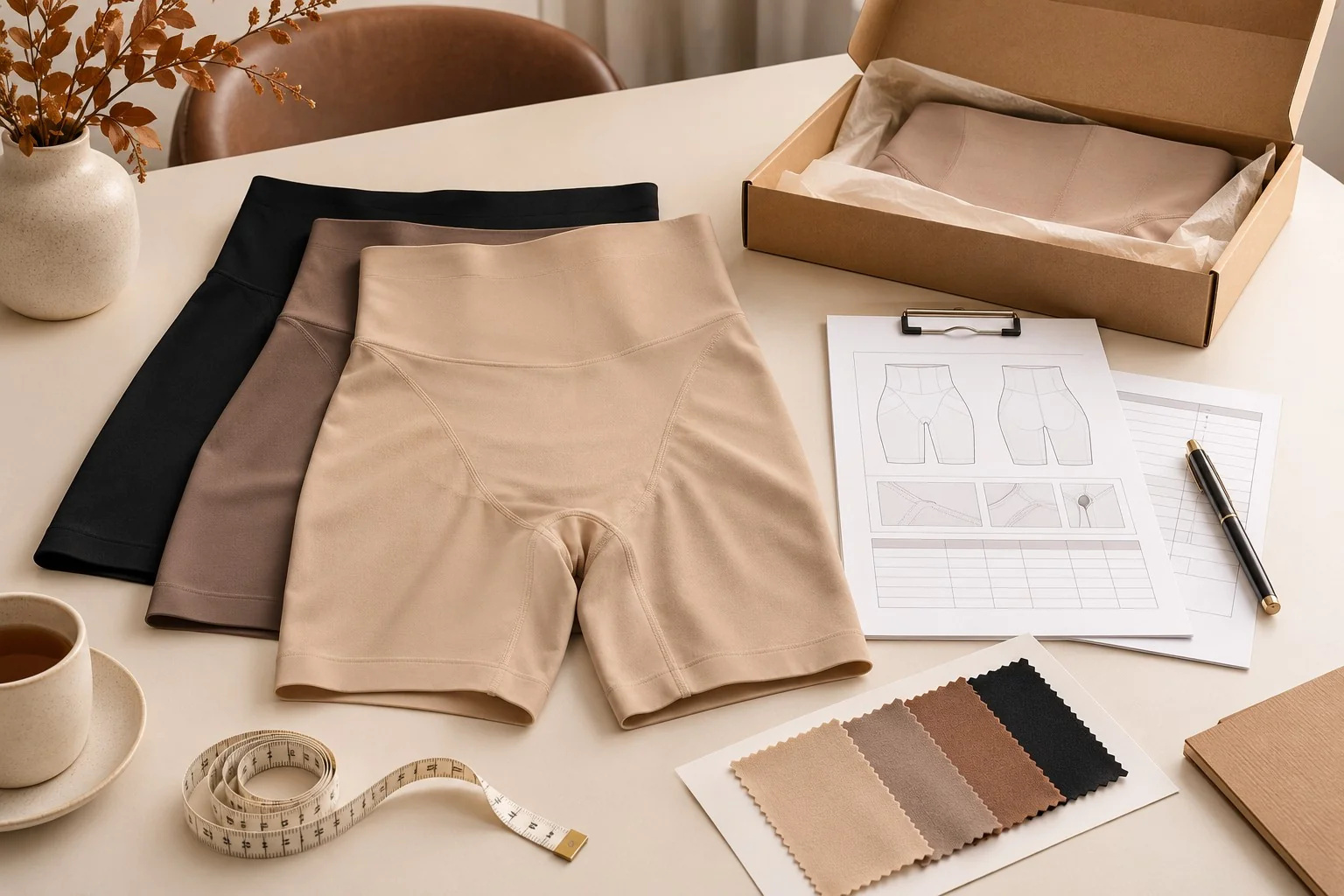
Illustrative proposal review. Discuss your first RFQ with the S-SHAPER team.
What Makes S-SHAPER a Relevant Manufacturing Option for Startup Brands?
S-SHAPER’s public offering connects a shapewear catalogue with OEM, ODM, customization and manufacturing support. Its service page explicitly includes emerging brands, and its factory information identifies production in Dongguan, China. The website provides concrete starting references for a startup conversation; the item-specific proposal establishes the work and conditions for your own project.
Use the factory introduction and product pages to prepare a focused inquiry. Ask the team to recommend a route based on your existing materials: a rough concept, an available reference, a tested sample or a defined technical pack. Confirm the development deliverables, size and branding work, order conditions and approval records.
Then contact S-SHAPER with your first RFQ. Evaluate its response against the same evidence framework used for other candidates. A useful partnership begins with clear responsibilities and a feasible next sample, while customer validation and the final brand promise remain decisions for your business.
FAQ: Manufacturing Support for Startups
What should a shapewear manufacturer for startups help with?
Depending on the agreed scope, support can include product-platform selection, ODM development, material recommendations, samples, specifications, branding and production coordination. Ask for the actual deliverables and approvals. A service list alone does not tell you which work is included in your quote.
Can a small business work directly with a manufacturer?
Potentially, when the product, quantity and development needs fit the supplier’s program. Confirm minimums per style, color, size and branded component. A direct relationship still requires clear product decisions and may need outside technical or logistics support.
Does a 10-piece testing option cover a fully custom design?
Do not assume that. S-SHAPER’s FAQ mentions an initial item-testing option, while product pages show different quantity tiers. Confirm the selected garment, customization and component conditions in writing before treating any small-order statement as applicable to your project.
How do I compare manufacturing support fairly?
Use the same brief and ask each supplier to identify the sample route, deliverables, minimums, quote scope, quality checks and delivery responsibilities. Compare missing evidence as well as price. A cheaper offer may leave more development or coordination work with the founder.
What should I send in my first inquiry?
Send the target wearer and country, product reference, desired changes, size and color direction, approximate quantity, branding needs and receiving target. Identify what you do not yet know. Ask for a scoped next step rather than requesting an unsupported all-in price for an undefined collection.