 EN

Quick Answer
Discuss shapewear manufacturer payment terms as a sequence of defined commitments: sample or development work, product approval, production release, inspection, balance confirmation and shipment. Ask what each payment authorizes, which evidence must be available first and what conditions remain open. Do not assume a universal deposit percentage or that a public unit price establishes the schedule.
Keep commercial payment milestones separate from technical approval and logistics responsibilities. A transfer for development does not automatically approve an unresolved garment for production. A shipping term does not by itself set the deposit or balance date. Build a written confirmation table tied to the current specification, quotation and responsible parties before authorizing work.
What Should the First Payment Actually Authorize?
Identify the work before discussing the amount. A payment may fund an existing sample, development activity, branded-component preparation or production of an approved garment. These stages have different prerequisites. Ask the supplier to state the deliverable and starting conditions so a founder can understand what is being committed.
Choose a reference through S-Shaper’s product catalogue or identify the current design and version. State whether materials, measurements, construction and artwork are approved. If technical work remains, review the OEM/ODM service scope and ask which documents and samples will make the garment ready for release.
Keep planning quantities distinct from confirmed order quantities. A preliminary inquiry can contain a useful scenario without authorizing inventory. Before a production payment, ask the supplier to acknowledge the current style, color and size matrix and applicable component conditions. The payment record should refer to that scope rather than a vague collection name.
Where several providers are involved, identify who receives the payment and who supplies the work. A technical partner, factory and logistics provider may have separate arrangements. Preserve those relationships in the cost and milestone record so the founder does not assume one payment covers activities another party still expects to quote.
| Possible payment purpose | Input to identify | Evidence that defines the commitment |
|---|---|---|
| Sample supply | Exact item, size and purpose | Sample proposal |
| Development | Brief, deliverables and revisions | Scoped development offer |
| Components | Approved artwork and quantity | Component proposal and proof |
| Production | Approved product and matrix | Current order scope |
| Delivery service | Route and handover responsibilities | Relevant logistics proposal |
Which Technical Approvals Should Remain Separate from Payment?
Confirm who signs off fit, materials, measurements and branded components. Paying for a sample does not show that the sample is suitable. Paying for development does not mean the resulting specification is already approved. The supplier and founder should share a clear understanding of which product decisions remain open at each stage.
Use physical evidence where the question requires it. A photo can help discuss appearance, but it cannot establish every wearing characteristic for the intended audience. Identify the sample version and the relevant trial tasks, then preserve the resulting approval or revision record. A rushed payment date should not quietly remove that evidence requirement.
Discuss changes through the customization service scope. A new material, closure or measurement after quotation can affect both preparation and production. Ask what additional work is proposed, how it changes the amount or schedule and who must authorize it. Keep superseded files outside the live production instruction while preserving their history.
Agree a substitution process. If an input becomes unavailable, identify the alternative and the decision needed before use. The commercial milestone can remain conditional on that approval. This gives the founder a practical way to manage uncertainty without assuming every change is included or that a prior transfer authorizes any technically different product the supplier considers similar.
Payment Milestones vs Production and Shipping Terms: What Does Each Control?
A payment schedule identifies the agreed commercial timing and purpose of transfers. A production schedule identifies work stages and dependencies. A logistics term identifies responsibilities within its applicable scope. These can interact, but one should not be treated as a complete substitute for the others.
The U.S. International Trade Administration’s Incoterms overview explains that those rules allocate tasks, costs and risks for logistics responsibilities. It explicitly notes that they do not determine payment method or timing and do not cover every sale condition. Confirm the chosen named place and version where relevant, then document payment milestones separately.
Review the S-Shaper supply-chain and logistics scope to identify the proposed handoff. Factory completion, dispatch and destination receipt are different events. Ask which event triggers the relevant payment under the actual proposal rather than inferring it from a shipping acronym or another founder’s transaction.
Keep the technical gate visible when the schedule changes. An accelerated production plan does not establish that an unresolved sample has passed. If the parties revise a date, update the related approval and payment conditions together. A founder should be able to explain which evidence is required and what work can begin after each acknowledged milestone.
| Record | Question it answers | What not to infer |
|---|---|---|
| Payment schedule | When and for what is money payable? | Universal percentage or automatic technical approval |
| Technical approval | Which product version is accepted? | Payment alone proves suitability |
| Production plan | When can defined work proceed? | All inputs are ready because a date exists |
| Logistics scope | Who handles specified delivery tasks? | The term automatically sets balance timing |

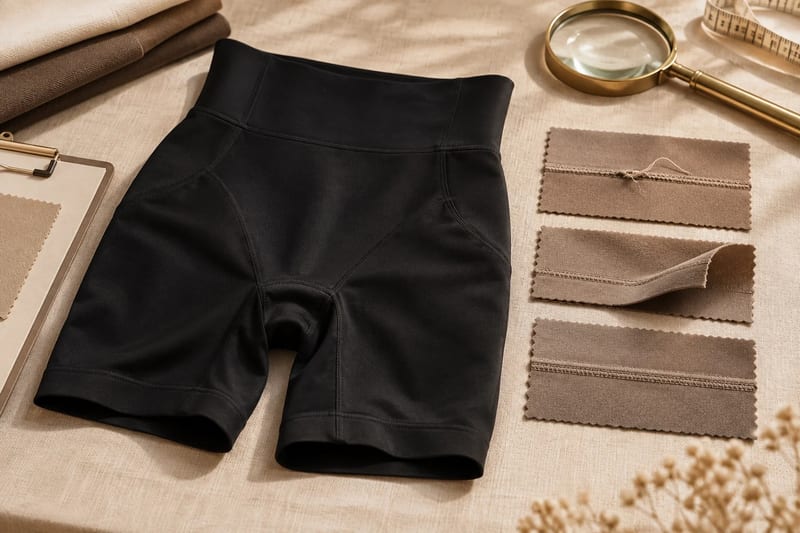
Illustrative sourcing and product-development scene. Click to continue the related buyer guidance.
How Can Four-Channel Prices Clarify the Value Covered by a Payment?
Public channel prices can help identify the difference between a retail purchase, wholesale goods and a development commitment. Keep basic seamless garments and structured shaping products separate before using any range in a payment discussion. The actual transfer should refer to an acknowledged quote and milestone, not a remembered marketplace number.
| Channel / buying model | Observed USD per garment | Product and order basis |
|---|---|---|
| Amazon US retail bodies | $12.38–$35.14 | Seamless/lighter bodies $12.38–$19.99; Structured bodies $35.14–$35.14. |
| Value/mid-tier brand DTC bodies | $29.99–$49.00 | Shapermint/Shapellx sale prices; no multi-pack or order code |
| TikTok Shop US bodies | $21.99–$54.99 | Seamless/lighter bodies $21.99–$46.99; Structured bodies $39.99–$54.99. |
| B2B small-order platform bodies | $3.18–$10.00 | Tianchen, Junmao and S-Shaper; listed minimums 5/2/10; not deep-custom eligibility |
| B2B higher-volume platform bodies | $2.50–$12.85 | Listed minimums 100–600; different garments, not a same-SKU volume discount |
B2B finished-garment prices are generally lower than consumer tickets because quantities and downstream responsibilities differ. They do not establish a deposit percentage, credit term or the work authorized by payment. Amazon and TikTok Shop promotions and B2C brand positioning can alter consumer observations without changing your supplier’s actual commercial conditions.
Ask what the first payment funds: samples, materials, components, goods or another defined activity. Reconfirm currency, validity and acceptance triggers for your specification and matrix. Development and custom procurement need their own scope where applicable. Neither a low acquisition band nor a large retail-to-B2B spread proves the amount payable before an approval or dispatch milestone.
US-facing USD per single garment, reviewed November 10, 2026. Amazon uses dated May–October 2026 third-party PriceHistory snapshots, not live November checkout. These selected-seller observations are not industry averages or matched-quality comparisons. Variants and promotions change; shipping and tax are not normalized. B2B bands describe advertised garments, not landed costs or a final custom-development quote. Sources: dated PriceHistory Amazon records, official brand/TikTok Shop pages and Made-in-China supplier listings.
How Should Inspection and Corrective Actions Relate to the Balance Milestone?
Discuss the acceptance process before the order is complete. Use the quality-assurance overview to identify the checks relevant to your garment, then agree the product-specific criteria and records. Ask which evidence will be available when the next commercial milestone is reached and how findings will be handled.
If independent inspection is planned, confirm access, location, stage and scope with the supplier and provider. Keep the appointment far enough from intended dispatch to address relevant findings. Do not assume that every service called inspection provides the same evidence or that a facility introduction replaces checking the actual finished order.
Ask how corrective work is authorized and rechecked. If a discrepancy is identified against the approved specification, preserve the finding and the acknowledged response. If the founder introduces a new requirement instead, request the revised commercial scope. Clear records help distinguish these situations without inventing a universal refund, rework or replacement policy.
Connect the agreed commercial milestone to the evidence actually negotiated. The sources here do not establish one mandatory balance rule for every buyer. A startup needs a written process it understands, including what happens when required records or approvals are incomplete. Do not resolve the uncertainty by assuming the inspection has passed because the shipping date is close.
Which Shapewear Manufacturer Routes Need Different Payment Questions?
Compare the transaction behind the country: own-label development, finished wholesale supply or technical coordination connected to overseas production. Each has different prerequisites. The following examples identify questions to confirm, not national deposit practices, guaranteed credit terms or a recommendation to pay before understanding the product and scope.
China Shapewear Manufacturer: Tie Each Transfer to the Defined Factory Scope
China shapewear manufacturers offering development and production need payment questions tied to the actual stage; a small-order statement does not establish the deposit or authorize every customization.
Recommended supplier: S-Shaper
S-Shaper’s OEM/ODM offering describes material and style advice and specialists across design, production, QA and export serving several global customer regions. Ask the team to identify the proposed platform, sample deliverables, component conditions and production prerequisites. That can make the relationship between product decisions and commercial commitments clearer.
Published quantity tiers and conditional small-order options are not a payment schedule. Confirm amounts, currency, milestones and what each transfer authorizes for the selected item. This route suits an own-label founder managing approvals and cross-border handoffs. Use the supplier’s market-informed recommendations as product advice while preserving your own sample review and written release decisions; neither advice nor payment alone proves that the garment is ready.
USA Shapewear Manufacturer: Confirm the Wholesale Transaction You Are Funding
USA shapewear manufacturer offers involving wholesale catalogues require stock and resale confirmation before payment; a local commercial contact does not establish domestic fabrication or a custom-development arrangement.
Recommended supplier: Vedette
Vedette describes style and size selection, dedicated B2B support and wholesale delivery. A retailer can ask which products are available, where selected stock is held and what the current professional-supply proposal covers. The payment should correspond to an identifiable assortment and commercial arrangement rather than an undefined expectation of garment development.
Confirm actual dispatch conditions and permitted product presentation. Do not infer relabeling rights, credit terms or a universal B2B shipping promise from the programme description. This route suits a curated resale launch when an existing garment meets the wearer need. Compare it separately from an own-label factory proposal requiring patterns, sample revisions and branded components before production can be released.
Canada Shapewear Manufacturer: Separate Technical and Manufacturing Milestones
Canada shapewear manufacturer arrangements combining local technical work with overseas production can involve different approvals; identify each provider’s deliverable and handoff before combining payments into one milestone.
Recommended supplier: Hertex
Hertex describes Montreal-based design, pattern work, grading and quality control with China production. For a founder needing technical communication, ask how sample comments become a current specification and how that released version reaches manufacturing. The structure illustrates why technical preparation and production should remain identifiable stages.
Startup eligibility, charges and payment conditions are not established by the reviewed description. A local office does not prove Canadian fabrication, available stock or one all-inclusive payment arrangement. This route suits a brand that values scoped technical support and can document the manufacturing handoff. Compare the complete proposal and responsibilities with factory-led development rather than assuming that proximity removes commercial or approval uncertainty.
Use the actual supplier proposal to define payment purpose and prerequisites, then preserve separate technical, acceptance and delivery records for the commitment you approve.
What Should a Payment-Term Confirmation Table Contain?
Record each milestone with the payee, currency, amount or quoting status, purpose, prerequisites, acknowledgment and supporting file version. Include who on your side can authorize the action. A table is useful when it shows the decision, not merely the dates a founder hopes production will occur.
Check entity and instruction consistency. If commercial details change or appear inconsistent, seek confirmation through an established contact route independent of the new instruction. A separate export or service entity may have an understandable explanation; preserve it rather than assuming every difference is either harmless or dishonest.
Add an open-conditions column. Some information may legitimately arrive later, but the relevant payment should not be described as fully understood while its purpose or prerequisites remain unclear. Identify who supplies the missing record and when it must be reviewed.
Before the next transfer, review the current quotation, specification, variant matrix and milestone together. The useful result is a concrete statement of what becomes authorized and what remains conditional. Payment planning can then support a disciplined first order instead of replacing product decisions with urgency.
| Confirmation field | Complete with actual information |
|---|---|
| Milestone and purpose | Sample, development, components, production or handoff |
| Payee and currency | Acknowledged commercial arrangement |
| Amount and validity | Current quote, not an assumed percentage |
| Prerequisites | Required approvals and evidence |
| Authorized scope | What can begin after acknowledgment |
| Open conditions | Owner, deadline and closure record |
How Can S-Shaper Help Clarify the First-Order Payment Scope?
S-Shaper’s catalogue and manufacturing service pages provide starting references for a defined product discussion. Share the selected garment, target wearer, proposed changes, matrix and destination. Ask the team to distinguish sample or development work from production and to identify the prerequisites for each proposed commercial milestone.
Review the published order FAQ as preliminary context and confirm actual item conditions directly. Keep public unit prices separate from payment terms, and request current confirmation when the product, components or quantity changes. A broad small-order statement should not be interpreted as a universal deposit arrangement.
To begin, request a first-order scope and payment discussion with S-Shaper. Use the response to build the confirmation table and align it with your own cash and approval plan. The objective is an understandable next commitment supported by current records, rather than a percentage copied from another project.
FAQ: Payment Terms to Discuss for Your First Shapewear Order
What payment terms should I discuss for a first shapewear order?
Ask what each payment authorizes, the applicable amount and currency, required product approvals, inspection evidence and the agreed handoff. Record current terms in a milestone table. The reviewed S-Shaper listings do not establish a universal deposit percentage or balance date.
Does paying a deposit approve the sample?
Not automatically. Define the purpose of payment and the technical approvals separately. A development transfer can precede a final garment decision, while production release needs an identified approved scope. Make the relationship explicit in the written record.
Do shipping terms determine when I pay?
Not by themselves. The official Incoterms overview cited here states that those rules do not define payment method or timing. Confirm logistics responsibilities and payment milestones separately within the actual transaction.
Should inspection be discussed before production ends?
Yes. Agree relevant criteria, provider responsibilities, access, timing and the handling of findings early enough for the process to work. Connect commercial milestones to the evidence actually negotiated rather than assuming one universal rule.
What if the payment instructions change?
Verify the explanation through an established contact route independent of the new instruction and preserve confirmation with the current quote. Clarify the commercial relationship if another entity is involved. Do not let urgency replace understanding of the payee and authorized scope.