 EN
Quick Answer
Treat a shapewear manufacturer red flag as a reason to verify or pause a specific decision, rather than instant proof that a business is dishonest. Useful warning signs include refusing an identifiable specification, unexplained entity or payment-detail inconsistencies, samples that cannot be linked to the proposed order, undisclosed production responsibilities and pressure to approve unresolved changes.
Ask for the missing evidence through an established contact route and record the response. If a critical condition remains unresolved, keep the affected payment or production approval open. A founder can reduce avoidable risk by tying every commitment to a clear garment, commercial scope and approval record instead of relying on confidence, urgency or attractive images.
Which Supplier Promises Deserve an Immediate Follow-Up Question?
Be cautious when a supplier accepts every requirement without discussing the actual garment. “Any fabric, any size, any quantity” may sound supportive, but it does not establish what is feasible at your proposed order size. Ask which platform, material and production route the statement refers to. A useful response should make the work more concrete.
Separate a marketing statement from an order condition. Fast sampling or small-order language can describe a particular service route without applying to every customized product. The warning sign is not that different routes exist; it is that the supplier cannot or will not explain which one it is quoting. Request an item-specific written scope before interpreting the promise as part of your order.
Watch for urgency replacing evidence. A legitimate deadline may exist, but the reason and consequence should be explainable. Ask what approval is needed, which file version it concerns and what happens if you need time for fit review. An expiring offer should not quietly turn an untested sample into a fully approved production garment.
Use one rule: every important promise must have a subject, starting condition and responsibility. Who will do what for which product, and when does that stage begin? If those questions remain unanswered, label the statement as unconfirmed. That is more actionable than deciding whether the salesperson sounds trustworthy.
| Statement | Follow-up question | Decision to keep open |
|---|---|---|
| Any customization is possible | Which changes qualify at this quantity? | Development route |
| Very fast delivery | Which stage and start event are covered? | Public launch date |
| No problem with quality | Which criteria and records apply? | Production acceptance |
| Pay today to secure this | What exactly does payment authorize? | Commercial commitment |
What Should You Do About Inconsistent Company or Payment Details?
Compare the supplier identity across the introduction, quotation, invoice and established contact information. A separate export or commercial entity can have a legitimate explanation. Ask for that explanation in writing and identify the contracting relationship rather than assuming that every name difference proves misconduct.
If payment instructions change or appear inconsistent, verify them through a contact route you already established independently of the new message. Do not let a hurried email become the sole basis for updating an important commercial instruction. Record the confirmation and the entity receiving payment with the relevant quotation or order.
Ask which organization is responsible for samples, production and commercial remedies. Those roles may not all belong to one entity. A clear relationship can be evaluated; a supplier that refuses to identify the responsible party leaves the buyer unable to understand the proposed arrangement. Keep the affected approval open until the scope is clear enough to review.
Limit the personal or commercial information you disclose to what the stage actually requires. A preliminary product inquiry typically needs garment and project details, not unrelated confidential records. If a request seems unnecessary, ask what purpose it serves and whether a narrower alternative will answer the question. The goal is disciplined verification of the transaction, not an accusation against a business you have not investigated.
Which Sample Problems Signal an Unresolved Product Risk?
A sample should be identifiable. Ask which size, material, construction and version it represents and whether those match the proposed production scope. If the supplier cannot connect the sample to the quotation, a good-looking garment does not tell you what you will receive in the order. Use a relevant reference from the product catalogue to anchor the discussion.
Watch for approvals based only on photographs when the main question is fit or wear behavior. A picture may show appearance but not waistband movement, torso comfort or closure use. If the supplier discourages relevant physical review without explaining an alternative suited to the question, the product decision remains unsupported.
Ask how a revision is documented. Repeatedly receiving a similar sample without a response to numbered comments can indicate a communication or development problem. Request a point-by-point answer and the version identifier for the next sample. The customization service scope should clarify which changes and additional work are actually being proposed.
Do not interpret every failed sample as a supplier red flag. Development can reveal that a platform or material is unsuitable. The more important distinction is whether the team explains the result, proposes a realistic next step and preserves the record. A transparent negative finding can support a better buying decision; an undocumented promise to fix it later cannot.
| Observation | What to verify | Appropriate next action |
|---|---|---|
| Sample ID missing | Relation to quoted product | Request identification before approval |
| Fit issue dismissed | Trial conditions and relevant measurements | Keep fit approval open |
| Revision not traceable | Response to each requested change | Request versioned change record |
| Material differs | Reason and production implications | Review the proposed version physically |

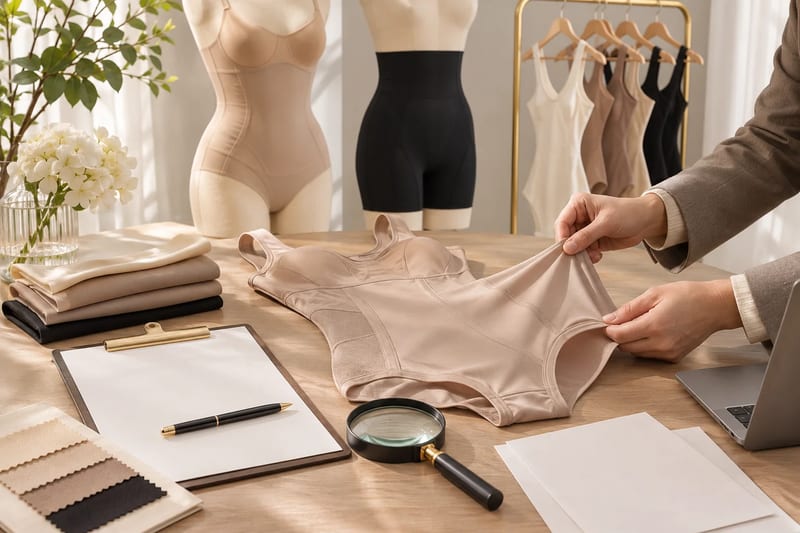
Illustrative sourcing and product-development scene. Click to continue the related buyer guidance.
Why Is Refusing a Written Specification a Serious Warning Sign?
A written specification provides the reference against which the order can be discussed. It identifies the garment’s materials, measurements, construction and branded components at an appropriate level for the project. Without an agreed record, the founder and supplier can remember different versions while both believe they are following the conversation.
The warning sign is a refusal to make essential requirements identifiable, not the absence of a highly elaborate technical pack at the first inquiry. Supplier-assisted development can begin from a concept or reference. Review the OEM/ODM service distinction and ask who will prepare the final production information before release.
Ask for a substitution process as part of that record. If a fabric or component becomes unavailable, who proposes the replacement, who evaluates its effects and who approves it? A statement that substitutions are always equivalent does not establish that the customer experience will remain the same. Relevant changes should be disclosed before use.
Keep one current file set and ask the supplier to acknowledge it. A founder can contribute to confusion by sending contradictory messages or leaving superseded artwork in circulation. Good risk control includes your own instructions. Before treating a mismatch as supplier misconduct, establish what was approved and whether both parties had the same version.
Unusually Low Quote vs Retail Promotion: Which Price Difference Needs Verification?
An inexpensive offer is a reason to check scope, not automatic evidence of misconduct. Channel prices can differ because of construction, selected variant, consumer promotion, inventory quantity or development exclusions. The table below helps identify those possibilities without defining a universal fair-price floor for every shapewear supplier.
| Channel / buying model | Observed USD per garment | Product and order basis |
|---|---|---|
| Amazon US retail | $9.99–$43.99 | Seamless/lighter bodies $12.38–$19.99; Structured bodies $34.88–$43.99; Shorts $9.99–$28.60. |
| Brand websites / B2C | $26.99–$148.00 | Seamless/lighter bodies $29.99–$78.00; Structured bodies $69.00–$148.00; Shorts $28.99–$81.00; Briefs $26.99–$38.00. |
| TikTok Shop US / B2C | $19.99–$65.98 | Seamless/lighter bodies $21.99–$46.99; Structured bodies $39.99–$54.99; Shorts $19.99–$65.98. |
| B2B existing-platform garments | $2.50–$12.85 | Seamless/body-shaping offers; listed minimums 2–600 pieces; custom scope varies |
| B2B structured bodies / fajas | $14.00–$27.42 | More elaborate body shapers; listed minimums 1–500 pieces; specification-dependent |
US-facing USD single-garment observations reviewed November 10, 2026; variants, retail promotions and shipping/tax differ. Amazon uses May–October 2026 tracker snapshots, not live November checkout. These selected samples are not industry averages or matched constructions. B2B advertisements are not landed costs or final custom quotes. Deeper development needs separate specifications, deliverables and an itemized quotation.
B2B is generally cheaper per piece because the buyer takes on more quantity and selling responsibility, while consumer brands may charge for identity, service and product investment. A structured faja can also carry a different specification from ordinary seamless smoothing. Ask S-Shaper or another candidate to identify the exact garment and work before judging the gap. If the supplier refuses to clarify a critical condition while pressing for payment, keep the commitment open. Do not accuse a business merely because its bulk number falls below a consumer discount, and do not accept it without sample and scope evidence.
Seamless bulk supply and structured fajas have different specifications. Neither B2B row establishes a final price for deep development, samples or tooling.
Which Shapewear Manufacturers Should You Consider for Supplier Due Diligence?
Compare shapewear manufacturers in China, France, Turkey and Colombia for checking supplier warning signs. The recommendations below connect country-level capabilities with specific suppliers and the work your brand needs.
China Shapewear Manufacturer: Verify What the Small-Order and Factory Claims Cover
China shapewear manufacturers promoting small orders need item-specific verification; connect the claimed minimum, proposed platform and approval responsibilities before accepting a broad factory-direct or customization promise.
Recommended China Supplier: S-Shaper
S-SHAPER describes factory-direct OEM/ODM support, material and style recommendations and specialists across design, production, QA and export serving global customers. Those are useful starting points for a documented own-label inquiry. Ask which platform the recommendation concerns and which team member owns each sample, quality and production decision.
The caution is expanding a conditional testing or small-batch statement into a promise of full customization at the same minimum. Public product tiers also require their actual quantities and exclusions. This route suits a startup that can keep the brief and approvals identifiable. Verify the exact item and change scope rather than treating either China sourcing or a factory-direct claim as proof of dishonesty or automatic safety.
Source: S-SHAPER OEM/ODM and global-brand support.
France Shapewear Manufacturer: Check Which Design and Commercial Program Is Offered
France shapewear manufacturer design presentations should identify the actual commercial program; distinguish an available occasion garment from funded adaptation before relying on an elegant concept or unquoted packaging.
Recommended France Supplier: Gilsa Paris
Gilsa Paris describes professional resale and own-label development for invisible lingerie, including occasion-led solutions. A convincing design presentation should lead to questions about the actual garment, required adaptation and approval sample. Ask whether the proposal is for finished stock, a revised platform or specific development.
Own-label minimums are product-dependent and the reviewed source does not publish your development price. A polished concept is not evidence that all design work and packaging are included. This route suits an occasion-focused brief when the proposed sample solves the outfit problem. Keep commercial scope visible and avoid assuming French service proves every garment’s origin, exclusive ownership or a superior fit without physical verification.
Source: Gilsa Paris professional resale and own-label development.
Turkey Shapewear Manufacturer: Test the Product Behind the Integrated-Facility Description
Turkey shapewear manufacturer facility claims warrant product-level checks; inspect material identity, opacity, recovery and grading rather than treating integrated production or an attractive quote as sufficient evidence.
Recommended Turkey Supplier: SML Seamless
SML’s documented Turkish yarn-to-packed facilities and private-label shapewear offering provide a meaningful production claim to investigate. Ask which stages your product would use, how yarn and finish are identified and who communicates changes. Relevant technical explanation is more useful than unrelated images of large facilities.
The reviewed source does not establish universally low minimums or the cheapest offer. A low quotation should be checked for material, opacity, recovery, grading and color-batch scope, without attributing presumed quality problems to the country. This route suits a seamless product with a traceable sample and production record. An unresolved specification deserves clarification regardless of how impressive the facility or how attractive the unit price appears.
Source: SML Seamless integrated private-label manufacturing.
Colombia Shapewear Manufacturer: Verify the Rights Behind an Established Shaping Range
Colombia shapewear manufacturer ranges can support legitimate specialist wholesale, while remaining unsuitable for an unconfirmed own-label plan; verify branding rights and the selected garment before committing.
Recommended Colombia Supplier: Leonisa
Leonisa identifies Colombian manufacturing and an international wholesale program. That can provide a credible specialist finished-product route, but the buyer still needs terms for the selected assortment. Test the garment’s materials, closures, coverage and support feel with the intended users rather than assuming every item fits a national shaping stereotype.
A claim that wholesale supply automatically includes your own labels or a custom pattern needs separate evidence; the reviewed sources do not establish those services. Confirm what the payment purchases and what presentation is permitted before building an own-label launch around it. This route suits a specialist retailer when commercial rights and supply are clear. A legitimate finished-product program can still be the wrong arrangement for a brand requiring its own revised garment.
Source: Leonisa Colombian manufacturing and shaping product range.
Pause the affected commitment when a critical claim remains unverified; suitability should follow documented scope and product evidence, not reassurance or suspicion based on country alone.
When Should You Ask for Clarification, Pause or Reject a Supplier?
Classify the issue by consequence. An incomplete product description may be resolved through a clearer brief. An unexplained payment inconsistency requires a different verification step. An unapproved material change can affect product acceptance. Identify the decision at risk and the evidence that could close it, instead of assigning the same severity to every question.
Ask for a specific correction with an owner and response date. If the supplier provides a coherent explanation and relevant records, update the assessment. If the answer avoids the question, contradicts earlier evidence or leaves a critical condition unresolved, keep the affected approval paused. Document the reason so another person can understand the decision.
Use the quality-control overview to prepare order-specific questions and the logistics discussion to clarify the dispatch handoff. Do not treat those public pages as proof that your own arrangement is already confirmed. The important result is an acknowledged scope and a process for handling findings.
Reject or redesign the arrangement when an essential requirement cannot be met, even if no wrongdoing is established. A supplier can be legitimate and still be unsuitable for your garment, quantity or support needs. A startup’s goal is a manageable product relationship, not proving that every rejected candidate is a bad business.
How Can You Evaluate S-SHAPER Using the Same Evidence Standard?
S-SHAPER publicly presents OEM/ODM, customization, product and factory information that can support an initial review. Apply the same verification questions to its proposal as to any candidate: identify the product, work included, production route, approvals and commercial conditions. Website visibility is a starting point for inquiry rather than a replacement for that process.
Provide the target wearer, garment reference, desired changes, size range, destination and approximate quantity. Ask the team to identify the sample route and respond to the specific uncertainties in your brief. Review the published FAQ but confirm which item and customization conditions apply to your own order.
Then contact S-SHAPER for a documented sample and quotation discussion. A useful exchange should make the open decisions clearer and produce records you can review. Keep the final approval with your brand, and judge the response by its relevance and consistency rather than by untested promises.
FAQ: Shapewear Supplier Red Flags a New Founder Can Check
What are the main shapewear manufacturer red flags?
Useful warning signs include refusing an identifiable specification, unexplained entity or payment inconsistencies, untraceable sample revisions and pressure to approve unresolved changes. Each should lead to a specific verification action. A warning sign is not automatic proof that the business is dishonest.
Is a low price proof of a supplier scam?
No. First align the garment, quantity, materials, branding and delivery scope. An incomplete or different offer can explain a low number. If the supplier refuses reasonable clarification, keep the commercial decision open and reconsider whether the arrangement is manageable.
Should I reject a supplier after one failed sample?
Not necessarily. Development can reveal a genuine technical problem. Evaluate whether the supplier documents the result and proposes a clear next step. A persistent inability to identify versions or respond to the actual fit issue deserves more concern than a transparent unsuccessful test.
What if payment details change?
Verify the change through a contact route already established independently of the new instruction. Ask the supplier to explain the entity and relationship in writing. Preserve the confirmation with the current quotation before acting on an inconsistent commercial instruction.
When should a startup stop the process?
Stop or revise the arrangement when a critical product or commercial condition remains unresolved or cannot meet your requirements. Document what is missing and what would be necessary to continue. You do not need to establish misconduct to decide that a supplier is unsuitable.