 EN
Quick Answer
A useful shapewear manufacturing cost breakdown separates the defined garment from development, branded components, quality work and delivery. Within the garment, material choice, coverage, construction, trims, finishing and order quantity can affect the quotation. Ask which change affects the supplier’s actual price rather than inventing percentages for its internal labor or fabric costs.
Use the multi-seller four-channel observations below to distinguish consumer price positioning from B2B acquisition. Keep basic seamless and structured garments separate, and obtain a current quote for your actual specification. Neither a retail ticket nor an advertised bulk band discloses the factory’s fabric, labor or profit percentages. Ask which controlled change affects the real proposal before deciding where costs can be reduced.
Which Costs Belong in a Shapewear Manufacturing Breakdown?
Define the physical product before dividing the quotation. A shaping brief, seamless short and built-in shaping dress have different coverage and construction. Select a reference from S-Shaper’s product catalogue and identify the exact version, size range and essential changes. Without that baseline, a breakdown may describe a garment you are not buying.
Separate recurring garment supply from work that prepares the product. Pattern development, sample revisions, artwork preparation or component setup may be quoted separately or included under specific conditions. Ask the provider to identify the treatment. A service called free does not establish that its cost has disappeared from the commercial arrangement; it establishes only the scope the provider has offered.
Then identify branded components and the delivery boundary. Labels, packaging and related minimums can create commitments beyond finished units. Freight and receiving do not become manufacturing operations merely because the supplier coordinates them. Keep each category visible so the factory quote can be compared with a complete order budget later.
Ask for enough detail to make a decision without demanding proprietary accounting. The supplier may not disclose its payroll, overhead allocation or margins. You can still request which requirements drive price, which services are included and what would cause repricing. The goal is a usable buying record, not a fictional reconstruction of the factory’s books.
| Category | Clarify with provider | Decision it supports |
|---|---|---|
| Garment supply | Specified material, construction and quantity | Product comparison |
| Development | Deliverables, samples and revisions | Preparation budget |
| Brand components | Setup, quantities and application | Presentation commitment |
| Quality work | Included checks and separate inspection | Acceptance scope |
| Delivery | Handover and destination responsibilities | Complete order budget |
How Do Material, Coverage and Construction Change the Quote?
Ask what material the proposed price actually covers. Composition alone does not identify every aspect of feel, recovery, opacity or finishing. Confirm the fabric reference, relevant specification and whether the approved sample uses the proposed production material. If the supplier offers an alternative, compare its actual sample and quotation instead of assuming a cheaper fiber description produces an equivalent garment.
Coverage affects the physical design, but the source pages do not establish a universal cost per square meter or an exact fabric share of the unit price. A longer short or full bodysuit can introduce additional material and construction decisions. Ask which of those decisions changes the supplier’s proposal and how it affects the wearer benefit you intend to preserve.
Paneling, bonding, closures, straps and edge treatments can add different operations or components. The important question is whether a detail solves the customer problem. A more complex garment is not automatically better, while a simplified construction is not automatically acceptable if it removes the support, coverage or convenience the customer needs.
Discuss alternatives through S-Shaper’s material and product customization service. Ask the team to distinguish essential functional construction from optional visual details. Request revised samples where a change could affect fit or comfort. Savings are meaningful only when you know what changed and what remained within the approved requirement.
Unit Price vs Total Project Cost: Which Number Should You Compare?
The unit price answers what a defined quantity of garments costs under the quoted scope. Total project commitment also includes any separate preparation, components, inspection and handoff services needed to complete the order. These are connected numbers, but they answer different questions. A startup can accept a lower unit price while committing more cash overall.
Use the OEM/ODM service scope to clarify development responsibilities. An OEM quote assuming a complete technical pack is not directly equivalent to an ODM proposal that prepares product information and samples. If you need the missing work, obtain its scope and price before concluding that the lower garment quote is more economical.
Keep the denominator stable when allocating a separate charge across units. Dividing a hypothetical setup amount by 50 units and then by 500 creates different per-unit allocations, but does not prove a factory’s actual setup cost. Label any such model as your own scenario and replace assumptions with provider quotations before using it in a commercial decision.
Compare what remains reusable. An identified specification or approved artwork can support later orders, while a color-specific component commitment may be less flexible. Ask who owns unused components and how future work is quoted. This helps you evaluate the first commitment without promising that every development expense will disappear on reorder.
| Measure | Includes | Can conceal if used alone |
|---|---|---|
| Garment unit price | Defined garment and quantity scope | Separate preparation and logistics |
| Goods value | Units multiplied by quoted unit price | Other necessary order commitments |
| Project commitment | Confirmed relevant provider charges | Unresolved costs if entered as zero |
| Modelled allocation | Assumed charge divided by selected units | A hypothetical denominator mistaken for actual factory accounting |
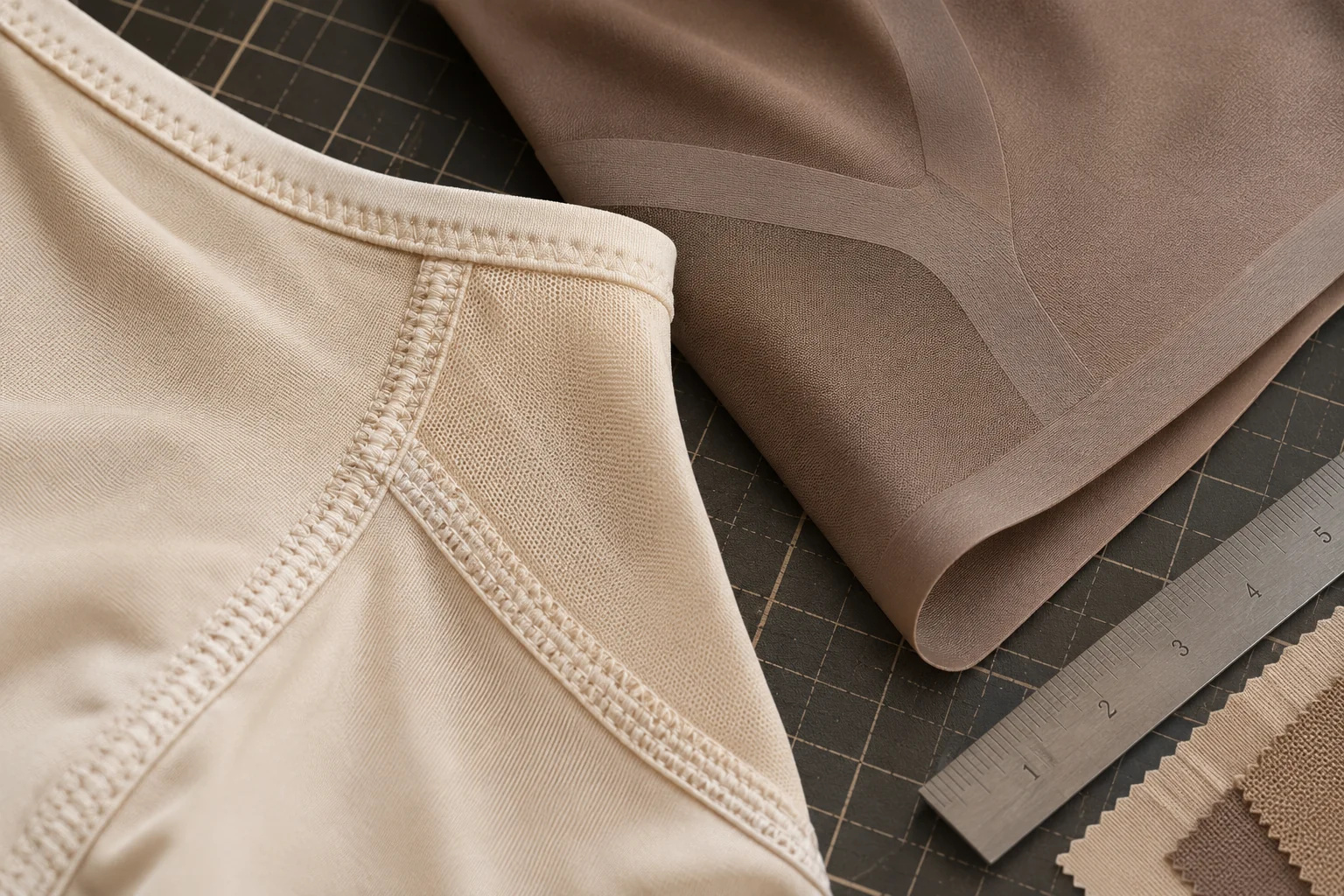
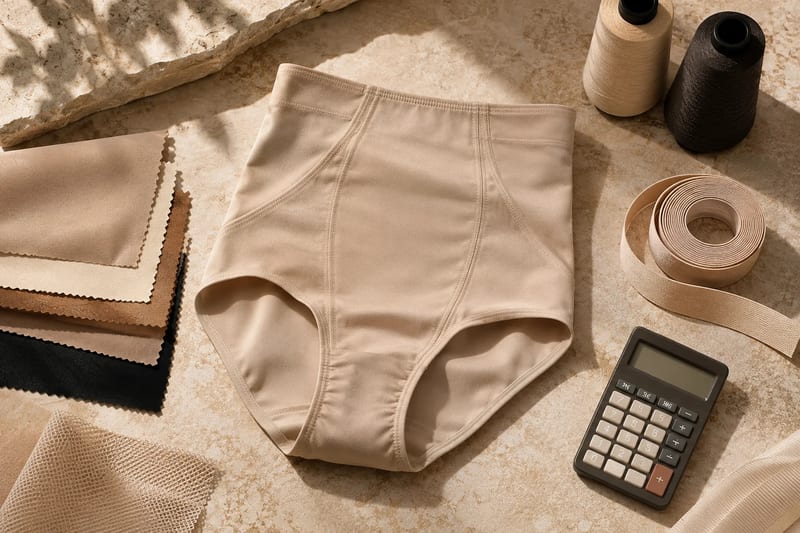
Illustrative sourcing and product-development scene. Click to continue the related buyer guidance.
What Do Amazon, B2C, TikTok Shop and B2B Prices Reveal About Manufacturing Cost?
Public selling prices are a market observation, not a disclosure of factory fabric, labor or overhead percentages. The four-channel comparison below separates simpler seamless garments from structured shaping products because construction and coverage change the physical scope. Use it to frame procurement questions rather than reverse-engineer a universal cost breakdown from unrelated retail tickets.
| Channel | Basic seamless bodysuits: USD/piece | Structured body shapers/fajas: USD/piece | Observed scope |
|---|---|---|---|
| Amazon | $12.38–$19.99 | $34.88–$43.99 | Selected variants; dated tracker offers |
| B2C brand websites | $29.99–$78.00 | $69.00–$148.00 | Basic: Shapermint/Shapellx/SKIMS; structured: Shapellx/SPANX |
| TikTok Shop | $21.99–$46.99 | $39.99–$54.99 | FeelinGirl/YIANNA selected offers; campaigns vary |
| B2B finished/platform offers | $2.50–$12.85 | $14.00–$27.42 | Multiple suppliers; quantity/brand terms vary; development separate |
B2B finished-garment offers generally sit below consumer channels, while development work, components and delivery may remain additional. Amazon marketplace and TikTok Shop promotions can reduce the displayed consumer price; B2C brand websites may support another positioning, presentation or service model. Product differences and channel costs explain part of the spread, so the entire difference is neither disclosed manufacturing profit nor pure brand premium.
Ask the factory to quote your identified material, construction, matrix and branding. To understand a cost driver, request the same platform with one controlled alternative and preserve its inclusions. The useful result is an actual supplier explanation and comparable quote, not an invented national labor share or a retail multiple applied to every garment.
US-facing USD per single garment, reviewed November 10, 2026. Amazon uses dated May–October 2026 third-party PriceHistory snapshots, not live November checkout. These selected-seller observations are not industry averages or matched-quality comparisons. Variants and promotions change; shipping and tax are not normalized. B2B bands describe advertised garments, not landed costs or a final custom-development quote. Sources: dated PriceHistory Amazon records, official brand/TikTok Shop pages and Made-in-China supplier listings.
Amazon’s official US pricing schedule lists a standard 17% referral fee for Clothing and Accessories when the total sales price exceeds $20. On a hypothetical $40 total sales price, that fee is $6.80, before advertising or fulfillment. This concrete channel charge illustrates why a consumer-to-B2B price difference is not entirely brand premium or profit; it does not disclose the manufacturer’s costs.
Confirm the applicable fee category; the total-price basis includes shipping and gift wrap where charged.
Which Decisions Should Be Frozen Before You Ask for a Firm Quote?
Confirm the product version, materials, measurements, color, size split, artwork and packaging choices at the level required for the proposal. An early estimate can legitimately use assumptions, but those assumptions should remain visible. Ask which inputs must be finalized before the supplier can provide a firm production price.
Keep an approved change list. If you alter a closure, increase coverage or request another material after quotation, ask whether the sample, minimum or price changes. A founder can create hidden cost uncertainty by keeping several versions in circulation and assuming the supplier has inferred the latest requirement from informal messages.
Preserve quality scope when examining savings. Use the quality-assurance overview to discuss the checks relevant to your construction. Removing a check without understanding the risk is not the same as simplifying an unnecessary decorative detail. Identify what evidence you still need to accept the goods after any change.
Finally, clarify the delivery boundary through the supply-chain and logistics discussion. A manufacturing comparison can remain goods-only if that is deliberate, but a launch budget needs the remaining responsibilities. Mark unquoted work as unresolved and assign an owner rather than hiding it inside a generic contingency percentage.
Which Shapewear Manufacturers Fit Your Cost-Breakdown Priorities?
Compare supplier models around the cost question your brief actually raises. Factory-led customization, integrated seamless manufacture and research-led development can involve different work. The examples below support a product-specific comparison; they do not establish national price rankings or a universal premium for any country.
China Shapewear Manufacturer: Price a Defined Platform Before Adding Complexity
China shapewear manufacturers offering factory-led development can connect material and construction choices with production pricing; ask which changes preserve the wearer benefit before evaluating optional upgrades.
Recommended supplier: S-Shaper
S-Shaper’s OEM/ODM team describes material and style recommendations with design, production, QA and export specialists serving clients across several global regions. For a startup cost breakdown, ask those specialists to separate a suitable existing platform from changes requiring further work. A direct proposal can connect the sample, approved material and actual tier to the same garment.
Current specification-matched proposals provide the relevant manufacturing input; small-order eligibility depends on the item and customization. They do not reveal the supplier’s internal fabric or labor allocation. Confirm development, component and delivery inclusions before comparing totals. This route suits an own-label founder who wants practical alternatives on one defined platform, provided each saving is checked against fit and the approved customer benefit.
Turkey Shapewear Manufacturer: Evaluate the Seamless Process Behind the Price
Turkey shapewear manufacturer options with integrated seamless operations can clarify yarn-to-finish responsibilities; compare the selected process and sample rather than attributing savings to the country.
Recommended supplier: SML Seamless
SML describes integrated Turkish private-label production from yarn through packed shapewear and activewear, with dedicated communication. If your brief is seamless, ask which knitting, color and finishing stages apply and how each material option changes the proposal. That provides a concrete production comparison instead of a broad cheap-country assumption.
The reviewed source does not establish a universal minimum, startup price or national cost advantage. Request actual yarn and color-batch conditions, then test opacity, recovery, openings and grading. Integration may clarify handoffs, but it does not prove that a cheaper option preserves the same finish. This route suits a product aligned with seamless capabilities and a founder able to compare the actual garment specification across offers.
Portugal Shapewear Manufacturer: Separate Technical Development from Garment Supply
Portugal shapewear manufacturer routes involving textile research add a distinct development scope; price the required evidence and materials separately from the recurring cost of an approved garment.
Recommended supplier: Impetus
Impetus describes research capability, technical collaborations and development spanning seamless and cut-and-sew products. That is relevant when a cost comparison includes a new material or construction result that an existing style cannot provide. Ask which prototype or investigation the proposal covers and how it will inform a production specification.
Startup acceptance, minimums and development fees are not established by the reviewed information. Research, testing and material scope may create commitments beyond existing-style supply; they do not establish a universal Portuguese price premium. This route suits a defined technical need whose evidence matters to the product promise. Compare the scoped development work honestly instead of treating it as an unexplained increase in the garment unit price.
Choose the route that makes the relevant product and preparation costs understandable, then compare the same wearer result rather than national price assumptions.
How Can You Request a Useful Cost Explanation Without Inventing Internal Percentages?
Ask the supplier to identify the main quote drivers and provide alternatives against the same brief. For each alternative, request what changes, what remains equivalent, what sample review is needed and whether quantity conditions change. This gives the founder actionable information even when proprietary internal costs are not disclosed.
Use a decision sheet with the baseline garment, proposed change, quoted amount, required evidence and approval owner. If an alternative changes the benefit, classify it as a different product proposition rather than a simple saving. Compare its fit and customer response before assuming that the lower price improves the business.
Keep arithmetic and commercial evidence separate. You can calculate tier differences accurately while still lacking a confirmed quote for your own branding and destination. State the source date and assumptions beside the calculation, then update the proposal when the specification changes. This prevents a correct spreadsheet formula from being applied to the wrong product.
Before release, ask the supplier to acknowledge the final scope and current files. The resulting cost breakdown should explain what you are buying, why the alternatives differ and which commitments remain unresolved. Its value is better product and purchasing decisions, not an apparently precise list of factory percentages unsupported by source evidence.
How Can S-Shaper Help Explain the Cost of Your Selected Style?
S-Shaper’s product catalogue and OEM/ODM offering provide concrete starting points for a manufacturing-cost discussion. Choose the reference garment, describe the target wearer and identify essential changes. Ask the team to recommend an appropriate platform and explain which decisions alter the sample, quantity conditions or quotation scope.
Review the published order FAQ as preliminary context, then confirm the actual product and variant rules. Request current prices for the selected material, construction, branding and delivery boundary. A useful response separates garment supply from additional development or component commitments rather than reducing the conversation to an unsupported universal cost per piece.
To begin, send S-Shaper a product-specific cost review request. Compare the proposed alternatives against your approved benefit and customer evidence. The goal is a manufacturable first product with an understandable commitment and a clear basis for later revisions or reorders.
FAQ: Shapewear Manufacturing Cost Breakdown for First-Time Buyers
What drives shapewear manufacturing cost?
Material choice, garment coverage, construction, components, finishing, order quantity and the work included in the proposal can affect cost. Ask for a product-specific explanation. The reviewed public listings do not disclose universal fabric, labor or overhead percentages.
Can I calculate factory margins from public prices?
No. Quantity tiers show the seller’s public price under stated conditions, not its internal cost or margin. You can calculate the unit-price difference and goods commitment, but should not label that arithmetic as disclosed factory economics.
Is a lower bulk price always a better startup choice?
Compare total inventory commitment with demand evidence and remaining cash needs. A lower unit tier can require substantially more stock. Ask whether the same material, variants and branding qualify before applying a public tier to your proposed order.
Should development costs be included in the unit price?
The commercial treatment can vary. Ask which deliverables are included, which are separately quoted and what changes trigger additional work. Keep the arrangement visible so garment-only supply is not compared as equivalent to a fuller development proposal.
What is the best next step for a first-time buyer?
Identify one reference garment and essential wearer requirements, then request a current proposal with inclusions, exclusions and change drivers. Evaluate alternatives through samples where relevant. Do not replace missing provider amounts with invented internal cost percentages.