 EN
Quick Answer
Choose shapewear fabric by the garment result you need, then compare identified samples for extension, recovery, force at relevant extension, opacity, feel and behavior after the intended care routine. Fiber composition is one input, not a complete performance specification. A fabric that stretches easily may still grow after wear, while a resistant swatch may not create a comfortable finished garment.
Ask the supplier and laboratory to agree methods, directions, conditioning and reporting units before comparing numbers. Use physical garment trials to connect the material evidence with the intended wearer. There is no universal best nylon blend, fabric weight or elastane percentage established for every first collection.
What Wearing Result Should the Fabric Brief Define First?
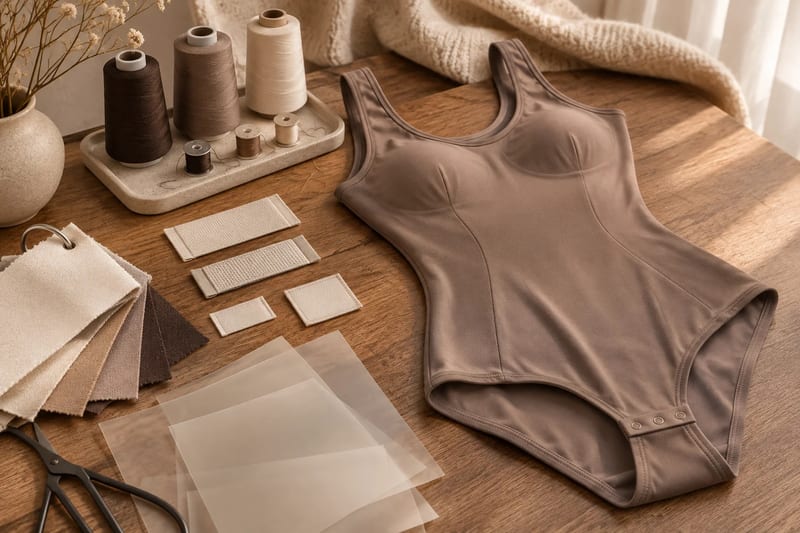
Begin with the garment and use case. Everyday shaping shorts worn during a seated day create different questions from a bodysuit under a particular neckline. Identify coverage, desired support feel, movement, contact areas and the outer clothing the garment must work beneath. A brief that says only soft and strong does not prioritize the trade-offs.
Use an identified product direction from S-Shaper’s product catalogue and separate material choices from construction. A panel, waistband, leg opening or lining can change the wearer experience even when the main fabric is unchanged. Ask which part of the sample provides the result you want before attributing every observation to fiber content.
Describe failures in observable language. A waistband folding after sitting, visible show-through at a relevant extension or a leg opening that moves during walking gives the developer a question to investigate. Do not immediately prescribe a higher fabric weight or more elastane unless the technical comparison supports that choice.
Keep essential and optional requirements separate. If concealment is essential, preserve the relevant coverage and visibility checks. If a particular surface finish is only an aesthetic preference, compare it with other feasible options. The first fabric decision should make the product more testable rather than add unverified performance language to the marketing brief.
| Brief field | Describe this | Avoid this shortcut |
|---|---|---|
| Use case | Garment, movement and wearing duration | One fabric suits every application |
| Support feel | Target wearer observations | Unverified medical pressure value |
| Coverage | Intended stretch and outer clothing | Opacity inferred from an unstretched swatch |
| Contact | Edges, seams and lining arrangement | Soft hand alone proves comfort |
| Care | Proposed routine and reassessment | Initial sample proves durability |
Which Fabric Properties Should a Startup Compare Separately?
Extension describes a dimensional change under defined conditions. Recovery concerns what happens after release or repeated use. Force at a stated extension describes another part of elastic behavior. These properties are related, but a single maximum stretch percentage cannot stand in for all of them.
Ask how the sample directions are identified. Fabric behavior can differ by direction, and the garment pattern determines how the material is oriented on the body. A swatch rotated during comparison can create a misleading impression of equivalence. Record direction, sample identity and the method before evaluating which result is more useful for the garment.
Separate visual and tactile observations from laboratory measurements. Hand feel, surface appearance and visibility under clothing remain important, but they should be recorded as observations under stated conditions. They cannot be converted into a quantified support level merely because the sample feels firm between two hands.
Compare appearance under the extension relevant to the intended product, not only flat on the table. If one material looks more opaque because it is stretched less in the sample garment, the comparison is incomplete. Ask the developer how fit, material and construction interact, then use a consistent trial to decide whether the proposed version meets the actual brief.
Stretch Percentage vs Recovery and Tension: Which Data Can Be Compared?
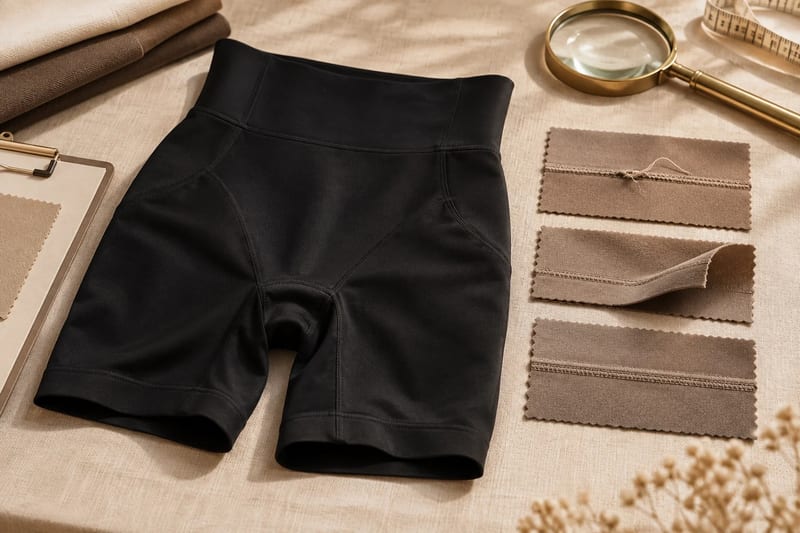
ISO 20932-1 describes strip-form methods for fabric elasticity and related properties, excluding narrow fabrics. That establishes a useful method family to discuss with a laboratory, not a ready-made acceptance threshold for every garment. Ask the laboratory to select the appropriate procedure and record the exact conditions used.
Source: ISO 20932-1: fabric elasticity strip-test scope
ASTM D4964 addresses tension and elongation of elastic fabrics and notes the relevance of loop tension-extension relationships to foundation garments, brassieres and swimsuits. Its published guidance emphasizes comparable machines, extension rates, loading or extension levels and specimen specifications before tension-recovery curves are compared.
Source: ASTM D4964: tension and elongation of elastic fabrics
Do not assume any stretch test is suitable because the fabric is knitted. ASTM D2594 concerns low-power stretch and its scope points support applications toward other methods, including D4964 and D6614. The published D2594 guidance also identifies limitations for commercial-shipment acceptance. Ask for a suitable method rather than copying the easiest code from a generic report.
Source: ASTM D2594: low-power stretch scope and limitations
Before accepting a report, check the specimen description and the meaning of each unit. A force result without its specimen width, direction and selected extension can be difficult to interpret. Two reports can use the same standard family while selecting different conditions within its permitted scope. Ask the laboratory to identify those choices and compare the actual setups before attributing the difference to a better textile. Preserve any agreed deviations rather than hiding them in an informal summary. If the comparison remains unresolved, request a controlled retest of the relevant options instead of inventing a conversion between incompatible figures. This is a review plan, not an additional ISO or ASTM requirement.
Keep method evidence and product conclusions separate. A measured strip result can compare selected materials under the agreed setup. It does not independently establish medical pressure, correct size grading or wearer comfort. Those questions require their own evidence and a relevant garment evaluation.
| Evidence type | What it can describe | What must match |
|---|---|---|
| Extension result | Dimensional response under the chosen conditions | Direction, loading and specimen basis |
| Recovery/growth result | Change remaining after defined release/recovery | Timing, history and measurement method |
| Tension-extension data | Force relationship over the specified setup | Machine, rate, loading and specimen |
| Wear trial | Observed result in the garment | Version, size, wearer and tasks |
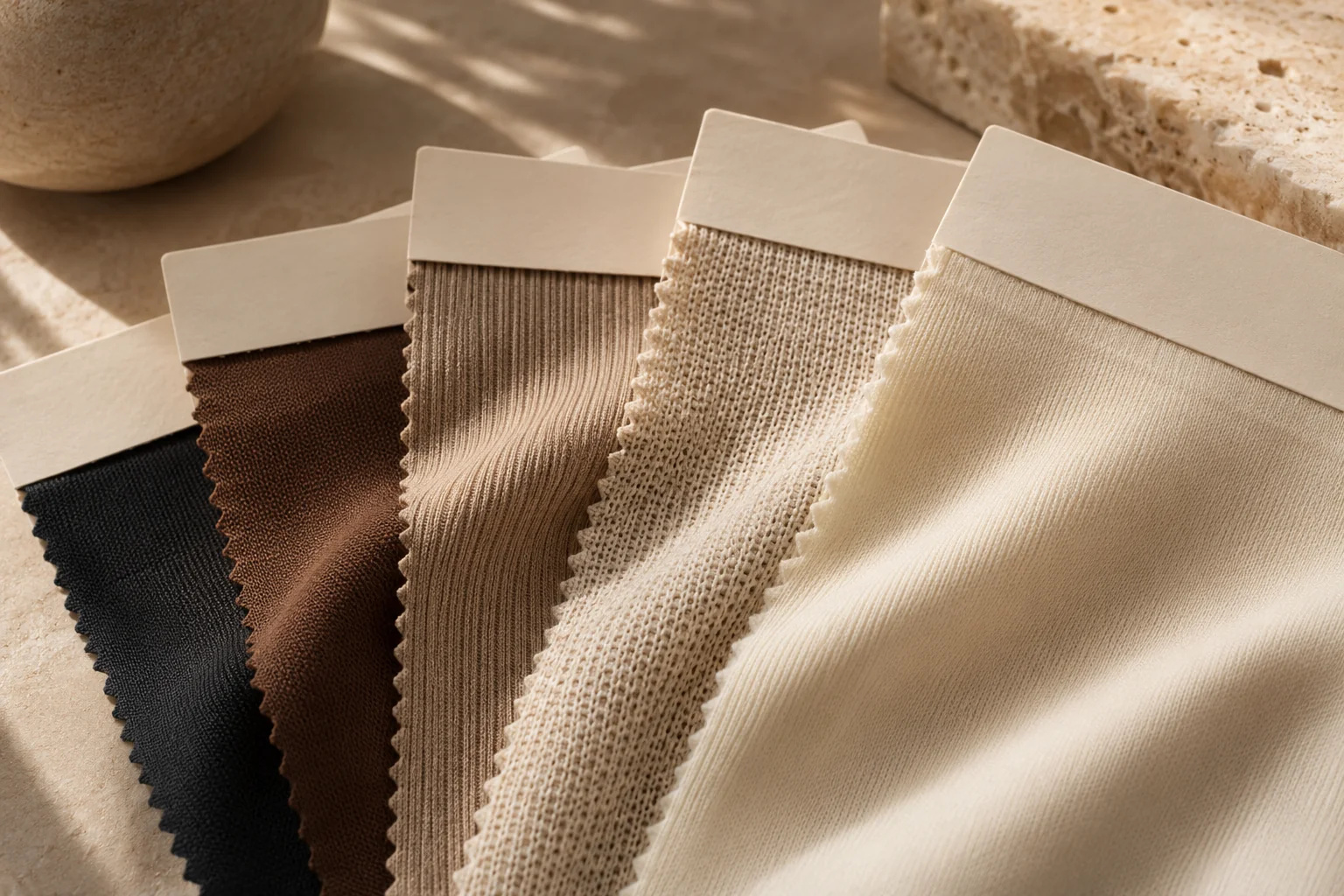
Illustrative sourcing and product-development scene. Click to continue the related buyer guidance.
How Can You Interpret a Simple Stretch and Recovery Example?
The following is an illustrative arithmetic exercise, not a laboratory report, material specification or claimed result for a supplier’s fabric. Both chosen swatches begin with a 100 mm reference length. Sample A is extended to 150 mm and later measures 105 mm; Sample B is extended to 140 mm and later measures 102 mm. No universal load, recovery time or acceptance rule is implied.
Using the original length as the denominator, A’s extension is 50% and its remaining dimensional increase is 5%. B’s corresponding figures are 40% and 2%. If this illustration defines recovered extension as the amount regained divided by the extension imposed, A gives 45/50, or 90%, while B gives 38/40, or 95%. State that definition rather than assuming every report uses the same recovery metric.
The figures do not prove B is the better shapewear material. A and B might have different force-extension relationships, construction, opacity or suitability for the garment. Without comparable test conditions and the relevant product requirement, ranking them from one percentage would be premature.
Use the example to check the denominator and request the missing evidence. A supplier report should identify the actual method, conditions, units and sample. Replace these chosen numbers with comparable results before making an acceptance decision. Do not present the exercise as an ISO or ASTM procedure or a prescribed level of stretch for every collection.
| Chosen arithmetic input | Sample A | Sample B |
|---|---|---|
| Initial reference length | 100 mm | 100 mm |
| Extended length | 150 mm | 140 mm |
| Later chosen length | 105 mm | 102 mm |
| Extension / initial length | 50% | 40% |
| Remaining increase / initial length | 5% | 2% |
| Recovered fraction of imposed extension | 90% | 95% |
| Interpretation | Illustrative only | Not a material ranking |
How Should You Check Hand, Moisture and Appearance Without Overclaiming?
A material can feel pleasant as a swatch while behaving differently in a finished garment with seams, edges and a particular fit. Review the areas that contact the wearer and the tasks that matter. Keep the garment version, size and wearer observations attached to the material identity.
Do not treat a fiber name as a complete breathability or moisture-management result. Those questions depend on the material and test used, while the garment and wearing context affect the experience. Ask which evidence supports the intended claim and avoid converting a subjective sensation into an unsupported technical number.
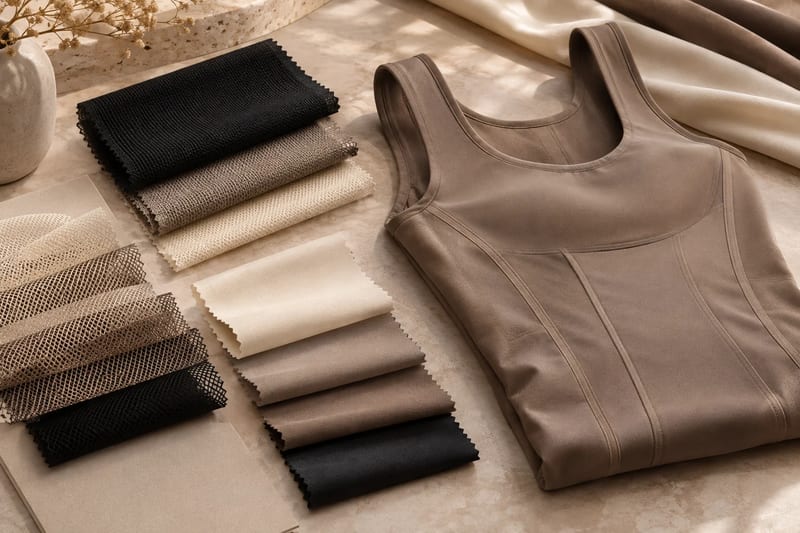
Discuss alternatives through S-Shaper’s material customization service. Ask which surface, structure and finish options are proposed and what they change. Compare them under the relevant stretch and outer clothing, then follow the intended care routine before reassessing. Record any changes rather than relying on the first impression.
Use the quality-assurance discussion to agree product-specific checks and handling of substitutions. A new fabric or finish may require another sample review even if the composition label is unchanged. The approved garment should identify the actual material, not just a generic description that several different textiles could satisfy.
Which Shapewear Fabric Manufacturers Fit Your First Material Comparison?
Compare the material work behind the location: coordinated garment development, research-led investigation or an integrated seamless route. These examples identify relevant capabilities and limits. They do not establish national fabric quality rankings, mandatory blend ratios or a universal testing package for startups.
China Shapewear Fabric Manufacturer: Connect the Swatch with the Garment Brief
China shapewear fabric manufacturer comparisons should connect material recommendations with garment construction and fit; an attractive composition label does not establish recovery, opacity or the intended wearer result.
Recommended supplier: S-Shaper
S-Shaper’s OEM/ODM service describes material and style recommendations with design, production, QA and export specialists experienced across several customer regions. A founder can ask the team which available material and platform address the brief and which technical records would distinguish the options. That connects fabric selection with sample and production decisions.
Conditional small-order support does not establish that every new material qualifies under the same program. Confirm sample scope, availability, documentation and the approval needed for substitutions. This route suits an own-label founder who needs coordinated product advice and can provide clear trial feedback. Supplier market experience can inform the recommendation, while actual material and garment evidence must establish whether it meets the wearer need.
Portugal Shapewear Fabric Manufacturer: Scope the Technical Evidence Required
Portugal shapewear fabric manufacturer routes involving research and testing can address defined material questions; select the evidence needed before commissioning a broad development investigation.
Recommended supplier: Impetus
Impetus describes research capability, technical collaboration and development across seamless and cut-and-sew products. Its quality information addresses checks on knitted materials, elastics, accessories and finished parts. A founder can ask how the proposed work would compare identified materials and support the final garment requirement.
The reviewed information does not establish a universal startup minimum, test package or development fee. Research and material scope require a current proposal. This route suits a product whose technical differentiation justifies scoped evidence rather than selection by hand feel alone. It does not remove the need for wearer trials or prove that every material developed through a research team is suitable for the first collection.
Turkey Shapewear Fabric Manufacturer: Review Material Behavior Within a Seamless Route
Turkey shapewear fabric manufacturer comparisons involving integrated seamless production should identify yarn, knit and finish together; material behavior needs evaluation within the construction proposed for the garment.
Recommended supplier: SML Seamless
SML describes integrated Turkish private-label shapewear and activewear production from yarn through packed goods, with dedicated communication. For a seamless platform, ask which material and knitting choices address recovery, coverage and edge behavior, and how the sample will identify those choices for later production.
The reviewed source does not establish a universal minimum, preferred elastane percentage or guaranteed material result. Request actual yarn, color and sample conditions and compare the relevant physical evidence. This route suits a brief aligned with seamless construction. Integration can clarify the workflow, but it is not a substitute for comparable test methods or proof that a lower- or higher-elastane alternative preserves the wearer benefit.
Choose the route that can identify the proposed material and produce the evidence your garment needs, then preserve the approved swatch and sample references together.
What Should the Final Fabric Approval and Reorder Record Contain?
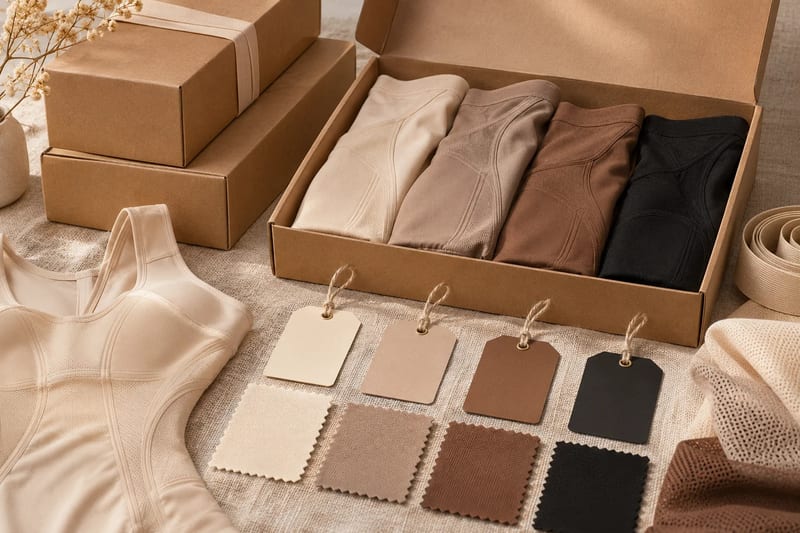
Keep the material identifier, composition information, construction description, color and finish linked to the approved sample. Attach relevant laboratory results with their method, conditions and units. The record should let another person distinguish the selected option from a similar-looking alternative without relying on the founder’s memory.
Add the garment conclusions separately: fit trial, size coverage, visibility, edge behavior and any limitations. A material report does not automatically approve the garment, and a good middle-size trial does not validate every proportion. State which additional sizes or features still require review.
Request a change process before release. If the supplier proposes another material, ask what differs and which evidence must be repeated. Review the published order FAQ as preliminary context, then confirm the selected item’s actual conditions rather than treating a general small-order statement as approval of every material option.
Finally, connect material and lot identification with the packing and receiving handoff. A well-chosen textile is only useful if the order records preserve the product version. Keep the first approval record for the reorder review so changes are evaluated against what customers actually wore and what the brand promised.
How Can S-Shaper Help Turn Your Material Priorities into a Sample?
S-Shaper’s product and OEM/ODM offering provides a starting point for selecting a material within an actual garment platform. Share the intended wearer, use case, coverage, fit problem and relevant references. Ask the team to recommend identified alternatives and explain which evidence would distinguish them.
Request the sample purpose, material reference, current measurements and proposed review method. Keep availability, components and any development work separately scoped. A recommendation can help a founder organize the comparison, but it should not be interpreted as a universal best fabric or a guarantee of comfort for every customer.
To begin, send S-Shaper a fabric-and-garment development brief. Use the response to compare materials consistently and authorize a relevant sample. Preserve the approved material, garment version and test conditions so the first selection becomes a usable production and reorder record.
FAQ: How to Choose Shapewear Fabrics for Your First Collection
What is the best fabric for shapewear manufacturing?
There is no universal choice established for every garment. Define the wearer result and compare identified options for relevant extension, recovery, force response, appearance and care behavior. Validate the selected material in the actual garment rather than relying on composition alone.
Is stretch percentage enough to choose a fabric?
No. Recovery, tension at relevant extension, direction, opacity and construction can change the result. Compare test conditions before ranking values. A high extension figure does not establish the desired support feel or comfort in a finished product.
Can I use any knitted-fabric stretch test?
Ask the laboratory to select a suitable method. The cited D2594 scope concerns low-power fabrics and points support applications toward other methods. D4964 and ISO20932-1 have their own scopes and conditions; a code alone does not make unlike results comparable.
Are the 50% and 40% examples acceptance targets?
No. They are chosen arithmetic inputs used to show denominators and definitions, not laboratory results or prescribed performance thresholds. Replace them with appropriately comparable measurements and product-specific acceptance criteria agreed for your garment.
Should I approve only the fabric swatch?
Approve the identified material and the relevant finished garment separately. Record fit, size coverage, construction and care observations, and require proposed substitutions to be reviewed. A suitable swatch cannot prove every aspect of the completed product.