 EN
Quick Answer
More spandex does not automatically make better shapewear. The percentage describes composition; it does not independently specify stretch, recovery, force, coverage, fit or comfort. Ask what the complete fabric and garment must achieve, then compare identified alternatives with relevant material evidence and wearer trials.
Keep three numbers separate: elastic-fiber content, measured extension under stated conditions and the garment’s fit relationship to the wearer. They have different denominators and meanings. A higher composition percentage cannot replace the other two, and no universal percentage is established for every style, size or support preference.
What Do Spandex, Elastane and LYCRA Mean in a Supplier Conversation?
Spandex and elastane refer to the elastic-fiber category discussed here, while LYCRA is a trademarked fiber brand. The LYCRA Company explains that its branded fiber is used with other fibers in knitted and woven fabrics. Do not assume that a quotation saying spandex contains that brand, or that a branded fiber automatically proves the finished garment meets your brief.
Source: The LYCRA Company: spandex, elastane and branded fiber identity
Ask the supplier for the material identity and declared composition rather than substituting a marketing term for a specification. If a particular branded fiber matters to the product claim, ask what documentation supports that identity and any proposed label use. Keep the material record aligned with the actual sample and production proposal.
The location of an elastic component also matters to the buying question. A garment may have a main fabric, lining, waist elastic and reinforcement with different compositions. Request the relevant component breakdown. A single percentage copied from one part cannot describe every layer of a structured product.
Start from a specific S-Shaper product direction and identify the component whose behavior needs improvement. If the issue is a leg opening or an underband, increasing the main fabric’s elastane content may not address it. First ask which construction feature is producing the observed result, then compare a targeted change rather than rewriting the whole material brief.
Why Can Two High-Stretch Fabrics Have Different Elastane Percentages?
Fiber content is one input to an engineered textile. The yarn system, knitted structure, material mass, direction and finish also belong in the specification. Ask for the complete identified material rather than assuming that the remaining percentage is an interchangeable background.
Penn Solutions’ catalogue offers a useful concrete warning against percentage-only buying. It lists article 12109 as Rascheltronic, 51% polyamide and 49% LYCRA, at 265 g/m². Article 12115 is listed as Rascheltronic, 56% LYCRA and 44% polyamide, at 240 g/m². These are named catalogue constructions, not recommended percentages for every shapewear launch.
Source: Penn Solutions: identified elastic textile constructions and compositions
| Published catalogue example | Elastic brand share as listed | Polyamide share | Nominal mass |
|---|---|---|---|
| Penn 12109 | 49% LYCRA | 51% | 265 g/m² |
| Penn 12115 | 56% LYCRA | 44% | 240 g/m² |
| Observed contrast | 7 percentage points higher | Different composition | 25 g/m² lower |
The examples differ in more than content, so they cannot prove that adding elastane reduces weight or improves performance. They demonstrate why the buyer needs an article code and supporting specification. A comparison of two commercial options can inform selection, while a claim about the isolated effect of one variable needs a more controlled investigation.
Ask what is available for the intended garment and which property distinguishes the alternatives. Keep any supplier recommendation attached to its actual material identity. A phrase such as premium high-spandex fabric should lead to a request for evidence, not an automatic purchase approval.
Spandex Percentage vs Measured Stretch: Which Number Answers Your Question?
Composition percentage reports the share of a component under the applicable composition basis. Extension describes dimensional change under a defined setup. Tension at a selected extension describes the force response of a specimen. A garment’s relationship to the wearer involves another set of dimensions and construction choices. Similar-looking percentages can therefore answer very different questions.
If a 100 mm reference length becomes 140 mm in an illustrative exercise, extension relative to the original length is 40%. That does not mean the fabric contains 40% spandex. The number describes the selected length change, and without a stated force, direction and method it remains incomplete as material evidence.
ASTM D4964 addresses tension and elongation of elastic fabrics and discusses comparability of tension-extension measurements. Its published guidance refers to machine, rate, loading or extension and specimen conditions. Ask the laboratory to document the relevant choices rather than accepting two results as equivalent because both contain a percent sign.
Source: ASTM D4964: tension and elongation of elastic fabrics
| Number | Meaning | Useful buying follow-up |
|---|---|---|
| Elastane content | Composition information | Which article and component? |
| Extension percentage | Length change relative to an identified length | At what force, direction and setup? |
| Remaining growth | Change after specified release/recovery | After what history and time? |
| Force at extension | Response at a defined test point | Which specimen width and method? |
| Garment dimensions | Pattern and finished-product measurements | How does the intended wearer trial perform? |
Do not turn a stronger hand pull into a laboratory measurement. A founder can use a simple handling comparison to identify questions, but the result should remain an observation. For an actual acceptance specification, work with the supplier and laboratory on a suitable documented method and relevant garment validation. This keeps the purchasing decision reproducible without inventing a universal spandex target.
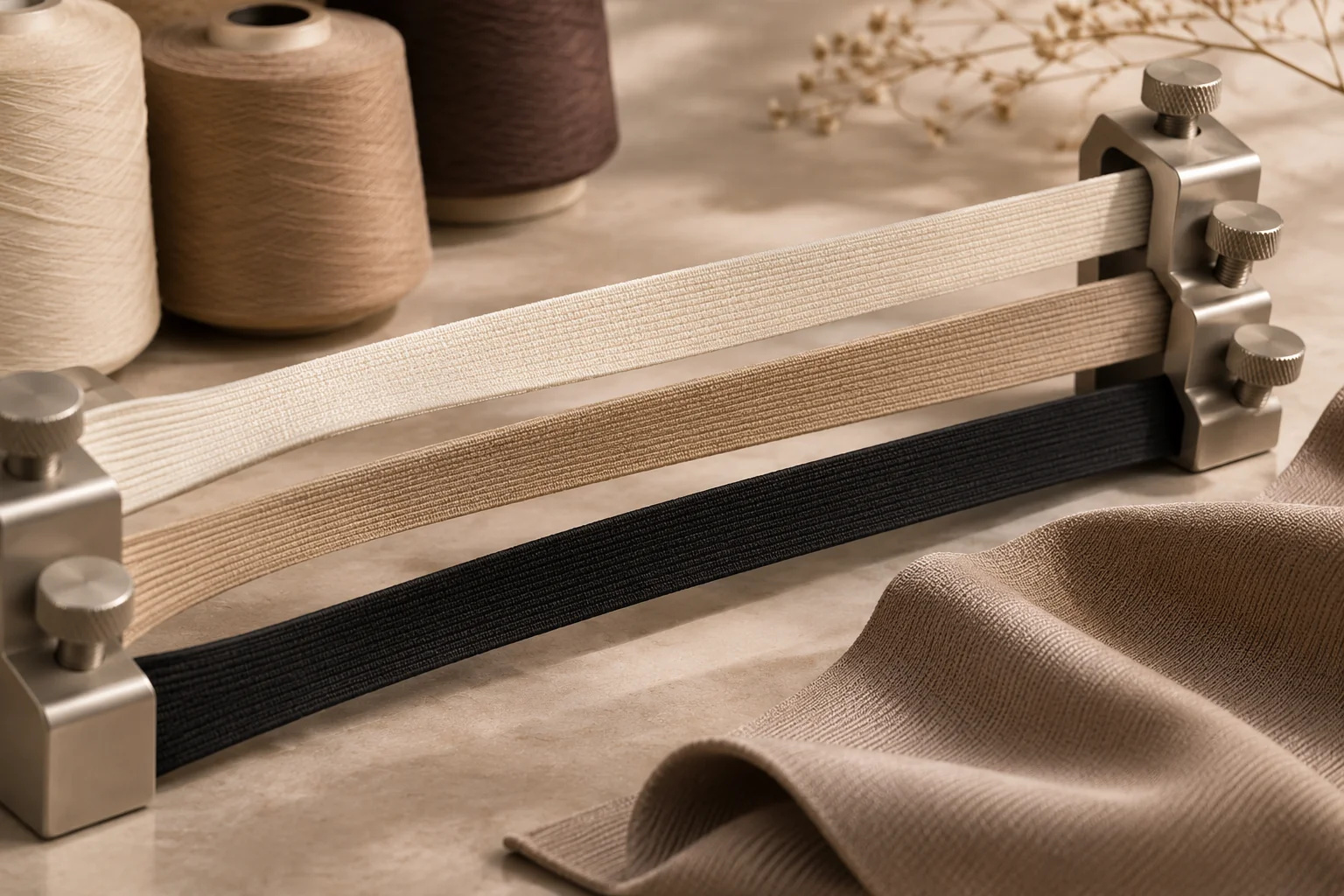
Illustrative sourcing and product-development scene. Click to continue the related buyer guidance.
How Can You Avoid Confusing Percentage Points with Performance Gains?
In the published catalogue examples, the elastic-brand share changes from 49% to 56%. That is an increase of seven percentage points. Relative to 49%, the numerical increase is about 14.3%. Neither calculation establishes a 14.3% improvement in support, recovery or comfort.
The nominal mass changes from 265 to 240 g/m², or 25 g/m² less. Relative to 265, that is approximately 9.4% lower. Again, the two catalogue articles differ and this is descriptive arithmetic, not a controlled experiment or a causal rule. Keep the numbers alongside the source identities so the conclusion does not become broader than the evidence.
For a separate illustrative review, imagine three materials offered with 18%, 22% and 28% elastane. Those chosen values are not public supplier quotations, industry targets or a prescribed range. Without comparable force, recovery, coverage and garment evidence, the buyer cannot honestly rank them. The correct next step is to obtain the missing evidence, not calculate an average and call it optimal.
Use a purchasing worksheet that keeps composition, method results and wearer observations in separate columns. If one field is missing, mark it missing. A neat but unsupported score can hide uncertainty and make an untested material look approved. A transparent comparison makes it easier to request exactly the sample or report needed to resolve the decision.
| Arithmetic | Result | Valid interpretation |
|---|---|---|
| 56 − 49 | 7 percentage points | Difference in listed content |
| 7 ÷ 49 × 100 | 14.3% | Relative numerical change only |
| 265 − 240 | 25 g/m² | Nominal mass difference |
| 25 ÷ 265 × 100 | 9.4% | Not a quality or support change |
What Should You Test Before Requesting More Spandex?
Locate the actual complaint. If a waistband folds, document where and during which movement. If the garment feels difficult to put on, record the size, opening, closure and dressing sequence. If the fabric appears sheer, preserve the color, fit and viewing conditions. Each problem can involve construction and fit as well as the main material.
Ask S-Shaper’s customization team to propose a small number of identified changes with reasons. A targeted pattern adjustment, edge change or material alternative may address the issue more directly than a higher percentage. Request a comparison that changes as few relevant variables as feasible, while documenting any necessary differences.
Review the chosen versions with representative wearers for the actual first size range. Record dressing, sitting, walking and relevant outer-clothing observations. These tasks form a proposed product review, not a universal testing standard or proof of long-term performance. Avoid asking a tester to tolerate discomfort simply because a higher number is marketed as stronger.
Discuss the laboratory and after-care evidence with the quality-assurance service. Keep conditions comparable and distinguish an initial material report from finished-garment approval. If the material changes, assess whether the previous fit and care results still apply. The aim is a stable garment result supported by evidence, rather than a composition headline chosen before development.
Separate comparison sessions from sales photography. A photographed garment can look smooth while a tester reports difficult dressing or a migrating opening. Record both types of evidence without letting the preferred campaign image decide the technical approval. Where observations disagree, ask whether size selection, body proportions, task or sample version explains the difference. Revisit the identified issue rather than averaging incompatible comments into one score. A founder does not need to solve the textile engineering alone, but does need a clear question for the developer. This approach makes a proposed percentage change reviewable: the next sample must address the documented problem, not merely display a revised composition label.
Which Shapewear Manufacturers Can Help Resolve a Spandex-Percentage Question?
Choose the sourcing model that can answer the actual question: a component change, a seamless platform comparison or a distinction between an existing catalogue and redevelopment. These examples describe published capabilities and limits. They do not establish national material-performance rankings or standard elastane percentages.
China Shapewear Manufacturer: Request a Targeted Elastic-Material Alternative
China shapewear manufacturer comparisons should identify the component behind the fit problem before requesting higher elastane content; main fabric, reinforcement and openings may need different changes.
Recommended supplier: S-Shaper
S-Shaper’s OEM/ODM offering includes material and style recommendations with design, production, QA and export specialists. A founder can share the observed problem and ask the team to compare feasible changes on an identified platform. Experience across several customer regions helps frame the inquiry, while the sample evidence must establish the result.
Conditional low-quantity options do not mean every new yarn, blend or custom finish uses one minimum. Confirm the actual program and quote the approved version. This route suits an own-label founder who needs coordinated product advice and can return precise wearer feedback. Ask why the proposed change should address the issue instead of treating a higher spandex percentage as the deliverable.
Turkey Shapewear Manufacturer: Evaluate the Knitted Platform Behind the Percentage
Turkey shapewear manufacturer routes involving seamless knitting should compare yarn and knit decisions together, because a composition figure alone does not describe an engineered garment zone.
Recommended supplier: SML Seamless
SML describes integrated private-label shapewear and activewear production in Turkey, from yarn through packed goods. For a seamless brief, ask how the proposed yarn system and knitting choices address the required areas, and which sample evidence will distinguish alternatives. Keep the construction reference attached to any composition proposal.
The reviewed source does not establish a universal elastane target, order minimum or guaranteed wearer result. Request current yarn, color, development and quantity conditions. This route suits a product aligned with the supplier’s seamless workflow. Integration may clarify responsibilities, but it does not replace appropriate testing or justify a claim that a nationally sourced material is automatically more supportive.
France Shapewear Manufacturer: Separate Catalogue Selection from Material Redevelopment
France shapewear manufacturer comparisons should establish whether the buyer is selecting professional stock or commissioning material development before debating a different elastane percentage.
Recommended supplier: Gilsa Paris
Gilsa Paris describes professional resale and separate own-label adaptation, specific development and packaging possibilities. A catalogue item may offer a practical reference for an invisible-lingerie use case, while changing its material is a different request. Ask which route permits the intended change and what sample and approval work follows.
Its published information does not prove every item is manufactured in France or available for unrestricted private labeling. Minimums depend on product type and require confirmation. This route suits a buyer who values the supplier’s style direction and can distinguish resale from development. If an existing garment already meets the brief, a higher content target alone is a weak reason to reopen its construction.
Ask for the least ambiguous comparison that can resolve the observed product problem, then approve the identified fabric and garment rather than the percentage alone.
What Should Your Approved Material Record Say Instead of “More Spandex”?
Name the selected article and relevant component, attach composition information and preserve the actual swatch. Identify direction, finish and shade where relevant. Add the method, conditions and units for any laboratory result instead of reducing the report to one isolated number.
Record the garment version and the reason it was approved. A useful statement describes the actual requirement and reviewed evidence: the opening performed acceptably in the agreed trial, for example. It does not claim that an ingredient percentage guarantees the same experience in a different style or size.
Use the order FAQ to prepare questions, then confirm the item-specific quantity and sampling terms. Ask how substitutions and reorders will be handled. Another material with the same content may need a new review if its construction or relevant behavior differs.
Connect these identifiers with production packing and receiving records. The person checking the shipment should know which version was ordered. A good technical decision can be lost if the commercial record says only high-spandex shapewear and leaves the selected construction undefined.
Give the commercial team a separate claim record. If development compared only initial hand feel, do not let a product description turn that observation into all-day recovery or an unmeasured compression level. If a laboratory report covers a fabric specimen, identify that scope when deciding what the garment page can honestly say. The approved ingredient information may be straightforward, while broader performance wording still needs evidence. Keep unresolved claims out of the release decision until the relevant work is complete. This also helps a later material substitution review: the team can see which customer promises depend on properties beyond the listed fiber percentage and which checks must be repeated before the revised version is sold.
How Can S-Shaper Help Translate a Percentage Request into Product Work?
S-Shaper can be approached with the wearer problem, garment reference and priorities together. Ask the team to propose material or construction alternatives and explain the evidence needed to compare them. This provides a more useful development brief than requesting a higher number without defining the desired result.
Its published support spans recommendations and specialist communication across design, production, quality and export. Confirm the specific material, sample route and order conditions for your project. The service scope is a starting point for a proposal, not proof that every composition or first-order quantity is available.
Send an identified reference and observations through a focused S-Shaper inquiry. Request a reviewable sample plan and an accurate quote for the chosen version. Keep any final product claim within the evidence actually obtained and retain the approval record for later changes.
FAQ: Does More Spandex Always Make Better Shapewear?
Is 30% spandex always better than 20%?
No universal ranking follows from those chosen percentages. Compare actual material and garment evidence for the intended use. The figures alone do not describe tension, recovery, coverage, construction or fit.
Is 40% stretch the same as 40% spandex?
No. In an illustrative length calculation, 100 mm extended to 140 mm gives 40% extension. That is a dimensional result under selected conditions, not a composition statement.
Can I label all spandex as LYCRA?
LYCRA is a trademarked fiber brand. Confirm the actual fiber identity and documentation for any proposed brand use rather than treating the trade name as a generic synonym on labels.
What should I send a supplier when the garment feels too loose?
Identify the garment version, size, wearer measurements, affected area and when looseness appears. Ask for a targeted review of material, pattern and construction rather than prescribing more elastane before the cause is understood.