 EN
Quick Answer
Start a shapewear brand by defining one wearer problem, selecting a suitable product and validating physical samples before approving a manufacturing order. Compare suppliers on the same specification, quantity and complete scope.
Existing-platform private label can simplify preparation; ODM can support an idea; OEM suits a defined buyer design. Approve fit, size coverage, components and receiving responsibilities.
The multi-channel price table distinguishes consumer offers from B2B supply and seamless garments from structured fajas. Use observed ranges as context, then request your own current proposal through S-Shaper’s OEM/ODM services.
Who Should Your Shapewear Brand Serve First?
A useful starting point is a specific wearing problem: everyday smoothing under workwear, comfortable shaping shorts, fuller-size support, or a bodysuit that works under a particular neckline. “Shapewear for every woman” gives a factory too little direction. Define the intended wearer, occasion, coverage, support feel and expected retail position in one short brief.
There is a measurable category opportunity. Grand View Research estimates the global market at $2.9 billion in 2025, with North America representing 38.5%. Its 2033 forecast is $5.4 billion. The implied increase from 2025 is approximately 86.2%, calculated as (5.4 ÷ 2.9 − 1) × 100. These are rounded research estimates, not evidence that a particular startup will find demand. Grand View Research, Shapewear Market 2026–2033
Interview potential buyers about what they already wear, where garments roll or dig, and which measurements make shopping difficult. Ask them to compare samples rather than approve a mood board. A waiting list measures interest; paid trial orders and structured wear feedback give stronger evidence of a workable product.
Choose one launch market before attempting a global size and language strategy. The same silhouette may require different customer guidance, merchandising and fit validation across markets. The supplier comparison below helps distinguish the country where customers shop from the country where goods are actually manufactured.
Which Shapewear Products Should a Startup Launch First?
Choose the product whose key benefit you can explain and verify. A shaping brief can be a focused starting point; shorts add leg-opening and ride-up questions; a bodysuit adds torso length, bust coverage, straps and gusset decisions. A dress with integrated shaping introduces a second garment layer and deserves its own fit review.
| Product direction | Specification to define | Question to test |
|---|---|---|
| Shaping briefs | Waist height, front panel, gusset, leg opening | Does the waistband remain comfortable when seated? |
| Shaping shorts | Inseam, thigh opening, rise and edge finish | Do the legs ride up during walking? |
| Shaping bodysuit | Torso length, neckline, bust and closure | Can different torso lengths wear it comfortably? |
| Built-in shaping dress | Outer fabric and internal layer separately | Do both layers move and recover together? |
For example, S-SHAPER’s bonded tummy-panel briefs provide a real reference for a panel-based product, while its built-in shapewear lounge dress illustrates a fashion-led direction. Use them as starting references, then ask which changes are possible at your proposed quantity.
Limit the first range deliberately. One style in two colors and five sizes already creates 10 SKUs. Three styles with the same color and size structure create 30. This arithmetic is an illustration of product complexity, not a recommended size ratio. Do not reduce size coverage mechanically; use your target customers’ measurements to decide what a credible first range requires.
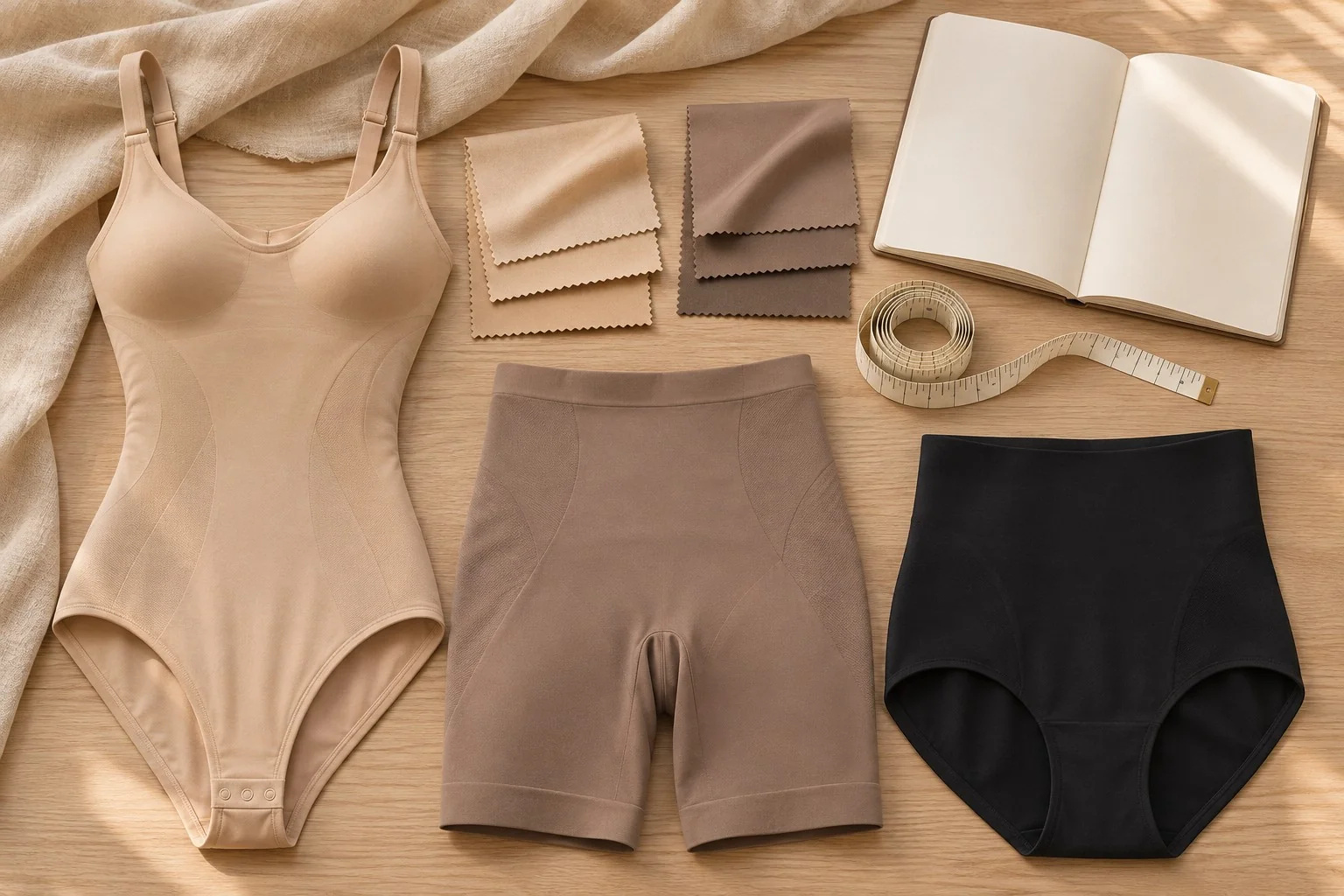
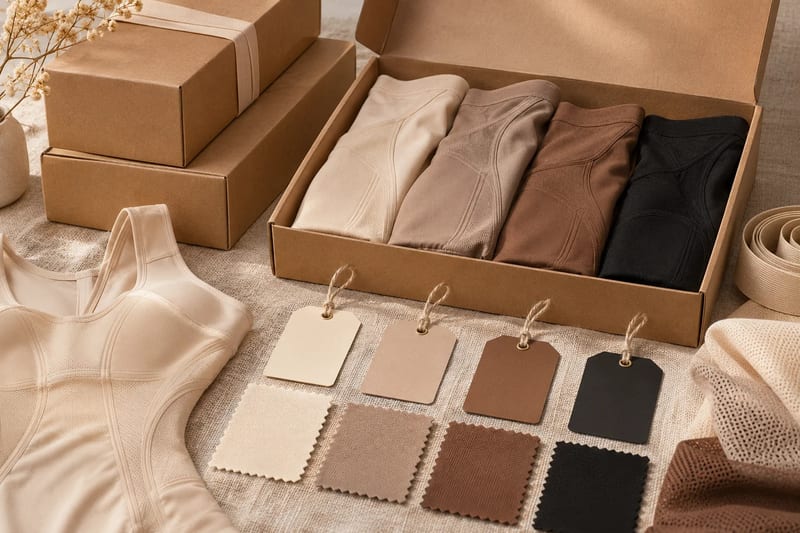
An illustrative first-collection concept. Compare product styles, materials and development routes.
Private Label vs OEM vs ODM: Which Manufacturing Route Fits Your Brand?
Supplier terminology varies, so compare the actual work included. In this guide, private label means branding an existing product platform, ODM means supplier-assisted product development, and OEM means manufacturing from your defined design and specification. None automatically guarantees exclusive ownership of an underlying style.
| Buying decision | Existing-style private label | ODM development | OEM production |
|---|---|---|---|
| Starting material | A suitable existing style | A concept, sketch or reference | A defined design or tech pack |
| Founder’s main task | Select and validate the product | Approve development decisions | Provide and approve specifications |
| Typical changes to discuss | Logo, labels, packaging; selected adjustments | Material, fit and construction development | Production to agreed materials and construction |
| Startup trade-off | Less development, less uniqueness | More support, more sample decisions | More design control, more preparation |
For a founder without technical experience, a proven platform with clearly scoped modifications can be more manageable than commissioning every detail from scratch. A distinctive fit requirement may justify deeper development. Choose the route that resolves the customer problem, rather than assuming maximum customization always creates a stronger brand.
Ask the supplier to state which patterns already exist, which changes trigger new samples, what revision work is included, and whether the resulting design can also be supplied to other buyers. Obtain those answers before comparing prices between development routes.
How Do You Choose a Shapewear Manufacturer for a Startup?
Shortlist manufacturers by product competence, not by the longest list of promises. A factory experienced in everyday seamless garments may approach construction differently from a specialist in heavily paneled shaping. Request examples close to the product you intend to launch and ask who performs development, production and inspection.
Check MOQ at four levels: style, color, size and branding component. S-SHAPER’s public FAQ mentions an initial 10-piece-per-item testing option, while other pages describe 50-piece starting quantities. Treat this as a reason to request an SKU-specific explanation, not permission to assume every fully customized design starts at 10 pieces. Review the published supplier FAQ and confirm the applicable conditions in writing.
Other suppliers also separate sourcing tiers. HB Shaper describes stock, private-label, color/packaging and deeper development programs with different thresholds. That supports the need to compare customization scope alongside quantity; it does not establish a universal industry MOQ. HB Shaper public sourcing tiers
A useful first inquiry contains your launch market, product reference, target wearer, size range, expected quantity, material preferences and branding requirements. Ask for a sample proposal and a line-by-line quote against that brief. If a supplier cannot explain which product or specification its quote covers, the apparent price advantage is difficult to evaluate.
Finally, ask for measurable evidence: a size chart, sample measurements, material details and an inspection plan. A general quality statement is not a substitute for agreed criteria for your own garment.
Which Shapewear Manufacturers Should You Consider for Your First Brand Launch?
Compare shapewear manufacturers in China, the USA, France, Portugal and Turkey for a first brand launch. The recommendations below connect country-level capabilities with specific suppliers and the work your brand needs.
China Shapewear Manufacturer: Develop an Own-Label Platform with Factory Specialists
China shapewear manufacturers offering OEM/ODM can connect platform selection with production; compare the available garment before commissioning a new design.
Recommended China Supplier: S-Shaper
S-SHAPER’s China-based OEM/ODM offering combines material and style recommendations with design, production, QA and export specialists. Its stated experience with clients in Europe, the US, Japan and other regions can help frame a market-specific product discussion. For a founder without an established supply chain, direct communication across those functions is useful when choosing between an existing platform and further development. Ask the team to explain which changes solve your wearer problem.
Evaluate the commercial advantage through a current factory proposal linked to the garment and development scope. The channel comparison below provides broader selling-layer context; one S-Shaper product should not stand in for the industry. Small-batch and initial-testing statements remain conditional. Confirm branded components, samples and delivery before budgeting. This route suits a startup building its own identity that can manage product approvals and cross-border receiving.
Source: S-SHAPER OEM/ODM and global-brand support.
USA Shapewear Manufacturer: Launch a Curated Assortment from Wholesale Supply
USA shapewear manufacturer comparisons must distinguish available wholesale assortments from domestic fabrication; established stock may suit a curated first launch.
Recommended USA Supply Partner: Vedette
US-facing programs such as Vedette’s offer catalogue style and size selection with dedicated B2B support. That can make an established assortment easier to evaluate than a garment designed from the beginning. For a founder testing a boutique or ecommerce concept, reviewing available silhouettes and asking about replenishment can shorten the list of product-development decisions. Confirm where the selected stock is held and which sizes are actually available.
The trade-off is control over the garment and brand presentation. A wholesale offer does not establish US manufacture, permission to remove labels or access to your own exclusive pattern. Request resale terms and actual dispatch conditions rather than borrowing a retail delivery promise. This route is particularly relevant when your first proposition is curation and customer service; it needs a different commercial comparison if your goal is an own-label collection with changed measurements.
Source: Vedette US-facing wholesale program.
France Shapewear Manufacturer: Prioritize Occasion Styling and Invisible-Lingerie Design
France shapewear manufacturer routes include occasion-led invisible lingerie; evaluate outfit compatibility before investing in own-label adaptations and presentation.
Recommended France Supplier: Gilsa Paris
Gilsa Paris documents professional resale and own-label development for invisible lingerie, including shaping and occasion-dressing solutions. A founder targeting bridal outfits, backless cuts or a specific neckline can therefore compare a style-led specialist route with a general shaping platform. Ask which available product or proposed adaptation addresses the outfit, coverage and finish your customer actually needs. The product’s relationship to outer clothing should lead the trial.
Development, packaging and material choices still need a quotation, and Gilsa states that own-label minimums depend on product type. A design-led proposal can require more preparation and component commitment than reselling an available item. Do not infer a verified French price premium or that every garment is made in France. Choose this route when occasion-specific fit and presentation justify the work, and compare the offered result physically before deciding that a sophisticated concept is ready for production.
Source: Gilsa Paris professional resale and own-label development.
Portugal Shapewear Manufacturer: Explore Material and Technical Differentiation
Portugal shapewear manufacturer options with research capabilities merit consideration when material differentiation justifies technical development beyond an existing platform.
Recommended Portugal Supplier: Impetus
Impetus describes its own research team and collaboration with universities and technology centers, alongside seamless and cut-and-sew development. That makes this Portuguese example relevant when your first product depends on a material or construction question that an existing garment cannot answer. A founder can ask how the proposed technical work would become a sample and what evidence would demonstrate the claimed benefit. Define the desired wearer result before requesting innovation in general terms.
The uncertainty is commercial fit for a small launch: the reviewed source does not establish startup acceptance, minimum quantities or development fees. Research, laboratory work and material sourcing may create commitments beyond an existing-style order. Obtain a scoped proposal and decide whether the extra differentiation is essential now. This route is strongest as a technical comparison for a defined need, rather than a reason to commission extensive development before customer interviews have established the problem.
Source: Impetus research and development.
Turkey Shapewear Manufacturer: Evaluate an Integrated Seamless Production Route
Turkey shapewear manufacturer routes with integrated seamless operations can simplify production coordination when yarn, knitting and finish match the garment.
Recommended Turkey Supplier: SML Seamless
SML describes Turkish private-label shapewear and activewear production in integrated facilities covering yarn through packed goods, with dedicated communication and experience serving European and American customers. For a seamless brief or short, the potential benefit is fewer separate production handoffs to coordinate. Ask which stages the proposed garment uses and how your chosen yarn, color and finish move through that route. Integration is useful only when it fits the product.
The reviewed information does not provide a universal minimum or verified startup price. Request color-batch conditions, sample scope and the actual first-order commitment. Inspect opacity, recovery, edge finish and grading instead of assuming that any alternative production country delivers either lower or higher quality. This option belongs on a shortlist when seamless construction is central to your promise and the supplier can connect its facilities to a relevant sample, clear technical records and a manageable private-label proposal.
Source: SML Seamless integrated private-label manufacturing.
Start with the route that resolves your biggest product gap: own-label development, available wholesale stock, occasion design or technical construction. Then compare the actual sample and complete commitment.
How Do Amazon, Brand Stores, TikTok Shop and B2B Prices Compare for a First Launch?
Build the first budget around the garment and business model. The observations below separate consumer selling prices from B2B procurement, with everyday seamless bodies and structured fajas treated as different constructions rather than interchangeable pieces.
| Channel / buying model | Observed USD per garment | Product and order basis |
|---|---|---|
| Amazon US retail | $9.99–$43.99 | Seamless/lighter bodies $12.38–$19.99; Structured bodies $34.88–$43.99; Shorts $9.99–$28.60. |
| Brand websites / B2C | $26.99–$148.00 | Seamless/lighter bodies $29.99–$78.00; Structured bodies $69.00–$148.00; Shorts $28.99–$81.00; Briefs $26.99–$38.00. |
| TikTok Shop US / B2C | $19.99–$65.98 | Seamless/lighter bodies $21.99–$46.99; Structured bodies $39.99–$54.99; Shorts $19.99–$65.98. |
| B2B existing-platform garments | $2.50–$12.85 | Seamless/body-shaping offers; listed minimums 2–600 pieces; custom scope varies |
| B2B structured bodies / fajas | $14.00–$27.42 | More elaborate body shapers; listed minimums 1–500 pieces; specification-dependent |
US-facing USD single-garment observations reviewed November 10, 2026; variants, retail promotions and shipping/tax differ. Amazon uses May–October 2026 tracker snapshots, not live November checkout. These selected samples are not industry averages or matched constructions. B2B advertisements are not landed costs or final custom quotes. Deeper development needs separate specifications, deliverables and an itemized quotation.
Select the relevant construction before approaching a manufacturer. A consumer offer can help identify positioning and what customers receive, while a B2B listing starts a conversation about quantity, materials and inclusions. B2B is generally cheaper per piece because the transaction commonly transfers inventory and selling work to the buyer; it is not a promise that custom development costs the same as ready-made bulk stock. Ask S-Shaper for the actual garment, sample and branding scope, then add delivery and other confirmed commitments before ordering.
A wide observed spread does not isolate manufacturing cost or brand markup. Confirm the garment specification and services before using either endpoint to set a budget or resale target.
What Should You Approve Before Placing Your First Production Order?
Translate the product idea into an approvable record. Confirm material composition, construction, measurement points, color, size range, labels and packaging. If you lack a technical pack, ask which specifications the development team can prepare and which decisions still need your approval. S-SHAPER’s customization service describes material, color and branding options you can discuss.
Run wear trials with people representing your target body measurements and torso lengths. Record waistband movement, leg openings, seam visibility, shoulder comfort and gusset access. Use consistent sitting, walking and dressing tasks, then check the sample again after following its intended care instructions.
Do not approve the whole size range from one middle-size fitting. Agree which additional sizes need physical verification and document changes with photographs, measurements and version numbers. A manufacturer should be able to explain how those comments reach the next sample.
Finally, agree on inspection criteria against the approved reference. Review S-SHAPER’s quality-control process, then request the product-specific checks relevant to your order. The approved garment and specification should describe what will be accepted; a website’s broad quality claim cannot perform that job.
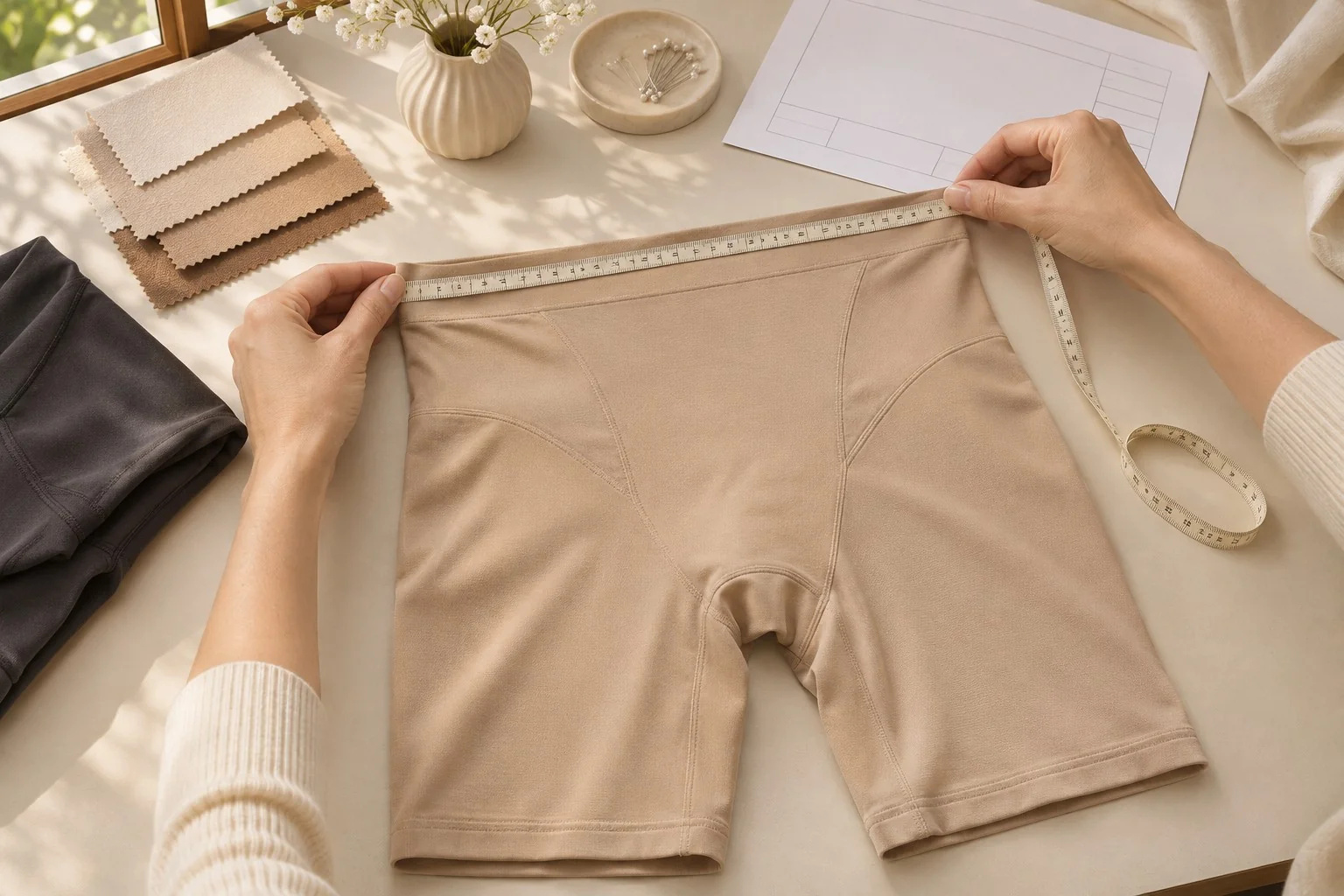
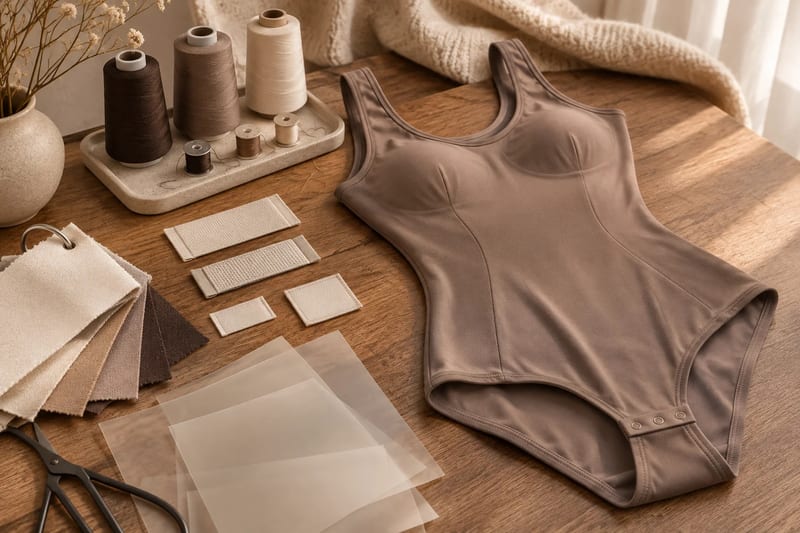
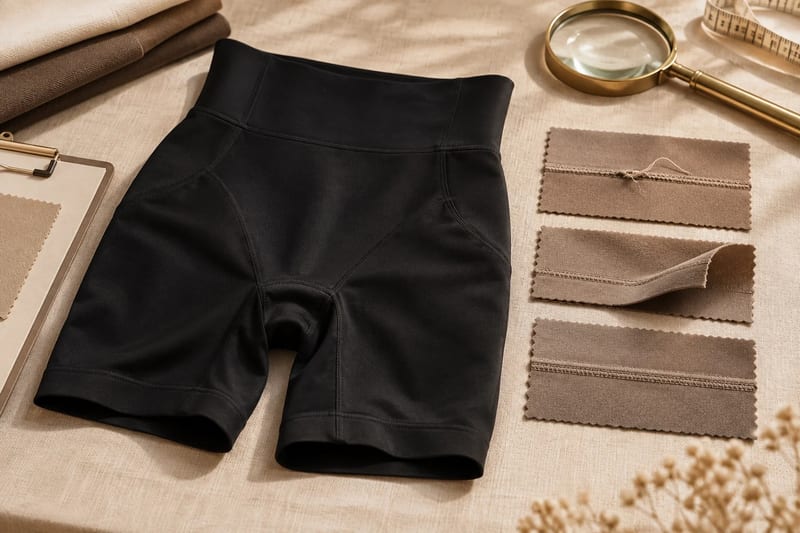
An illustrative sample-development scene. Confirm measurement points and approval criteria with your manufacturer.
How Can S-SHAPER Support Your First Shapewear Collection?
S-SHAPER is a China-based shapewear manufacturing and development option for brands building their own product line. Its public website presents OEM production, ODM development and private-label customization across shaping briefs, shorts, bodysuits and other garment directions. Its product catalogue and factory introduction provide starting points for a product-specific conversation.
For a startup, the useful discussion is concrete: can an existing style solve your wearer problem, which materials and measurements can change, what sample record will you receive, and which quantity conditions apply? Ask the team to connect its proposed service to your launch market, customer measurements and branding requirements.
Regional websites for the UK and Germany can help organize language and market discussions, but they should not be interpreted as proof of local manufacturing. Likewise, published small-order and fast-sampling statements need confirmation for your selected garment and development scope.
Prepare a one-page brief with your target customer, first style, reference images, intended size range and approximate order quantity. Then contact S-SHAPER for a sample and quotation discussion. Request a written scope that separates the garment, customization and development work so your next decision rests on a comparable proposal.
FAQ: Starting a Shapewear Brand
Can I start a shapewear brand without designing the garment myself?
Yes. Existing-style private label or supplier-assisted ODM can provide a starting route. You still need to define the intended wearer and approve fit, materials and branding. Ask what development work and revision rounds are included.
Can I launch a private-label shapewear brand with 50 pieces?
Possibly, depending on the product and customization. Fifty pieces is not a universal factory promise. Confirm whether the threshold applies to a style, color or size and whether labels or packaging have separate minimums.
What price should I expect for startup shapewear sourcing?
Compare the four-channel observations by construction and commercial scope. They are selected offer ranges, not statistical industry averages or a final custom quote. Request current item-specific terms before budgeting.
Should I choose a manufacturer in my country or in China?
Compare the work included, sample quality, communication and actual production location. A local supplier may manufacture abroad, while a Chinese factory may serve your country directly. The supplier’s address alone does not answer the production question.
What is the most useful first step after reading this guide?
Write a short product brief and send the same version to a few suitable suppliers. Compare their proposed sample scope and written answers before ordering. A clear brief turns a broad brand idea into a buying decision you can evaluate.