 EN
Quick Answer
Choose between nylon and polyester shapewear fabrics by comparing identified constructions in the intended garment. Ask for composition, mass per area, stretch direction, tension and recovery evidence, finish, care behavior and availability. Neither fiber name establishes how much support, opacity or comfort a finished garment will provide.
Use matched trials wherever possible. A heavier nylon blend and a lighter polyester blend with the same elastane percentage differ in more than their base fiber. They can be useful sourcing options, but their results cannot isolate a nylon-versus-polyester effect. Approve the material and garment together, then preserve both references for production.
What Must a Nylon or Polyester Option Achieve in Your Product?
Start with the customer situation. A shaping short under a fitted skirt needs a different evaluation from a bodysuit worn visibly as clothing. Describe coverage, skin contact, movement, the outer garment and the proposed care routine. These requirements give the supplier a reason to recommend one material rather than simply defend a fiber preference.
Browse S-Shaper’s garment categories to identify the relevant platform, then request alternatives for that platform. Ask what would change in the pattern, lining or edge construction if the main fabric changed. A fabric comparison becomes difficult to interpret if one garment is also smaller, more layered or finished with a different opening.
Record the result you need in observable terms. For example, visibility through the selected outer clothing, waistband position after sitting and the wearer’s ability to dress without excessive pulling are questions a sample can address. Do not translate these observations into unmeasured medical compression or universal breathability claims.
Give each proposed material an identifier. Keep the color, finish and sample date attached to it, and identify which version the supplier priced. Two swatches carrying the same composition may be different constructions. The comparison should help a purchasing decision, not create a broad verdict about every nylon or polyester textile.
| Decision | Useful comparison | Incomplete substitute |
|---|---|---|
| Concealment | Same outer clothing and relevant garment stretch | Unstretched swatch appearance |
| Support feel | Comparable fit and tension evidence | Base-fiber name |
| Care | Same agreed routine and reassessment | An attractive new sample |
| Continuity | Identified material and replenishment terms | A generic blend description |
Set a priority order before requesting the alternatives. If coverage under a pale dress is essential while a particular surface sheen is optional, say so. Otherwise the developer may optimize the feature that is easiest to show in a photograph. Also identify what must remain comparable: the intended size, garment coverage and trial tasks. A useful comparison can allow necessary pattern adjustments while still preserving the same wearer objective. Record those adjustments rather than pretending the test is chemically controlled. This lets the buyer make a practical selection without publishing a causal claim the evidence cannot support. The brief should distinguish what the brand must deliver from the material explanation it hopes will be true.
What Do Actual Supplier Datasheets Show About the Two Options?
Carvico’s Vita PL page identifies a particular recycled-polyester fabric with 78% polyester and 22% elastane, at 190 g/m². Its stated applications include swim and sport. These are facts about that named textile, not a specification that all polyester shapewear should meet or proof it is suitable for a particular first collection.
Source: Carvico Vita PL: published composition and weight
Carvico’s January 2024 Vita Power sheet identifies 78% polyamide and 22% elastane, with a nominal 225 g/m² and a stated weight tolerance. Polyamide is the fiber family commonly described as nylon in this comparison. The document also distinguishes test conditions and material variants. It should be read as a dated supplier specification, subject to confirmation for the proposed supply.
Source: Carvico Vita Power January 2024 technical data
| Published example | Base component | Elastane | Nominal mass per area | Interpretation |
|---|---|---|---|---|
| Vita PL | 78% recycled polyester | 22% | 190 g/m² | Named swim/sport textile |
| Vita Power | 78% polyamide | 22% | 225 g/m² | Dated supplier technical sheet |
| Difference | Base polymer differs | Same listed percentage | 35 g/m² | Not a controlled fiber-only experiment |
The shared 22% figure does not make these equivalent materials. Their nominal mass differs, their product identities differ, and this is not a matched experiment. Use the pair to improve the questions you ask: what else changes, which relevant properties are documented, and what evidence does the actual garment need? Do not convert a supplier example into an industry average or claim one polymer caused a particular wearer result.
Nylon vs Polyester Shapewear: Which Comparison Can Support a Purchase?
A fiber-only comparison asks what changes when the base polymer changes while relevant construction and test conditions remain controlled. A purchasing comparison asks which available complete option works better for the intended product. Both questions can be useful, but they require different interpretations.
For a startup, the available complete options may matter most. Keep those options identified and test them fairly. If the pattern must change to accommodate a fabric, document that change and evaluate the resulting product. You can select the better garment without claiming to have isolated the chemical contribution of nylon or polyester.
Do not rank softness, drying, durability or support from a label alone. Ask for the evidence relevant to the actual material and any proposed finish. A visual or tactile impression can remain part of the decision, provided it is described as an observation and not disguised as a quantified performance result.
ASTM D4964’s published guidance provides a useful reminder for elastic textiles: comparable tension-extension results depend on the machine, rate, loading or extension and specimen specification. Ask a competent laboratory to choose and document the method. A familiar standard number alone does not make two differently configured reports directly comparable.
Source: ASTM D4964: comparable tension and elongation measurements
| Buying question | Compare this | Do not infer this |
|---|---|---|
| Which feels preferable? | Identified garments, same task and relevant fit | All nylon is softer |
| Which maintains fit? | Agreed recovery and after-care evidence | Higher elastane always wins |
| Which conceals better? | Color, stretch, construction and outer clothing | Polymer name proves opacity |
| Which supports a launch? | Approved performance plus actual supply terms | One national or fiber price rule |
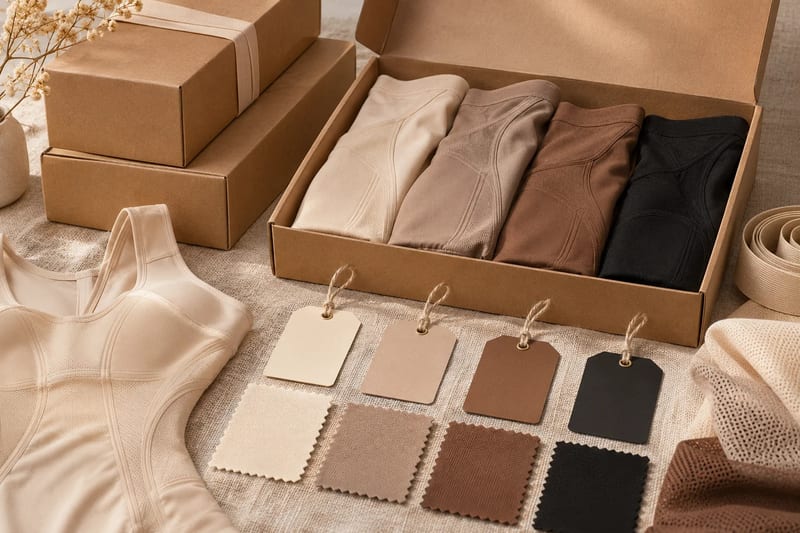
Illustrative sourcing and product-development scene. Click to continue the related buyer guidance.
How Can You Normalize Material Data Without Inventing a Performance Score?
The nominal weight difference in the two published examples is 225 − 190 = 35 g/m². Relative to 190 g/m², that is approximately 18.4% more mass per unit area. It is not 18.4% more support, durability or quality. The calculation describes the weight labels and nothing about a finished garment’s benefit.
For an illustrative planning area of 0.40 m², 190 g/m² corresponds to 76 g of fabric and 225 g/m² to 90 g, a 14 g difference. This chosen area is not a supplier’s garment consumption figure. It excludes cutting loss, additional layers, trims and components and cannot be used as a final garment-weight forecast.
When quotations arrive in different units, first establish usable width, buying unit and construction. A per-meter quote cannot be compared fairly with a per-kilogram quote by looking only at the currency amount. Ask the supplier to provide the conversion basis and any minimums, then preserve the original units alongside the normalized calculation.
The purpose of arithmetic is to reveal missing information. A spreadsheet that converts everything into one apparently precise number can hide incompatible assumptions. Keep performance evidence, material consumption and commercial terms in separate columns. Request a current quote for the approved material rather than using nominal weight as a proxy for its cost.
| Calculation | Result | Limit |
|---|---|---|
| 225 − 190 | 35 g/m² | Named nominal weights only |
| 35 ÷ 190 × 100 | 18.4% | Mass comparison, not performance |
| 190 × chosen 0.40 m² | 76 g | Illustrative area; excludes losses |
| 225 × chosen 0.40 m² | 90 g | Not a finished-garment specification |
How Should You Sample Color, Finish and Care Behavior?
Request comparable garment versions and identify any unavoidable differences. If a supplier cannot make the same construction in both materials, ask why, then evaluate two complete solutions openly. Trying to hide the construction difference makes the eventual recommendation less useful.
Check the proposed colors rather than assuming one successful dark sample approves every shade. Keep the lighting, outer clothing and stretch conditions consistent for visibility reviews. Record appearance and wearer feedback without inventing a universal pass score. An observation from one garment should remain tied to its version and conditions.
Use S-Shaper’s material customization discussion to ask which finishes are included, which are optional and whether the selected fabric is a regular supply or a development request. Ask how proposed changes affect the sample route. A familiar fiber name does not establish material availability or a low minimum for every custom color.
Agree the intended care routine and the relevant reassessment with the quality-assurance team. Review fit, dimensions, surface appearance and elastic behavior as appropriate to the product. Do not infer long-term performance from a single wash or treat an arbitrary home trial as a standardized laboratory result. Preserve what was actually tested and what remains uncertain.
Which Manufacturers Can Help You Compare Nylon and Polyester Shapewear?
Compare the work offered around the material: coordinated garment sampling, development across locations or a scoped technical investigation. These examples illustrate sourcing models, not national rankings of nylon, polyester, quality or price. Confirm the current program and approval responsibilities with each supplier.
China Shapewear Fabric Manufacturer: Compare Available Garment Platforms
China shapewear fabric manufacturer comparisons should connect nylon or polyester proposals with an actual garment platform, the intended finish and a testable first-order scope.
Recommended supplier: S-Shaper
S-Shaper’s OEM/ODM service describes material and style recommendations supported by design, production, QA and export specialists. Its experience across several customer regions can help frame the brief, while the buyer should still request specific material records and garment evidence. Ask whether both fiber routes can be reviewed on a comparable platform.
Factory coordination can simplify the handoff from swatch to sample, but no universal price advantage or minimum follows from the fiber name. Conditional small-order options require confirmation for the actual material, shade and customization. This route suits a founder seeking an own-label garment and practical alternatives, with the discipline to approve the material version before production.
Canada Shapewear Fabric Manufacturer: Preserve the Development-to-Production Reference
Canada shapewear fabric manufacturer routes can separate local development from overseas manufacture; preserve material identity and responsibilities when comparing nylon and polyester proposals across that handoff.
Recommended supplier: Hertex
Hertex describes Montreal-based design, pattern development, grading and quality control, with manufacturing in China since 2006. The useful question is how the chosen fabric, sample and technical changes travel through that workflow. Ask who confirms the material code and whether a substitution triggers another fit and appearance review.
The published background does not establish Canadian manufacture, current local stock or a standard startup program. Obtain a proposal covering development, material sourcing and production separately. This route suits a buyer who values the stated development interface and can define approval ownership across locations. Do not assume a local commercial contact removes the need for production-level material evidence.
Portugal Shapewear Fabric Manufacturer: Investigate a Defined Material Difference
Portugal shapewear fabric manufacturer comparisons involving research teams should begin with a defined nylon-versus-polyester question, rather than commissioning open-ended testing without a product decision.
Recommended supplier: Impetus
Impetus describes research and development, technical collaboration and quality checks involving knitted materials, elastics, accessories and finished parts. A founder can ask whether the proposed investigation can distinguish complete textile options under comparable conditions and connect the result with a seamless or cut-and-sew garment.
The reviewed material does not promise a universal minimum, development fee or ready-made test package. Agree the scope and deliverables before proceeding. This route suits a collection with a clear material question worth investigating, rather than a launch that only needs a catalogue choice. Research capability provides a resource; the approved sample and evidence must still establish suitability for the wearer.
Choose the route that can preserve material identity and produce a relevant garment comparison, then use the same evidence discipline when ordering again.
What Should Be Locked Before You Order the Chosen Blend?
Identify the approved fabric, composition, construction, shade, finish and relevant test references. Attach the garment version and note any pattern changes made for that material. A purchase description saying nylon blend or polyester blend alone leaves too many alternatives open.
Ask the supplier to state how substitutions will be handled. A similar composition does not establish equivalent force, appearance or care behavior. Decide which changes need a new material review and which also need a garment trial. Preserve the original evidence so the next discussion has a reference.
Read S-Shaper’s order FAQ as preliminary context and confirm the item-specific quantity, sample and timing terms in writing. Material continuity and color availability can affect a reorder even when the original garment performed well. Record the agreed commercial terms separately from the performance approval.
Use the packing and logistics handoff to connect lot and product identification with receiving checks. The buyer should be able to tell whether the delivered order matches the approved version. A successful comparison has limited value if the order and receiving records cannot distinguish the selected textile from an unreviewed substitute.
Keep rejected options and their reasons in the project record as well. A later substitution proposal may look attractive because its price or availability changes, but the original comparison could reveal a problem that remains relevant. Write a specific reason such as visible edge under the chosen skirt or changed fit after the agreed care review. Avoid vague comments such as cheap or premium that another buyer cannot reproduce. If a rejected material is reconsidered, ask what has changed and identify the evidence needed to reopen the decision. A disciplined record can make a second comparison shorter, because the team knows which question it must resolve and which parts of the original approval still apply.
How Can S-Shaper Help You Select a Blend for a Real Garment?
S-Shaper can be approached with the wearing result, garment reference and material questions together. Ask the team to recommend identified nylon- or polyester-based options and explain what changes in construction, appearance or sampling. This turns a broad fiber debate into a reviewable product proposal.
Its published service scope covers material and style recommendations with specialist communication from development through quality and export. Request the documents and samples relevant to your project; that scope is not a guarantee that every fabric or custom finish is available under the same small-order conditions.
Send the intended market, wearer profile, outer-clothing use and proposed care routine through a focused project inquiry. Ask for a comparison plan and a quotation for the approved route. The useful deliverable is an identified garment that meets the brief, supported by appropriate evidence and clear supply terms.
FAQ: Nylon vs Polyester in Shapewear: A Buyer’s Comparison
Is nylon always better than polyester for shapewear?
No. Compare identified fabrics and finished garments for the intended requirement. Construction, mass, finish, fit and test conditions can change the result, so a fiber name cannot establish a universal winner.
Does equal elastane content make two fabrics equivalent?
No. The documented examples both list 22% elastane but have different identities, base components and nominal weights. They illustrate why composition alone is incomplete, not a controlled performance experiment.
Can I estimate support from GSM?
Mass per area is useful material information, but it is not a support measurement. Ask for relevant tension and recovery evidence and evaluate the actual garment with the intended wearer.
Should I approve one color for every shade?
Approve the proposed shade and finish with relevant appearance and care checks. Preserve the tested version and confirm which changes require another review rather than assuming one dark sample covers all options.