 EN
Quick Answer
A private-label shapewear design is not automatically exclusive because it carries your logo, uses a custom color or required paid development. Define the underlying platform, new work, files and product features involved, then agree any ownership, permitted use and supply restrictions explicitly. The actual rights and enforceability need appropriate review for the relevant markets and arrangement.
Before paying for exclusivity, identify what commercial problem it should solve. You may need control of brand artwork, access to technical deliverables, a restriction on supplying a defined version or protection for an eligible design. Those are different subjects. Ask the manufacturer to explain what it can offer and keep the agreement connected to an identifiable product rather than the vague phrase your design.
What Exactly Do You Want to Be Exclusive?
List the assets and activities before discussing price. A logo, packaging artwork, graded pattern, technical specification, developed sample and production platform are not the same thing. Some may originate with your team, others with the supplier and others through project work. Identify the source and expected permitted use of each.
Start with the garment reference in S-Shaper’s catalogue or the development brief. Ask which elements are established resources and which are proposed for the project. If the base style is already supplied to other buyers, a new brand component does not automatically change that underlying arrangement.
Describe the business concern. A founder may want to prevent another supplier customer from receiving the same adapted version in a particular market, retain the ability to reorder consistently or obtain files for future production discussions. Each concern needs a specific commercial and technical answer. Do not assume one broad word resolves them all.
Keep ownership, access and restrictions separate. Possessing a sample does not necessarily establish the right to every pattern file, while receiving a technical document does not automatically mean no one else can use the underlying know-how. Ask what will be delivered and what use is intended, then seek appropriate review of the arrangement.
Record the expected result before development starts. Waiting until the product is approved can leave the parties with different assumptions about the fee already paid. A clear discussion protects the project from ambiguity and helps the founder decide whether an exclusive arrangement is necessary for the first launch.
| Subject | Commercial question | Record needed |
|---|---|---|
| Brand artwork | Who may apply or reuse it? | Identified artwork and permitted-use arrangement |
| Existing platform | Is it supplied to other buyers? | Baseline status and proposed restrictions |
| Project-specific work | What is new and who may use it? | Defined deliverables and reviewed terms |
| Technical files | What is supplied and for which use? | File list, format and access scope |
| Supply restriction | Which product, markets and period? | Specific commercial arrangement |
Shared Platform vs Adapted Style vs Exclusive Development: What Changes?
A shared platform can support a coherent brand without being uniquely owned by that buyer. The founder may differentiate through suitable selection, verified fit guidance and service. If uniqueness of the underlying garment is essential, ask whether the supplier offers a different arrangement instead of assuming private label provides it.
An adapted style can introduce project-specific changes while retaining established elements. Identify what changed and which parts remain shared. A different waistband, measurement or material should be evaluated physically, but its existence alone does not establish a comprehensive legal right or a restriction on every similar garment.
An exclusive-development discussion needs the work and restrictions defined at a level both parties can identify. Ask about the product version, territory, channels, period, deliverables and any commercial conditions. Have the arrangement reviewed appropriately rather than relying on a message saying the product is special for your brand.
The S-Shaper OEM/ODM service scope describes client-design manufacture and supplier-assisted development. Those describe ways to work; they do not independently settle ownership of all resources or promise exclusivity. Ask what the proposed project actually includes before attaching a rights assumption to the service label.
| Route | Useful starting point | What must not be assumed |
|---|---|---|
| Shared platform | Known style under a permitted brand arrangement | No other buyer can use the underlying garment |
| Adapted platform | Defined changes to an existing style | Every element becomes uniquely owned |
| New development | Scoped technical and design work | Payment transfers every file or right automatically |
| Exclusive supply arrangement | Specific product and restrictions | Worldwide or indefinite effect without defined terms |
How Are Supplier Agreements Different from Industrial-Design Protection?
A commercial arrangement with the manufacturer and intellectual-property protection are separate subjects. One concerns what the parties agree to do with an identified product or resource. The other concerns rights arising under the relevant legal framework. A founder should not treat a supplier promise as proof of worldwide protection against all third parties.
WIPO explains that industrial-design rights concern a product’s appearance or aesthetic features, while technical solutions may involve different forms of protection. It also describes territorial limits: protection in one country or region does not automatically establish protection everywhere. The relevant facts and applicable laws need appropriate review for the product and markets involved.
That distinction matters for a global brand plan. The customer market, factory location, design work and sales channels may be different. Identify where you expect the agreement to operate and which activities are relevant. Do not infer a universal legal outcome from the country in which the sample was developed.
Avoid treating apparent functionality as automatic permission to reproduce a third-party design. Different rights can be relevant to the same product, and an ordinary procurement conversation cannot decide every issue. Obtain suitable specialist help for the actual design and arrangement rather than relying on a generic statement about shapewear construction.
Keep the practical workflow clear while that review is completed. Identify what can be shared, what should remain controlled and which approval depends on resolving the question. The founder can continue clarifying the garment and commercial scope without pretending that a logo or development invoice answers all rights questions.
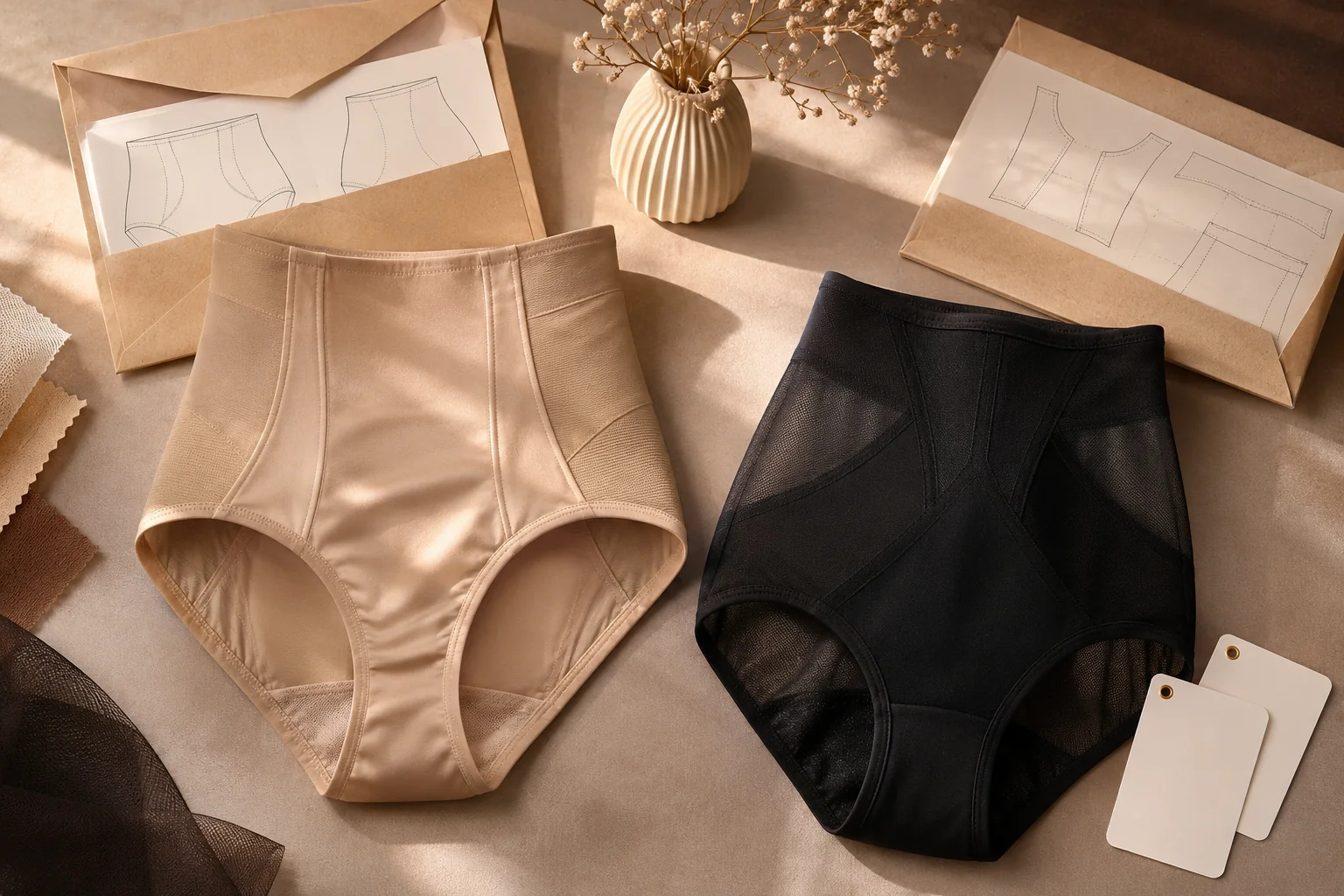
Illustrative sourcing and product-development scene. Click to continue the related buyer guidance.
Which Territory, Channel and Time Conditions Should Be Discussed?
Describe the intended restriction precisely enough that another person can recognize its scope. Name the product version and relevant changes rather than only a broad category such as seamless bodysuit. Ask whether the supplier is discussing the exact version, selected features or a different defined limitation.
Identify the markets and channels relevant to the business concern. A founder’s own online store, wholesale resale and a third-party marketplace can involve different activities. Discuss the actual plan instead of asking for worldwide exclusivity by habit. Broad requests can be commercially different from the limited protection the first launch needs.
The period and conditions also need attention. When would the arrangement begin, what must each party do and what happens when it ends or a condition is not met? The sources do not establish a standard term, minimum spend or exclusivity fee. Request the provider’s proposal and have the terms reviewed for the intended arrangement.
As a hypothetical discussion example, a founder might initially consider two markets, two sales channels and a twelve-month period for one identified version. Those numbers only illustrate the fields to define; they are not recommended legal terms or evidence that any manufacturer offers that package. The actual scope should follow the business need and reviewed agreement.
Keep product changes connected to the arrangement. If the neckline, material or grading changes later, ask whether the revised version is covered and what record establishes that. A development process can create ambiguity if the commercial restriction refers only to an obsolete sketch while the manufactured garment has changed.
| Scope field | Question to resolve | Ambiguity to avoid |
|---|---|---|
| Product | Which identified version or elements? | Every vaguely similar garment is covered |
| Market | Where does the arrangement apply? | One location implies worldwide effect |
| Channel | Which supply or selling activities? | All possible uses are automatically restricted |
| Period/conditions | When and under what requirements? | The restriction is indefinite or unconditional |
| Changes | How are revisions incorporated? | A new version silently inherits old terms |
What Do Four-Channel Prices Establish About Design Exclusivity?
Public garment prices concern product offers, not automatic ownership or exclusive supply rights. Keep the four-channel observations in their procurement and consumer-market roles, with basic seamless garments distinct from structured shaping products. A high retail ticket or low bulk listing does not identify which patterns, files or restrictions a private-label agreement includes.
| Channel / buying model | Observed USD per garment | Product and order basis |
|---|---|---|
| Amazon US retail bodies | $12.38–$35.14 | Seamless/lighter bodies $12.38–$19.99; Structured bodies $35.14–$35.14. |
| Brand DTC bodies | $29.99–$148.00 | Seamless/lighter bodies $29.99–$78.00; Structured bodies $69.00–$148.00. |
| TikTok Shop US bodies | $21.99–$54.99 | Seamless/lighter bodies $21.99–$46.99; Structured bodies $39.99–$54.99. |
| B2B advertised OEM bodies | $4.25–$8.30 | Rihope/Shangyou garment offers; listing MOQ 600/100; own-design terms reconfirmed |
| B2B custom shiny-fabric example | $22.00–$23.00 | Hucai FOB garment example, MOQ 200; a different fabrication; development fees unconfirmed |
B2B finished-garment bands are generally lower than consumer tickets, while product development and any proposed exclusive arrangement need separate scope. Amazon and TikTok Shop promotions and B2C brand positioning influence consumer comparisons. The whole spread is not an exclusivity fee, nor evidence that branding alone grants rights or creates the same willingness to pay.
Request the garment, development deliverables and proposed commercial restrictions as distinct parts of the discussion. Clarify the identified version, permitted use, territory, channel and period with appropriate review. Use the price observations to understand the commercial context, not to invent a standard exclusivity premium or treat a product purchase as a transfer of all underlying resources.
US-facing USD per single garment, reviewed November 10, 2026. Amazon uses dated May–October 2026 third-party PriceHistory snapshots, not live November checkout. These selected-seller observations are not industry averages or matched-quality comparisons. Variants and promotions change; shipping and tax are not normalized. B2B bands describe advertised garments, not landed costs or a final custom-development quote. Sources: dated PriceHistory Amazon records, official brand/TikTok Shop pages and Made-in-China supplier listings.
Which Shapewear Manufacturers Should You Compare for a Defined Design Arrangement?
Compare the underlying platform and development relationship before asking for restrictions. The country does not determine ownership or exclusivity, and a capability description does not establish which rights or files a supplier can offer in your project.
China Shapewear Manufacturer: Separate the Platform and New Work
China shapewear manufacturers offering existing platforms and ODM support should identify which resources are shared, what the project develops and which commercial restrictions are actually proposed before development payment.
S-Shaper
S-Shaper describes design, material recommendations, QA and export specialists for international brands. Ask the OEM/ODM team to define the platform, project-specific deliverables and intended use of files or samples. Its public small-order options and project-specific factory quotes are product references, not exclusivity promises. Confirm the selected garment’s conditions and material availability, then document any proposed restriction separately. This route suits a founder needing coordinated development while retaining clarity over the exact product and commercial scope being approved.
France Shapewear Manufacturer: Identify Adaptation and Brand Scope
France shapewear manufacturer and own-label development proposals should distinguish an adapted occasion product from an existing resale assortment, with any requested exclusive use tied to the actual proposed work.
Gilsa Paris
Gilsa describes professional resale alongside own-label adaptation, specific development and packaging, with invisible-lingerie expertise. That can help a founder identify a suitable route for an occasion requirement. Product-dependent minimums and development charges need a quote, while any rights or restrictions need an explicit reviewed arrangement. French service does not establish manufacturing origin or automatic brand ownership of the underlying platform. Confirm what can be supplied repeatedly and how changes will be recorded.
Portugal Shapewear Manufacturer: Define Research Outputs and Access
Research-oriented Portugal shapewear manufacturer proposals may involve technical resources beyond a single garment, making the distinction between project outputs, existing know-how and any requested use restriction particularly important before work begins.
Impetus
Impetus describes research partnerships and seamless or cut-and-sew development with quality-testing functions. Ask which deliverables address your requirement and which records will be supplied for the intended use. Capability does not establish startup acceptance, a minimum or automatic exclusivity. Quote the technical and material scope, then review the proposed resource and commercial arrangements separately. This route is relevant when the design needs technical differentiation rather than assuming research itself guarantees unique legal rights.
Canada Shapewear Manufacturer: Clarify Cross-Border Technical Records
A Canada-based shapewear manufacturer or technical partner should identify who creates and maintains the pattern and grading records, and how any agreed restrictions connect with overseas production of the approved version.
Hertex Lingerie
Hertex identifies Montreal design, patterns, grading and QC with production in China. A founder can investigate a technical coordination route while asking which files, permissions and responsibilities form the proposal. Confirm startup suitability and the complete service scope; local technical contact does not mean Canadian fabrication or automatic ownership transfer. The arrangement should describe the relevant parties and current product record clearly enough that future revisions do not leave the intended commercial understanding ambiguous.
Choose a partner able to define the platform, deliverables and proposed restrictions clearly, then obtain appropriate review before relying on an exclusive arrangement.
How Do You Keep the Design Arrangement Aligned with Production and Reorders?
Identify the accepted product version and the records to which the arrangement refers. Include the final specification, material, construction, variants and artwork as appropriate. Keep the technical and commercial documents connected without assuming they serve the same purpose.
Use S-Shaper’s quality-assurance process to discuss the conformity checks for the physical order. A manufacturing restriction does not prove the goods meet the approved fit or components. Conversely, a well-made garment does not establish that the expected rights or file access were agreed.
Define the process for proposed changes. Ask whether a new material, pattern revision or production route affects the commercial arrangement, and record the relevant approval. Avoid an informal sequence where technical files change repeatedly while the only commercial description remains an early concept name.
Review the supply and dispatch handoff with the correct product identifiers and parties. If another provider performs a stage, clarify how the agreed product and information controls reach it. The founder should understand the route without assuming one factory contact covers every legal or operational relationship.
Before reordering or changing suppliers, review access, permitted use and remaining obligations with the appropriate advisors and providers. Keep the decision grounded in the actual records rather than a remembered assurance that the design was yours. Clear documentation supports a more reliable commercial conversation as the brand grows.
How Can S-Shaper Help Clarify a Private-Label Design Proposal?
S-Shaper presents existing products, OEM/ODM development and customization support that a founder can use to define an actual project. Its service descriptions provide starting categories for discussion; they do not independently establish exclusivity or transfer every underlying design resource.
Share the garment reference, intended market, required changes and the commercial concern motivating the request. Ask the team to distinguish established platform elements, project-specific work, deliverables and any arrangement it can propose. Use the order FAQ for preliminary quantity questions, then confirm the conditions and documentation for the selected scope.
To begin, request a clearly defined design-and-supply discussion with S-Shaper. Evaluate the product and commercial proposal together, with appropriate review of the intended rights and restrictions. A useful partnership makes the assumptions explicit before the brand relies on them in its launch plan.
FAQ: Private Label Shapewear and Design Exclusivity: What to Agree
Will my private-label shapewear be exclusive to my brand?
Not automatically. Identify the platform and new work, then agree any ownership, permitted use or supply restriction explicitly. A logo, custom shade or development payment does not by itself define all rights or prevent every other buyer from receiving a related product.
Is exclusivity the same as owning the pattern?
They are different subjects to clarify. A commercial restriction, access to technical files and ownership or permitted use of design resources can involve different arrangements. Ask which deliverables are supplied and obtain appropriate review of the intended rights and obligations.
Does protection in one country cover all markets?
WIPO describes industrial-design rights as territorial. The relevant product, rights and markets require appropriate assessment. Do not treat one registration or a manufacturer’s assurance as automatic worldwide protection against all third parties.
What does exclusivity cost?
The reviewed sources do not establish a universal fee or percentage. Request a proposal for the defined product, territory, channel, period and conditions. Keep garment pricing and development work separate from any additional commercial arrangement.
When should the agreement be discussed?
Before relying on exclusivity or authorizing development under unclear assumptions. Identify the baseline, proposed work, files and intended restrictions early, then keep the arrangement aligned with the final product and later revisions. Obtain appropriate specialist review for the actual project and markets.