 EN
Quick Answer
Build a private-label shapewear size chart from the body measurements your specific garment is designed to serve, then validate those ranges through the approved material, pattern and fit samples. Keep customer body ranges separate from relaxed garment measurements and the manufacturing tolerances used to inspect production.
Define how each body measurement is taken, record relevant proportions and review what happens near size boundaries. For a bodysuit, torso and bust relationships may require guidance beyond waist and hip. Do not import another brand’s labels or a generic international conversion as proof of fit.
A startup should approve one connected system: measurement instructions, body-range chart, garment specification, fitting evidence, size labels and product-page guidance. Keep a version number so sample revisions and reorders cannot quietly use different charts. The result is a defensible selection guide, not a promise that one numerical size fits every body shape.
Which Measurements Should Your Shapewear Size Chart Use?
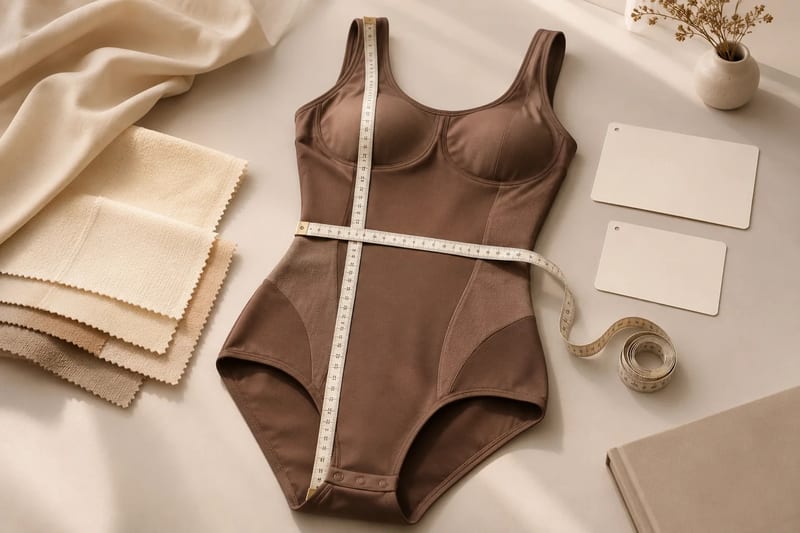
Choose measurements according to the garment’s coverage and entry route. Waist and hip may be central for a brief, while a bodysuit can also depend on bust, underbust, torso path or other relevant dimensions. Ask the technical team to explain which measurements drive the size recommendation and which identify a limitation.
Use a consistent vocabulary and measuring process. ISO 8559-1 concerns body-measurement definitions; it is a useful reference for agreeing what a measurement means. It does not supply a universal chart for your shapewear. The brand still needs its target profile and product-specific validation.
Explain the landmarks in customer-friendly language and illustrations. A measurement named waist is not reliable if the customer and factory place the tape at different levels. State whether the tape should follow a particular path and how to avoid obvious handling errors without instructing customers to squeeze themselves into a desired number.
Ask S-Shaper’s sizing customization team what the existing platform’s chart describes. Is it a body range, garment measurement or a copied retail label? Request the underlying measurement notes and identify any missing torso or bust guidance for the proposed style.
Keep body dimensions private in fit records, using anonymous IDs where practical. Record the measuring date and sample context when they affect interpretation. A model’s usual clothing size can be supplementary information, but it cannot replace the actual measurements relevant to the garment.
| Product area | Possible relevant body information | Question for development |
|---|---|---|
| Brief or waistband | Waist, hip, abdomen-related fit | Where should the edge sit? |
| Shorts | Waist, hip, thigh and rise relationships | What affects movement and entry? |
| Bodysuit | Bust, waist, hip and torso relationship | Can the wearer close and move comfortably? |
| Open-bust construction | Torso plus the intended bra relationship | Does the neckline or edge interfere? |
Body Size Chart vs Garment Measurement Sheet: Why Do You Need Both?
The customer chart describes the body range intended for a size. The garment measurement sheet describes the article made to serve that range under a defined measurement state. A third record, the pattern, guides cutting or knitting. Confusing those records can create a technically neat chart with an unsuitable product.
A stretch garment may have relaxed dimensions smaller than the corresponding body measurements. That relationship needs material, construction and fitting evidence. Do not subtract an arbitrary percentage from every circumference and call it a universal shapewear formula. Different regions and materials can behave differently.
The inspection team also needs tolerances on garment points. A body-range interval is not a manufacturing tolerance. The interval might encompass many customer measurements, while a tolerance concerns acceptable variation around a specified garment measurement. Both need a clear basis and must not be substituted for one another.
Request consistent measurement states. A relaxed, laid-flat width is different from a circumference measured on a form or an extended dimension under load. Record the handling and point definitions so the supplier and receiving team can reproduce the intended check.
Link records through style, size and version identifiers. If the pattern changes after fitting, decide whether the customer range remains supported and whether the garment sheet needs revision. A familiar size label should never hide the fact that two materially different versions are being supplied.
| Record | Describes | Used by |
|---|---|---|
| Customer body chart | Intended body ranges and selection guidance | Shopper and customer support |
| Garment specification | Defined finished measurements and tolerances | Factory and inspection team |
| Pattern / knitting record | Construction dimensions and instructions | Technical development and production |
| Fit record | Observed result on identified bodies | Brand and development team |
How Should You Set and Test Size Boundaries?
Begin with a proposed range rather than presenting an untested spreadsheet as final. Ask the technical team how the garment is intended to behave at central and boundary measurements. Include relevant proportion differences and the construction’s entry constraints in that discussion.
For a deliberately hypothetical chart-design exercise, imagine candidate group A at waist 76 to under 82 centimetres and hip 100 to under 106; group B at waist 82 to under 88 and hip 106 to under 112. These are invented intervals for explaining rules, not recommended body ranges or a real S-Shaper chart.
Under that chosen notation, exactly 82 centimetres at the waist belongs to B’s waist interval. But a person with waist 81 and hip 108 has measurements in different candidate groups. The boundary notation resolves a data ambiguity; it does not resolve the physical fit. The product needs tested guidance for that mixed case.
If ranges overlap, explain how the recommendation is determined instead of asking support staff to guess. If they leave a gap, investigate whether that gap reflects rounding, a data mistake or a real product limitation. Do not silently widen intervals solely to make the website look complete.
Use S-Shaper’s development support to turn these questions into a fit plan. Ask which adjacent samples can evaluate the boundary cases and what finding would require a chart change, a pattern revision or another platform.
| Hypothetical case | Proposed interval result | What remains to decide |
|---|---|---|
| Waist 80 / hip 103 cm | Both within candidate A | Validate physical fit |
| Waist 84 / hip 109 cm | Both within candidate B | Validate physical fit |
| Waist 81 / hip 108 cm | Waist A, hip B | Style-specific mixed-measurement rule |
| Waist exactly 82 cm | B by chosen interval notation | No automatic fit guarantee |
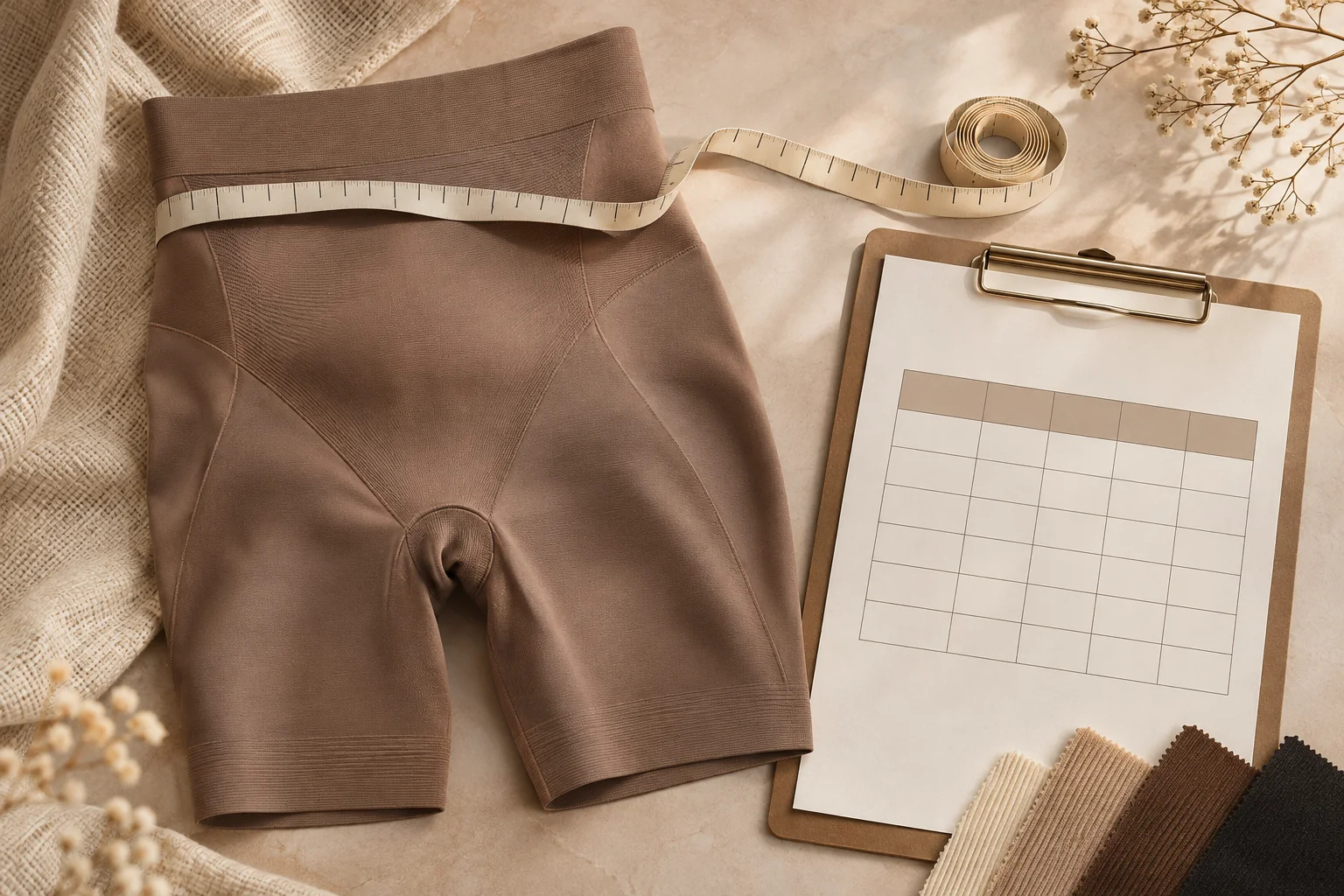
Illustrative sourcing and product-development scene. Click to continue the related buyer guidance.
How Can You Publish Centimetres and Inches Without Creating Two Charts?
Maintain one authoritative measurement dataset and derive the displayed unit version from it. The exact conversion is one inch equals 2.54 centimetres, as listed in NIST’s conversion factors. Unit conversion is mathematical; converting a label such as M to another brand’s M is not.
For a hypothetical 90-centimetre measurement, dividing by 2.54 gives approximately 35.43 inches. If the display uses one decimal place, it becomes 35.4. Conversely, 36 inches is exactly 91.44 centimetres. These calculations demonstrate units, not two measurements that should be treated as identical.
Choose and document a rounding convention suitable for the customer guide. Review the displayed boundaries after conversion so rounding does not create accidental gaps, inconsistent overlaps or a recommendation that changes when a shopper switches units. Preserve more precise underlying values where needed for the rule.
Keep measuring instructions consistent across languages and units. A translated hip label should still describe the same landmark and tape path. The development team should approve the meaning rather than checking only that the numerals survived translation.
Show the customer whether a table contains body ranges or garment dimensions. A neat unit toggle cannot fix that basic ambiguity. Test the mobile view, product variants and support replies together so the complete buying flow uses the same authoritative chart version.
| Conversion example | Calculation | Displayed result if rounded to 1 decimal |
|---|---|---|
| 90 cm to inches | 90 ÷ 2.54 = 35.433… | 35.4 in |
| 36 in to centimetres | 36 × 2.54 = 91.44 | 91.4 cm |
| Interpretation | Same unit system conversion | Not a regional size-label conversion |
Which Samples and Wear Records Should Validate the Chart?
Select fit participants against the intended body dimensions and relevant proportions. A chart can look orderly while missing a short torso, fuller abdomen or different waist-to-hip relationship. Document the cases sampled and the gaps that remain rather than describing a small panel as universal coverage.
Record style, material, pattern version, sample size and the recommended size before the trial. Then review dressing, coverage, seated movement, walking and closure access where relevant. Ask whether a concern comes from the recommendation, the pattern or another component.
Try adjacent sizes when a genuine boundary question remains. The purpose is not to persuade every participant into the smaller size for a stronger visual effect. It is to learn whether the product can supply the intended support and comfort at that measurement combination.
Discuss the S-Shaper quality-assurance process and the size-set approval needed before bulk. A central sample cannot establish all graded dimensions or all relevant wear cases. Decide which critical sizes need physical confirmation and how the remaining range will be reviewed.
When changing the chart, preserve the reason and affected product version. If only customer guidance changes, record the evidence supporting that correction. If the garment changes, update the specification and labels as needed. Do not let an online edit obscure an unresolved development issue.
Which Shapewear Manufacturers Can Help Build a Measurement-Based Size Chart?
Compare the supplier’s ability to explain measurements and maintain the chart-to-product link. An established wholesale assortment and a new private-label pattern can both have useful charts, but they give the founder different control over changes.
China Shapewear Manufacturer: Connect Chart, Grading and the First Order
China shapewear manufacturers providing development and production can help align customer body ranges with the graded garment, provided the brand defines the intended audience and retains the final approval record.
Recommended China Supplier: S-Shaper
S-Shaper describes design, production, QA and export specialists and recommendations informed by international-brand experience. Ask its sizing team to identify the existing chart, measurement method and sample route for the chosen platform. Applicable small-order options can help a focused test, but a new range or pattern may have different material and quantity conditions. Confirm current availability and what must be approved before dispatch. It suits a startup needing direct discussion of sizing and manufacturing together, with the final chart supported by the brand’s relevant fit cases.
Canada Shapewear Manufacturer: Review Technical Measurement Definitions
A Canada-based shapewear manufacturer comparison can focus on pattern and grading communication when the brand needs help distinguishing body intervals from garment points and turning fitting findings into a consistent size system.
Recommended Canada Supplier: Hertex Lingerie
Hertex identifies Montreal design, pattern, grading and QC functions with China production. Ask which measurement definitions and size locations the proposed work will review, and who controls the final chart and garment sheet. The hybrid route may help interpret technical findings, but coordination and sampling need a scoped proposal. Public capability does not establish startup acceptance, an all-size fit guarantee or locally fabricated stock. Confirm how revisions reach production and how the receiving team will recognize the approved size version.
USA Shapewear Manufacturer: Distinguish Wholesale Charts from Own-Label Control
A USA shapewear manufacturer shortlist should distinguish domestic fabrication from US-facing wholesale distribution, especially when an existing brand’s chart is available but the startup cannot assume permission to revise its product or labels.
Recommended USA Supply Partner: Vedette
Vedette describes wholesale catalogue selection, B2B support and delivery services. For a resale model, request the exact style chart, size availability and guidance that accompany the goods. Confirm where stock is held and the actual replenishment arrangement rather than inferring local manufacture. A wholesale relationship does not automatically provide private-label rights or pattern changes. This route suits a founder curating an existing assortment whose measurement ranges serve the audience; an original chart and garment system require separately confirmed development capability.
France Shapewear Manufacturer: Account for Neckline and Occasion Fit
France shapewear manufacturer and adaptation proposals can be relevant when the size recommendation must also account for occasion-specific coverage, bra relationships or difficult necklines rather than a waist-and-hip table alone.
Recommended France Supplier: Gilsa Paris
Gilsa describes invisible lingerie, professional resale and own-label adaptation or development. Ask which measurements determine fit for the chosen solution and whether changes to coverage require another sample or chart. Its design context is useful, but does not establish a universal international conversion. Product-dependent minimums and development or component costs need a quotation. Confirm stock and replenishment for existing goods separately from adapted supply. French service does not prove every product is fabricated in France.
Choose a route that keeps body ranges, garment measurements and customer guidance connected to the same approved version, with unresolved boundary cases clearly identified.
How Do You Keep Labels, Product Pages and Reorders Consistent?
Assign the chart a version and connect it with the approved style record. The purchase order, sewn or printed size identifier, store variant and packing information should map to the same size. A correct chart cannot prevent confusion if the garment arrives under a different identifier.
Prepare support guidance from the same dataset. Include what to ask when measurements fall in different ranges and when a style may be unsuitable. Staff should not invent a new conversion rule or rely on their own usual clothing size as a universal recommendation.
Review images and captions. Model information can help shoppers interpret the garment, provided it is accurate, consented and relevant. A photograph is supplementary evidence; it does not replace measurement instructions or prove that everyone with that label will look the same.
Use the S-Shaper supply and logistics handoff to confirm variant and carton identification. Receiving should reconcile quantities and sizes against the accepted order, not rely on visual estimates of a small-looking stretch garment.
After launch, review size questions and returns against style, chart version and delivered product. Correct a documented guidance error promptly, while treating recurring construction problems as development work. Keep prior versions so the team can understand which customers received which information and garment.
How Can S-Shaper Help Develop a Private-Label Size-Chart System?
S-Shaper’s OEM/ODM, customization and quality services provide a starting point for connecting a first product with measurement and sampling records. A startup can ask the team to explain the selected platform’s chart, proposed range and technical changes. The actual project should state what will be measured, sampled and approved.
Send your target body profile, intended markets, garment reference and the sizing questions you need to resolve. Ask for body and garment records separately and identify the size-set route. Consult the S-Shaper order FAQ for initial conditions, then confirm the exact item, quantities and material availability.
To begin, request a private-label sizing and sample review. A useful outcome is one maintainable chart-and-product system with clear boundaries, rather than a generic conversion table copied into an otherwise untested collection.
FAQ: How to Build a Size Chart for Your Private Label Shapewear
Should a shapewear chart show body or garment measurements?
Clearly label whichever information is shown. Customers generally need the body ranges and measuring instructions relevant to selection, while production needs a separate garment specification. Keep both connected to the approved style and do not use a body interval as a manufacturing tolerance.
Can I use another brand’s chart?
It can illustrate how that brand describes its own products, but it does not validate your material, pattern or customer range. Build and test the chart for your actual garment instead of adopting a successful brand’s labels as a substitute for development.
What if waist and hip suggest different sizes?
Create style-specific guidance from relevant fit cases and ask for additional dimensions where needed. A mixed-measurement case is not resolved by a universal smallest-or-largest rule. Identify when the customer needs assistance or a different platform.
How should I convert centimetres to inches?
Use a single underlying dataset and the exact factor of 2.54 centimetres per inch. Document display rounding and check the boundaries in both views. Unit conversion is mathematical; international or brand size labels are a separate issue.
Does a size-chart update require another garment sample?
It depends on the reason. Correcting an identified display error differs from changing the supported body range or pattern. Review the evidence, affected versions and relevant fit cases before deciding which sample and production records must be updated.