 EN
Quick Answer
Choose shapewear fit models by the body measurements and proportions your product must serve, not by appearance or a usual clothing-size label. Include the relevant base size, critical range locations and differences such as torso length, waist-to-hip relationship or bust needs. Record which cases the panel covers and which remain untested.
Use identified samples and consistent tasks: dressing, movement, seated wear, coverage and closure access as appropriate. Collect anonymous measurements and specific feedback with consent. A participant should be able to decline photos or stop wearing an uncomfortable garment without pressure.
A startup does not need to pretend a small panel represents a whole national market. It needs a focused development plan that can reveal important failures and guide the next correction. Separate fit approval, wear feedback and campaign photography, then release only the range supported by the work completed.
Which Body Measurements and Proportions Should Guide Recruitment?
Start with the garment’s coverage and the customer profile. A brief and a full bodysuit do not require identical selection criteria. Identify the measurements most likely to affect entry, positioning and comfort, then ask the technical team how to define and record them consistently.
ISO 8559-1 provides a body-measurement vocabulary. Use relevant definitions and clear instructions instead of informal descriptions such as average curves. Height, waist and hip can be useful, while a particular bodysuit may require a defined torso measurement and bust relationship as well.
Recruit by actual measured cases rather than a model agency’s label alone. Someone who usually buys M may use different sizes across brands. That usual label can be recorded as context, but it is not the development input that makes the fitting interpretable.
Ask S-Shaper’s sizing customization team which proportions the proposed platform is designed to address and which concerns need investigation. If the supplier cannot yet define the range, make that a development question rather than filling every fit slot with a convenient participant.
Avoid collecting unrelated personal information. The useful record connects an anonymous participant to relevant measurements, sample and observations. Describe what the session is for and who needs access to the technical record. Fitting should help understand the product without turning a person’s body into a public marketing asset by default.
| Platform | Recruitment question | Relevant variation to investigate |
|---|---|---|
| Brief | What controls waist and lower coverage? | Waist-to-hip and abdomen relationships |
| Shorts | What affects entry and thigh comfort? | Rise, hip and thigh proportions |
| Bodysuit | What affects shoulder-to-closure fit? | Torso and bust relationships |
| Occasion solution | What outfit must remain compatible? | Neckline, bra and coverage needs |
Fit Model vs Campaign Model: Why Should the Briefs Be Different?
A fit model helps evaluate whether a garment meets a defined technical and wearing requirement. A campaign model helps communicate the product visually. One person may do both roles with clear agreement, but the purpose and evidence are different.
A pleasing photograph cannot establish ease of dressing, movement or sustained positioning. It may show a pose that never reveals an uncomfortable closure or a rolling edge. Likewise, a valuable fitting participant need not match the brand’s preferred photographic presentation to provide useful development evidence.
Write separate briefs. The fit session needs measurements, sample identity, tasks, observations and consent for any technical images. The campaign session needs an accurate approved product and clear permission for how images will be used. Do not assume a participant’s agreement to private fitting includes public advertising.
Avoid choosing only people on whom the first sample looks best. That can hide the very proportion difference the product claims to serve. Select meaningful cases and treat an unsuitable result as information about the garment or recommendation, rather than a reason to exclude the participant from the record.
Budget the roles deliberately. Ask providers or participants to agree compensation, time and deliverables without inventing a universal rate. The technical value comes from a reproducible, respectful process, not from how polished the session appears in a behind-the-scenes image.
| Purpose | Fit session | Campaign session |
|---|---|---|
| Primary output | Technical observations and decisions | Accurate product communication |
| Selection basis | Relevant measurements and proportions | Agreed visual and audience brief |
| Garment status | Identified development version | Approved customer-facing product |
| Image use | Specified technical permission | Separate agreed publication permission |
| Approval meaning | Evidence for the defined cases | No automatic range validation |
How Can a Small Startup Build a Focused Fit-Model Matrix?
List the technical questions before counting participants. Perhaps the base sample is unresolved, the upper size needs a coverage review or the boundary between two sizes needs guidance. Those questions determine which cases are useful. A single large total does not prove that the important cases are present.
For a deliberately hypothetical plan, choose three size locations and two relevant proportion cases at each. That creates six case slots. If every case evaluates two versions, it creates 12 fitting sessions. It still represents six case slots, not 12 independent people or a statistically representative sample.
Suppose one participant can attend only one version session. The completed plan then contains 11 sessions out of the chosen 12, or about 91.7% of the scheduled sessions. That is a scheduling completion measure, not a 91.7% customer-fit coverage claim. Preserve the missing comparison rather than treating its absence as a pass.
Formal population coverage is another task. ISO 8559-4 addresses body-table coverage against selected dimensions of a target population. A small convenience fit panel cannot be relabeled as such a population database. Keep descriptive session arithmetic separate from a market-coverage estimate.
Use the matrix to choose the next useful participant or sample, not to decorate the project with a large-looking number. If a crucial case remains missing, explain what remains uncertain and whether it blocks the intended range approval.
| Hypothetical plan | Chosen count | Interpretation |
|---|---|---|
| Size locations | 3 | Specific technical locations |
| Proportion cases per location | 2 | Six planned case slots |
| Versions per case | 2 | 12 sessions, not 12 participants |
| One session missed | 11 ÷ 12 = 91.7% | Schedule completion only |
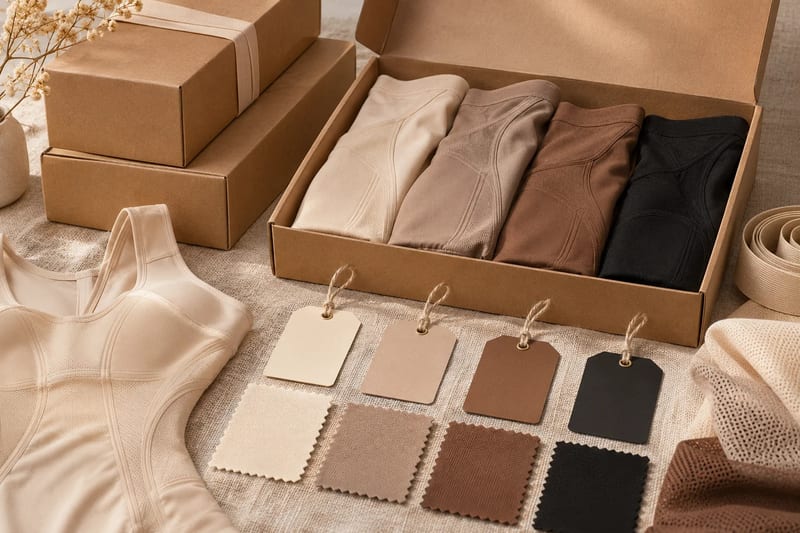
Illustrative sourcing and product-development scene. Click to continue the related buyer guidance.
What Should Happen During a Shapewear Fit Session?
Confirm the participant’s relevant measurements using the agreed method and record the sample identifier. Include material, size, pattern version and care state. If a sample is made with substitute fabric, state that before drawing a conclusion about the final construction.
Explain dressing instructions and allow the participant to put on the garment privately. Observe only what has been agreed. Ask whether entry, closure access and removal are practical; an article that looks suitable once positioned may still be difficult for its intended customer to use.
Use tasks appropriate to the brief. Standing, sitting, walking and reaching may reveal different issues. An occasion garment can also need a check under the specified outfit. Record location and timing rather than asking only whether the sample feels good.
Separate observation from interpretation. A participant can report the waist edge folding while seated; the technical team can investigate its cause. Do not rewrite the observation as fabric too weak before considering rise, tension, panel or pattern effects.
Review S-Shaper garment references and the OEM/ODM sample route when planning the session. The purpose is a specific product decision, such as whether another torso proportion or edge construction is needed. Stop or remove an uncomfortable garment rather than treating endurance as proof of a good fit.
How Should You Record and Compare Fit Feedback?
Use a consistent form that records the issue, place, activity and sample. Include positive findings too, especially when a revision should preserve a successful feature. A technically useful comment is specific enough that another person can understand what needs investigation.
Keep the wearer’s words distinct from the technical response. For example, a shoulder-pulling report may lead to checking torso length, strap position and closure geometry. It should not automatically trigger longer straps alone. Assign the investigation to a named role and record the proposed change.
Avoid averaging away a critical failure. A generally positive panel cannot cancel a participant’s inability to use the closure in a case the product claims to serve. Review whether the issue is isolated to a sample discrepancy, a proportion limit or a broader construction problem.
Discuss S-Shaper’s quality-assurance process and how dimensional checks can help distinguish a faulty sample from the intended pattern. The fit record and measurement sheet should support one another without pretending that either is sufficient alone.
Keep comparisons conditional. If versions differ in both fabric and pattern, state that the result concerns two assemblies. If a participant’s conditions changed, record it. Clear limitations make the findings more useful for the next prototype and prevent a small development exercise becoming an unsupported performance statistic.
| Wear observation | Technical question | Decision record |
|---|---|---|
| Waist edge folds when seated | Rise, edge or panel relationship? | Investigate and identify revision |
| Closure pulls during reaching | Torso path or component position? | Compare controlled alternative |
| Thigh edge feels localized pressure | Opening, trim or recommendation? | Review relevant measurements |
| One size differs unexpectedly | Sample discrepancy or grade issue? | Verify identity before changing range |
Which Shapewear Manufacturers Can Help Organize Fit-Model Findings?
Compare how the supplier receives body measurements, interprets observations and controls revisions. The useful route depends on whether you are developing a new pattern or evaluating an existing assortment for resale.
China Shapewear Manufacturer: Turn Session Findings into Sample Changes
China shapewear manufacturers with development and quality teams can be assessed through their ability to connect anonymous fit cases with the actual pattern, material and component changes proposed for production.
Recommended China Supplier: S-Shaper
S-Shaper describes design, production, QA and export specialists and recommendations informed by work across international markets. Ask the development team how it wants measurements and session findings supplied and which sample will answer each unresolved question. Item-dependent small-order tests can be relevant, while a new pattern or material may create another scope. Confirm sample availability, approvals and material readiness before dispatch planning. This route suits a founder who can provide structured feedback and needs direct technical communication rather than an unqualified assurance that every body will fit.
Canada Shapewear Manufacturer: Prioritize the Interpretation of Body Proportions
A Canada-based shapewear manufacturer comparison can emphasize local technical interpretation when the founder needs help choosing meaningful body cases and converting their observations into pattern and grading work.
Recommended Canada Supplier: Hertex Lingerie
Hertex identifies design, pattern, grading and QC in Montreal with production in China. Ask which fit-planning or revision tasks the proposed service includes and how the approved findings reach the factory. The model can help where technical interpretation is the main gap, but it does not establish that recruitment, sessions or every size are included. Coordination and startup eligibility need confirmation. Canadian involvement does not imply Canadian-made sample stock or rapid local replenishment; agree the actual sample and production handoff.
France Shapewear Manufacturer: Test the Intended Outfit and Coverage
France shapewear manufacturer and adaptation proposals can be relevant when fitting depends on occasion-specific clothing, neckline coverage and bra relationships as well as the participant’s waist and hip measurements.
Recommended France Supplier: Gilsa Paris
Gilsa describes invisible lingerie, bridal and difficult-neckline solutions, with professional resale and own-label adaptation or development. Ask which outfit and body cases should be reviewed for the proposed article and what adaptation is feasible. Design context does not prove fit on your target panel. Product-dependent minimums, component work and development require a quotation. Confirm stock availability for existing goods separately from the preparation needed for an adapted style. French commercial service does not establish that every product is fabricated in France.
USA Shapewear Manufacturer: Evaluate Existing Wholesale Styles on Your Audience
A USA shapewear manufacturer shortlist should separate domestic production from US-facing distribution when the founder’s immediate task is fitting an existing wholesale assortment rather than commissioning a revised pattern.
Recommended USA Supply Partner: Vedette
Vedette describes wholesale style and size selection, B2B support and delivery. Ask for current sample availability and the style-specific chart, then recruit the relevant measurement cases to assess the actual goods. Confirm where stock is held and what replenishment terms apply. Wholesale access does not automatically allow relabeling or fit changes, and US-facing service does not prove US manufacture. This route suits a resale model whose available products serve the audience; original fit development needs a separately verified service.
Choose the partner that can use your fit records to make a clear next decision, with the model-selection gaps and sample limitations visible.
When Is Fit-Model Evidence Sufficient to Approve the Next Stage?
Define the stage being approved. A base fitting can authorize a controlled revision or a size-set request without releasing bulk. Do not let an enthusiastic session become an undefined approval of every size, material and component.
Review the cases completed, unresolved observations and required corrections. Confirm that the technical team has an identifiable final sample and that the customer chart remains supported. If a relevant proportion has not been evaluated, decide whether the gap limits the intended claim or requires another session.
Keep the release record short and precise. State the approved version, purpose, conditions and who authorized it. Archive earlier comments and specimens separately so production does not accidentally follow a rejected change.
Use the S-Shaper supply and logistics discussion to connect approved sizes and materials with the actual order. A fit session does not reserve stock or guarantee warehouse arrival. Identify procurement and production dependencies before scheduling a launch.
After selling, compare customer questions with the cases already evaluated. New evidence can reveal an overlooked proportion or an inaccurate recommendation. Revisit the relevant development question without claiming that the original small panel guaranteed a particular return rate or universal customer satisfaction.
How Can S-Shaper Help a Startup Use Fit-Model Evidence?
S-Shaper’s OEM/ODM, customization and quality services provide a starting point for discussing how a specific shaping product will be sampled and revised. A startup can ask the team to connect material and pattern decisions with the body cases the brand needs to evaluate. The proposal should specify what technical support is included.
Send the product reference, target measurements, planned fit cases and precise observations from any existing sample. Ask which comparison will answer the most important remaining question and what approval it can support. Consult the S-Shaper order FAQ for initial conditions before confirming the selected sample and production route.
To begin, request a fit-led shapewear sample discussion. Seek useful interpretation and traceable revisions, while the brand maintains responsibility for participant consent, the target customer promise and the range it ultimately offers.
FAQ: Choosing Fit Models for a Startup Shapewear Collection
Can my campaign model also be a fit model?
Yes if the roles, measurements, session purpose and permissions are clearly agreed. A photo shoot alone does not create a technical fit record, and permission for private fitting images should not be assumed to include public advertising.
How many people should try the first sample?
Choose cases based on important sizes, proportions and unanswered product questions. There is no universal number here that guarantees coverage. Record the panel’s limits and prioritize missing cases that could change the decision before approving the intended range.
Should I recruit by clothing-size label?
Use the actual body dimensions relevant to the garment. A usual label varies between brands and can be context only. Record torso, bust or other proportions where they matter rather than expecting waist and hip alone to explain every fit issue.
Can I average the feedback into one approval score?
A summary can help, but it should not conceal a critical failure or a missing case. Keep observations by participant, sample, location and task. Decide whether each issue needs a measurement check, recommendation change, construction revision or another fitting.
Does a small fit panel prove market coverage?
No. A small targeted development panel can reveal useful issues, but it is not automatically a population database or statistically representative study. Keep scheduling and descriptive calculations separate from claims about national coverage or guaranteed performance.