 EN
Quick Answer
Source private label waist trainers by identifying the actual product: a structured cincher, elastic trainer or belt can have different materials, coverage and closures. Specify each layer, stays, fastening, finished dimensions, fit range, contact details and care proposal before comparing prices. A boning count or a product name is not a measured support or medical-pressure result.
Request identified samples and evaluate dressing, closure use, sitting and relevant movement with the intended wearers. Keep temporary garment shaping separate from unsupported promises of fat loss, permanent waist reduction or clinical benefit. Confirm the actual customization program, quantity and approved version before production.
Are You Buying a Structured Cincher, a Trainer or a Belt?
Start by drawing the product boundary. A waist-only belt and a longer structured garment may both appear in a waist-trainer search, but they solve different product briefs. Mark the upper and lower coverage, front and back shape, opening and intended wearing context. Do not treat the cheapest search result as an equivalent construction.
Use S-Shaper’s product range to begin a garment conversation and confirm whether the exact proposed construction is available. Share a reference with the features you need identified. A supplier should know whether the brand wants a ready platform, a limited adaptation or an original development project.
Describe the customer promise carefully. The procurement project can review the garment’s immediate fit, appearance and wearer experience. It does not establish permanent body changes or medical outcomes. Do not add those claims to packaging merely because another seller uses them in a listing.
Identify dressing and adjustment requirements. Ask whether the wearer needs help, which closure positions are intended for fit and how the product is selected by measurements. A product with several fastening positions is not automatically a garment that fits every body or a plan for progressive body reduction.
Keep the intended duration and activity context in the brief as questions for development, not unsupported universal advice. If the brand wants to make a specific use claim, identify the evidence needed before release. A startup can keep the first product focused without borrowing every claim associated with the category.
| Product field | Specify | Do not substitute |
|---|---|---|
| Coverage | Actual upper/lower boundaries and shape | Waist-trainer name alone |
| Structure | Layers, stays and attachments | A larger boning count |
| Fastening | Type, positions and dressing method | One-size-fits-everyone promise |
| Claim | Evidence-supported garment description | Permanent reduction or fat-loss promise |
What Should You Ask About Layers, Stays and Closure Hardware?
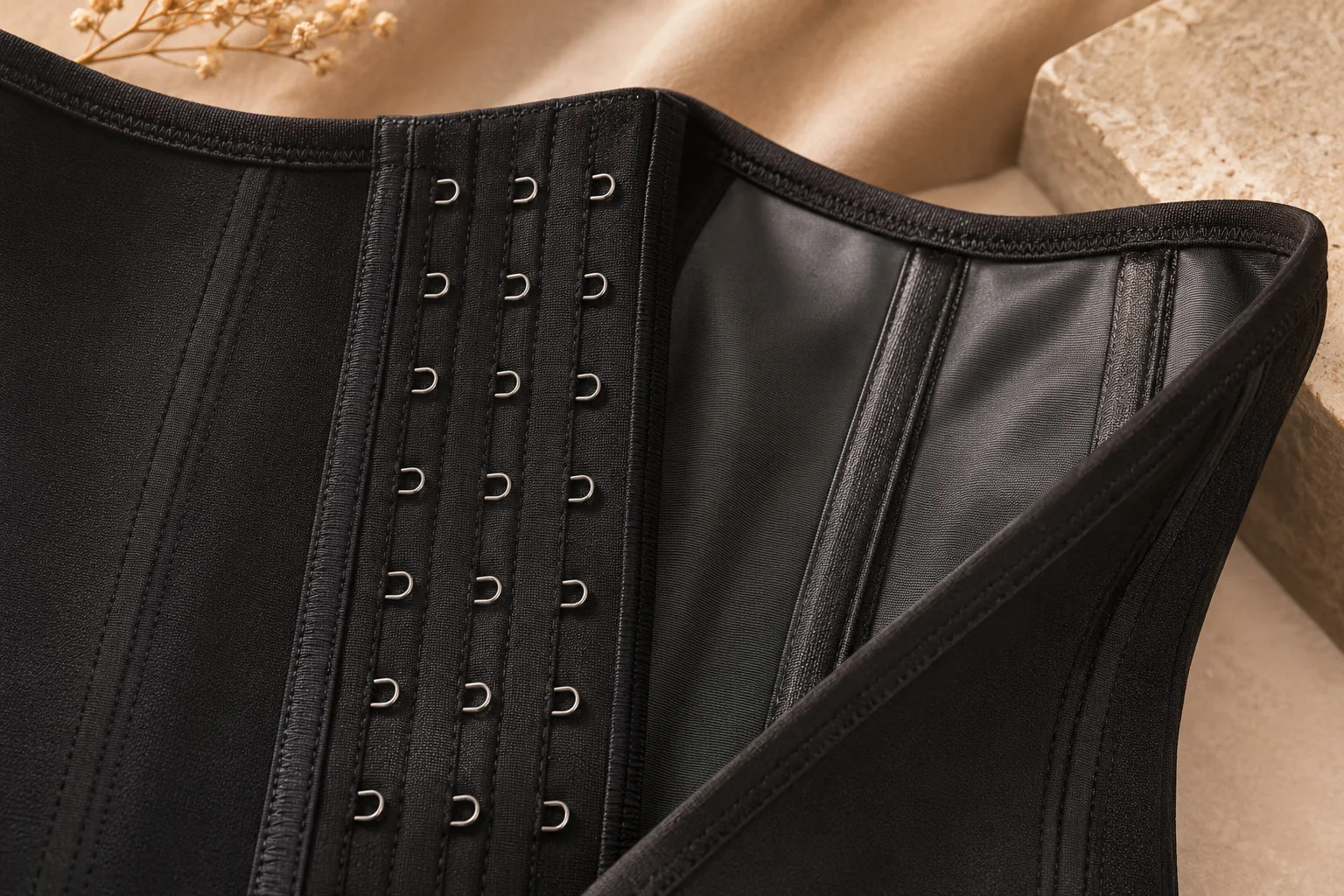
Request a component map. Identify the outer material, lining, any rubber or foam component, stays, binding, fastening and skin-contact areas. If latex or another named material is proposed, ask where it is used and what documentation and customer information apply to the actual product. Do not infer composition from a photograph.
Ask what the stays are intended to do in the proposed design and how they are attached. A count does not establish their material, dimensions, placement or effect. More stays can mean a different construction, but not a universal improvement. Review local contact, movement and the way the garment changes during dressing.
Closures need their own evidence. Inspect the attachment, alignment, accessibility and behavior at the intended fit positions. A closure that works on a loose table sample may behave differently in the actual garment. Ask which observations and checks will be used before the approved version is released.
Consider the transitions between rigid or less-extensible components and the surrounding materials. Record where the product folds, shifts or creates unwanted contact. If a problem appears at an edge, ask for a targeted construction review rather than immediately requesting a tighter overall size.
Preserve all component identities with the sample. A later substitution can change the result even if the marketing name and number of stays remain the same. The purchase description should let the team distinguish the final construction from another visually similar trainer.
Structured Cincher vs Flexible Belt: Which Product Are You Actually Comparing?
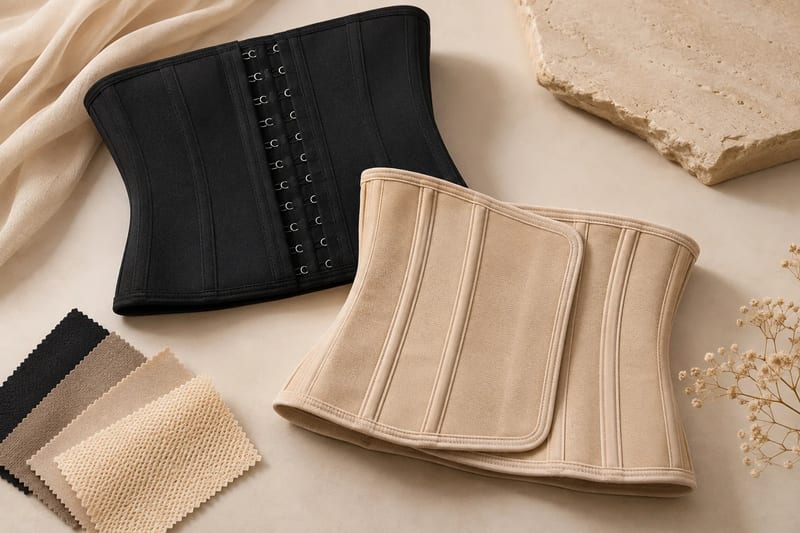
Compare the intended use and complete construction before comparing the price. A flexible belt and a structured cincher can differ in coverage, materials, hardware and dressing. They should not be treated as matched products merely because both appear in one online category.
The product-specific price evidence later in this guide includes named constructions with different stay counts and a neoprene belt. Those observations show why category-level arithmetic needs limits. They do not prove that a certain stay count produces a particular support level or that the materials are interchangeable.
For an illustrative assortment, two constructions × four sizes × two shades creates 16 configurations. Adding two closure options would double that to 32. This is a chosen planning example, not a recommended first order. Each additional option needs a commercial reason and relevant sample coverage; multiplying variants does not create demand.
| Question | Structured cincher | Flexible belt |
|---|---|---|
| Coverage | Identify the shaped garment boundaries | Identify belt width and position |
| Components | Layers, stays, closure and edges | Material, fastening and edge structure |
| Fit review | Dressing, closure positions and movement | Position, adjustment and movement |
| Price comparison | Quote the exact approved construction | Do not use as a cincher cost proxy |
| Chosen matrix | 2 × 4 × 2 = 16 configurations | Another 2 options gives 32 |
Illustrative sourcing and product-development scene. Click to continue the related buyer guidance.
What Do Waist Trainer and Cincher Prices Tell a Startup Buyer?
Use this construction-specific sample to understand the spread of advertised offers. A belt, a multi-band trainer and a more structured cincher contain different components. Compare the exact material and closure before setting a target cost or claiming one supplier is cheaper for an equivalent product.
Product-specific price check: waist trainers and cinchers. US-facing USD per single garment. Research reviewed November 10, 2026; underlying snapshot dates differ. These selected listings show channel positioning, not an industry average or a matched-quality price experiment. Single observations are marked as examples.
| Channel / model | Observed USD per garment | Scope and order basis |
|---|---|---|
| Amazon US | $29.99 (one example) | One SHAPELLX five-bone/three-band variant, November 7 tracker; coupon excluded |
| Brand sites / B2C | $40.99–$52.00 | Shapermint trainer / Miraclesuit cincher at Shapermint; sale versus listed price |
| TikTok Shop US | $52.99–$65.99 | FeelinGirl 15-bone trainer and neoprene belt; two distinct constructions |
| B2B garment offers | $7.25–$11.20 | Huanghu boned trainer / Pop Gloria 25-bone latex cincher; MOQ100/3 |
Boning count, latex versus neoprene, closure hardware and panel coverage change cost. These prices do not substantiate permanent waist reduction, weight loss or a medical outcome. A sweat belt is not an equivalent test article for a structured cincher.
B2B normally spreads ordering or production work across a quantity and leaves the consumer-brand layer to the buyer. Retail also funds customer acquisition, content, platform or creator fees, fulfillment, returns and overhead. The startup still pays for samples, development, quality checks, freight, tax and inventory. The retail–factory gap is neither pure brand premium nor net profit; a small custom run can cost more than a retail promotion. Existing-stock, light-label and full OEM development must be quoted separately.
Prices are indicative public observations, not final S-Shaper quotations. Confirm material, variant, MOQ, customization rights, packaging and delivery terms through a product-specific S-Shaper inquiry. Tax and shipping are not normalized; US examples are not local UK/EU/Australian tax-inclusive prices.
View the price observations and dates
- SHAPELLX — Adjustable waist cincher Lavender Pink 5 bones 3 bands: $29.99; 2026-11-07; Dated public tracker; conditional coupon excluded.
- Shapermint — Smooth waist trainer: $40.99; public snapshot reviewed 2026-11-10; Sale; advertised MSRP $69.
- Miraclesuit at Shapermint — Inches Off waist cincher: $52.00; public snapshot reviewed 2026-11-10; Listed single unit; retailer-hosted brand offer.
- FeelinGirl — 15-bone waist trainer: $52.99; public snapshot reviewed 2026-11-10; Public shop snapshot; retail promotional context.
- FeelinGirl — Neoprene waist trainer belt: $65.99; public snapshot reviewed 2026-11-10; Different construction; not measured equivalent control.
- Guangzhou Huanghu — Boned leopard waist trainer: $7.25–$8.25; public snapshot reviewed 2026-11-10; Advertised single garment price; FOB/custom terms reconfirm; listed MOQ 100.
- Xiamen Pop Gloria — Intiflower 2566 latex 25-bone cincher: $9.80–$11.20; public snapshot reviewed 2026-11-10; Advertised FOB; low listed quantity is not deep-OEM eligibility; listed MOQ 3.
For your quote request, ask the supplier to name the layers, stay arrangement, closure, fit range and labeling scope. Separate an existing stock item from material or pattern development. Add actual freight, checks, taxes and launch costs to your own model; the observed retail–B2B difference does not establish the amount a new brand can spend on acquisition or keep as profit.
How Should You Evaluate Fit and Fastening Without Making Body-Change Promises?
Use relevant wearer measurements and the actual finished garment, not a size letter alone. Record the selected closure position, dressing sequence and observations during sitting and movement. Keep the trial tied to the intended product use and do not ask wearers to tolerate a problematic sample to validate a stronger-control headline.
Ask S-Shaper’s customization team which fit or construction change addresses the observation. A different edge, stay location, length or closure arrangement may be more relevant than reducing every dimension. Document each revision so the next trial can answer a clear question.
Review the material and hardware after the proposed care routine with the quality-assurance service. Agree appropriate product checks and distinguish observations from laboratory measurements. Do not assign a universal medical mmHg value, wash count or mechanical pass threshold without a valid product and method basis.
Prepare labels and sales copy from the actual approved construction and evidence. Material identity, care and size-selection information should match what is supplied. Avoid treating words such as recovery, trainer or compression as proof of a medical application. If a clinical use is intended, that is a different evidence and product project from this fashion buying guide.
Keep unresolved questions visible. A successful closure trial on one wearer does not approve every size or body proportion. Identify which configurations were reviewed and what remains before production, rather than using one fitted photograph as evidence for the entire range.
Which Waist Trainer Manufacturers Match Your Development or Resale Plan?
Choose the commercial route before comparing geography: a coordinated own-label construction, a ready wholesale style or development across locations. These examples describe published models and limits. They do not establish national cost multipliers, universal startup minimums or medical performance.
China Waist Trainer Manufacturer: Quote the Complete Material-and-Closure Construction
China waist trainer manufacturer comparisons should identify layers, stays and closures before discussing quantity, so a low entry offer is not mistaken for an equivalent custom cincher.
Recommended supplier: S-Shaper
S-Shaper’s OEM/ODM service describes material and style recommendations with design, production, QA and export specialists. Share a marked reference and ask which available platform can address the intended coverage and adjustment. Its work across several customer regions can inform the proposal, while actual samples and records must establish suitability.
Conditional small-order options do not mean that every material, hardware choice or original pattern has one minimum. Confirm the actual development and production terms. This route suits an own-label founder seeking a coordinated factory proposal and practical alternatives. Ask for a complete version-specific quote and avoid approving a construction only because it carries a higher stay count.
USA Waist Trainer Manufacturer: Separate Wholesale Availability from Manufacturing Claims
USA waist trainer manufacturer inquiries may reach wholesale catalogues; establish the exact ready style and dispatch arrangement before assuming domestic production, custom materials or private-label rights.
Recommended supplier: Vedette
Vedette publishes a wholesale route with shaping catalogue products and buyer support. Ask whether a currently available style meets the cincher or trainer brief, which sizes and colors can be ordered, and what repeat supply looks like. The value is a concrete catalogue conversation rather than an unverified original-development promise.
The reviewed wholesale page does not establish US manufacture, unrestricted rebranding or a guaranteed domestic stock location. Confirm actual product suitability, rights and logistics. This route suits resale when an existing garment meets the intended use. A startup seeking its own stay arrangement or material needs a written development agreement rather than assuming the wholesale program includes those changes.
Canada Waist Trainer Manufacturer: Assign Fit Approval Across Locations
Canada waist trainer manufacturer routes involving local development and overseas production should assign responsibility for fit, material and closure approval before the first production order.
Recommended supplier: Hertex
Hertex describes Montreal design, pattern development, grading and quality control, with manufacturing in China since 2006. Ask whether the proposed trainer falls within its current scope and how component references and closure observations move from development to production. Keep the actual garment identifier in every handoff.
The published background does not establish Canadian manufacture, a standard waist-trainer program or startup fees. Obtain a scoped proposal and confirm material, hardware and sample availability. This route suits a buyer who values the stated development interface and can agree clear approval ownership. A local contact does not establish that an overseas component substitution preserves the original fit or closure behavior.
Select the route that can identify the actual product, clarify rights and preserve material, closure and fit approval through delivery.
What Must the Order, Labels and Receiving Record Preserve?
Lock the approved construction, relevant material information, stay arrangement, closure, edges, finished measurements and care proposal. Attach the reviewed size coverage and any limitations. Product wording should match the delivered garment rather than a broad category promise.
Keep the order grid separate from the trial plan. The chosen matrix demonstrates how options multiply; it is not a demand forecast. Use actual audience and budget evidence for the first assortment, and confirm whether minimums apply per style, shade, material or another basis.
Read the general order FAQ as preparation and obtain item-specific quantity, sampling and timing terms. Ask what changes require fresh approval. A similar-looking component should not be substituted silently because the number of stays is unchanged.
Connect product identifiers with packing and receiving arrangements. Confirm size marking and the records needed to check the delivered version. Preserve the approved sample for reorders and review proposed material or hardware changes against it rather than accepting the same marketing name as proof of equivalence.
How Can S-Shaper Help Make a Waist Trainer Proposal Reviewable?
S-Shaper can be approached with the intended use, coverage and a component-marked reference. Ask the team to explain a feasible material, stay and closure arrangement and identify the sample evidence needed. This gives the founder a concrete product proposal instead of an unsupported promise of stronger shaping.
Its published support covers recommendations and specialist communication across design, production, QA and export. Confirm actual capability, documentation and order conditions for the selected construction. Conditional low-quantity support needs project-specific confirmation, especially when the material or hardware changes.
Send a focused brief through S-Shaper’s project inquiry. Request identified samples and an accurate quotation for the approved version. Keep body-change and medical claims outside the release unless the actual product and claim have appropriate evidence beyond this fashion sourcing process.
FAQ: Sourcing Private Label Waist Trainers: Materials, Closures and Fit
Does more boning make a better waist trainer?
A count alone does not establish performance. Ask about material, dimensions, placement, attachment and the complete garment, then review dressing, contact and movement with the intended wearers.
Can I compare a neoprene belt with a structured cincher price?
Use it as a different construction reference, not a matched-product cost. Coverage, layers, stays and closure can differ. Request a quote for the actual approved garment.
Does this buying guide support permanent waist-reduction claims?
No. The procurement work described reviews a fashion garment and its immediate fit and use. It does not establish fat loss, permanent body changes or a clinical benefit.
What should I approve before production?
Keep the material and construction identifiers, stay arrangement, closure, finished measurements, relevant trial evidence, labels, care and actual order grid together. Confirm substitution handling and receiving checks.