 EN
Quick Answer
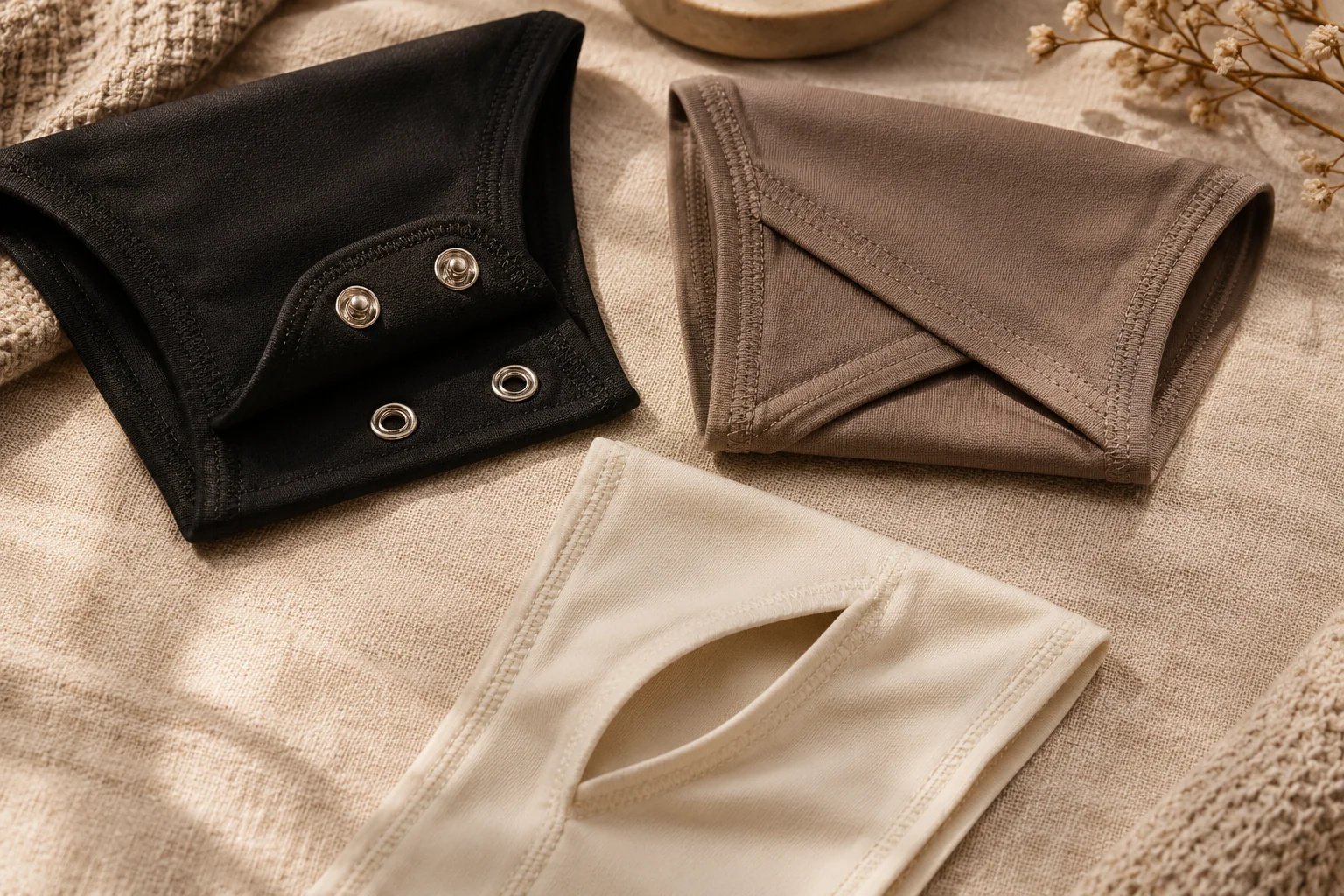
Choose a shapewear bodysuit gusset by reviewing dressing, toilet access, coverage, contact and the actual closure construction with intended wearers. Open, overlap and snap-flap arrangements create different product questions. A photographed opening is not proof that the design is convenient, durable or suitable for every body proportion.
Specify the gusset material, dimensions, position, attachment and any fastener. Evaluate operation and wearer use separately from mechanical tests. For snaps, distinguish resistance to unsnapping from attachment holding strength; a larger number from another test is not automatically a better closure. Approve the identified garment and relevant after-care evidence before production.
What Must the Gusset Allow the Wearer to Do?
Begin with the entire dressing and use sequence. Identify how the bodysuit is put on, adjusted, opened or moved for toilet use and removed. A design can be technically operable while still difficult for the intended wearer to reach or align. Ask the developer to consider the sequence, not just the flat opening.
Choose an actual platform from S-Shaper’s product catalogue or the project drawing. Mark the intended bra arrangement, torso coverage, leg style and lower opening. Gusset decisions interact with the body construction and should not be detached from the garment reference.
Describe coverage and contact requirements in observable terms. Ask which edges or hardware contact the wearer and how the lower area behaves during sitting and walking. Do not assume a cotton lining or another component description establishes hygiene, skin compatibility or a medical benefit.
Identify relevant wearer proportions and the size-selection basis. A closure location can be experienced differently when torso fit changes. A comfortable upper body does not approve the lower opening, and a working snap on the table does not establish reach or use in the actual garment.
Avoid a convenience promise before the design is reviewed. Easy bathroom access can mean different things to different wearers and constructions. State the actual arrangement and evidence rather than guaranteeing an effortless experience for everyone.
| Use question | Record on the sample | Avoid assuming |
|---|---|---|
| Dressing | Sequence and adjustments | Flat operation equals wearer convenience |
| Access | Reach, opening and reclosure | A photo proves practical use |
| Coverage | Initial and task-state position | One torso fit approves every proportion |
| Contact | Edges, layers and hardware location | Component name proves skin or hygiene claims |
What Should the Gusset Material and Attachment Specification Include?
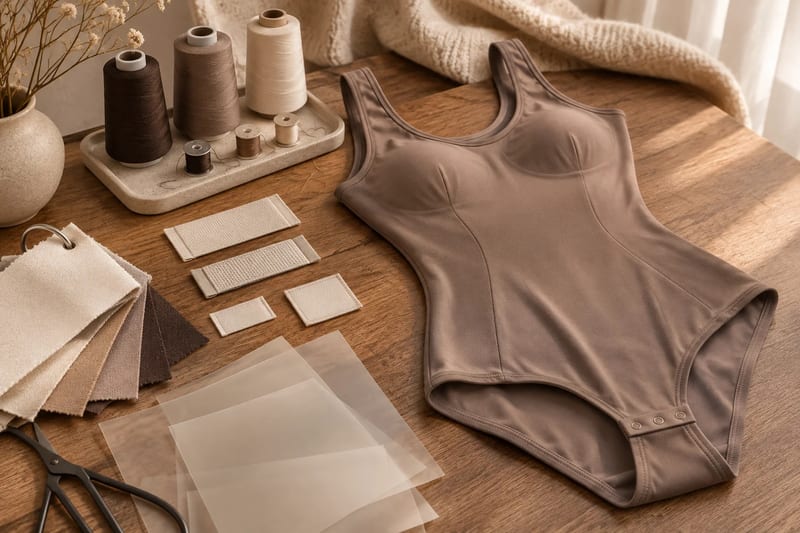
Identify the gusset and lining as components, including material references, dimensions and attachment. If a lining is described by fiber content, clarify which component that statement covers. The main body and gusset can have different compositions and roles.
Mark the opening shape, overlap or flap direction and relevant seam or edge construction. Ask how the developer controls the transition to surrounding fabric. A smooth outer appearance can hide an internal edge or attachment that still needs contact review.
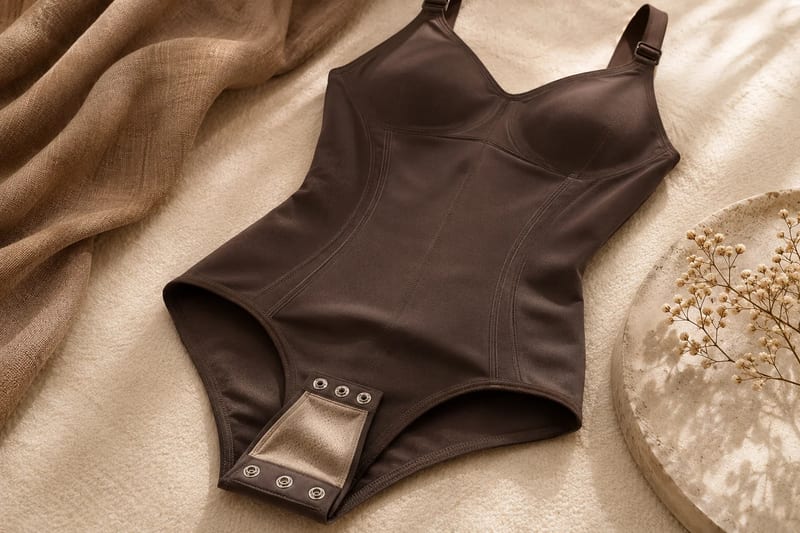
If snaps are used, identify the actual fastener, number, positions and mounting arrangement. Ask what materials and reinforcement are proposed and whether the sample reflects production inputs. A same-looking replacement can have a different operating or attachment behavior.
Keep the gusset linked to the torso and lower-body dimensions. A pattern revision elsewhere can change the location and demand on the closure. Ask which related points need another trial if the body length, rise or opening changes.
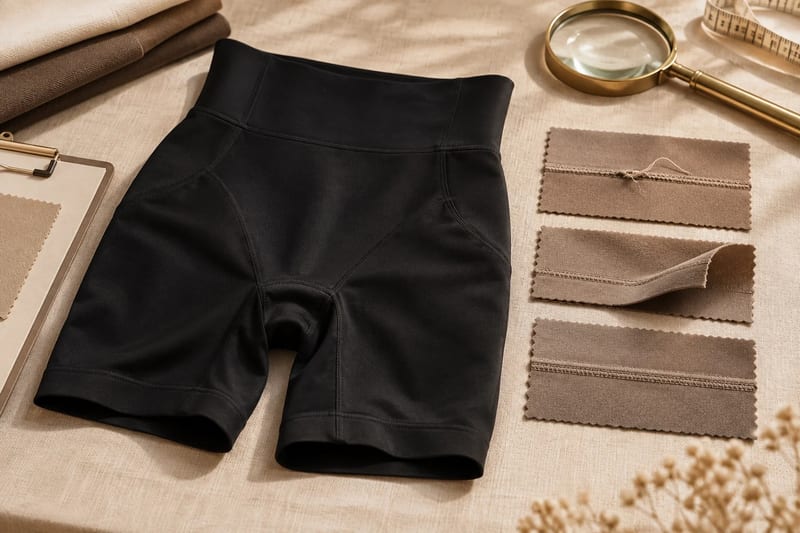
Review care compatibility of the assembled area. The fabric, lining, thread, fastener and any reinforcement belong to one product, even if their individual descriptions look suitable. Request the relevant checks for the proposed routine rather than inferring durability from a new sample’s appearance.
Keep accessibility and size guidance concrete. A closure can be reachable for one tester while another with relevant proportions needs a different arrangement. Record the actual task and garment rather than generalizing from either person. Ask whether the intended product should accommodate both situations or whether its wearer guidance needs a clear limit. Do not claim an adaptive or universally accessible design without the appropriate development and evidence. The practical aim is to understand the chosen garment’s use and decide which unresolved requirement matters before production.
Open Gusset vs Overlap vs Snap Flap: Which Arrangement Fits the Product?
Compare complete identified proposals against the intended use. An open arrangement, an overlap and a fastened flap have different coverage and operation questions. No universal ranking follows from the category. The buyer needs to understand what the wearer actually does and what remains in contact during use.
Ask the manufacturer to identify design changes that accompany each route. A different material, torso dimension or edge can affect the comparison. The brand can choose a complete solution while acknowledging that it has not isolated every construction variable.
For a chosen review plan, three arrangements × two relevant size/proportion profiles × two review states creates 12 cells. These are hypothetical planning factors, not a required sample count, a medical protocol or a recommendation to launch three gusset versions. Allocate actual garments and identify any configuration still unreviewed.
Preserve the essential requirement when selecting the option. A convenient closure that creates unwanted contact, or comfortable coverage that cannot be used as intended, still needs development. Do not average one blocking issue into a favorable overall score.
| Arrangement | Main review question | Additional evidence |
|---|---|---|
| Open | Coverage and practical access in the actual body | Edges, material and task behavior |
| Overlap | How the layers move and return during use | Coverage, contact and assembly |
| Snap flap | Reach, alignment, opening and reclosure | Actual snap and attachment evidence |
| Chosen plan | 3 × 2 × 2 = 12 cells | Not twelve independent approvals or a universal minimum |
Illustrative sourcing and product-development scene. Click to continue the related buyer guidance.
Snap Unfastening vs Attachment Strength: Which Test Is Relevant?
ASTM D4846 addresses resistance to unsnapping, including pulls in different directions relative to the fastener. The official guidance also flags limitations in interlaboratory precision for acceptance use. Ask a competent laboratory to select the actual method and conditions rather than treat an isolated force number as a complete garment approval.
Source: ASTM D4846-96(2021): resistance to unsnapping of snap fasteners
YKK Americas separately describes garment snap attachment testing that can record holding or breaking strength. That is a different question from how the mating parts disengage during operation. Its application guidance is a reason to review the actual fastener, mounting and material together, not a universal threshold for every bodysuit.
Source: YKK Americas FAQs
For an illustrative report-reading exercise, imagine one result labeled unsnapping force at 12 N and another labeled attachment holding at 40 N. These are invented teaching values, not supplier data, recommended limits or tests performed here. The larger 40 N cannot be used to rank closure convenience because it describes another event.
Ask what the test measures, which direction and assembly it uses, the sample history and how results are reported. If comparable testing is needed, agree the setup rather than divide or average unlike force values. Neither result alone proves wearer reach, comfort or practical access.
Do not improvise a universal home pull test as a substitute for the appropriate component evaluation. The buyer can inspect and record operation, while technical testing requires the actual method and scope. Keep both evidence types connected to the identified garment.
| Evidence | Question answered | Cannot replace |
|---|---|---|
| Resistance to unsnapping | How mating parts disengage under the specified setup | Attachment holding and wearer use |
| Attachment holding/breaking | How the mounted component behaves under its test | Operating convenience |
| Wearer operation | Reach, alignment and practical sequence | Mechanical durability evidence |
| After-care review | Behavior after the agreed routine | Every lifetime condition |
| Invented 12 N vs 40 N | Different labels and events | No direct performance ranking |
Ask the report to distinguish a mating-part event from a failure in the surrounding assembly. A fastener can remain engaged while its mounting or fabric behaves undesirably, and a well-attached fastener can still be difficult for the wearer to operate. Those are separate observations to investigate, not contradictory verdicts. Preserve the actual component and assembly identifiers so the laboratory and garment developer are discussing the same construction. If the test setup does not represent the proposed mounting, ask what additional evidence is appropriate rather than assuming the result transfers.
Keep the use review equally specific. Record whether reclosure restores the intended coverage and garment position, not merely whether the snap can be pressed together once. If the wearer must reposition the entire body, preserve that sequence. A successful tabletop demonstration can remain useful component evidence while the actual garment still needs another access or proportion revision.
How Should the Bodysuit Be Reviewed in Dressing, Sitting and Access Tasks?
Use identified garments and relevant wearer proportions with the agreed size-selection basis. Record strap or closure settings where they affect the body fit. Keep initial placement, task sequence, actual duration and any adjustments in the record.
Discuss targeted alternatives through S-Shaper’s customization service. If reach is difficult but the upper body fits, ask which lower construction or proportion change is proposed and what accepted features can remain. Avoid prescribing more snaps or a larger opening without the developer’s review.
Use the quality-assurance discussion to agree actual component, garment and after-care checks. Reassess operation, attachment, coverage and contact as relevant to the proposed routine. Do not claim hypoallergenic performance, universal hygiene or clinical suitability from a component listing.
Consider a fictional trial: a flap closes easily off the body but is difficult to align when worn. That finding concerns the assembled use and should not be dismissed because the snap force report is acceptable. Another version may improve reach but change coverage. Preserve both observations and request the next comparison that addresses the complete requirement.
If the wearer stops or changes the sequence because of discomfort, record the event. Do not require completion of an arbitrary schedule or report a successful routine that did not actually occur. The trial is useful when it exposes the product question accurately.
Which Bodysuit Manufacturers Can Support Your Gusset Decision?
Compare the actual route: coordinated factory construction, a documented own-label body program or ready wholesale selection. These examples describe published models and limits. They do not establish national comfort rankings, one best gusset or a universal hardware threshold.
China Shapewear Bodysuit Manufacturer: Integrate the Gusset with the Whole Garment
China shapewear bodysuit manufacturer comparisons should connect gusset reach, coverage and fastener decisions with torso fit before the buyer approves a lower opening as an isolated component.
Recommended supplier: S-Shaper
S-Shaper’s OEM/ODM offering describes material and style recommendations with design, production, QA and export specialists. Ask the factory team to identify feasible arrangements on the selected body platform and the evidence each needs. Its experience across several customer regions informs the brief, while actual samples must establish use and contact.
Conditional low-quantity options depend on the selected material, hardware and customization. They do not establish one minimum for every original gusset. This route suits an own-label founder seeking coordinated garment advice and a focused sample comparison. Request an identified proposal and separate component-test evidence from the practical wearer decision.
Colombia Private Label Bodysuit Manufacturer: Confirm the Selected Opening and Assembly Scope
Colombia private label bodysuit manufacturer comparisons should identify the exact opening, layers and assembly in the chosen reference, rather than infer practical access from a faja or body name.
Recommended supplier: CI Aliada
CI Aliada publishes a Bogotá own-label manufacturing program including body-shaper constructions. Ask which selected reference and gusset changes fit the current program, how the proposed sample is identified and what component and wearer review it includes.
The supplier’s stated program conditions are not universal requirements for every private-label body. Confirm actual quantity, development and delivery terms. This route suits a founder seeking a documented Colombian own-label route and willing to approve the complete garment. Medical or recovery wording in the portfolio does not establish clinical suitability or practical access for the brand’s intended product.
USA Shapewear Bodysuit Manufacturer: Separate Catalogue Closure Selection from New Development
USA shapewear bodysuit manufacturer inquiries can lead to ready wholesale styles; establish whether the existing gusset suits the wearer before assuming the opening can be redesigned or relabeled.
Recommended supplier: Vedette
Vedette publishes a shaping-product wholesale route with catalogue products and buyer support. Ask which ready body has the required opening, sizes and construction and what current availability and repeat-supply terms apply. A physical catalogue sample can be useful for a resale decision.
The reviewed wholesale information does not establish US manufacture, unrestricted private labeling or custom gusset development. Confirm rights, product origin and dispatch location for the actual order. This route suits resale when an existing garment meets the use. A founder requesting a new flap, lining or fastener needs an agreement that explicitly covers the development and approval work.
Choose the route that can identify the complete garment and distinguish component evidence from the wearer’s actual access and contact requirements.
What Must the Approved Gusset Record Preserve Before Production?
Keep the arrangement, material and lining references, dimensions, edge and attachment details, fastener identity and relevant trial evidence with the approved bodysuit. Identify the reviewed proportions, size and garment state. A photograph of the open flap alone is not the complete release record.
Use the order FAQ to prepare quantity and sampling questions, then confirm item-specific conditions. Agree which material, hardware or pattern substitutions reopen approval. A same-looking snap should not be treated as automatically equivalent.
Retain the rejected options and reasons. A convenient arrangement rejected for contact can appear attractive later if only the operation video survives. Keep the whole product decision available to another buyer.
Connect released identifiers with packing and receiving arrangements. The ordered bodysuit should preserve the selected opening and components. On a reorder, compare proposed changes with the actual reference and relevant evidence rather than a broad convenience claim.
If a late substitution is proposed, review the event it may affect. Another lining can change contact; another fastener can change operation or attachment; another torso dimension can alter location. Request the relevant comparison rather than approve solely on appearance. Keep the previous evidence for unaffected requirements, but document why it remains applicable. This makes the review proportionate to the actual change and avoids repeating every task while still protecting the complete garment decision.
How Can S-Shaper Help Make a Gusset Proposal Reviewable?
S-Shaper can be approached with the body reference, intended wearer and a clear dressing and access objective. Ask its team to explain feasible opening arrangements, material and fastener choices and the relevant sample checks. The proposal should connect the lower area with the complete garment.
Its published support includes recommendations and specialist communication through design, production, QA and export. Confirm actual capability, component availability and sample terms for the selected scope.
Send the brief through S-Shaper’s project inquiry. Request an identified sample and evidence plan. The useful outcome is a reproducible opening with clear use, coverage and contact decisions, supported by appropriate component and garment review.
FAQ: Choosing a Gusset Design for a Shapewear Bodysuit
Is an open gusset always more convenient than snaps?
No universal ranking is established. Review coverage, reach, movement, contact and the practical sequence on the actual bodysuit with intended wearers.
Does a high attachment force mean easy operation?
No. Attachment holding and resistance to unsnapping describe different events. Neither independently establishes wearer reach or convenience; keep the actual method and garment context.
Can a cotton lining prove hygiene or skin compatibility?
A component description alone does not establish those broader claims. Identify the actual material and relevant evidence and keep product wording within its scope.
What should be reviewed after a torso-length change?
Ask how the revised fit affects gusset location, coverage, closure and dressing. Identify the affected checks rather than assuming the previously accepted lower construction transfers unchanged.