 EN
Quick Answer
Test shapewear seam visibility beneath the actual priority clothing, using identified garments, relevant fit, consistent viewing conditions and recorded movement. Inspect waist and leg edges, panel transitions, closures, labels and other attachments as well as conventional seams. A seamless or bonded label does not prove invisibility beneath every outfit.
Compare construction options against the same clothing and tasks, preserving any unavoidable differences. Record the visible location and condition, then ask the developer for a targeted change. Recheck comfort, dressing, durability-related evidence and after-care appearance so a lower-profile feature does not create another unacceptable trade-off.
What Does “Visible Seam” Mean in Your Customer’s Outfit?
Identify the actual visual event. A raised line, a panel boundary, a color showing through, a hem outline and a closure shape are different observations. A buyer who reports only visible shapewear may receive a material change when the issue is a local attachment.
Start from the intended outer clothing and a version from S-Shaper’s product range. Record the outer garment’s identity and relevant silhouette, color and surface. A loose dark outfit is not evidence for a pale fitted dress, and a campaign photograph is not a controlled comparison of every use.
Map the locations to review: waist, leg opening, sides, neckline, straps, panels, gusset-related boundaries, closures and labels where relevant. Some may be concealed by the intended outfit; others may be its critical compatibility point. Prioritize the actual customer use rather than inspecting every possible clothing combination.
Separate visibility from acceptability. A deliberate style line or visible strap may be part of an intended look, while a hidden underlayer has another requirement. Agree what the product is supposed to do before classifying every visible feature as a failure.
Avoid a universal no-show promise. A defined comparison can support a product decision under recorded conditions, while different clothing, lighting, fit and movement can change the view. The approved guidance should preserve that scope rather than turn one successful image into an absolute claim.
| Visual event | Record | Useful revision question |
|---|---|---|
| Raised join or edge | Exact location and outer clothing | Placement or construction profile? |
| Panel outline | Boundary and relevant stretch | Layer transition or fit interaction? |
| Color show-through | Shade, underlayer and viewing condition | Material/color compatibility? |
| Hardware/label outline | Attachment and garment position | Location, component or coverage change? |
Consider a fictional dress with a low back and a fitted hip. A slip might hide its side join but expose a strap, while a short avoids the upper opening yet shows a leg boundary. Neither observation establishes a universal winner. Identify which boundary matters to the actual design and whether another product or construction is needed. The same reasoning applies when an apparent seam line is really a panel transition or label. A location map prevents the developer from replacing the main fabric while leaving the actual visible component unchanged.
How Should You Control Clothing, Lighting and Camera Conditions?
Choose representative outer garments from the actual brief and keep them identified. Record what is worn beneath the shapewear where relevant. If the underlayer or bra changes, preserve that difference; it can be part of a practical use comparison without being a controlled test of the seam alone.
Define the viewing setup with the team. Keep position, distance, angle and lighting reasonably consistent for a repeat comparison, and record conditions rather than claiming a universal laboratory protocol. Do not choose the most flattering camera exposure and call it evidence that a line has disappeared.
Observe the garment directly as well as through photographs where appropriate. Images can help locate and compare a finding, but they also depend on capture and display. A direct observation should remain tied to the recorded conditions rather than treated as proof for every environment.
Preserve relevant fit and adjustment information. A sample worn differently or pulled into another position can appear smoother for reasons unrelated to its seam construction. Record initial placement and any intervention before comparing the final view.
Plan the review sequence. If the same wearer evaluates several versions, identify the order and sample state. A garment already stretched, worn or washed is not the same initial reference as a new version. Keep the history visible so the next revision answers the actual question.
If a phone image and a direct observation disagree, preserve the difference and review the setup. Do not edit the image until the line disappears and then use it as technical evidence. The campaign image and product-approval record can have different purposes, but the latter needs to show the actual comparison honestly. Ask the reviewer to locate the feature and state the conditions in which it was seen. That information is more useful to the developer than a debate about whether one monitor is brighter than another.
Bonded Edge vs Sewn Seam vs Seamless Body: What Can You Actually Compare?
Compare complete identified constructions, not category slogans. A sewn join can be placed or executed differently; a bonded edge uses its own materials and process; a seamless body may still contain openings and attachments that matter beneath clothing.
Bemis describes lower-profile bonding concepts and emphasizes selecting the adhesive and sealing conditions for the textile. Santoni describes seamless technology as producing clothing almost free of seams. These are relevant supplier descriptions, not independent proof that any resulting garment is invisible, comfortable or durable in every application.
Sources: Bemis FAQs; Santoni company profile
Ask the manufacturer to show which actual feature changes between the proposals. If material, dimensions and placement also change, evaluate the complete solutions openly. The buyer can select a better garment without claiming an isolated technology effect.
Do not optimize profile alone. A feature that looks discreet initially still needs dressing, contact, movement and relevant care review. Ask which evidence supports the proposed construction and what must remain controlled in production.
| Construction route | Inspect in the actual garment | Do not assume |
|---|---|---|
| Sewn join | Placement, profile, stitch and contact | All stitching must show |
| Bonded feature | Material, overlap, edge and process reference | A smooth initial sample proves durability |
| Seamless body | Remaining edges, joins and attachments | No seams anywhere or universal invisibility |
| Layered panel | Transition, surrounding fit and color | A thin-looking swatch hides every boundary |
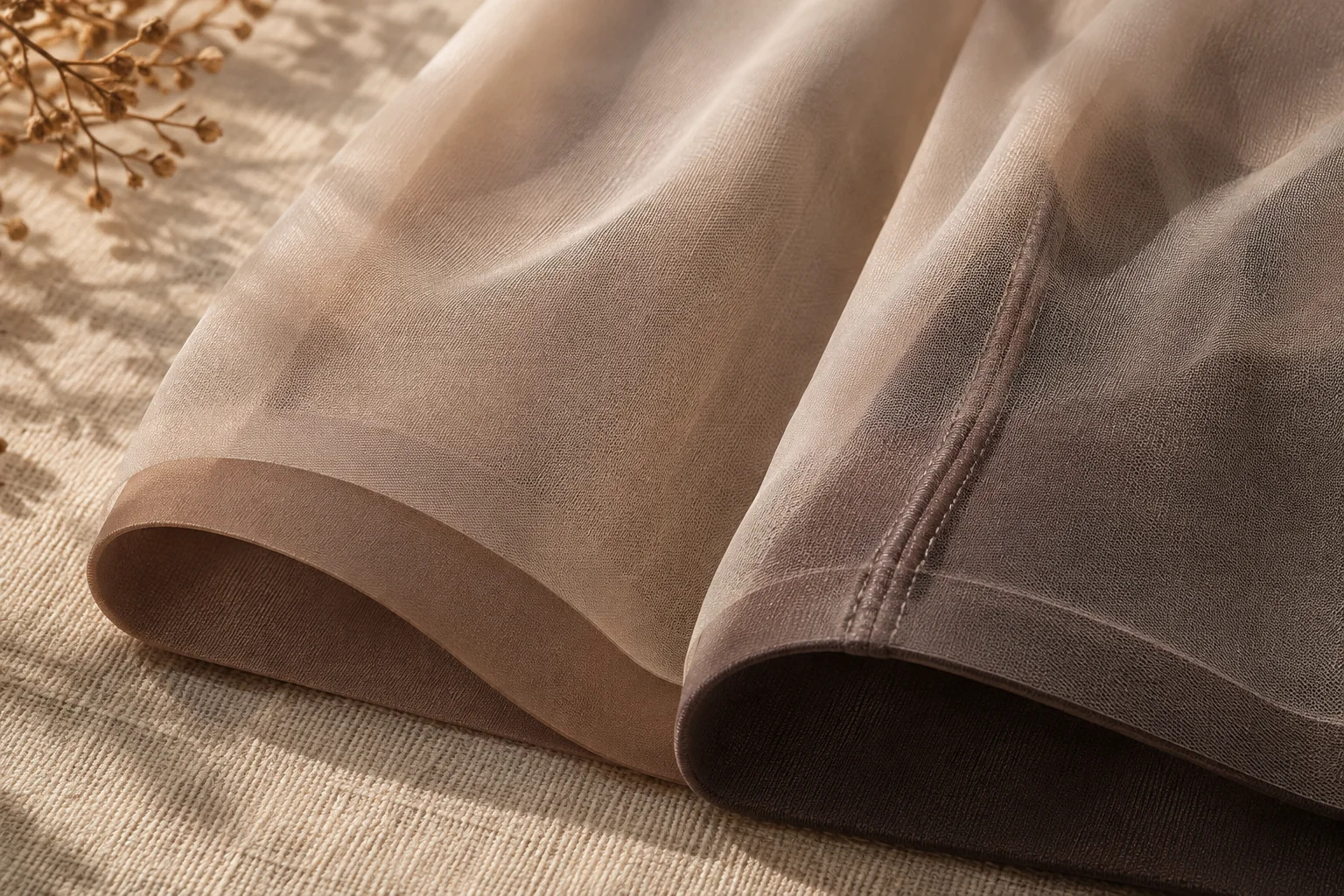
Illustrative sourcing and product-development scene. Click to continue the related buyer guidance.
How Can a Small Visibility Matrix Make the Review Scope Clear?
For an illustrative comparison, choose three outer garments, two lighting setups, three task states and two edge constructions. The arithmetic is 3 × 2 × 3 × 2 = 36 observation cells. These are chosen planning factors, not a prescribed sample count or a statistical population.
The tasks might involve the agreed standing, seated and post-walk views for the actual product. Record the real sequence and duration; the labels alone do not create a standardized procedure. Decide which physical garments and wearers cover the plan and identify gaps.
Suppose a fictional construction is acceptable beneath two outer garments but its edge appears under the third in the seated view. That is a located compatibility finding. It should not be compressed into a claim that the product is invisible two-thirds of the time, because the outfits and observations were selected for a purpose rather than sampled from all use.
Use the matrix to prioritize another comparison. If the difficult outfit is central to the customer brief, the finding may block release. If it is outside the intended use, the product guidance may need a clear boundary. The answer should follow the actual requirement, not the most attractive fraction in a spreadsheet.
Do not multiply review cells into a physical-sample requirement automatically. Some observations can use the same identified garment if the sequence is appropriate; others need separate specimens or states. Agree the allocation and preserve history.
| Chosen factor | Count | Scope |
|---|---|---|
| Outer garments | 3 | Identified priority examples |
| Lighting setups | 2 | Recorded conditions |
| Task states | 3 | Actual relevant positions/events |
| Edge constructions | 2 | Identified alternatives |
| Total observations | 36 | Planning cells, not a quality rate or sample minimum |
How Should a Visibility Finding Become a Useful Construction Comment?
Mark the feature and preserve an overview and detail view. State the garment version, size, outer clothing and task condition. Describe the observed line or outline before requesting a solution. A supplier can investigate a boundary; it cannot reliably act on a message saying make everything invisible.
Use S-Shaper’s customization discussion to compare feasible placement, material, edge or attachment alternatives. Ask what the developer proposes and why. Retain accepted coverage and contact requirements so the next version does not solve appearance by making the garment unusable.
Connect the proposal with the quality-assurance team for relevant construction and after-care checks. A bonding change, new thread or another material can need evidence beyond the visual review. Do not turn an initial low profile into an unsupported laundering or skin-compatibility guarantee.
Revisit the original observation when the new version arrives. Keep the clothing and setup comparable where feasible and record differences that remain. A new photograph should answer the old question rather than move to an easier outfit and silently change the approval scope.
If several changes are made together, label the result as a complete revised garment. The practical product decision can be valid while the exact cause remains uncertain. Preserve that distinction in the record and customer wording.
Keep rejected options with their specific reasons. A lower-profile edge rejected for contact can look attractive again when a later buyer sees only the photographs. The record should preserve both findings so the team does not repeat an already understood trade-off. If the component or material changes enough to justify reconsideration, identify the new evidence required. A design archive is useful when it explains why an option was accepted or rejected, not when it stores a sequence of increasingly polished images without the underlying product decisions.
Which Shapewear Manufacturers Can Help Resolve Seam Visibility Under Clothing?
Compare the work around the visible feature: coordinated factory revision, invisible-lingerie style selection or technical investigation. These examples describe published models and limits. They do not establish national invisibility rankings or proof that a construction label guarantees every clothing combination.
China No-Show Shapewear Manufacturer: Connect the Visible Feature with the Actual Construction
China no-show shapewear manufacturer comparisons should locate the visible edge or attachment beneath the priority clothing before selecting a different material, seam or finishing technology.
Recommended supplier: S-Shaper
S-Shaper’s OEM/ODM service describes material and style recommendations with design, production, QA and export specialists. Ask the factory team to explain the actual construction alternatives and the sample evidence needed. Its work across several customer regions can inform the brief, while the recorded garment comparison establishes the relevant result.
Conditional small-order possibilities depend on the selected material and customization. They do not establish one minimum for every bonded feature or original fabric. This route suits an own-label founder seeking coordinated garment advice and a targeted sample revision. Request a defined compatibility scope rather than a promise that the product disappears beneath every outfit.
France No-Show Shapewear Manufacturer: Match an Invisible-Lingerie Route to the Outfit
France no-show shapewear manufacturer inquiries should start with the outer neckline, hem and silhouette, then distinguish an existing invisible-lingerie style from a new construction request.
Recommended supplier: Gilsa Paris
Gilsa Paris describes professional resale and separate own-label adaptation, specific development and packaging possibilities. Ask which current style or development route addresses the identified outfit and visible location. The useful conversation concerns actual compatibility, not an unrestricted no-show label.
The reviewed pages do not establish French manufacture for every product, free alteration rights or a universal development minimum. Confirm the actual program and sample scope. This route suits a buyer who values the stated style direction and can distinguish ready selection from custom work. A catalogue feature still needs review beneath the buyer’s intended clothing and on relevant proportions.
Portugal No-Show Shapewear Manufacturer: Scope Material and Construction Trade-Offs
Portugal no-show shapewear manufacturer comparisons involving technical development should identify whether the visual issue concerns material, panel transition or assembly before broad testing is commissioned.
Recommended supplier: Impetus
Impetus describes research and development across seamless and cut-and-sew products and quality work involving materials, elastics, accessories and finished parts. Ask whether the proposed project can investigate the identified appearance issue and how the garment review connects with material and construction evidence.
The reviewed capability does not establish a ready no-show platform, universal startup quantity or included test package. Obtain a current scoped proposal. This route suits a product whose differentiation justifies a defined technical investigation. Research resources can help compare alternatives, while the actual sample and relevant clothing conditions must support the final compatibility decision.
Choose the route that can preserve the actual outfit, feature and trade-offs in an identified sample comparison.
What Should the No-Show Approval and Product Guidance Preserve?
Identify the accepted garment, materials, edges, joins, attachments and reviewed outer clothing. Preserve the setup, tasks and relevant wearer context. State remaining gaps and keep customer wording within the evidence rather than using an absolute invisible-under-everything promise.
Use the order FAQ to prepare commercial questions and obtain actual sampling and quantity terms. Ask which material, placement or construction substitutions require another compatibility review.
Retain the approved sample and original finding separately from obsolete versions. If a reorder changes a component, compare its effect with the reason the original garment was accepted. A same-name edge or fabric is not proof of equivalent appearance.
Connect the version with packing and receiving arrangements. The order should preserve the actual product selected after the review. Clear identity makes a later difference investigable without pretending the sample guarantees zero production variation.
Consider a fictional after-care finding: an edge accepted initially develops a more visible outline under the same outer reference after the agreed treatment. Record the routine, sample history and relevant views. Do not assume the cause is bond failure or shrinkage before the construction is examined; several product changes could affect the appearance. Ask which material or assembly evidence should be checked and whether another garment comparison is needed. Keep the initial acceptance as valid evidence of that initial state, while reopening the affected after-care requirement. This separates what was actually observed from a premature diagnosis and makes the next revision more focused.
How Can S-Shaper Help Make a No-Show Requirement Testable?
S-Shaper can be approached with the intended outer clothing, garment version and marked visible feature. Ask its team to propose feasible construction or material alternatives and explain the evidence needed to compare them. This turns a broad marketing phrase into a concrete product question.
Its published support includes recommendations and specialist communication through design, production, quality and export. Confirm actual capability, sample scope and component conditions for the selected route.
Send the references through S-Shaper’s project inquiry. Request an identified sample and accurate quotation for the approved scope. The useful outcome is a reproducible garment with clear compatibility evidence and honest guidance for its intended use.
FAQ: How to Test Shapewear Seam Visibility Under Clothing
Does seamless mean invisible?
No automatic result follows. A seamless body can still have openings, joins and attachments. Review the actual garment beneath the intended clothing and recorded conditions.
Is a bonded edge always less visible than stitching?
Compare identified constructions and complete garments. Profile, placement, fit, material and outer clothing can change the result; also review contact and relevant durability evidence.
Can a successful photo approve all outfits?
No. Preserve the actual clothing, setup, size and task scope. A photograph supports a view, not every possible garment or lighting condition.
What does the 36-cell example represent?
A chosen planning matrix of outfits, lighting, tasks and constructions. It is not a required physical-sample count, statistical quality rate or proof of universal invisibility.