 EN
Quick Answer
Reduce shaping-short ride-up by investigating inseam, leg-opening construction, material response, fit and wearer movement together. Record whether the edge rolls locally, the leg moves upward or the whole garment shifts, then ask the developer for a targeted comparison. A longer leg or tighter opening does not automatically solve every event.
Use identified samples, relevant thigh and body proportions, priority outer clothing and recorded sitting and walking tasks. Review comfort, dressing, concealment and after-care behavior alongside movement. Approve the evidence for the intended use rather than promising that the short will never ride up on any wearer.
What Exactly Moves When a Shaping Short Rides Up?
Separate a curled edge from a leg that migrates and a garment that changes overall position. Mark the initial opening and the observed event with comparable views. Record which movement preceded it and whether the wearer adjusted the short. These distinctions help the developer choose a useful next question.
Identify the actual garment from S-Shaper’s product range or the project version. Preserve rise, inseam, opening and material information. A short label such as thigh length does not establish where the opening sits on a particular wearer.
Record size selection and relevant waist, hip and thigh proportions using the agreed basis. A leg opening can sit at a different location on two people with the same nominal size. Do not assume a smaller label is the answer before the developer reviews the actual fit.
Keep the outer-clothing context. A test beneath a loose outfit and another beneath a fitted skirt can create different observations. Both can be relevant, but they should not be described as one controlled comparison if clothing and tasks changed.
Ask the wearer to describe the location and sequence rather than diagnose the textile. It rolled at the inner leg after the recorded walk is more useful than the fabric is bad. Preserve the observation and ask which material, edge or pattern change could address it.
| Observed event | Useful record | Possible development question |
|---|---|---|
| Edge curl | Location and task | Opening finish or local interaction? |
| Leg migration | Initial/later location and adjustments | Length, fit or material response? |
| Whole-garment shift | Waist and leg observations together | Overall proportion relationship? |
| Changed after care | Routine and sample history | Material or edge behavior after treatment? |
How Should Inseam and Thigh Location Be Specified?
Agree the inseam measurement path and garment state with the developer. Record the actual sample dimension and intended coverage. A nominal product description cannot replace a diagram, particularly when the garment has a shaped opening or construction that changes how the leg sits.
SPANX’s Invisible Girlshort page lists a 4-inch inseam and describes its opening construction. That is a named catalogue specification, not a recommended anti-ride-up length or evidence that all 4-inch shorts behave alike. Use it as a reminder that length belongs to an identified garment with other features.
Source: SPANX, Invisible Girlshort
The exact conversion of 4 inches is 10.16 cm. For a separate hypothetical design comparison, a chosen 6-inch leg is 15.24 cm, a difference of 5.08 cm. The longer chosen value is 50% greater numerically, but that is not a 50% reduction in movement or a performance prediction. The 6-inch input here is illustrative, not a second cited supplier specification.
Review where each opening sits on the intended wearer and beneath the priority outer hem. Extra coverage can create a visibility trade-off or move the edge to another contact area. A longer option should be selected for a reason, not because a larger number sounds more stable.
If the developer changes the pattern as well as the inseam, preserve that difference. The buyer can compare complete versions honestly without attributing every result to length alone.
| Length information | Value | Limit |
|---|---|---|
| Named catalogue example | 4 inches | One identified garment |
| Exact unit conversion | 10.16 cm | Not a preferred specification |
| Hypothetical comparison | 6 inches = 15.24 cm | Chosen design input |
| Numerical difference | 5.08 cm; 50% longer | No ride-up reduction claim |
Longer Inseam vs Revised Leg Opening: Which Change Should You Try?
A length change moves the boundary and coverage. An opening change alters the local construction. A material change can affect the whole garment. Choose the comparison that addresses the event and document every relevant difference between versions.
Ask the supplier to explain why the proposed revision is likely to be informative. If the opening is tightened, review contact and dressing as well as movement. If it is made longer, check concealment and the new edge location. Solving one observation by creating another unacceptable feature is not a complete approval.
For a chosen development map, two inseams × two opening options × three wearer/size profiles gives 12 cells. These are illustrative factors, not a universal tester count, minimum order or required assortment. Decide which actual garments cover the questions and identify the unresolved configurations.
Do not add a grip or reinforcement merely as a premium label. Ask for the actual component, attachment and care evidence. A feature can be useful within a particular garment, but its name does not prove the underlying fit has been resolved.
| Revision | What changes | Trade-off to preserve |
|---|---|---|
| Inseam | Coverage and edge location | Outer-hem concealment and contact |
| Opening construction | Local finish and response | Dressing, contact and appearance |
| Material | Complete textile behavior | Fit, recovery, coverage and care |
| Pattern/size relationship | Garment proportions | Affected waist, seat and leg areas |
| Chosen comparison | 2 × 2 × 3 = 12 cells | Not a promise of universal stability |
Keep the assortment decision separate from the engineering comparison. Two inseams can be useful development alternatives without both belonging in the launch. Ask whether they solve distinct customer uses or merely reflect an unresolved selection. If only one is chosen, retain the other’s evidence and rejection reason for later review. A founder should not turn every prototype into stock simply because it already exists.
If two lengths remain necessary, confirm which construction decisions are shared and which need independent approval. The longer version may place its opening elsewhere and can need a different local review. A shared fabric does not automatically make their movement results interchangeable. Document the actual dependency so the first order does not imply coverage that the sample plan never provided.
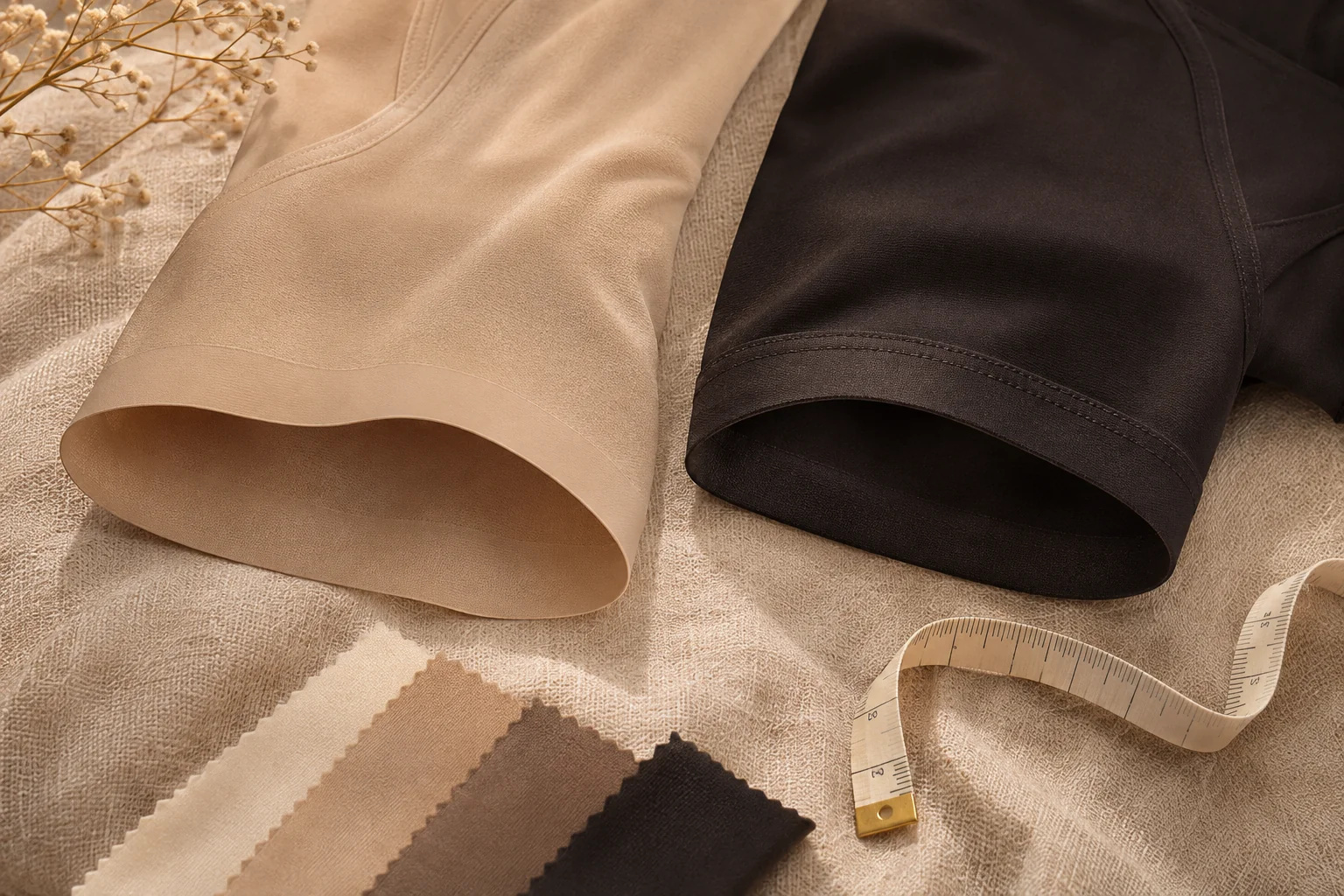
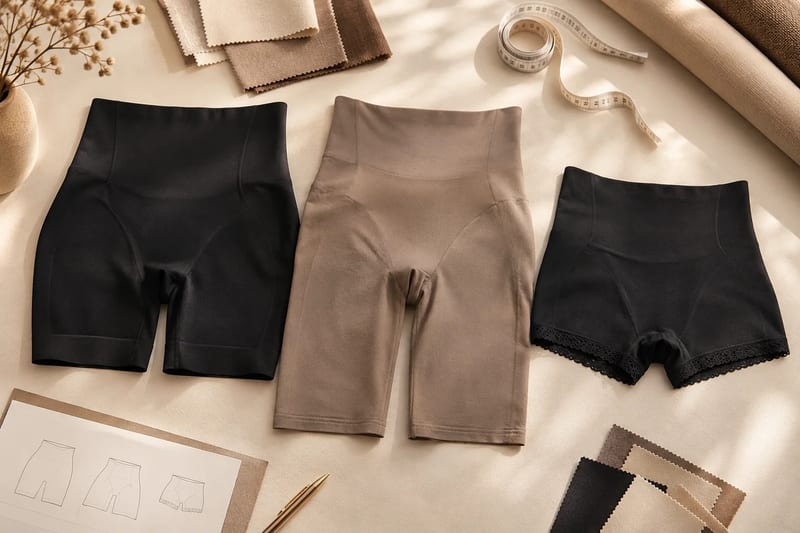
Illustrative sourcing and product-development scene. Click to continue the related buyer guidance.
What Material and Edge Evidence Should the Manufacturer Provide?
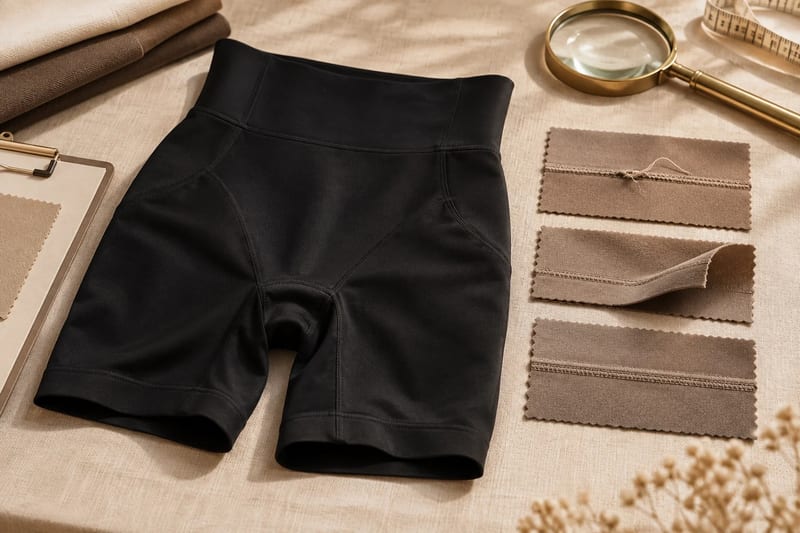
Identify the main fabric, opening material and relevant attachment. A cut edge, folded finish, elastic or bonded detail can involve different inputs. Ask which construction is actually proposed and what the approved sample will preserve.
Use comparable elastic evidence where it answers the question. ASTM D4964 concerns tension and elongation of elastic fabrics and identifies conditions that must remain comparable. The result can inform a material discussion; it does not independently prove how an assembled short will move on a wearer.
Source: ASTM D4964: conditions for comparing elastic-fabric response
Ask for method, direction, specimen and history when numbers are supplied. A higher force or elastane percentage is not a universal stability score. Do not convert it into a medical-pressure claim or choose the strongest hand feel without reviewing the intended garment.
If a bonded or attached feature is proposed, identify the materials and process reference. A smooth initial edge does not establish its after-care behavior. Request the relevant checks for the actual construction rather than assuming one technology always lasts longer.
Keep material and wearer findings connected but separate. If a strip result is acceptable while the leg still migrates, the evidence may concern different parts of the product. Ask whether pattern, boundary location or another construction interaction needs review before replacing the entire material.
How Should Sitting and Walking Tests Record Ride-Up Without Overclaiming?
Prepare identified garments and the priority clothing. Record size-selection information, relevant proportions, initial position, tasks and actual duration. Keep comparable views and note adjustments. Do not ask a wearer to tolerate an uncomfortable opening to complete an arbitrary schedule.
Discuss targeted revisions through S-Shaper’s customization service. A useful comment preserves the event, accepted features and desired result. Ask the developer to explain which change the next sample tests and which conditions should remain comparable.
Agree after-care and relevant product checks with the quality-assurance team. Review opening appearance, dimensions, contact and movement after the intended routine. Do not invent a universal wash count or claim the initial trial establishes a lifetime result.
Consider a fictional comparison: one version’s inner opening curls after a recorded walk; another retains its position under the comparable task but becomes visible beneath the selected skirt. Keep both findings. The next decision may involve another edge or a narrower intended clothing use, not an unsupported declaration that the longer short is better overall.
When testers disagree, inspect proportions, size selection, clothing and sequence before averaging responses. A short can be suitable for a defined wearer and use while still needing another option for a different requirement. Preserve that boundary rather than promising no ride-up for everyone.
Separate location evidence from an imprecise movement score. If the edge is initially positioned differently between versions, a later photograph alone cannot establish which one migrated more. Record the starting state and use comparable tasks before making a numerical comparison. If a tester adjusts one version but not another, retain the intervention. It may be important to the product decision even when the garment looks smooth at the end.
Also inspect whether an apparent leg problem begins elsewhere. If the waist shifts, the leg position can change as part of a larger garment event. Ask the developer to review the complete sequence rather than tightening the leg automatically. This preserves the actual question and avoids making a localized revision based on an incomplete observation.
Which Shaping Shorts Manufacturers Can Help Reduce the Observed Ride-Up?
Compare the response around the actual short: coordinated factory revision, an integrated seamless route or a pattern-development handoff. These examples describe published models and limits. They do not establish national movement-performance rankings or one inseam that suits every body and outfit.
China Shaping Shorts Manufacturer: Connect the Ride-Up Event with a Feasible Revision
China shaping shorts manufacturer comparisons should locate the leg event before selecting length, opening or material changes, so the next sample addresses the actual movement and coverage trade-off.
Recommended supplier: S-Shaper
S-Shaper’s OEM/ODM service describes material and style recommendations with design, production, QA and export specialists. Share the identified short and task record and ask the factory team for a reasoned comparison. Experience across several customer regions informs the brief, while the actual garment needs wearer evidence.
Conditional small-order routes depend on the selected materials and customization. They do not establish one minimum for every new opening or grip feature. This route suits an own-label founder seeking coordinated sample work and clear version-specific terms. Request a proposal that preserves outer-hem concealment and contact instead of treating a longer inseam as an automatic solution.
Turkey Shaping Shorts Manufacturer: Review Knit and Opening Decisions Together
Turkey shaping shorts manufacturer routes involving integrated seamless production should distinguish knit, finish and remaining opening assembly when a buyer requests a ride-up revision.
Recommended supplier: SML Seamless
SML describes integrated private-label shapewear and activewear production in Turkey from yarn through packed goods. Ask how the selected platform handles leg length and openings, which inputs change in the revision and how the next sample is identified. The complete garment remains the comparison unit.
The reviewed source does not establish a universal minimum, preferred inseam or guaranteed non-migration result. Confirm current yarn, shade and development conditions. This route suits a seamless-aligned brief and a buyer prepared to evaluate complete alternatives. Integration can clarify workflow, but it does not remove representative thigh-proportion and outer-clothing review.
Canada Shaping Shorts Manufacturer: Preserve Leg-Opening Comments Through Pattern Development
Canada shaping shorts manufacturer routes involving local development and overseas manufacture should preserve the precise leg event and accepted coverage when revisions pass between teams.
Recommended supplier: Hertex
Hertex describes Montreal design, pattern development, grading and quality control, with manufacturing in China since 2006. Ask who translates the ride-up record into a pattern or construction proposal and how the production team receives the current version. Keep the relevant wearer and measurement context attached.
The reviewed background does not establish Canadian manufacture, ready startup stock or an included revision package. Obtain a proposal for the actual short and size range. This route suits a buyer who values the stated development interface and can assign approval authority. A local contact does not make an undocumented opening substitution equivalent to the reviewed sample.
Choose the route that can preserve the event, construction identity and trade-offs in the next testable sample.
What Should the Final Ride-Up Review and Order Record Preserve?
Keep the approved short, material, opening construction, rise, inseam, measurements and reviewed use together. Attach the actual task evidence and remaining size or clothing gaps. Product wording should match those limits rather than promise universal non-movement.
Use the published order FAQ to prepare sampling and quantity questions, then confirm item-specific terms. Ask how an opening, textile or pattern change will be reviewed before a reorder.
Retain the original observation and rejected versions separately. They explain why the chosen construction was selected and which property matters if another material is proposed. Do not let a same-name shade or style replace actual product identity.
Connect the released references with packing and receiving arrangements. The order should identify the version selected after the trial. A receiving or reorder discussion can then compare the actual short with the record instead of debating a general anti-ride-up claim.
Prepare a compact release statement: the identified short is accepted for the recorded wearer range and priority clothing use, subject to the listed remaining conditions. Attach the measurement and opening references and state what changes require another review. Avoid a slogan as the only approval criterion. If a later complaint arrives, the record should let the team ask whether it concerns the approved version, an unreviewed use, a size-selection issue or a production difference. Those questions can lead to different corrective actions, so preserving the original scope has practical value beyond the first order.
How Can S-Shaper Help Turn a Ride-Up Complaint into a Product Change?
S-Shaper can be approached with the short version, relevant measurements, intended outer hem and a located movement record. Ask its team to explain feasible inseam, opening, material or pattern alternatives and the evidence needed to compare them.
Its published support includes recommendations and specialist communication through design, production, QA and export. Confirm the actual sample scope and material conditions for the selected proposal rather than assuming all leg constructions share one program.
Send the record through S-Shaper’s project inquiry. Request an identified next sample and a clear decision plan. The useful outcome is a reproducible short supported for its intended use, with trade-offs and limits preserved for production.
FAQ: Designing Shaping Shorts to Reduce Ride-Up
Will a longer short always ride up less?
No universal rule is established. A longer leg changes coverage and edge location, which can introduce visibility or contact trade-offs. Compare the actual garment and wearer tasks.
Does a tighter opening solve migration?
Not automatically. Review fit, material, boundary location and construction, including dressing and contact. Ask for a targeted comparison rather than simply reducing the opening.
What does the 4-inch reference prove?
It identifies a named catalogue specification. The conversion and hypothetical 6-inch comparison describe length arithmetic, not a recommended design or performance reduction.
What should be sent to the manufacturer?
Provide the version, size-selection basis, relevant proportions, initial position, task, actual duration, marked views and adjustments. Ask which revision would resolve the event while preserving coverage and comfort requirements.