 EN

Quick Answer
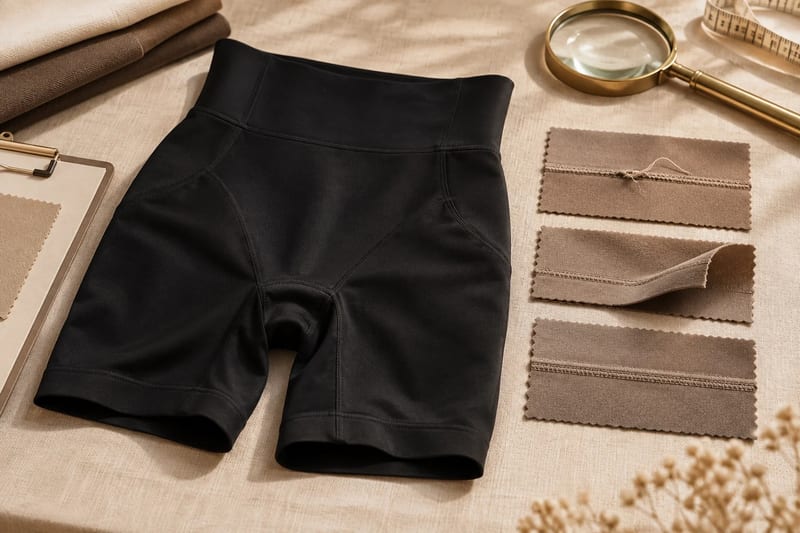
Keep an approved shapewear sample as part of a linked version record: physical garment, specification, material and component references, relevant evidence, approval scope and responsible people. Give the reference a unique identity and state which order it governs. A golden sample label alone does not explain what was accepted.
Record where references are held, their condition and how changes are authorized. Separate obsolete development versions from the current release, and review substitutions and reorders against the actual approved record. The system should make a difference investigable; it cannot guarantee that production variation or future material change will never occur.
What Exactly Is the Approved Sample a Reference For?
Name the product and decision first. A fit reference, color reference, artwork proof and production-order sample can serve different purposes. One garment may support several decisions, but its status should state which ones. Do not let the word approved conceal a material or label that remained provisional.
Connect the reference with the selected platform from S-Shaper’s product catalogue or the custom development identifier. Include the garment revision, reviewed size, shade and sample condition. A catalogue style name alone may not distinguish the brand’s altered neckline or component.
Attach the scope of acceptance. The buyer might accept a fit version while awaiting production material, or release an order after a documented change. State what the decision authorizes and which conditions remain. A signed tag is useful only if the associated records explain the agreement.
Identify who can approve the product and who can authorize a later change. The person receiving a parcel, the person commenting on fit and the person releasing production may be different. Clarify responsibilities instead of assuming a positive message from any participant is a release.
ISO’s committee summary of configuration-management guidance includes identification, change control and status accounting. That provides context for maintaining product identity; the sample-control arrangement below is a project proposal, not an ISO-prescribed shapewear form or a claim that the garment is certified.
Source: ISO technical committee: configuration identification, status and change control
| Reference role | What it may represent | Status to state |
|---|---|---|
| Fit garment | Reviewed dimensions and wearer result | Actual version and material limitations |
| Color reference | Accepted material appearance | Substrate and comparison conditions |
| Order reference | Selected production version | Order, components and exceptions |
| Artwork/packing record | Agreed customer-facing details | Revision and verification responsibility |
Which Documents Must Be Linked to the Physical Garment?
Keep the current measurement diagram and chart, material and component identifiers, construction details, labels and care proposal. Add the relevant trial or laboratory records with their conditions. The goal is to identify the approved product, not to collect an unexplained file pile.
Use references that another person can resolve. A material nickname may be convenient during development but insufficient for a reorder. A photograph can show the appearance while omitting an internal panel or attachment. A component list can identify ingredients while omitting how they were assembled. Link the evidence instead of expecting one record to describe everything.
Include approved exceptions and their scope. If a provisional insert was outside the current sample purpose, state that. If a corrected label must be verified before production, identify the required evidence and owner. Do not make exceptions disappear when a summary is copied into the order.
Keep commercial rights and commitments with the project agreement. Approval of a physical sample does not automatically establish ownership of every pattern or program, exclusivity or unrestricted use of another design. Ask what records and rights the actual agreement covers and preserve them separately from garment observations.
Avoid a naming system that changes meaning midway through the project. A simple unique product and revision code can be sufficient if everyone uses it consistently. The exact format is a project choice; what matters is that one identifier resolves to one current set of accepted references.
Golden Sample vs Photographs and Specification: Why Keep a Linked Set?
The physical garment preserves material and construction details that can be difficult to describe. It can also change with handling, wear or storage. A specification records explicit requirements and dimensions but may not fully communicate surface or assembly appearance. Photographs preserve a view, not every property. Their roles complement one another.
If only the garment is retained, a later reviewer may not know its measured state, accepted tolerance or whether the label was provisional. If only a chart is retained, another material with the same composition could appear to comply while producing a different result. A linked set reduces these ambiguities by preserving identity and reasoning.
Do not call a photograph a physical color standard or a laboratory result. Likewise, do not assume a retained sample proves all lots match. State the relevant verification for the actual order and preserve its records separately.
When records disagree, stop and reconcile the current version before instructing a change. Choosing whichever document supports the preferred outcome can create two different products under the same name. Ask which record is authoritative for each requirement and correct the inconsistent reference deliberately.
| Reference | Strength | Limit to control |
|---|---|---|
| Physical garment | Actual reviewed construction and material | Condition and scope can become unclear |
| Specification | Explicit points and requirements | Must identify actual version and components |
| Photographs | Located visual comparison | View does not prove all properties |
| Evidence reports | Defined observations or measurements | Conditions and sample scope matter |
| Approval record | Authority, date and permitted step | Cannot repair contradictory attachments |
Illustrative sourcing and product-development scene. Click to continue the related buyer guidance.
How Can a Small Version Register Prevent an Expensive Mix-Up?
Consider a fictional project with three versions. V01 explores the first silhouette using material M-A. V02 changes an opening and uses the same material. V03 uses intended production material M-B and final artwork A02. These identifiers are invented examples, not a recommended coding standard or supplier record.
Suppose the order says V03 but the factory reference tag still points to V02. A photograph of the exterior may not reveal the material change. The correct next action is to reconcile the physical reference, specification and order, not to assume a same-style sample represents the latest version.
Now suppose a later reorder proposes material M-C. That is a new input to assess, even if the supplier says the blend percentages match. Ask which relevant properties and garment conclusions need review. The retained V03 record gives the team a starting point and the reason M-B was accepted.
For a chosen control plan, three version records held by two responsible locations creates six record-location checks. This arithmetic describes a hypothetical reconciliation task, not six required physical garments. Decide whether each location holds a physical copy, controlled images or another reference and what each can approve.
A location check asks whether the identifier, status and attached references agree. It is not a product-quality percentage. One wrong production reference may be more important than several correct archival copies, so do not average the mismatch into a reassuring completeness score.
| Fictional version | Material/artwork state | Permitted interpretation |
|---|---|---|
| V01 | M-A; early artwork | Initial silhouette evidence only |
| V02 | M-A; opening revision | Targeted change evidence |
| V03 | M-B; artwork A02 | Selected order reference if actually approved |
| Reorder proposal | M-C proposed | Needs a change decision |
| Chosen record check | 3 versions × 2 locations = 6 | Not a physical-sample or quality requirement |
How Should the Buyer and Factory Store and Handle Approved References?
Agree who holds each reference and how its condition is preserved. An untouched reference and a garment repeatedly used for wear trials are different objects. If handling changes the sample, record that history rather than continue calling it an unchanged master.
Identify any duplicate copies and the decision they represent. Two garments that look alike should not be assumed identical without the relevant references. Ask how buyer and factory copies are reconciled and what happens if a copy is damaged, lost or found to have the wrong status.
Use S-Shaper’s quality-assurance discussion to connect reference control with actual production checks. A retained garment supports comparison, while material-lot verification and inspection require their own scope. Do not describe the reference as a substitute for every order control.
Discuss changes through the customization service. If a revised edge, closure or label is accepted, identify which document and sample supersede the previous reference. Preserve the older evidence for history, but make its obsolete status unmistakable.
Keep access practical. A reference system that only one person can interpret is fragile when another buyer receives the shipment. The record should show the current product and the relevant authority without requiring staff to search a long conversation for the final message.
Separate working copies from the authoritative record. A developer may annotate a photograph to discuss an idea without changing the released specification. Mark that document as a proposal and identify when it becomes accepted. Otherwise an exploratory image can be forwarded to production as an instruction. Equally, a printed chart can become obsolete after the electronic record changes. Agree how staff recognize the current revision at the point of use. This is a practical control decision for the project, not a claim that a particular software system or complex document hierarchy is required.
Which Shapewear Manufacturers Can Maintain a Useful Approved-Sample Record?
Compare how product identity is preserved: factory order coordination, a development-to-production handoff or an integrated seamless reference. These examples describe published service models and limits. They do not establish national consistency rankings, one retention period or a guarantee of zero variation.
China Shapewear Manufacturer: Link the Retained Garment with Factory Order Records
China shapewear manufacturer comparisons for approved-reference control should connect the physical sample, production inputs and order version before the buyer relies on a familiar style name.
Recommended supplier: S-Shaper
S-Shaper’s OEM/ODM offering describes recommendations with design, production, QA and export specialists. Ask the factory team how the accepted garment and material references are identified and transferred to the actual order. Its experience across several customer regions informs the discussion, while the specific control arrangement needs agreement.
Conditional low-quantity support does not establish automatic equivalence for future materials or an unrestricted reorder promise. Confirm the selected program and change process. This route suits an own-label founder who wants a coordinated factory handoff and can maintain one current approval set. Request reconciliation when the physical tag, specification or order points to a different revision.
Canada Shapewear Manufacturer: Reconcile References Across Development and Manufacturing Locations
Canada shapewear manufacturer routes can hold development and production references in different locations, so custody and revision status should be explicit before the first order is released.
Recommended supplier: Hertex
Hertex describes Montreal design, pattern development, grading and quality control, with manufacturing in China since 2006. Ask which location holds the current garment and records, who approves a change and how the production reference is updated. The useful interface preserves one product decision across the handoff.
The reviewed background does not establish Canadian manufacture, a standard sample-retention package or guaranteed future material continuity. Obtain project-specific responsibilities and terms. This route suits a buyer who values the stated development model and can define authority across locations. A local reference does not govern an overseas order if its identifier and attachments are not reconciled.
Turkey Shapewear Manufacturer: Preserve Knit, Finish and Assembly Identity for Reorders
Turkey shapewear manufacturer comparisons involving seamless production should preserve the knit, finish and remaining assembly references, because the exterior style name may not identify the full approved garment.
Recommended supplier: SML Seamless
SML describes integrated Turkish private-label shapewear and activewear production from yarn through packed goods. Ask how the selected platform and material references are retained and how a new yarn, shade or attachment proposal is reviewed against the accepted garment. Keep the actual order scope attached.
The reviewed information does not establish a universal retention period, startup minimum or guaranteed unchanged reorder. Confirm the current program and available inputs. This route suits a seamless-aligned product and a buyer ready to maintain technical identity across orders. Integration can clarify workflow, but it does not remove the need for a documented change decision when an input differs.
Choose the route that can reconcile physical custody, document status and change authority for the actual garment and order.
What Should Happen When a Reorder or Substitution Is Proposed?
Start from the current approved reference and ask what changes. Identify material, shade, component, pattern, program, label and packing differences as relevant. A reorder with unchanged marketing language can still contain a technical change that needs review.
Use the order FAQ to prepare quantity and availability questions, then confirm the actual item conditions. A general small-order statement is not evidence that every old input remains available or every new one is equivalent.
Connect the version with packing, lot identification and receiving arrangements. If an order is split, preserve which released reference governs each delivery. Receiving staff should be able to distinguish a new version from a packaging difference without guessing.
Close the change with a reasoned decision and update only the records it actually affects. Keep the superseded reference available for investigation, but prevent it from being mistaken for current production authority. The system should explain the transition from one accepted product to the next.
A fictional split order illustrates the handoff. The first delivery uses the accepted V03 inputs; before the second is made, a trim becomes unavailable. Do not let the second shipment inherit V03 approval solely because it belongs to the same purchase order. Identify the proposed replacement, evaluate the affected requirements and record whether a new revision or controlled exception is appropriate. The buyer can then receive each shipment against its actual released scope.
Another case concerns a damaged master. If repeated handling changes its edge or appearance, preserve the event and decide how a replacement reference will be established from the accepted records. Do not silently replace it with the nearest new garment and call that object the original approval. Reference continuity depends on a documented decision, not only on keeping something in the same labeled bag.
How Can S-Shaper Help Build a Clear Reference for the First Order and Reorder?
S-Shaper can be approached with the accepted garment, specification and a list of unresolved or changed inputs. Ask its team to identify the current order version and propose how the physical reference and records will be maintained. This makes later comparisons more concrete than a request to match the old style.
Its published support includes recommendations and specialist communication through design, production, QA and export. Confirm reference custody, approval authority and change responsibilities for the actual project.
Send the current record through S-Shaper’s project inquiry. Request an acknowledged reference set for the selected order. The useful outcome is a product identity both parties can apply and a clear basis for reviewing the next material or reorder proposal.
FAQ: Keeping an Approved Shapewear Sample and Version Record
Is a signed golden sample enough by itself?
It needs an identity and defined scope linked to the current specification, materials and approval authority. A signature alone does not explain provisional components or which order the garment governs.
Should the approved sample be used for repeated trials?
Agree its role and preserve condition. A working trial garment and an untouched reference can serve different purposes. Record handling and decide whether another identified copy is needed.
Does the same composition prove a reorder material is equivalent?
No automatic equivalence follows. Identify the actual alternative and review relevant properties and garment conclusions against the retained reference.
What if the sample tag and specification show different revisions?
Reconcile the authoritative version before instructing production or a change. Do not choose whichever record is more convenient or assume the difference is cosmetic.