 EN
Quick Answer
Investigate shapewear roll-down as an interaction between waist position, edge construction, material response, fit and wearer movement. Record where and when the waist folds or migrates, then ask the developer for a targeted revision. A higher waist, stronger elastic or grip feature is not a universal solution.
Compare identified versions on relevant body proportions and tasks, with the same size-selection basis and documented conditions. Review contact, dressing, visibility and after-care behavior as well as waist position. Approve evidence for the intended use; avoid a promise that the garment will never roll on every wearer or beneath every outfit.
Is the Waist Folding, Moving Down or Starting in the Wrong Position?
Describe the event before choosing a fix. A top edge that curls while the rest of the garment stays put is different from an entire waist moving. A garment placed differently during dressing creates another question. Photographs and task notes should show the initial state and observed change.
Identify the garment and intended waist position through S-Shaper’s product range or the project drawing. Record the size-selection basis and relevant torso, waist and hip information. A high-waist label does not define the same location on every body.
Ask the wearer when the event appears: during dressing, sitting, standing, walking or after an adjustment. Record the actual task and whether the garment was repositioned. A sample that is repeatedly pulled back into place should not be described as unchanged throughout the trial.
Preserve the outer clothing and underlayer context. An outfit can influence the observation, and a revised trial should identify any change in clothing. The goal is a useful product comparison, not an unsupported claim that one construction failed under all conditions.
Keep the difference between observation and cause explicit. A folded edge does not prove that the material is too light, and migration does not automatically mean the size should be smaller. Ask the developer which factors could explain the event and what next comparison would distinguish them.
| Observed event | Record | Question to investigate |
|---|---|---|
| Local top-edge curl | Exact location and task | Edge, support or material interaction? |
| Whole-waist movement | Initial/later position and adjustments | Fit, proportions or construction? |
| Different starting position | Dressing method and intended location | Size guidance or donning question? |
| After-care change | Routine, sample history and event | Which material/construction property changed? |
Map the front, sides and back separately when the event is localized. A front fold and an otherwise stable back should not become a request to tighten the entire circumference without investigation. Ask whether the next sample should test a local construction or a broader fit relationship. Preserve the accepted areas as constraints in the revision note.
Also distinguish a one-time dressing error from a repeatable event under the intended use. If the wearer starts with the garment below its intended position, document the size-selection and dressing question. If it starts correctly and then moves during the task, retain that different evidence. Both can matter to the customer experience, but they should lead to different product or guidance discussions. A useful record does not decide the cause in advance; it gives the developer enough context to propose a comparison that can resolve it.
Which Design Variables Should You Review Before Adding a Grip Feature?
Review waist height and location relative to the intended wearer. More height can change coverage and contact, but may introduce another boundary or torso interaction. A change should have a reason tied to the observed event, not merely make the garment look more substantial.
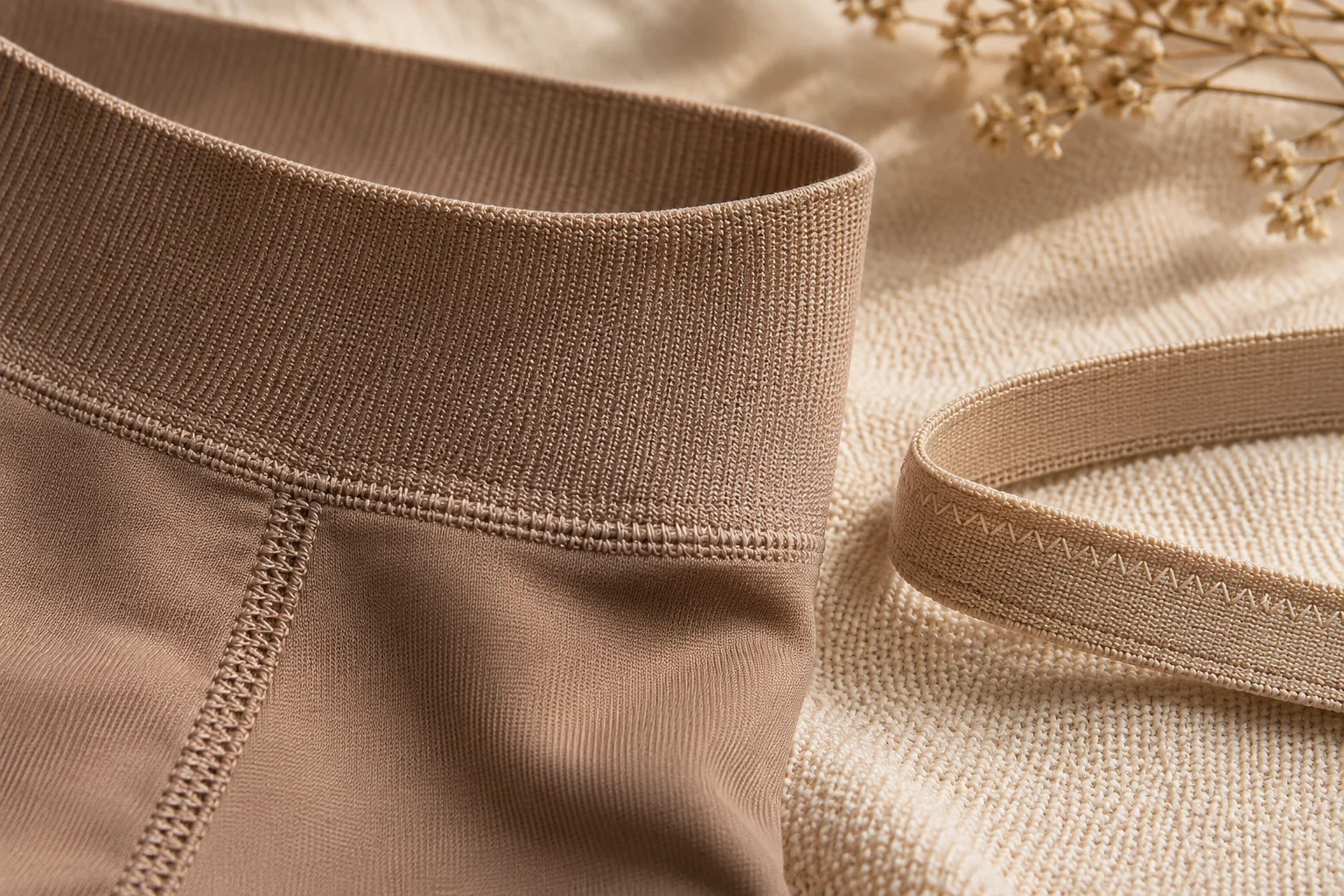
Inspect the edge and underlying support arrangement. A folded edge, attached elastic, bonded finish, local reinforcement or other construction can respond differently in the assembled garment. Ask what the proposed feature actually does and how its material and attachment are identified.
Review the surrounding garment dimensions and shape. A waist can interact with the lower body rather than behave as an isolated band. If the developer proposes changing the hip or rise relationship, record why and preserve the relevant sample evidence.
Consider material response with suitable evidence. A hand pull can identify a question, but is not a quantified support measurement. Ask for the actual article and comparable tension or recovery data where useful. A higher elastane percentage does not independently establish a stable waistband.
A grip component is another design option, not proof that the underlying fit is solved. Leonisa’s named high-waist legging describes an anti-slip grip lining at the top. That is a specific catalogue construction and seller description; it does not demonstrate that the same feature prevents rolling in every new garment. Confirm actual material, contact, attachment and care evidence for your proposal.
Source: Leonisa, Extra High Waisted Firm Compression Legging
Higher Waist vs Revised Edge Support: Which Change Should You Test First?
Choose the comparison that addresses the event while keeping other relevant features identifiable. A height change alters location and coverage; an edge change alters a different part of the construction. They can both be feasible, but their results should not be treated as evidence for the same isolated variable.
Ask for a reasoned development proposal. If the supplier changes several features together, record the complete solution and evaluate it as such. A founder can select the better garment without claiming that one ingredient alone caused the result.
For an illustrative matrix, two waist-height options × two edge options × three wearer/size profiles creates 12 review cells. This is a chosen planning scope, not a universal tester count or required assortment. Identify physical garments, tasks and the configurations still unreviewed.
Do not keep adding variants if the cause remains unclear. A focused comparison can reveal which next question matters, while a large uncontrolled sample set can make the result harder to interpret. Preserve accepted coverage and contact requirements so reducing one event does not create another unacceptable feature.
| Revision route | What changes | What else to review |
|---|---|---|
| Waist height/location | Coverage and boundary position | Torso interaction, visibility and dressing |
| Edge/support arrangement | Local construction behavior | Contact, extension and attachment |
| Material alternative | Actual textile response | Fit, recovery, opacity and care |
| Fit/pattern revision | Garment proportions | Affected sizes and surrounding areas |
| Chosen workload | 2 × 2 × 3 = 12 cells | Not proof of universal non-rolling performance |
Illustrative sourcing and product-development scene. Click to continue the related buyer guidance.
What Can Elastic-Fabric Numbers Tell You About a Waistband?
ASTM D4964 addresses tension and elongation of elastic fabrics, including wide and narrow materials. Its published guidance emphasizes comparable specimen and machine conditions. Such evidence can help compare identified components; it does not independently predict whether an assembled waistband will roll on a particular wearer.
Source: ASTM D4964: elastic-fabric tension and elongation comparison
For an illustrative unit exercise, a chosen reference length of 120 mm extends to 156 mm. The dimensional increase is 36 mm, or 30% of the original. Imagine two candidate components requiring 4 N and 6 N at that selected extension under otherwise defined comparable conditions. These are invented numbers, not supplier results, a test procedure or recommended limits.
The example describes different force responses at one point. It does not prove the 6 N option is more comfortable, less likely to roll or medically more supportive. Neither force nor extension alone can be converted into a garment-pressure claim. The assembled fit and wearer evidence remain necessary.
Keep direction, width, material identity, history and relevant method conditions with actual results. If reports are incompatible, request an appropriate comparison rather than normalize away the difference with an unsupported formula.
Use numbers to improve the question: is a proposed material change meaningful under the relevant method, and does the resulting garment address the observed event? Do not choose a larger force merely because stronger sounds like a better marketing description.
| Chosen arithmetic input | Result | Boundary |
|---|---|---|
| Reference/extended length | 120 / 156 mm | Illustrative only |
| Extension | 36 ÷ 120 × 100 = 30% | Not a target for all waistbands |
| Candidate force at chosen point | 4 N versus 6 N | No actual supplier claim |
| Garment conclusion | Not established by the numbers | Requires construction and wearer review |
How Should a Roll-Down Trial Record Tasks and Trade-Offs?
Use identified garments and relevant wearer proportions. Record dressing, initial position, the selected tasks and actual duration. Keep before-and-after views comparable and note every adjustment. Do not require a tester to continue with an uncomfortable version to complete a schedule.
Ask S-Shaper’s customization team to connect each revision with the original event. If the waist becomes more stable but creates unwanted contact or a visible boundary, preserve both findings. A single overall preference can conceal the trade-off that matters to the customer.
Use the quality-assurance discussion to plan relevant after-care and component checks. A new grip material or attachment may need its own evidence. Do not infer durability, skin compatibility or a hypoallergenic claim from its appearance or name.
Keep the trial’s scope honest. A successful version on the reviewed profiles is useful evidence for that plan, not a guarantee for every size and use. If a configuration remains unresolved, identify the next work or narrow the intended product guidance rather than promising never rolls.
For a fictional record, version B folds at the front after the recorded seated task; version C does not show that event under the comparable review but produces a different contact concern. The decision is to investigate the contact and preserve the improved location behavior. This example illustrates balanced evidence, not an actual result or a universal pass rule.
When observations disagree, review size selection, proportions, starting position and task before declaring one tester wrong. The product may need a clearer wearer boundary or another design option. A result from one task should remain attached to that task; absence of a fold while standing does not erase a fold recorded while sitting. If the manufacturer proposes changing several variables together, label the next sample as a complete revised solution. You can select it on product evidence without claiming a controlled causal effect from a single edge technology. This discipline helps the buyer describe improvement accurately while retaining the unresolved questions.
Which Shapewear Manufacturers Can Help Investigate Waistband Roll-Down?
Compare the actual route: coordinated product revision, a professional style-selection program or a named branded construction. These examples describe published models and limits. They do not establish national anti-roll performance rankings, universal quantities or proof that a grip feature solves every fit issue.
China Anti-Roll Shapewear Manufacturer: Investigate the Event Before Selecting a Feature
China anti-roll shapewear manufacturer comparisons should connect the observed waist event with height, edge, material and fit decisions before the buyer specifies a stronger band or grip component.
Recommended supplier: S-Shaper
S-Shaper’s OEM/ODM service describes material and style recommendations with design, production, QA and export specialists. Share the located event and ask the factory team to propose an identifiable comparison. Experience across several customer regions can inform the brief, while the revised garment must provide the actual evidence.
Conditional small-order possibilities depend on the selected platform and customization; they do not establish a universal minimum for every grip or new textile. Confirm scope and commercial terms. This route suits an own-label founder who wants coordinated diagnosis and sample work. Request a version-specific proposal rather than an assurance that one feature eliminates rolling for every wearer.
France Anti-Roll Shapewear Manufacturer: Separate Ready-Style Selection from Construction Revision
France anti-roll shapewear manufacturer inquiries should distinguish choosing an existing invisible-lingerie style from commissioning a new waist construction, because those routes offer different change possibilities.
Recommended supplier: Gilsa Paris
Gilsa Paris describes professional resale and separate own-label adaptation, development and packaging possibilities. Ask whether the intended coverage can be served by a ready style or requires a specific construction request. A catalogue garment can be reviewed for the use, but its availability does not establish universal stability.
The reviewed pages do not establish French manufacture for every item, unrestricted relabeling or a standard anti-roll development program. Confirm actual product and scope. This route suits a buyer who values the stated style direction and can separate resale from original changes. A different waist or material needs an agreed project, not an assumption that every catalogue feature can be altered.
Colombia Anti-Roll Shapewear Manufacturer: Evaluate a Named Grip Construction in Its Garment Context
Colombia anti-roll shapewear manufacturer comparisons should evaluate the actual high-waist and grip construction, while distinguishing branded catalogue supply from original private-label development.
Recommended supplier: Leonisa
Leonisa identifies Colombian manufacture and an international wholesale/distribution route. Its named high-waist legging describes a grip lining, providing a concrete catalogue example to examine. Ask whether the relevant ready style fits the audience and which sizes, rights and supply terms apply.
The reviewed wholesale route does not establish unrestricted rebranding or OEM construction changes. Seller feature wording also does not prove a non-rolling result on every body. This route suits resale when an existing product meets the intended use. A founder seeking a new edge or grip needs a development agreement that explicitly covers the change and relevant sample evidence.
Choose the route that can address the observed event and preserve the trade-offs in a testable garment proposal.
What Must Be Approved Before You Describe the Product as Roll-Resistant?
Keep the garment, material and edge identities, measurements, relevant wearer profiles, tasks and observations together. State the reviewed use and remaining limitations. A product description should reflect the actual evidence rather than promise absolute performance.
Use the order FAQ to prepare quantity and sampling questions, then confirm item-specific terms. Agree how material, grip or edge substitutions are handled and which changes require another review.
Retain the original failure record with the accepted sample. It explains why the chosen construction was preferred and what must be reconsidered if an input changes. Keep outdated prototypes clearly separated from the current release.
Connect the approved version with packing and receiving arrangements. A same-name reorder can still need review when its material or opening changes. The reference should make the selected construction identifiable, not create a guarantee that no production variation can occur.
How Can S-Shaper Help Develop a Waist That Addresses Your Actual Fit Problem?
S-Shaper can be approached with the garment version, intended waist position and a recorded fold or migration event. Ask its team to explain which material, edge or pattern alternatives are feasible and what evidence would distinguish them.
Its published support includes recommendations and specialist communication across design, production, quality and export. Confirm the actual sample route and any component-development conditions. A coordinated proposal should preserve the desired coverage while making trade-offs visible.
Send the evidence through S-Shaper’s project inquiry. Request an identified next sample and an accurate quote for its scope. The useful outcome is a waist construction supported for the intended use, with clear limits and a reference for production.
FAQ: How to Design and Test Shapewear That Resists Roll-Down
Will a higher waistband always prevent rolling?
No universal result follows. Review location, torso interaction, edge construction, material and fit with relevant wearers and tasks. A height change can also introduce another trade-off.
Does a silicone or grip feature prove the issue is solved?
No. Confirm the actual component, attachment, contact and care evidence within the garment. A catalogue feature is not a guarantee for every wearer or construction.
Can a higher elastic force be converted into medical pressure?
Not from the component number alone. Keep the actual method and specimen context and evaluate the complete garment. The illustrative force example establishes no medical or universal anti-roll result.
What should the supplier receive when the waist folds?
Send the version, size-selection basis, relevant wearer context, task, initial and later position, marked images and adjustments. Ask for a targeted revision that preserves other essential requirements.