 EN
Quick Answer
Run a shapewear wear trial against a defined product question with identified garments, relevant wearers, repeatable tasks and a clear record. Include dressing, sitting, walking and movements appropriate to the intended clothing and occasion. Record actual duration, adjustments, contact, position changes and visibility instead of relying on a brief mirror check.
Keep wearer observations separate from laboratory results and initial evidence separate from after-care evidence. Do not ask a tester to continue with an uncomfortable garment to complete a schedule. Use the findings to approve a named scope, request a targeted revision or obtain missing evidence before production.
What Product Question Should the Wear Trial Answer?
Choose the uncertainty before designing the session. A waistband that may fold, a bodysuit with unresolved torso fit and a short whose opening may migrate need different observations. The trial should answer a specific question rather than collect a general opinion about whether the product feels premium.
Start with the actual version and intended use from S-Shaper’s product range or your approved development brief. Identify the relevant outer clothing, size range and wearer proportions. A garment intended beneath workwear should not be approved solely from a photograph in an unrelated outfit.
Separate essential requirements from preferences. The trial may need to establish whether a closure is usable or a hem stays concealed under the priority dress. A preferred surface feel can remain valuable feedback, but should not hide a blocking dressing or coverage issue.
Decide what the session cannot establish. A small startup trial can reveal product questions and document the reviewed configurations. It does not automatically provide a representative market estimate, prove a clinical outcome or establish every possible wearing duration.
Write a short decision statement before recruiting testers: which version is being reviewed, for whom, under what tasks and what result would require revision. This helps the developer interpret feedback and keeps the buyer from changing the objective after seeing a preferred photograph.
| Trial question | Evidence to record | Avoid concluding |
|---|---|---|
| Waist stability | Initial and later position, task and adjustments | Never rolls for everyone |
| Torso/dressing | Version, proportions and dressing sequence | One size fits all proportions |
| Visibility | Outer garment, conditions and locations | Invisible beneath all clothing |
| Contact | Location, task and wearer description | Unverified medical or skin claim |
How Should You Choose Wearers and Prepare the Garments?
Choose relevant measurements and proportions with the developer rather than recruiting only people convenient to the founder. Keep size-selection information consistent and record how each garment was selected. A size letter alone does not explain torso, waist, hip or other proportion differences.
Use garment identifiers and condition records. Note whether a sample is new, previously worn, revised or treated under an agreed care routine. Do not compare a used sample with a new one while describing both as initial evidence. If the same garment is reused, preserve its history and any relevant handling.
Explain the tasks and how observations will be recorded. Testers should know they can stop or request an adjustment if the garment is uncomfortable. The purpose is useful product evidence, not completion of a predetermined endurance target.
Protect relevant personal information and collect only what the project needs. The supplier requires enough context to interpret the fit, not an unnecessary personal profile. Agree who consolidates feedback so the manufacturer receives a current instruction set rather than several conflicting messages.
Prepare the priority outer clothing and any relevant bra or underlayer arrangement. If those differ between testers, record the difference. It may be appropriate to review several outfits, but their results should not be averaged as if every condition were identical.
Brief Try-On vs Structured Wear Trial: What Extra Evidence Do You Gain?
A brief try-on can identify obvious dressing or initial-fit issues. A structured trial adds named tasks, actual timing and a record of what changes. It does not have to imitate a laboratory, but it should let another reviewer understand the conditions and event.
For a chosen plan, three wearer/size profiles × two garment versions × two review states gives 12 comparison cells. The states could be initial and after the agreed care routine. These are illustrative planning factors, not a required tester count or proof of statistical representation. Agree the physical garments and sequence used for each cell.
If one tester reviews two versions, record the order and relevant differences. A prior adjustment or another outer garment can affect the interpretation. The comparison should preserve such conditions rather than claiming an isolated construction effect from an uncontrolled session.
Keep the trial’s scope transparent. A completed matrix means the planned observations were made; it does not mean the garment meets every requirement or that all customers will respond the same way.
| Review feature | Brief try-on | Structured wear trial |
|---|---|---|
| Purpose | Initial orientation and obvious issues | Defined uncertainty and decision |
| Tasks | May be unrecorded | Named relevant activities |
| Timing | Often an impression | Actual duration and events recorded |
| Evidence | General preference or photograph | Located observations linked to version |
| Interpretation | Useful initial feedback | Evidence for the stated scope only |
| Chosen matrix | No implied universal coverage | 3 × 2 × 2 = 12 cells |
Consider a fictional comparison in which version A is reviewed with one skirt in the morning and version B with another outfit later. A tester’s preference is still useful, but the session does not isolate a construction effect. Ask which conditions changed and whether a more comparable review is needed for the decision. Do not erase the contextual differences when summarizing the result. Equally, a repeated review by the same person is not an independent new population observation. The record should distinguish repeated evidence on one wearer from coverage of another proportion. This helps a founder make a practical choice without overstating the strength or representativeness of the trial.
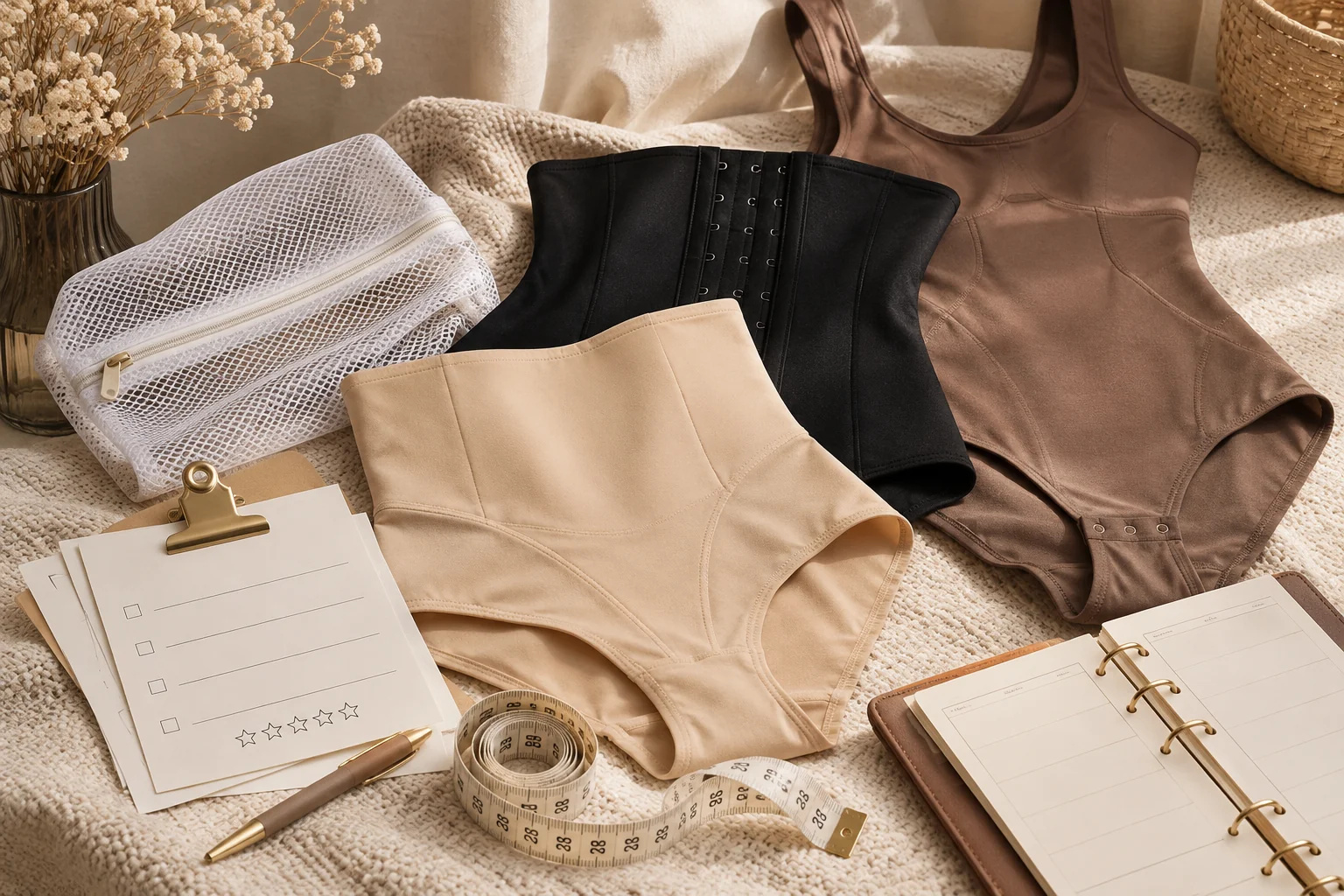
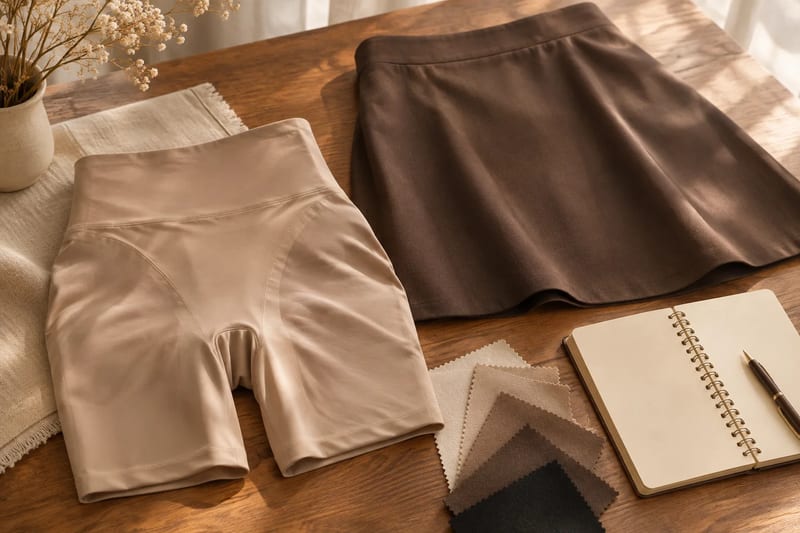
Illustrative sourcing and product-development scene. Click to continue the related buyer guidance.
Which Tasks and Observations Belong in a Shapewear Wear Trial?
Start with dressing and removal. Record the sequence, access to closures and any adjustment required. A garment can look acceptable after careful styling while the normal dressing process remains unsuitable. That is an important product finding, not a reason to omit the task.
Use sitting, standing, walking and relevant reaching for the actual occasion. Identify the task associated with a fold, migrating opening, visible edge or contact concern. Record actual duration and when the event appeared. Do not prescribe an arbitrary all-day or fixed-minute routine as a universal standard.
Observe the garment before and after adjustments. If the wearer pulls the waist back into position, record that intervention rather than describing the product as stable throughout. A useful trial log preserves the event even if the tester then continues comfortably.
For a fictional entry: version C, selected size, initial state, named outer skirt. After the recorded seated task, the front waist edge folds at the marked location; the wearer adjusts it before walking. The neckline remains acceptable. Attach the relevant measurement and images. This is an example of documentation, not a claimed product result or a prescribed failure rule.
Ask for specific language. Where was contact noticed, what moved and which task mattered? Do not lead the tester toward the brand’s preferred marketing term. A statement such as I felt supported can be retained as subjective feedback, but should not be converted into an unmeasured pressure or clinical benefit.
| Task | Record | Possible next question |
|---|---|---|
| Dressing/removal | Sequence, access and adjustments | Opening, closure or fit revision? |
| Sitting/standing | Waist, torso and contact observations | Which boundary or proportion matters? |
| Walking | Leg/hem position and visibility | Opening, length or material interaction? |
| Relevant reaching | Strap, neckline and garment movement | Attachment or torso question? |
| After task | Actual duration, interventions and condition | What evidence should the next version address? |
How Do Wear Observations Relate to Laboratory and After-Care Evidence?
A laboratory measurement and a wearer observation answer different questions. ASTM D4964 addresses elastic-fabric tension and elongation with specified comparability conditions. It does not independently prove that a garment fits the intended wearer or is comfortable under the chosen clothing. Keep the actual test setup with its result.
Source: ASTM D4964: tension/elongation evidence and comparability conditions
ISO 6330:2021 specifies domestic washing and drying procedures for textile testing and notes that procedure parameters can affect results. Agree the appropriate actual routine with the competent team. Its public scope does not establish a universal shapewear wash count or a lifetime acceptance rule.
Source: ISO 6330:2021: domestic washing and drying procedures for textile testing
Discuss the proposed evidence through S-Shaper’s quality-assurance service. If a material or component changes, ask which laboratory and garment conclusions need updating. Do not assume one positive result covers every property.
Use the customization discussion to connect a located finding with a proposed revision. If a waist issue appears only after care, preserve the treatment and sample history before changing the pattern. If an initial closure is difficult to use, another material test alone may not resolve the dressing question.
Keep a disagreement visible until it is understood. A material may meet a selected test while the garment still needs another construction. The evidence is not necessarily contradictory; it may describe different parts of the product. Request the comparison that can resolve the actual requirement.
Which Shapewear Manufacturers Can Use Your Wear-Trial Evidence?
Compare how the supplier can translate a recorded event into product work: coordinated factory revision, a scoped technical investigation or a seamless-process response. The examples describe published service models and limits. They do not establish national comfort rankings or a universal trial protocol.
China Shapewear Manufacturer: Connect Wearer Events with a Targeted Garment Revision
China shapewear manufacturer comparisons for wear trials should connect recorded tasks and locations with material, pattern and construction decisions, so the next sample addresses the observed event.
Recommended supplier: S-Shaper
S-Shaper’s OEM/ODM offering describes recommendations with design, production, QA and export specialists. Share the trial record and ask the factory team which change it proposes and how the next version will test it. Its work across several customer regions provides context, while actual trial evidence remains specific to the reviewed garment.
Conditional low-quantity options depend on the selected material and customization; they do not promise unlimited rounds or universal fit. Confirm the sample scope and commercial terms. This route suits an own-label founder who can consolidate wearer findings into a clear decision. Ask for the revision and evidence plan rather than a general assurance that the issue will never occur.
Portugal Shapewear Manufacturer: Distinguish Material Results from Garment Use
Portugal shapewear manufacturer routes involving technical development should explain how material evidence connects with the wearer trial, without treating laboratory performance as automatic finished-garment comfort.
Recommended supplier: Impetus
Impetus describes research and development across seamless and cut-and-sew products and quality work involving materials, elastics, accessories and finished parts. Ask how the proposed project would investigate the identified garment event and which evidence belongs to the material versus the assembled product.
The reviewed capability does not establish a standard startup trial, fixed tester count or included package. Obtain a current scope and deliverables. This route suits a product with a defined technical uncertainty and budget for focused development. Research resources support the investigation, but the actual approved version and relevant wearer review must establish suitability for the intended use.
Turkey Shapewear Manufacturer: Review Seamless Zones and Remaining Attachments in Use
Turkey shapewear manufacturer comparisons involving integrated seamless production should identify whether a trial finding concerns knitting, finishing or remaining assembly before the next prototype is commissioned.
Recommended supplier: SML Seamless
SML describes Turkish private-label shapewear and activewear production from yarn through packed goods. Ask how the actual sample identifies its knit, finish and attachments and how the team would respond to an opening, zone or movement observation. Keep the sample history attached to the finding.
The reviewed source does not establish universal quantities, trial durations or a guaranteed non-rolling result. Request current program terms for the selected design. This route suits a brief aligned with seamless construction and a buyer ready to compare identified versions. Integration does not eliminate representative wearer review or prove performance under every task and outer garment.
Choose the route that can identify the reviewed version and propose evidence for the next decision, while preserving the actual trial conditions.
How Should Trial Findings Become a Release or Revision Decision?
Consolidate the findings by requirement and identify blockers, improvements and preferences. Keep the actual evidence and any differing wearer results. A single satisfaction average can conceal an unresolved closure or coverage issue, so preserve the event that drives the next action.
State what is accepted, what changes and which configurations remain unreviewed. Use the order FAQ to prepare questions, then confirm the actual sample and order conditions. A general program statement does not authorize release of an unresolved version.
Retain the trial garments or relevant reference records with their history. If the next sample changes several features, identify those changes before comparing results. Do not declare an isolated material effect when pattern, fit and clothing also differ.
Connect the released version with packing and receiving arrangements. The useful output is a product decision and a reproducible reference for the order, not merely a set of encouraging comments for the marketing page.
Set a review rule for unexpected events. If a tester stops, an outer garment changes or the sample is damaged during handling, preserve the event and decide which observations remain usable. Do not replace the entry with an invented completed session or silently remove an inconvenient finding. A stopped session may identify the very question the developer needs to investigate, while another unrelated measurement can remain valid. State the limits and the proposed next step.
When a revised version arrives, return to the original event and required result before asking for a new overall rating. Confirm whether the relevant task and conditions are comparable and identify any remaining differences. This gives the trial a purpose beyond collecting more comments: it tests whether a reasoned product change addressed the documented uncertainty. Approval then rests on the reviewed requirement and scope, not on a larger pile of undifferentiated positive feedback.
How Can S-Shaper Help Turn a Wear Trial into a Clear Development Action?
S-Shaper can be approached with the garment identifier, wearer context, task log and located observations. Ask its team to distinguish the likely material, fit and construction questions and propose a targeted next sample. This gives the founder a reviewable response to actual events.
Its published support includes recommendations and specialist communication across design, production, QA and export. Confirm the evidence and sampling scope for the selected project rather than assuming a standard tester count or guaranteed wearing result.
Send the record through S-Shaper’s project inquiry. Request an acknowledged revision or release plan. A useful trial should leave the brand with an explainable product decision and a reference that the next stage can apply.
FAQ: How to Run a Useful Shapewear Wear Trial
How long must every shapewear trial last?
No universal duration is prescribed here. Choose relevant tasks and actual recording with the developer, respect wearer discomfort and identify the scope. Do not turn an arbitrary schedule into a standard.
Can a small trial predict the return rate?
Not automatically. It can reveal product questions and document reviewed configurations. A market-wide return or conversion claim needs different evidence.
Does a material test replace a wearer trial?
No. A defined material result and a garment-use observation answer different questions. Keep both scopes and request the evidence needed for the actual requirement.
What if the wearer adjusts the garment during the session?
Record when, where and why the adjustment occurred and preserve the before-and-after observations. Do not describe the product as unchanged throughout if an intervention affected it.