 EN
Quick Answer
Choose shapewear fabric weight by comparing identified materials in the intended garment, not by specifying one supposedly ideal GSM. GSM means grams per square metre: it describes mass over area. It does not directly measure thickness, stretch resistance, recovery, opacity or pressure against a body. Request those properties separately where they matter.
Start with the wearing occasion, coverage, layered construction and customer measurements. Obtain documented swatches, compare their mass using a consistent method, then sample the most promising options on the same platform. A heavier fabric can be useful in one panel and unnecessary in another. Approve the complete garment only after movement, appearance and care checks.
For a startup, the immediate decision is which material comparison deserves sample investment. A narrow, justified shortlist is more useful than a very precise GSM requirement that excludes a suitable fabric without testing it.
What Does Shapewear Fabric GSM Actually Measure?
GSM expresses a fabric’s mass per unit area. A square metre of a nominal 200 GSM material has a nominal mass of 200 grams before you consider cutting waste, garment components or additional layers. This arithmetic identifies the quantity being discussed; it does not tell you what a finished bodysuit weighs.
The public ASTM D3776/D3776M description concerns fabric mass per unit area. Ask a qualified laboratory or supplier to identify the method and sampling basis it uses. A result from one small swatch should not silently become a promise about every roll. Agree how bulk material will be identified and checked against the approved reference.
Keep material weight separate from garment weight. An identical fabric can produce different garment masses because size, coverage, lining and accessories differ. A waistband elastic, gusset and closure belong in the component record even when a supplier quotes only the main fabric’s GSM.
Ask S-Shaper’s material customization team for a material reference alongside the nominal weight. Include composition, construction, color, finish and intended panel. Otherwise a later quotation may match the number while referring to another fabric entirely.
Also record the unit. Grams per running metre depends on width and is not GSM. Do not compare the two values without the usable width and a consistent area basis. A supplier can help reconcile the units before either side makes an unnecessary substitution.
| Quantity | What it describes | What remains unproven |
|---|---|---|
| GSM / g/m² | Mass per unit area | Support, thickness and comfort |
| Grams per running metre | Mass along a stated fabric width | Area weight without width |
| Finished garment mass | Complete specified piece | Main-fabric GSM alone |
| Force at stated extension | Resistance under defined conditions | Medical pressure or all-body fit |
Higher GSM vs Lower GSM: Which Fabric Is Better for Your Product?
Neither end of the weight comparison is automatically better. The useful question is whether the construction supplies the intended coverage and response with acceptable wear behavior. Compare candidates on one platform so an extra lining or different cut does not masquerade as a material-weight effect.
A lighter candidate may reduce material mass while leaving the garment too transparent at the required extension. A heavier candidate may improve a particular appearance yet create an unwanted edge or feel bulky under the target outfit. Those are possibilities to test, not universal outcomes established by the GSM number.
Stretch resistance is another independent question. Two fabrics with similar mass can resist extension differently because yarns, knit structure, finishing and direction differ. ISO 20932-1 describes strip-based elasticity testing. Ask which relevant measurements and conditions will accompany a candidate instead of interpreting a blend percentage as a complete mechanical specification.
Use S-Shaper product references to explain the intended construction: a smoothing brief and a double-layer body need different comparisons. Describe what must remain unchanged between samples. If the supplier must alter a seam or panel to make a fabric usable, record the change and evaluate its contribution separately.
Avoid scoring every property into a single unexplained winner. Identify the failures that would reject a candidate, then evaluate the remaining trade-offs against the product brief. Your strongest material may be a combination of panels rather than a single heavier fabric throughout.
| Same-platform comparison | Lower-mass candidate: question | Higher-mass candidate: question |
|---|---|---|
| Appearance at intended extension | Is coverage sufficient? | Does the edge show under clothing? |
| Movement and dressing | Does it remain positioned? | Can intended users dress comfortably? |
| Layer interaction | Is a second layer necessary? | Does the assembly add unwanted bulk? |
| Care and recovery | Does shape remain acceptable? | Does the feel change after care? |
How Can You Check GSM Calculations Without Inventing a Quality Grade?
Use an explicit example to understand units before discussing acceptance. Suppose a deliberately hypothetical, accurately cut specimen has an area of 100 square centimetres and a mass of 2.10 grams. Its area is 0.01 square metre, so dividing 2.10 by 0.01 gives 210 g/m². This is a calculation demonstration, not a test result from S-Shaper or a recommended shapewear weight.
If three imaginary specimens of that same area weigh 2.08, 2.10 and 2.12 grams, their calculated values are 208, 210 and 212 g/m². The simple mean is 210. The observed span is four g/m², approximately 1.9% of that mean. Neither calculation establishes a permissible production variation.
Real test work requires the appropriate specimen preparation, equipment, conditioning and sampling procedure. Agree these with the laboratory rather than copying this simplified illustration into a test instruction. A balance reading is only useful when the specimen’s area and identity are dependable.
Do not average material from different shades or constructions to hide a difference. Retain individual readings and references. A nominal target can remain useful for procurement, but the acceptance band must be agreed for the selected material and method before inspection.
When reviewing a report, ask what was sampled, when, from which lot and with what uncertainty or reporting conventions. The practical buying question is whether the supplied material matches the approved specification, not whether one decimal place makes a quotation look more technical.
| Hypothetical specimen | Mass / area | Calculated GSM |
|---|---|---|
| A | 2.08 g / 0.01 m² | 208 g/m² |
| B | 2.10 g / 0.01 m² | 210 g/m² |
| C | 2.12 g / 0.01 m² | 212 g/m² |
| Simple mean | (208 + 210 + 212) ÷ 3 | 210 g/m²; not an acceptance target |
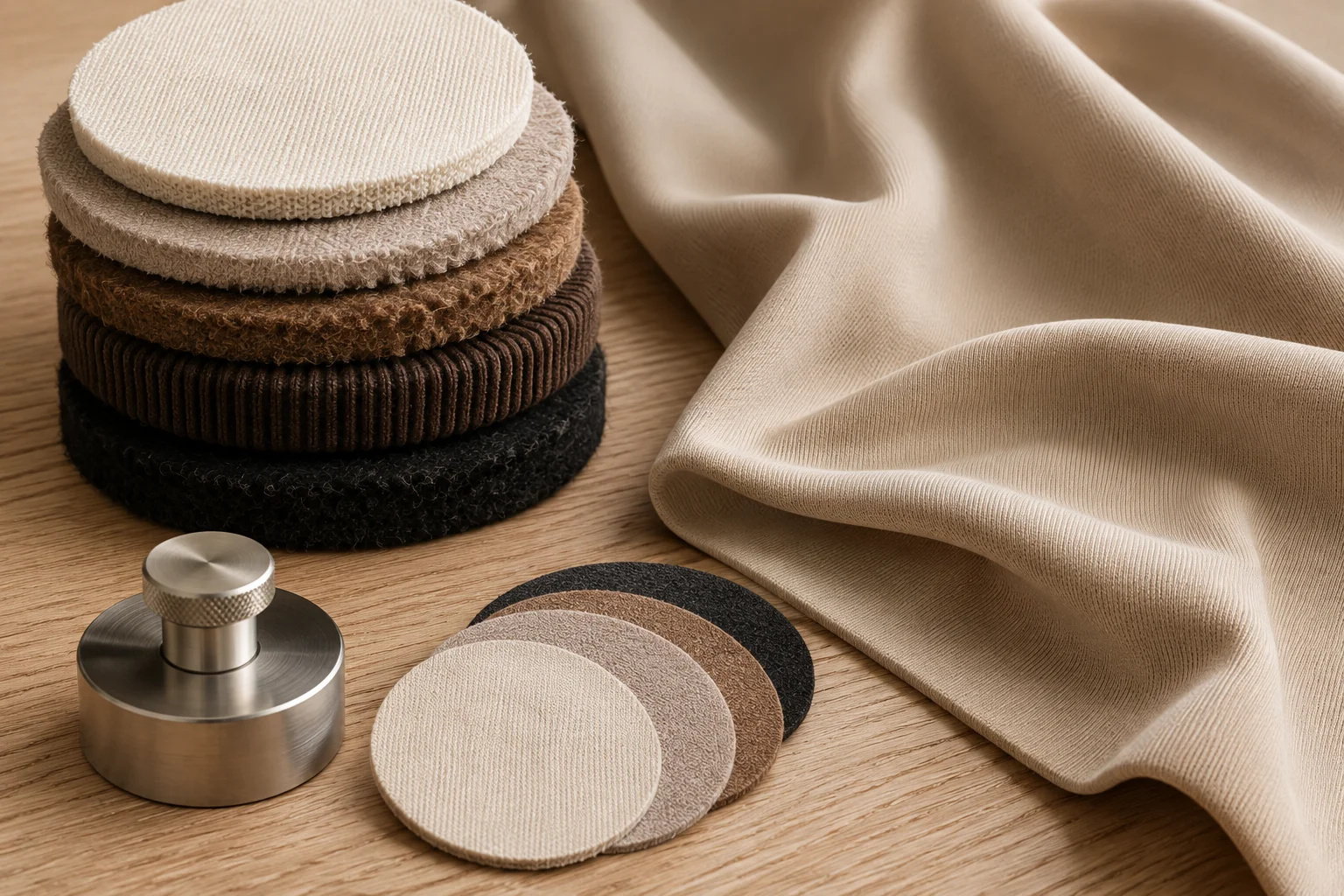
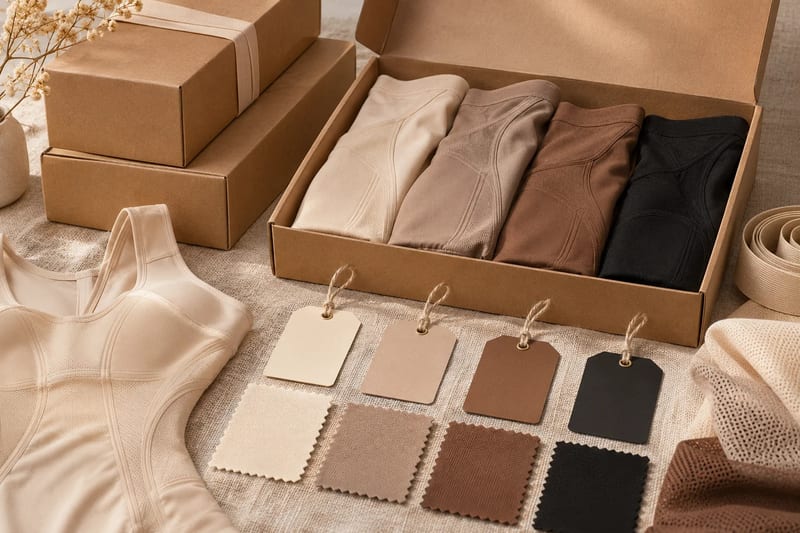
Illustrative sourcing and product-development scene. Click to continue the related buyer guidance.
How Do Panels, Linings and Size Change a Fabric-Weight Decision?
A garment assembly can contain several materially different zones. Identify the outer layer, control panel, gusset, waistband and any lining instead of writing one GSM figure beside the complete style. A coating or bonded layer also needs a clear description of what the reported weight includes.
Consider a hypothetical panel with 0.20 square metre of a 180 g/m² outer material and 0.12 square metre of a 220 g/m² reinforcement. Their simple material-mass estimate is 36 plus 26.4, or 62.4 grams. This excludes seams, trims, cutting loss and every other garment part. It illustrates area accounting, not a pattern yield or production consumption quote.
A lighter main material with reinforcement may therefore create another result from a heavier single layer. Sample both constructions if the product decision genuinely depends on that choice. Keep the location and coverage of the panel visible in the drawing so the comparison can be repeated.
Size introduces another variable. Larger panels consume more area, but material area alone does not establish support or comfort on a larger body. Review the pattern, extension and wearer feedback in the relevant sizes. Do not use a higher GSM as a substitute for grading work.
Discuss these dependencies through the S-Shaper OEM/ODM development route. Ask whether the candidate material is already compatible with the selected platform and which samples will establish the proposed layer arrangement. Quote development work separately from an existing-stock garment so the startup understands what it is approving.
Which Wear and Care Checks Should Accompany the GSM Comparison?
Write the intended use before choosing tasks. Daily wear under work clothes can require seated comfort, bathroom access and discreet edges. Occasion wear can place more importance on a particular neckline or outfit. The same material comparison cannot answer every wearing scenario without identifying the garment and participants.
Record sample size, tester measurements, material ID, care state and relevant activity. Ask where a garment moves or feels restrictive, rather than requesting only a general comfort score. Distinguish a seam complaint from a panel complaint so the supplier can propose a targeted correction.
Check appearance at the extension produced by the approved fit. A relaxed swatch photographed on a desk does not demonstrate opacity on a wearer. Keep viewing conditions consistent and obtain consent for any photographs. Record the intended outer garment where visibility is part of the requirement.
Review the sample after the proposed care process. Record what changed in dimensions, surface, edge behavior and recovery. Do not report an unspecified home wash as a standardized test or let a fabric report stand in for the complete assembly.
Use S-Shaper’s quality-assurance process to discuss which material and finished-garment checks will be documented. Decide which result requires another sample, a different panel or a material rejection. A failed wearer requirement should remain visible even if the GSM reading matches the purchase specification.
Which Shapewear Manufacturers Can Help You Evaluate Fabric Weight?
Compare suppliers through the material decision they can document. The country of a business relationship does not establish an ideal fabric weight, a national quality level or a ready quotation for your construction.
China Shapewear Manufacturer: Connect Weight to the Actual Panel
China shapewear manufacturers with development and production support can evaluate a material-weight request against the pattern, layered construction and available fabric rather than treating GSM as the whole specification.
Recommended China Supplier: S-Shaper
S-Shaper describes design, production, QA and export specialists and material recommendations informed by work with international brands. Ask the customization team to identify candidate fabrics and explain which layer each weight describes. Its item-dependent small-order options may help a focused platform test, but they do not promise a new fabric lot at a stock minimum. Confirm availability, material procurement conditions and sample approvals before planning dispatch. Direct communication is useful when the founder needs to distinguish a lighter fabric from a different garment construction.
Portugal Shapewear Manufacturer: Review Material Evidence and Assemblies
Portugal shapewear manufacturer proposals with research and laboratory coordination can be relevant when comparing a material property against performance of the complete assembly, rather than selecting on weight alone.
Recommended Portugal Supplier: Impetus
Impetus describes research collaboration, seamless and cut-and-sew development, and physical and chemical checks across materials and finished parts. Ask whether its relevant technical scope can compare your candidates and how the results connect to the sample. The trade-off is that laboratory work, material development and preparation need an actual proposal; no public evidence establishes a startup minimum or universal country price premium. It suits a founder with a defined technical question and the budget to investigate it. Confirm the current development slot and material readiness.
Turkey Shapewear Manufacturer: Separate Knit Settings from Fabric Mass
Turkey shapewear manufacturers operating an integrated seamless route can be assessed through their ability to explain how knitting, dyeing and finishing contribute to the material and garment being approved.
Recommended Turkey Supplier: SML Seamless
SML describes private-label shaping products and yarn-to-packed facilities. That creates a relevant discussion about maintaining one material reference through processing, but integration alone does not validate the GSM or support result. Ask which finished-state specimen represents production, what changes require a new sample and whether color-batch conditions fit the order. This route suits a compatible seamless product. It requires confirmation of quantities and dispatch dependencies, rather than an assumption that the same weight makes every knit construction equivalent.
Canada Shapewear Manufacturer: Translate Wear Feedback into a Specification
A Canada-based shapewear manufacturer comparison can focus on technical communication: translating a founder’s coverage or bulk concern into measurable fabric and panel requirements before overseas production is released.
Recommended Canada Supplier: Hertex Lingerie
Hertex identifies Montreal design, pattern, grading and QC work with production in China. That hybrid model may help when the main problem is defining why one material feels wrong in the pattern. Ask who owns the material record and how an approved change reaches the factory. Coordination and development need a quote; Canadian technical involvement does not mean Canadian-made replacement stock. It suits founders seeking technical interpretation, provided eligibility, sampling work and the production handoff are confirmed.
Choose the partner that can connect material identity, relevant measurements and wearer evidence, then preserve that connection in the production specification.
What Should the Fabric-Weight Approval and Bulk Handoff Contain?
Approve an identified material, not the phrase premium high-GSM fabric. Keep the code, composition, structure, color and finish beside the agreed weight reference and checking basis. Link each material to its garment panel and the sample version that established suitability.
Separate nominal targets from acceptance criteria. If a permissible range is agreed, record who proposed it, what method it uses and what happens when a result falls outside it. Do not choose a tolerance solely because a supplier’s first reading happens to fit.
Before commitment, confirm whether the sample and planned production use the same available material. A small development cutting does not establish the stock needed for bulk. Ask what purchasing or processing event fixes the material identity and which substitutions require written approval.
The S-Shaper supply-chain and logistics discussion should identify dependencies on material arrival, garment completion and the receiving destination. A passed fabric measurement does not release an unfinished or unapproved garment for shipment.
Retain the chosen reference and the rejected alternatives with the reasons for the decision. On reorder, a familiar GSM number should not override changed appearance or wear behavior. If the fabric or finishing changes, review the affected evidence before repeating the customer claim.
How Can S-Shaper Support a Practical Fabric-Weight Decision?
S-Shaper offers shaping-product references alongside OEM/ODM, customization, quality and supply support. For a startup evaluating fabric weight, the useful service is a coordinated discussion of the material, construction and wearing problem. Its published capabilities introduce that discussion; the agreed project defines what will actually be supplied and checked.
Send the proposed product, use case, target measurements, candidate swatches and the concern you need to resolve. Ask which alternatives can be sampled without unnecessary material development and which checks would distinguish them. Review the S-Shaper order FAQ for preliminary conditions, then confirm item-specific quantities and material availability.
To proceed, request a material-and-sample proposal from S-Shaper. Ask for identifiable deliverables and approval points. A defensible first decision is a suitable, repeatable garment with documented material choices, rather than the highest number printed on a swatch card.
FAQ: Choosing Shapewear Fabric Weight Without Over-Specifying GSM
Is there one best GSM for everyday shapewear?
No universal value follows from the unit. Consider coverage, construction, material behavior, intended fit and wear testing. Compare identified candidates on the relevant platform and agree the production requirements after sampling rather than selecting solely by nominal weight.
Does higher GSM mean stronger compression?
GSM measures mass per area. Resistance at a defined extension, pattern dimensions and the garment assembly also affect wearing behavior. A weight figure alone does not establish support or medical pressure. Ask for the relevant mechanical evidence and garment trials.
Can I calculate GSM from a small piece?
You can understand the arithmetic by dividing mass in grams by area in square metres. Dependable test results additionally require suitable equipment, specimen preparation and a defined procedure. The simplified examples here are hypothetical, not standardized test instructions or acceptance criteria.
Should lining and outer fabric have the same weight?
They perform different jobs and need separate material identities. Record which layers a quoted figure covers and approve their assembled behavior. A heavier total assembly can arise from multiple materials even when the main fabric’s nominal weight stays unchanged.
What should I ask before ordering bulk fabric?
Confirm the approved reference, available lot, finish, color, sampling basis and acceptance criteria. Identify garment panels, material quantities and substitution approvals. Keep wearer and care evidence connected to the final sample; a matching GSM reading alone is insufficient.