 EN
Quick Answer
To source breathable shapewear fabric, first define which property your claim means: airflow, liquid moisture transport, drying behavior or resistance to water-vapour transfer. These are different questions. Request the matching evidence for the identified material, then check the assembled garment in the intended wearing conditions.
A mesh appearance, a soft touch or a moisture-wicking label does not establish every aspect of breathability. Linings, control panels, adhesives, outer clothing and fit can change the experience. A startup should compare a small set of documented candidates rather than approve an undefined cooling claim from a swatch alone.
Ask for the test method, units, specimen identity, conditions and care state. Keep laboratory results separate from wearer feedback and advertising promises. Approve the combination that addresses the daily-wear problem with acceptable support and coverage, without inventing a universal comfort threshold or promising medical effects.
Which Breathability Claim Does Your Daily-Wear Product Need?
Begin with the customer situation. Is the concern feeling clammy under a work outfit, remaining comfortable while walking, or an overly dense control panel? Each points to another investigation. Write the complaint in ordinary language before deciding which technical measurement could help explain it.
Air permeability concerns air passing through a fabric under specified conditions. ASTM D737 is a relevant method reference. Liquid moisture management concerns wetting and movement of liquid through a textile; the public AATCC TM195 description addresses that separate subject. Water-vapour resistance is another measurement, addressed with thermal resistance in ISO 11092:2026.
These references identify different scopes, not an automatic test package for every startup. Ask the laboratory which method answers your particular question and what the reported result can support. A supplier’s statement that a fabric passed a test is incomplete without a method, result and requirement.
Use S-Shaper’s material customization support to discuss the garment zones that need investigation. The main body, reinforcement and gusset may not share the same material or claim. Identify the intended skin-facing side where that affects the test or application.
Keep the eventual product language narrower than the evidence. A report on liquid transport should not become proof that the complete garment keeps every wearer cool. A well-defined claim is easier to evaluate, explain and maintain when material availability changes.
| Buyer question | Potential evidence route | What it does not establish alone |
|---|---|---|
| Does air pass through this material? | Air-permeability result and conditions | Liquid transport or complete-outfit comfort |
| How does liquid move? | Liquid-moisture-management report | Airflow or drying time |
| How resistant is vapour transfer? | Water-vapour-resistance measurement | An all-day comfort guarantee |
| What happens during daily use? | Controlled garment wear comparison | A standardized fabric result |
Air Permeability vs Moisture Wicking: Why Should Buyers Separate Them?
A fabric can be discussed in terms of more than one transport mechanism, but the words should not collapse into one score. Air moving through an opening is different from liquid spreading across or through yarns. A material that performs well for one purpose still needs evidence for the other claim you intend to make.
The practical buying error is to compare two numbers with different meanings. A liquid wetting time in seconds cannot be ranked directly against an air-flow quantity. Even two air-permeability results need compatible test conditions before their difference is meaningful. Pressure difference and specimen configuration belong with the result, not in an email that disappears after approval.
Similarly, quick drying is a separate claim requiring a defined comparison. Do not assume a report on liquid distribution establishes the time a complete damp garment takes to dry. If drying is important, ask which suitable method and conditions will address it, and document that work independently.
ISO 11092:2026 also makes clear that its specified conditions are not particular comfort situations. That is a useful boundary for the founder: controlled material evidence informs selection, while the actual daily-wear proposition still needs garment-level evaluation.
Ask the supplier to describe what each candidate changes. A more open zone might alter coverage, seam behavior or support as well as airflow. Evaluate those consequences together. The winning comparison is the one that addresses the wearer need without introducing a different unacceptable problem.
| Comparison item | Air-permeability discussion | Liquid-management discussion |
|---|---|---|
| Quantity of interest | Flow through fabric under stated setup | Wetting and transport of applied liquid |
| Report requirements | Method, units, pressure conditions, specimen | Method, face orientation, reported measures |
| Common misuse | Treating mesh appearance as proof | Treating wicking as proof of cooling |
| Next buying check | Review covered garment zones | Review skin-facing and multilayer behavior |
What Should a Supplier’s Breathable-Fabric Evidence Contain?
Ask for a material identifier before requesting results. The fabric code, composition, structure, color and finish should connect the report to the actual swatch. If a supplier offers a family of materials, establish which member was tested and whether your chosen shade or treatment differs.
Record whether the specimen was relaxed, stretched or assembled with other layers. Do not silently compare one candidate in a relaxed single layer with another in a configuration that resembles the garment. Ask the laboratory which arrangement is appropriate and how any deviation is reported.
Separate method, result and acceptance requirement. A method name explains the procedure family; the result reports a measured property; your agreed requirement states what is acceptable for the project. None substitutes for the other two. Avoid accepting the word certified when no certificate or relevant report is identified.
Where the property depends on a finish, discuss the intended care exposure. Request evidence on the relevant care state rather than assuming the initial swatch result lasts unchanged. Keep an untreated or earlier reference where it helps investigate what a process changed.
The S-Shaper quality-assurance discussion can help assign responsibility for obtaining and checking the evidence. Ask which results are supplier-provided, which require external work and which concern the finished product. Agree the deliverable before authorizing costs; this article supplies no laboratory tariff or guaranteed turnaround.
| Record field | Example format to complete | Decision it enables |
|---|---|---|
| Identity | Material code / color / finish / lot | Connect result with sample |
| Method and setup | Named procedure / conditions / units | Assess comparison validity |
| State | Before care / specified care exposure | Review durability of the property |
| Layer configuration | Single fabric / identified assembly | Avoid claiming more than tested |
| Requirement and action | Agreed limit / revision owner | Approve, investigate or reject |
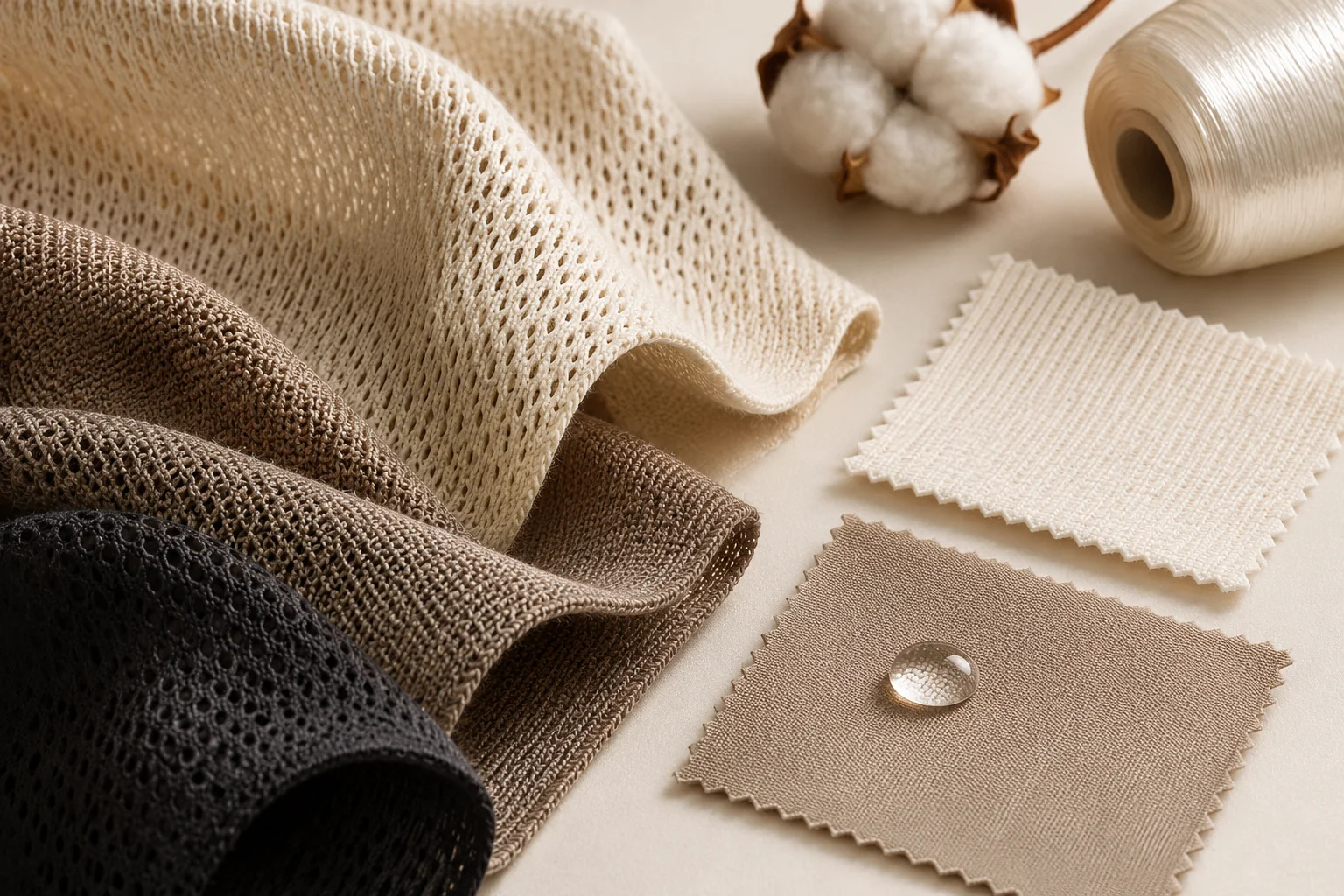
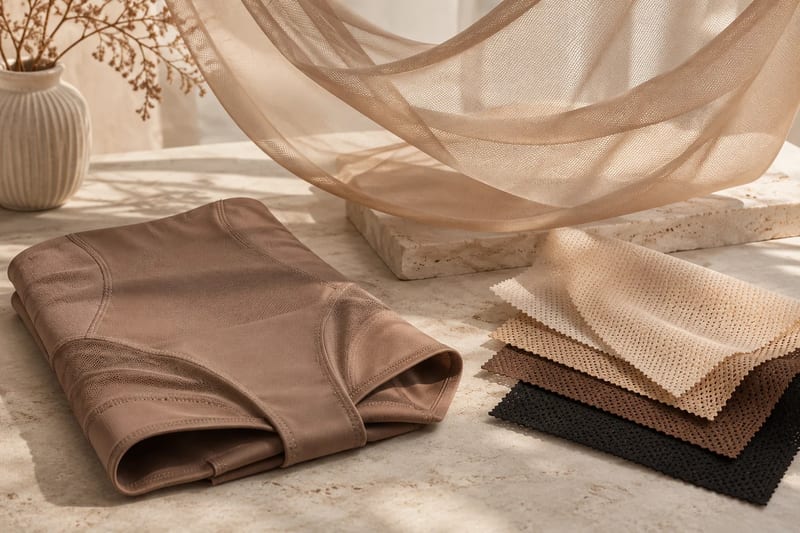
Illustrative sourcing and product-development scene. Click to continue the related buyer guidance.
How Can the Shapewear Construction Change the Fabric Result?
Draw the garment as a set of functional zones. Identify the main knit, control layer, lining, gusset, elastic and any bonded region. A report on the main material describes only that specimen; it cannot automatically represent a panel covered by reinforcement or adhesive.
For a hypothetical design review, imagine a front region of 600 square centimetres, with reinforcement covering 240. The reinforcement covers 40% of that region: 240 divided by 600. This is a chosen area calculation, not a breathability test or a prediction that airflow falls by 40%. Actual transfer depends on the assembly and conditions.
That distinction matters when changing a pattern. Reducing a reinforcement area may affect support and appearance as well as transport. Ask for a controlled sample alternative and identify which layer or attachment changed. Keep every other feasible feature consistent so feedback can be interpreted.
Use S-Shaper’s shaping-product references to show the coverage you need and the clothing worn over it. A fabric suitable for a brief may face another evaluation in a longline body or integrated dress. The outer outfit also belongs in a realistic wear comparison.
Review edges and seams, not just broad panels. A wearer can report discomfort at an elastic even when the main fabric performs well in the chosen lab test. Categorize the location and mechanism before asking for a different material everywhere. A targeted construction revision can be more informative than replacing the entire fabric without diagnosis.
How Should a Startup Compare Daily-Wear Samples Without Inventing Data?
Design a small, transparent comparison around the intended use. Record participant measurements relevant to fit, sample version, care state, outer clothing, activity and duration. Obtain consent and allow participants to stop or remove a garment if it causes discomfort. This is product feedback, not a clinical study.
Use the same questions for each candidate. Ask about clamminess, localized heat sensation, edge discomfort, movement and coverage, rather than one vague breathable rating. Allow a participant to explain why the experience changed. A rolled waistband can create a complaint that is not primarily about material transport.
For a deliberately hypothetical feedback sheet, suppose eight participants try two approved-fit samples. Three report persistent clamminess in A and one reports it in B. The descriptive proportions are 37.5% and 12.5% in that small exercise. The difference is 25 percentage points; it is not proof of a population improvement, statistical significance or a claim that B reduces complaints by a guaranteed amount.
Inspect the individual records before making a material decision. Were the complaints concentrated in one size, panel or activity? Did the samples use the same care state and lining? Missing or unequal conditions can explain an apparent difference.
Combine the observations with relevant lab evidence and appearance checks. If the comparison justifies another prototype, write the exact change and the question it will answer. If the evidence is inconclusive, keep that uncertainty visible rather than turning a small trial into a promotional percentage.
Which Shapewear Manufacturers Should You Compare for Breathable Daily Wear?
Compare suppliers by how they can connect a clearly defined transport property with the actual garment. Geography can describe a production or technical-service route, but does not certify a national level of comfort.
China Shapewear Manufacturer: Connect Material Claims with Zoned Samples
China shapewear manufacturers offering material selection and garment development can help test whether a breathable-fabric request remains useful after control panels, linings and fit are included.
Recommended China Supplier: S-Shaper
S-Shaper describes coordinated design, production, QA and export expertise, with material and function recommendations informed by global-brand work. Ask its development team to separate an air-flow question from a liquid-management claim and identify the needed evidence. Applicable small-order tests depend on the item; a new finish or material lot may introduce other conditions. Confirm which material is available, what sample configuration will represent the garment and which approvals affect dispatch. This route suits a founder needing practical guidance across the material-to-product handoff.
Portugal Shapewear Manufacturer: Ask for a Defined Research Comparison
Portugal shapewear manufacturer candidates with research and testing coordination can be relevant when the project needs measured comparisons of fabric and assembled zones rather than an unsupported cooling adjective.
Recommended Portugal Supplier: Impetus
Impetus describes its own research activity, technical partnerships and laboratory checks across materials and finished parts. Ask whether the proposed program can obtain the exact evidence you need and connect it to your sample state. Research capability does not disclose a startup MOQ, guaranteed laboratory slot or complete development price. Materials, evaluation and preparation require a project-specific scope. This route can suit a technically defined daily-wear brief; confirm the procurement and production dependencies before assuming a tested concept is ready to ship.
France Shapewear Manufacturer: Balance Outfit Compatibility with Comfort
France shapewear manufacturer and adaptation proposals may be useful when the comfort requirement is tied to bridal or difficult-neckline clothing, where coverage and invisible edges constrain the material choice.
Recommended France Supplier: Gilsa Paris
Gilsa describes invisible-lingerie solutions, professional resale and own-label adaptation or development. Its occasion-design context can help frame a sample comparison under the intended outfit. Ask what materials and technical evidence apply to the chosen style; a design specialty does not establish a particular moisture result. Existing assortment and newly adapted supply also have different replenishment and preparation needs. Product-dependent minimums, component work and development charges require confirmation. French service is not proof that every article is fabricated in France.
Colombia Shapewear Manufacturer: Evaluate an Existing Shaping Platform
Colombia shapewear manufacturer comparisons can include specialist finished-product platforms, where the founder evaluates the actual coverage and wearing experience before deciding whether resale meets the business model.
Recommended Colombia Supplier: Leonisa
Leonisa identifies Colombian manufacturing and an international wholesale program. Its shaping assortment can supply concrete products for a construction and use-case review, subject to actual wholesale availability. Ask for style-specific material and care information and test the relevant fit; country or brand familiarity cannot replace that evidence. Wholesale supply does not establish OEM permission or access to custom material changes. This route suits an appropriate resale assortment, while a founder needing original development should confirm that separate capability rather than infer it.
Choose the route that can document the property you need, preserve the sample’s identity and explain the construction trade-offs before you fund production.
What Should You Approve Before Publishing Breathability Claims?
Keep three connected approvals: the material evidence, the finished sample and the public wording. Name the material and tested configuration so the copy cannot quietly expand from a single fabric to the whole outfit. A broader promise requires broader supporting evidence.
Write the claim in terms a customer can understand. If the evidence concerns moisture transport, do not substitute temperature reduction or an all-day dry guarantee. Describe the intended application and relevant care guidance without presenting a lab result as a personal outcome for every user.
Connect changes to review triggers. A new lining, finish, reinforcement layout or material supplier can affect the basis of the claim. Require the production team to identify substitutions and the brand to decide which evidence must be revisited. Keeping the original marketing words is not a reason to ignore a changed construction.
Review the S-Shaper supply and logistics scope for material readiness and order handoff. A fabric report does not establish bulk availability or warehouse arrival. Identify the dependencies and confirmation points appropriate to the actual project.
After launch, collect specific comfort and fit questions without treating them as a standardized test dataset. Investigate repeated reports against the delivered version and wearing context. That feedback can guide another controlled material or panel comparison and help keep the customer promise aligned with the product.
How Can S-Shaper Help Define a Breathable-Material Sourcing Project?
S-Shaper combines shaping-product references with material customization, OEM/ODM, quality and supply-support services. A startup can use that scope to discuss a particular daily-wear problem and the evidence needed to evaluate a proposed fabric in a garment. Public service descriptions do not replace the agreed technical deliverables.
Send the wearing scenario, target measurements, sample reference and the claim you hope to substantiate. Ask which material alternatives are available, which construction changes they require and what testing or wear review is included. Use the S-Shaper order FAQ for initial conditions, then confirm the scope for the actual style.
To start, request a breathable-material development discussion. Seek a clear route from candidate swatch to approved assembly and carefully worded product information. The aim is useful, supportable performance for the intended customer, with uncertainty and remaining work made explicit.
FAQ: How to Source Breathable Shapewear Fabrics for Daily Wear
Does moisture wicking mean a fabric is breathable?
The terms can describe different properties. Liquid transport, airflow, drying and water-vapour resistance need suitable evidence of their own. Define the intended claim and garment zone before deciding which tests and wear checks belong in the project.
Is mesh always a better choice?
A visible open structure is not a complete performance record. Review coverage, fit, layering, edges and the relevant measured property. Compare the actual assembled garment rather than selecting a material solely because its appearance suggests airflow.
Which test should I request?
Start with the question. ASTM D737 concerns air permeability, AATCC TM195 concerns liquid moisture management, and ISO 11092 addresses thermal and water-vapour resistance. Confirm the appropriate method, edition, setup and interpretation with the qualified laboratory for your material and claim.
Can one small wear trial support a percentage improvement claim?
A small transparent trial can help diagnose a product issue, but descriptive feedback is not a population estimate or automatic advertising substantiation. Preserve participant and condition records, explain limitations and avoid guaranteed complaint-reduction or cooling percentages.
What needs rechecking after a material change?
Review the changed fabric or finish, layer configuration, fit, care behavior and any claim based on the previous version. Agree which evidence and sample approvals must be repeated before bulk release or reuse of the old product wording.