 EN
Quick Answer
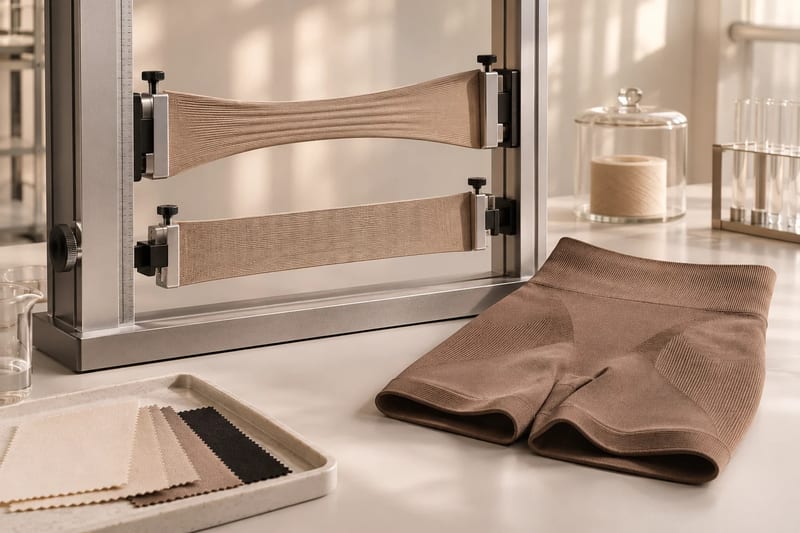
Compare shapewear stretch and recovery under agreed conditions: material direction, specimen size, loading or extension, cycle count, recovery interval and care state. Ask for the original readings and method rather than accepting a single stretch percentage without context. Stretch describes extension; recovery describes what happens after that extension is released.
Use identified fabric candidates and test the assembled garment as well. A material can extend easily yet leave unwanted growth, while another can recover but resist dressing too strongly for the intended user. Pattern dimensions, seams, panels and elastics help determine the complete result.
For a startup, the goal is a repeatable material-and-garment comparison, not the highest percentage on a supplier sheet. Specify the wearing requirement, request appropriate technical evidence and approve a sample only after relevant movement and care checks. Ordinary shaping support should not be presented as a medical pressure rating.
What Is the Difference Between Stretch, Growth and Recovery?
Stretch is a change in length under a stated condition. A reported extension percentage is incomplete without the starting gauge length, direction and applied condition. Two suppliers can report different-looking percentages simply because their setups differ, even before their fabrics are considered.
Growth describes a remaining dimensional change after release and a specified interval. Recovery describes return toward the initial dimension. These concepts can be expressed with different calculations, so ask for the formula and raw lengths. A percentage called recovery should never arrive without its denominator.
ISO 20932-1 identifies strip tests for fabric elasticity. ASTM D4964 addresses elastic-fabric tension and elongation using a constant-rate-of-extension machine. Their public descriptions establish relevant testing scopes; they do not supply one universal shapewear acceptance number. A qualified laboratory should select and execute the applicable procedure.
Ask S-Shaper’s material customization team which evidence fits the candidate and its intended panel. A broad body fabric and a narrow elastic can require different investigation. Do not automatically transfer a result from one component type to another.
Finally, distinguish fabric elasticity from finished fit. A strip has a controlled geometry; a garment has seams, closures, varying directions and contact with a body. Material evidence is essential to a technical decision, but it cannot by itself establish how every size will remain positioned or feel during daily use.
| Term | Buyer-friendly meaning | Information needed |
|---|---|---|
| Extension / stretch | Length change under a defined condition | Initial length, condition, direction |
| Residual growth | Remaining change after release | Rest interval and measurement basis |
| Recovery | Return toward the original state | Formula, denominator and timing |
| Garment fit | Interaction of construction and wearer | Sample version, measurements and tasks |
Easy Stretch vs Reliable Recovery: Which Property Should You Prioritize?
Easy extension can help with dressing and movement, but it is not synonymous with the desired support. A candidate that stretches readily may need evaluation for positioning and residual change. A resistant candidate may create an uncomfortable entry or edge even if its dimensions return well afterward.
Decide which wearing problem is essential. For a bodysuit, the customer must get through the opening and use the closure without the torso pulling excessively. For shorts, waist and thigh movement matter. The correct comparison therefore connects material behavior to the particular pattern and task.
Request a controlled alternative rather than changing composition, pattern and elastic at the same time. If a supplier proposes another fabric, establish what remains constant and what has to change for construction compatibility. Interpret the outcome as an assembly comparison when several features differ.
Do not select by maximum extension to failure unless that is genuinely the question. Normal wearing and repeated extension can require other measurements. Ask for the tension at a relevant specified extension or the extension under an agreed condition, as appropriate to the method and garment investigation.
Treat apparent recovery as time-dependent evidence. A sample that looks restored after a long rest may have behaved differently immediately after wear. Agree which observations are useful for the product and retain those intervals in the report. The objective is relevant repeatability, not a favorable result achieved by changing when the measurement is taken.
| Buying objective | Insufficient shortcut | More useful comparison |
|---|---|---|
| Ease of dressing | Largest stretch claim | Relevant opening and wearer tasks |
| Stable positioning | Fabric feels springy by hand | Defined repeated-use and growth evidence |
| Intended support feel | More elastane must be firmer | Mechanical evidence plus garment trial |
| Reorder continuity | Same blend percentage | Material ID, setup and approved sample |
How Can You Read Stretch and Recovery Percentages Correctly?
Consider a deliberately hypothetical example with an initial gauge length of 100 millimetres. Under a chosen demonstration condition it reaches 120 millimetres. The extension is 20 millimetres, or 20% of the initial length. After release and an explicitly chosen rest interval, it measures 102 millimetres.
Residual growth relative to the initial length is then 2%: the remaining two millimetres divided by 100. If the analyst defines recovery as the recovered portion of the imposed extension, it is 18 divided by 20, or 90%. These two percentages answer different questions and can both describe the same imaginary observation.
The table demonstrates denominator choice, not an ISO or ASTM prescribed formula, laboratory result, pass criterion or recommended extension. A real report must state the applicable method, calculation and conditions. Do not mix a supplier’s result using another recovery definition with this illustration.
If a second candidate measured 101 millimetres after the same hypothetical sequence, its residual growth would be 1%, and its recovered portion would be 19 divided by 20, or 95%. That mathematical difference would still need repeat readings, material identity and a relevant acceptance requirement before a buying decision.
Ask for values before and after the stated care exposure as separate records. A result can only be compared fairly when its condition is clear. Preserve individual observations instead of presenting a rounded average that hides a specimen or direction requiring investigation.
| Hypothetical length record | Calculation | Result |
|---|---|---|
| Initial → extended | (120 − 100) ÷ 100 | 20% extension |
| After-rest residual length | (102 − 100) ÷ 100 | 2% growth |
| Recovered imposed extension | (120 − 102) ÷ (120 − 100) | 90% by this defined formula |
| Meaning | Chosen lengths and conditions | Not a standard procedure or acceptance limit |
Illustrative sourcing and product-development scene. Click to continue the related buyer guidance.
Which Conditions Should Be Agreed Before Materials Are Compared?
Start with traceable samples. Record material code, composition, structure, color, finish and lot or development status. A report for a similar material cannot automatically represent the fabric going into your garment. Keep an unaltered reference where practical.
Name the directions in a way both teams understand. Longitudinal and transverse or another agreed convention should match markings on the specimen and pattern. If a panel rotates the fabric, the relevant garment direction may differ from the way a swatch was casually handled.
Agree the test question and applicable setup with the laboratory: specimen form, gauge length, loading or extension condition, rate, repetitions and recovery interval as relevant. This is not a substitute for the chosen method’s requirements. It is a checklist for understanding what the report actually represents.
Discuss care and conditioning states. Initial, washed and otherwise processed samples should be labeled separately, with the actual process recorded. A customer’s normal care guidance and a laboratory treatment are not interchangeable unless the relationship is explained.
Use the S-Shaper quality-assurance discussion to decide who provides the report, interprets an unexpected result and authorizes a material change. Acceptance criteria belong in the project record before bulk inspection. Do not derive a tolerance by looking at whichever result has already arrived.
How Should Material Recovery Be Checked in the Finished Garment?
Choose the platform through the wearer problem rather than the material sheet alone. Use S-Shaper shaping-product references to identify coverage, openings and panels. Explain which movement or stability issue the new material is meant to improve.
Record the wearer’s relevant measurements and the sample’s material and pattern versions. Include dressing, seated movement, walking and closure access as appropriate. Ask participants to describe location and timing: a waistband rolling after sitting is a more useful observation than a general score of poor recovery.
Review seams and elastics as separate contributors. A body panel may return toward its original length while an edge remains distorted. Conversely, a stable edge can conceal a material that has changed elsewhere. Identify the component before deciding that the entire main fabric must be replaced.
Retain before-and-after garment measurements using the same points and handling state. Measure after the specified interval and care process, not immediately for one sample and the next morning for another. Photography can support the record but does not replace dimensions or movement observations.
When a revision is proposed, ask which feature changed and what evidence needs repeating. The OEM/ODM development route can connect material selection with a controlled pattern or component alternative. A successful material test should remain provisional until the assembled product meets the intended fit and use requirements.
Which Shapewear Manufacturers Can Help Evaluate Stretch and Recovery?
Compare technical evidence and sample control, rather than assuming one production country has a universally better elastic response. The relevant partner can connect the material report with the approved garment and repeat order.
China Shapewear Manufacturer: Keep Material and Sample Versions Connected
China shapewear manufacturers with coordinated development and quality support can investigate whether a recovery concern belongs to the fabric, panel orientation, elastic or pattern before proposing a replacement.
Recommended China Supplier: S-Shaper
S-Shaper describes design, production, QA and export specialists and global-market-informed material recommendations. Ask its quality team to identify the applicable report, sample version and remaining garment checks. Item-specific testing opportunities may support a focused first trial, while a new material or construction can carry different quantity conditions. Confirm availability and the approvals that must precede dispatch. This route suits a startup needing technical and commercial questions handled together, without treating a hand-feel preference as sufficient evidence for bulk release.
Portugal Shapewear Manufacturer: Scope the Mechanical Investigation
Portugal shapewear manufacturer candidates with research and testing functions can be relevant when the material decision depends on comparable mechanical records and the finished assembly, rather than a nominal stretch claim.
Recommended Portugal Supplier: Impetus
Impetus describes material research, technical partnerships and laboratory checks on knitting, elastics, accessories and finished parts. Ask which evaluation is available for your specific component and how its conditions will be documented. Research capability does not establish that a particular material has passed your requirement or that the program accepts the proposed startup quantity. Laboratory, development and material work need a quoted scope. This route suits a defined performance question, with sampling and production timing confirmed after the necessary materials are identified.
Turkey Shapewear Manufacturer: Follow Elastic Behavior Through Processing
Turkey shapewear manufacturers using integrated seamless production can be assessed through the continuity of material references across knitting, dyeing and finishing when comparing the response of a completed garment.
Recommended Turkey Supplier: SML Seamless
SML describes private-label shapewear and yarn-to-packed facilities. Ask what finished-state specimen and garment represent the proposed order, and which processing change requires renewed evaluation. Integration can simplify communication, but it is not proof of a recovery percentage or appropriate fit in your range. Confirm yarn and color conditions, sample approvals and dispatch dependencies. It suits a compatible seamless platform whose performance can be assessed on the actual construction; it should not be selected simply because the country appears in a technical supplier search.
Canada Shapewear Manufacturer: Separate Material Response from Fit Correction
A Canada-based shapewear manufacturer comparison can prioritize interpretation of garment feedback, especially when the founder is unsure whether apparent looseness needs another material or a revised pattern.
Recommended Canada Supplier: Hertex Lingerie
Hertex identifies design, pattern, grading and QC work in Montreal with manufacturing in China. That model may help translate a localized wear problem into a controlled revision. Ask who keeps the original material and measurement record and who confirms that the factory used the revised version. Coordination requires a defined scope and startup eligibility check. Canadian technical communication is not evidence of Canadian-made stock or immediate replacement delivery. It suits a founder who needs documented fit interpretation alongside the overseas production handoff.
Choose a supplier that can explain the measurement, preserve the reference and verify the garment consequence before changing materials or increasing order quantities.
What Recovery Evidence Should Be Retained for Bulk and Reorders?
Create one live specification linking the approved material, applicable report, pattern and component versions. Keep the calculation definitions and test conditions with the result so a later supplier or inspection team does not compare incompatible percentages.
Distinguish a development demonstration from production acceptance. A few promising specimens can justify another sample, but the bulk sampling plan and requirements need their own agreement. Decide how an unexpected result is investigated and who authorizes correction or substitution.
Confirm what material will be used in the actual order. An available swatch does not reserve the required lot or color. The S-Shaper supply and logistics discussion should identify procurement and approval dependencies before anyone treats a sample pass as a shipment date.
On reorder, investigate changes in fit feedback against the supplied version. Check material identity, care guidance, panel orientation and the relevant measurements before assuming the customer chose the wrong size. A familiar blend percentage is not a complete continuity check.
Maintain a concise decision record: what failed, what changed, what evidence was reviewed and what was approved. That record makes a modest startup test more useful than a large folder of attractive laboratory numbers that cannot be connected to the garment customers receive.
How Can S-Shaper Support a Stretch-and-Recovery Development Brief?
S-Shaper’s shaping range and OEM/ODM, customization and quality services provide a starting point for a practical material investigation. A startup can ask the team to distinguish a fabric concern from pattern, panel or elastic behavior and define the sample work needed to evaluate it. The agreed proposal should identify the actual deliverables.
Send the garment reference, target wearer measurements, material reports and a precise description of the issue. Ask which controlled alternative is feasible and which test or wear records will support the decision. Consult the S-Shaper order FAQ for preliminary conditions, then confirm item-specific sampling and production requirements.
To proceed, request a stretch-and-recovery sample review. Seek a repeatable specification and clear approval route, rather than the largest stretch claim or an unqualified promise that every garment will retain its shape indefinitely.
FAQ: Stretch and Recovery: How to Compare Shapewear Materials
Is more stretch always better for shapewear?
No. Extension, resistance, residual growth and finished fit answer different questions. The useful balance depends on the pattern and intended wearing task. Compare identified materials under compatible conditions and verify the assembled garment rather than choosing the largest percentage.
Can I compare two recovery percentages directly?
Only after checking their formulas, loading or extension conditions, directions, care state and recovery interval. Different denominators can produce different percentages from related observations. Ask for original readings and the method instead of relying on the headline number.
Does a hand-pull test prove recovery?
It can help generate questions, but it is not a controlled laboratory result. Use suitable measured evidence for a technical decision, with clear specimen identity and conditions. Then evaluate the complete garment for the intended fit and use.
Should washed and unwashed fabric be compared?
Where care durability matters, record the relevant states separately and use defined procedures. Do not compare unspecified home treatment with a laboratory result as if conditions were identical. Ask how any change affects the sample and production acceptance.
Can stretch data establish medical compression?
No automatic medical-pressure classification follows from ordinary fabric extension or tension data. The garment, application and substantiation would require appropriate separate work. Keep everyday shaping support claims within the evidence available for the actual product.