 EN
Quick Answer
A shapewear tech pack should connect the product drawing, materials, measurements, construction, color, components, branding, tolerances and approval history in one controlled record. It should identify what the manufacturer must make and which details are still proposed, unknown or awaiting a sample.
For a first-time founder, begin with a clear wearer brief and reference, then ask the technical team to help complete missing information. Do not invent stitch codes, fit tolerances or material properties merely to fill a template. Record who will define and approve each technical field.
Keep the pack linked to physical samples and fit evidence. A neat document cannot establish that the garment works, while a successful sample without a repeatable specification is difficult to reproduce. Release the identified version only after the relevant material, size, construction and customer-information decisions are resolved.
What Should the First Shapewear Tech Pack Actually Contain?
Begin with style identity, version, date, owner and development status. Add the intended wearer, use case and essential product benefit in a concise brief. This context helps the technical team judge whether a proposed change preserves the reason for making the garment.
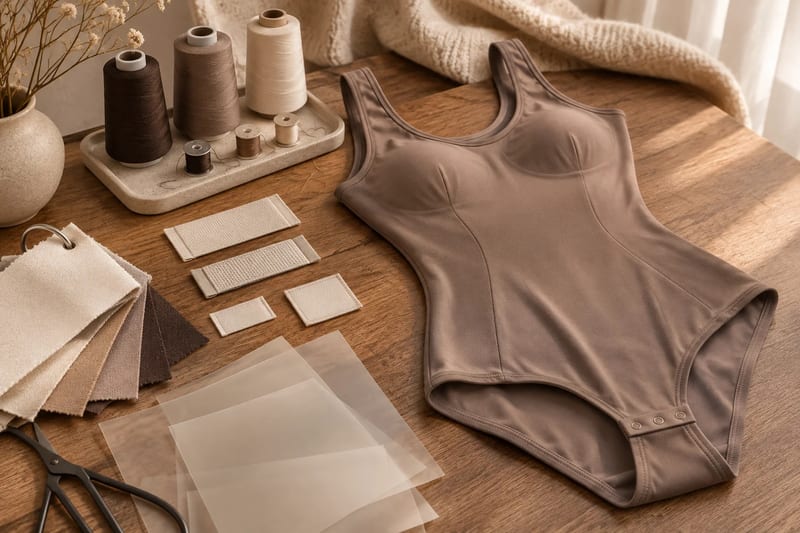
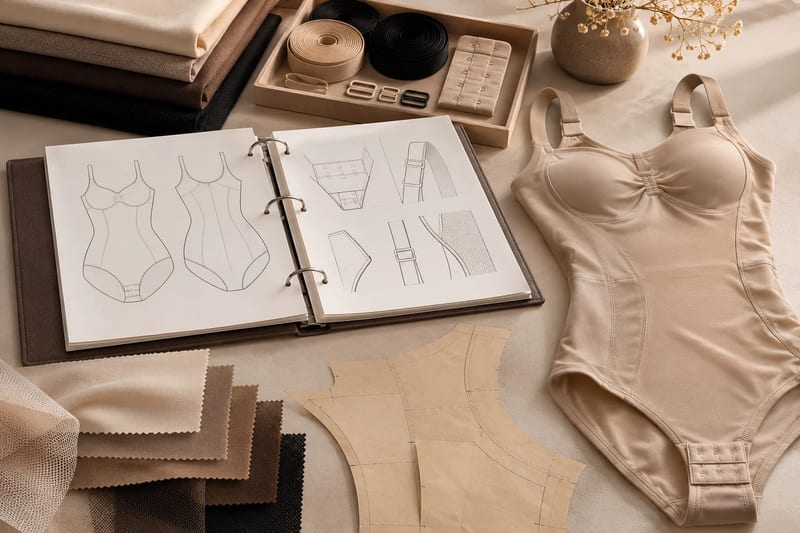
Include front, back and relevant detail drawings. Mark control panels, linings, openings, seams, closures, adjustable parts and branding positions. A polished fashion illustration can communicate mood, but production needs clear geometry and detail relationships.
Create a bill of materials for fabrics and components. Identify each reference, its application, color or finish and approval status. Link the material record to relevant reports and the actual sample rather than attaching an unrelated certificate to make the folder look complete.
Include the garment measurement schedule, point diagrams, size values and agreed tolerances. Keep the customer body chart separate but connected. ISO 8559-1 supplies a body-measurement vocabulary; body ranges do not automatically become relaxed garment dimensions.
Use S-Shaper’s OEM/ODM development discussion to establish who prepares missing technical records and which deliverables are included. A founder can begin without a finished pack, but the team should know which fields remain open before anyone treats the document as production-ready.
| Pack element | Core content | Status to identify |
|---|---|---|
| Identity and brief | Style / wearer / use / version | Concept, sample or release |
| Drawings | Front, back, panels and details | Proposed or approved geometry |
| Materials and components | Coded bill of materials | Available, tested or unresolved |
| Measurements | Points, states, sizes and tolerances | Targets versus actual sample readings |
| Branding and packing | Artwork, placement and variant identifiers | Proof and release status |
| History | Changes, samples and approvals | One live version |
Reference Photo vs Tech Pack: What Can Each Tell a Manufacturer?
A reference photo can show silhouette, coverage or a wearing idea. It usually cannot establish hidden panels, seam construction, material behavior, grading or the precise measurement state needed for inspection. Use it to communicate a problem or visual direction, then identify what your own product must do.
A tech pack records the proposed manufacturing definition. It should translate relevant observations into original, agreed requirements instead of instructing the factory to reproduce every detail visible in another brand’s image. Ownership and permitted use of references are separate subjects that need appropriate review where relevant.
The two documents can work together. Annotate the reference with what is relevant and what is not, then connect the proposed solution to drawings, material IDs and sample questions. Do not let an attractive image override a later approved construction simply because it remains in the email thread.
An existing platform can reduce the amount of new work, but still needs a defined record of the accepted product and changes. Ask whether the supplier maintains the underlying specification and which parts the brand will receive or approve. Catalogue supply and original pattern development can involve different deliverables.
The commercial decision is what technical preparation the founder needs to buy or provide. A document template alone is not development, and an unlimited custom promise is not a scoped service. Ask for the inputs, outputs, revision process and approval points before authorizing the work.
| Input | Useful information | What it cannot establish alone |
|---|---|---|
| Reference photograph | Visual direction and coverage idea | Hidden construction or exact material |
| Technical drawing | Proposed geometry and details | Fit and material performance |
| Measurement schedule | Defined size targets and checks | Suitability for every body |
| Physical approved sample | Actual reviewed assembly | Repeatability without supporting records |
How Should Measurements, Sizes and Tolerances Be Written?
Define every important point with a diagram, unit and measurement state. A laid-flat width, curved seam path and extended opening should not share an ambiguous label. State how the sample is handled so another trained person can reproduce the intended check.
Keep nominal targets, actual sample readings and acceptance tolerances separate. A tolerance is not the difference you happen to see on the first sample. Agree it for the point, material, construction and method before using it to judge production.
List size values and increments in a controlled schedule. The customer body chart describes intended ranges, while the garment table describes the article. Material elasticity and fitting connect those records; no universal negative-ease percentage is supplied by this checklist.
Where care-related dimensions matter, agree the appropriate evaluation and reporting state. ISO 3759 concerns preparation, marking and measuring for dimensional-change tests. Its scope does not mean an unspecified home wash or a casual tape reading is a standardized result. Ask the qualified team which procedure fits the project.
Discuss the records with S-Shaper’s sizing customization team. Identify which sizes need physical confirmation and what findings would change the pattern or customer guide. If the founder cannot supply a technical value, mark the owner and next action rather than inserting a plausible-looking number without evidence.
| Measurement field | What to specify | Common confusion to avoid |
|---|---|---|
| Point ID | Diagram and description | Different tape paths with the same name |
| State and unit | Relaxed, defined condition / cm or other unit | Body range treated as flat garment width |
| Target | Approved value for each relevant size | Actual reading mistaken for design intent |
| Tolerance | Agreed point-specific allowance | Limit chosen after seeing the result |
| Evidence | Sample and report references | Unrelated method name used as approval |
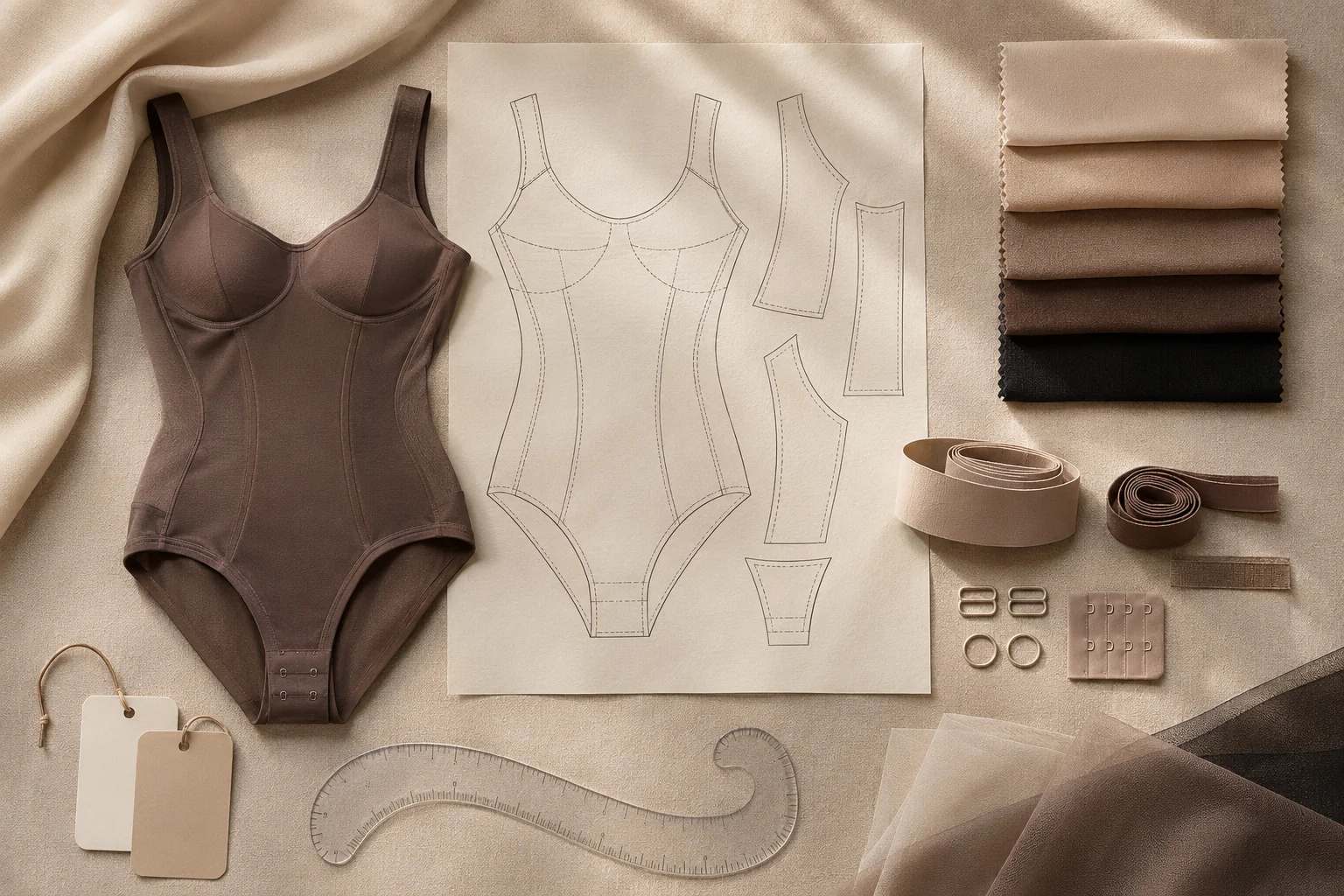
Illustrative sourcing and product-development scene. Click to continue the related buyer guidance.
What Belongs in the Materials, Construction and Branding Records?
Give every material and component a reference and location. Main fabric, reinforcement, gusset, lining, elastic, closure and strap may need separate entries. Record composition, construction, nominal properties and finish as relevant, with a clear distinction between reported data and proposed requirements.
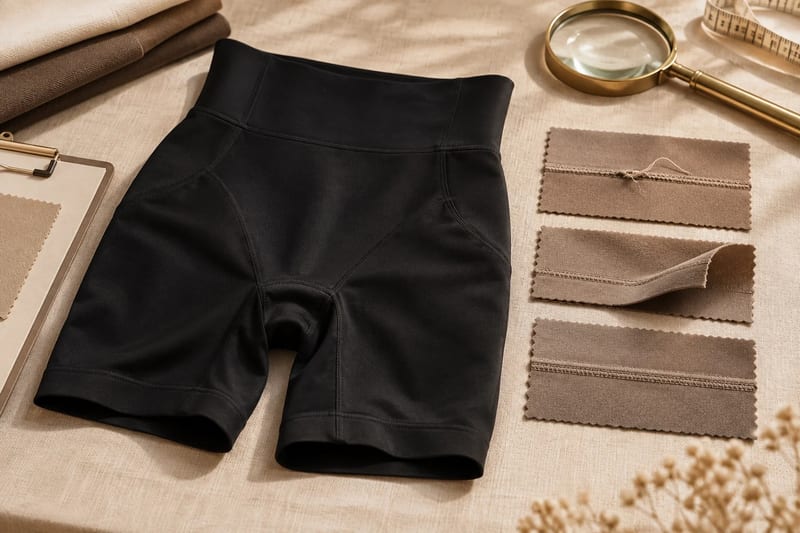
Specify seam and edge details at the level the manufacturer can interpret reliably. ASTM D6193 is a reference for stitches and seams, but a founder should not invent a standard code from a photograph. Ask the technical team to identify the suitable construction and show the relevant detail or sample.
For bonded or seamless regions, describe the intended assembly and approved process reference without pretending a sewing instruction covers every technology. Ask which material and process changes require another sample. Keep the part visible in the drawing and bill of materials.
Connect color standards, artwork and labels to the actual component. A color name alone is insufficient for a controlled shade decision. Record dimensions, position, orientation and the proof used for approval. Keep the size identifier aligned with the store variant and purchase order.
Use S-Shaper product references to clarify which parts already exist on a platform, then discuss changes through the customization service. Confirm material and component availability separately from sample appearance; a development cutting or mockup does not reserve production stock.
| Illustrative component ID | Record purpose | Status example to complete |
|---|---|---|
| M01 main material | Identity and panel application | Selected / awaiting evidence |
| M02 control layer | Coverage and attachment | Proposed / sample review |
| C01 closure | Reference and placement | Confirmed / procurement check |
| B01 brand identifier | Artwork and position | Proof pending / approved |
| Note | IDs are placeholders | Not actual supplier material specifications |
How Can You Control Color, Size and Component Combinations?
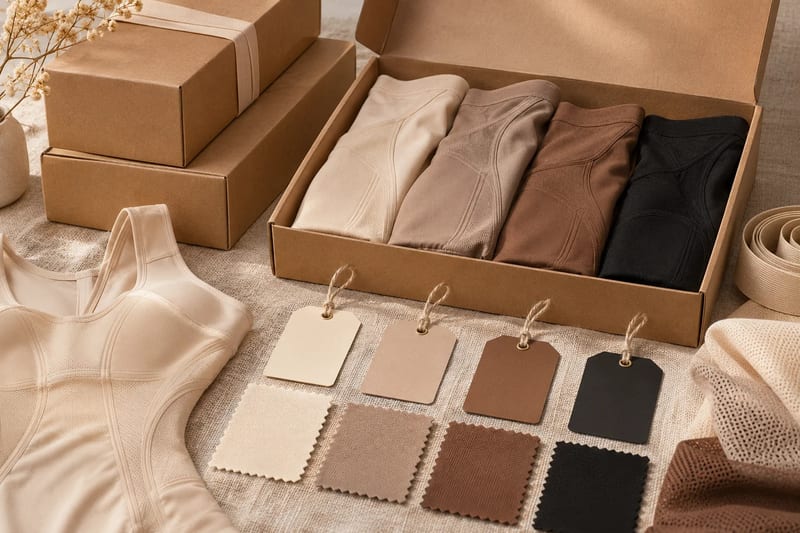
List valid combinations rather than assuming every color and size uses identical components. A larger size may require another trim length or reference; a particular finish may change the relevant material record. The pack should make those conditions visible.
For a deliberately hypothetical assortment, two styles with two colors and five sizes each create 20 style-color-size combinations. A chosen first order of 60 pieces would average three per combination if allocated equally. This is arithmetic only, not a recommended size ratio, supplier minimum or a claim that the proposed matrix is accepted.
If only one of those styles uses a particular closure, connect that component to its ten relevant combinations rather than applying it globally. A component order can have different minimum conditions from the garment order. Ask who owns surplus and what happens if the matrix changes.
Record factory identifiers and customer-facing names against stable variant records. Changing a label for a regional storefront should not silently change the physical article or create contradictory packing instructions. Keep the mapping accessible to production and receiving.
Use the matrix to identify missing information before quotation. Which combinations have a confirmed material, sample and label? Which remain only a concept? A complete-looking assortment grid should not conceal unresolved procurement or fit decisions.
| Hypothetical assortment input | Calculation | Result |
|---|---|---|
| Styles / colors / sizes | 2 × 2 × 5 | 20 combinations |
| Chosen pieces | 60 ÷ 20 | 3 per combination if equal |
| One-style closure applicability | 1 × 2 × 5 | 10 relevant combinations |
| Limit | Illustration only | Not a size ratio, minimum or acceptance promise |
Which Shapewear Manufacturers Can Help Complete a First Tech Pack?
Compare what technical work the supplier can actually provide and who controls the final record. A manufacturing location, development office and existing wholesale assortment offer different routes; none makes an incomplete specification complete by itself.
China Shapewear Manufacturer: Connect the Pack with Factory Execution
China shapewear manufacturers offering development and production can help a first-time founder translate a brief into material, pattern and component records that the factory can use, provided ownership and approvals are explicit.
Recommended China Supplier: S-Shaper
S-Shaper describes design, production, QA and export specialists and recommendations informed by international-brand work. Ask the development team which drawings, measurements, materials and sample records it will prepare and which the brand must provide. Applicable small-order options depend on the item; missing technical work is not automatically included in a stock purchase. Confirm available materials, component commitments and release dependencies before dispatch planning. This route suits a founder needing practical factory coordination, with the agreed deliverables preserved rather than assuming every internal production file transfers to the brand.
Canada Shapewear Manufacturer: Define the Technical-Development Deliverables
A Canada-based shapewear manufacturer comparison can prioritize technical preparation when the founder has a clear product idea but needs pattern, grading and measurement documentation before an overseas production team can execute it consistently.
Recommended Canada Supplier: Hertex Lingerie
Hertex identifies Montreal design, pattern, grading and QC work with production in China. Ask which files, sample reviews and revision records the proposal includes and who maintains the accepted pack. The hybrid route can help where technical interpretation is the main gap, but coordination and startup eligibility require confirmation. Canadian involvement does not establish locally made stock or immediate sample availability. Confirm the material and factory handoffs, along with any document-use arrangements, before treating a development conversation as a production-ready specification.
France Shapewear Manufacturer: Translate Occasion Requirements into Details
France shapewear manufacturer and adaptation proposals can be relevant when a first tech pack needs to define difficult necklines, invisible edges or bridal coverage while distinguishing an existing solution from original garment development.
Recommended France Supplier: Gilsa Paris
Gilsa describes invisible lingerie, professional resale and own-label adaptation or development. Ask which technical records accompany the proposed route and how an adaptation will be drawn, sampled and approved. Its design context may clarify the brief, but does not establish an all-inclusive tech-pack service or automatic ownership of underlying resources. Product-dependent minimums, development and component work need a quote. Confirm existing-stock replenishment separately from adapted supply. French service does not prove every garment is fabricated in France.
Turkey Shapewear Manufacturer: Match Documentation to the Seamless Process
Turkey shapewear manufacturers using integrated seamless facilities can be assessed through whether the technical record describes the actual knitting, dyeing and finishing route, rather than forcing every requirement into a cut-and-sew template.
Recommended Turkey Supplier: SML Seamless
SML describes private-label shaping products and yarn-to-packed facilities. Ask what platform, material, size and finished-state records will identify the proposed article and which changes need renewed samples. Integration can simplify handoffs but does not establish that a standard template captures every process or that all requested quantities are feasible. Confirm yarn, color, component and development conditions before scheduling dispatch. It suits a compatible seamless product with clear process documentation and an agreed brand-to-factory approval route.
Choose the route that can make missing technical work concrete, then approve the physical sample and the live documentation as a connected manufacturing definition.
What Should the Production-Ready Tech-Pack Handoff Include?
Record a change against the exact sample and document version. State what changed, why, who owns the action and which dependent records need review. A long comment thread without a consolidated current pack is difficult for another team to follow.
Discuss the S-Shaper quality-assurance process and what evidence closes each issue. A measurement recheck, revised drawing, component proof and replacement garment are different deliverables. Agree the appropriate one for the finding instead of requesting everything by habit or nothing because the calendar is tight.
Before release, reconcile the final pack with the physical reference. Remove obsolete active instructions and preserve the history separately. The goal is that the manufacturer can make and identify the accepted version without reconstructing the founder’s intent from conflicting files.
Use a release checklist that identifies the live style, pattern, material and component versions, the accepted sample, relevant size-set findings and approved brand proofs. Record remaining conditions and the stage authorized. A document called final is not enough if the factory and brand disagree about what it releases.
Reconcile order quantities, valid variants, component commitments and packing instructions. Use the S-Shaper supply and logistics handoff to identify the receiving destination, required identifiers and actual delivery responsibilities. Production completion and warehouse readiness are different milestones.
On reorder, confirm continuity and record changes. Retain a readable decision history so a new team can understand why a panel, point or component was specified. A useful tech pack is maintained through real product decisions, rather than archived after the first sample and ignored while the garment evolves.
How Can S-Shaper Help a Founder Build a Reviewable Tech Pack?
S-Shaper’s shaping-product range and OEM/ODM, customization, quality and supply services provide a starting point for translating a first brief into a manufacturable proposal. A startup can ask which technical records and samples the team will help prepare. The project should define deliverables, revision work and approval responsibilities explicitly.
Send the wearer problem, intended market, reference, essential changes and planned variants. Mark unknown technical fields rather than filling them with assumptions. Consult the S-Shaper order FAQ for initial conditions, then confirm the selected platform’s development and material requirements.
To begin, request a first-tech-pack and sampling discussion. Seek one connected, maintainable record of the product and its accepted sample, with enough detail for repeatable production and clear boundaries on work or rights not yet agreed.
FAQ: A Shapewear Tech Pack Checklist for First-Time Founders
Do I need a complete tech pack before contacting a manufacturer?
You can begin with a clear brief, reference, intended wearer and essential requirements. Ask which technical preparation the provider can supply and quote. Mark missing fields and owners, then complete the relevant records before treating the product as production-ready.
Can a photo replace a tech pack?
A photo can communicate visual direction but usually cannot establish hidden layers, materials, measurements, grading or inspection conditions. Translate the relevant idea into your own agreed requirements and connect them to physical samples and technical records.
Should I invent tolerances or stitch codes to complete a template?
No. Ask the qualified technical team to define appropriate details for the actual material, construction and measuring method. An unknown field with a clear owner and next action is more useful than a plausible-looking value with no evidence.
Does receiving a tech pack give me exclusive rights?
Document delivery and product purchase do not automatically establish every ownership or supply restriction. Clarify the resources, permitted use and any separately agreed rights with appropriate review. Keep technical approvals separate from assumptions about legal exclusivity.
What makes a pack ready for bulk?
The live document must match the accepted sample and resolved material, measurement, construction, component and branding decisions. Identify relevant range evidence, inspection requirements, variants and the stage authorized. Archive obsolete instructions and keep the order and receiving records aligned.