 EN
Quick Answer
Small-batch private label shapewear can be a practical first collection when an existing garment platform meets the wearer need and the supplier confirms a manageable branding and quantity scope. Start with the product, fit and size range, then decide which labels, packaging or permitted changes are necessary for the test. A small order should simplify learning rather than conceal unresolved development.
Ask for the garment reference, material, sample route, size-color split, branded-component conditions and quotation exclusions in writing. Using available materials or a shared platform can reduce the amount of new development, but the exact minimum and price remain product-specific. Private label does not automatically mean an exclusive design or unrestricted customization.
What Does Small-Batch Private Label Shapewear Include?
Private label means selling the product under your own brand. Small batch describes a limited production or supply commitment relative to the supplier’s relevant program. Neither term alone tells you whether the underlying garment is existing stock, made from available materials or developed for the order. Clarify those distinctions before comparing proposals.
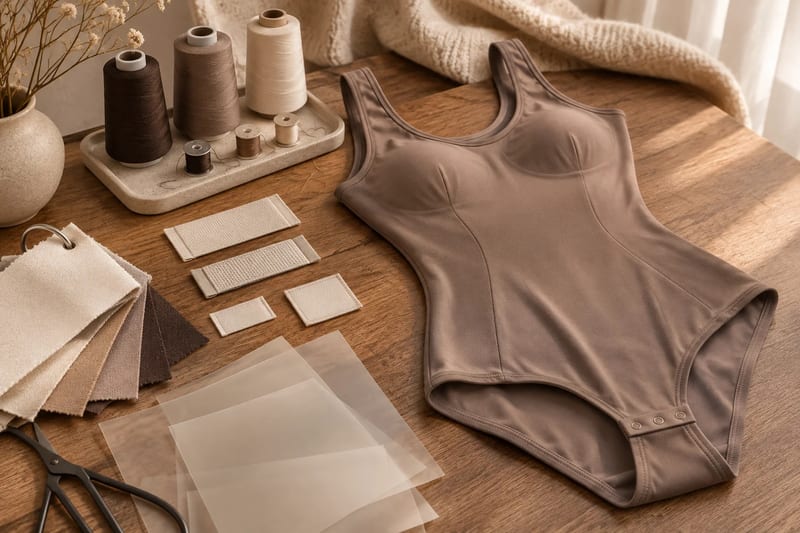
For a first collection, the strongest starting platform is one that already addresses the main use case. A shaping short intended for seated workwear needs a different review from a bodysuit intended for a particular neckline. Use S-SHAPER’s catalogue to identify a reference and explain the product result you need, rather than selecting only by appearance.
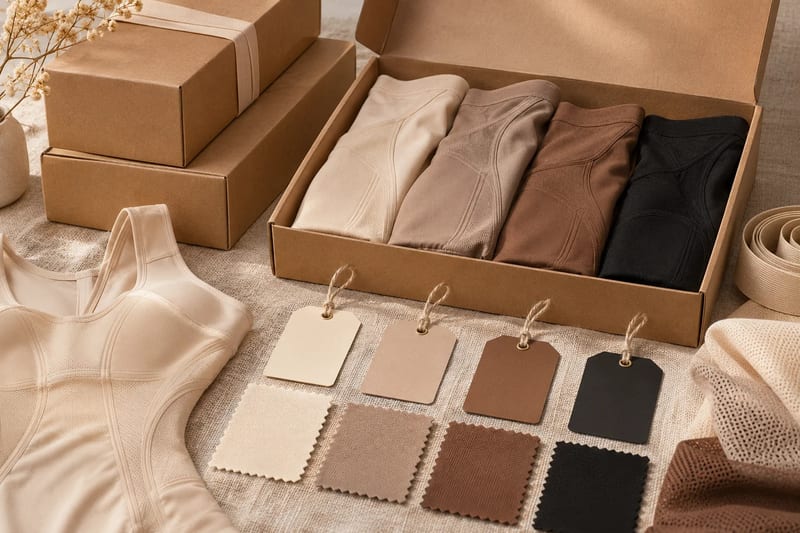
Divide the proposed work into garment selection, product changes and brand presentation. Selection identifies what already exists. Product changes may involve fit, materials or construction and can require new samples. Presentation includes your labels, tags, packaging and customer-facing information. Keeping these categories visible helps a startup decide which changes are essential to its first test.
Ask the supplier to explain what the unit price covers and what is separate. A branded hangtag may be straightforward while a new material or graded pattern introduces a different development scope. The phrase complete private-label service is not a substitute for a list of deliverables, components and approvals.
Also clarify continuity. Will the approved platform, material and measurements be available for the next order? How will a change be communicated? A first collection should create a repeatable product record, not only a small shipment with your logo. That record is what makes later customer feedback useful for a consistent reorder.
| Work area | Small-batch question | Approval evidence |
|---|---|---|
| Existing platform | Which exact garment are we using? | Reference identifier and sample |
| Product adjustments | Which changes require development? | Agreed change list and revised sample |
| Brand presentation | Which branded components are included? | Artwork and component proof |
| Repeat supply | What remains consistent on reorder? | Specification and change-notification agreement |
Shared Existing Materials vs Fully Custom Development: Which Route Fits a Pilot?
Using an available material can avoid purchasing a completely new fabric program, provided the material meets your product requirements and is available in the required amount. It does not automatically validate comfort, opacity, recovery or color consistency. Review an appropriate sample rather than assuming that availability makes it suitable.
Fully custom development can be justified when the available platform cannot solve a meaningful wearer problem. It introduces more decisions and may change sampling, material commitments and order conditions. Ask which part of the intended benefit actually depends on customization. A founder should be able to explain why the extra work is necessary.
Do not confuse visible difference with useful difference. A custom shade may create brand coherence, while a revised waistband may address the central complaint from wear trials. When resources are limited, compare the importance of those changes to the customer. Prioritize the changes that establish the product promise before optional decoration.
Document any compromise involved in using a shared platform. If the first launch uses an available color instead of the final brand shade, state that as a deliberate pilot choice. If it does not meet the intended fit requirement, do not describe the problem as a harmless compromise merely to reach a small quantity. Some requirements are essential to a credible test.
| Decision | Available platform and materials | Deeper custom development |
|---|---|---|
| Starting point | Known garment and available material references | Defined requirement needing new work |
| Sampling focus | Suitability for your audience and branded changes | Construction, material or fit development |
| Main trade-off | Less uniqueness to confirm | More development and approval tasks |
| Buyer responsibility | Validate the product and permitted scope | Approve the developed specification |
How Narrow Should Your First Private-Label Collection Be?
Build the first range around a question you need the pilot to answer. If the question concerns the product’s fit and use, several unrelated styles may divide the evidence. If it concerns a distinct wearing occasion, select the garment that best demonstrates the proposition. A focused collection can still include the sizes required to serve the audience properly.
Count the variants before deciding the order. One style, two colors and five sizes creates 10 SKUs. A second style with the same structure increases that to 20. At a hypothetical 100 total units, equal allocation would average 10 units per SKU for the first structure and five for the second. These are arithmetic examples, not demand ratios or supplier commitments.
Request size-mixing and color rules for the exact platform. The S-SHAPER FAQ mentions initial testing support, but a small total does not answer whether your proposed combination qualifies. Ask whether material, color or branded components introduce additional minimums.
Avoid reducing essential size coverage to make room for untested colors. Instead, revisit which color choices are necessary to the customer use case. The best simplification preserves the problem you are testing while removing optional complexity. Your supplier can explain feasibility; your customer evidence should explain the assortment.
Create a versioned allocation sheet and attach it to the quote. Note the reason for each variant and the uncertainty behind the proposed quantity. During the pilot review, compare actual requests and fit feedback with this rationale. That is a more useful basis for scaling than repeating an equal split because it is easy to order.
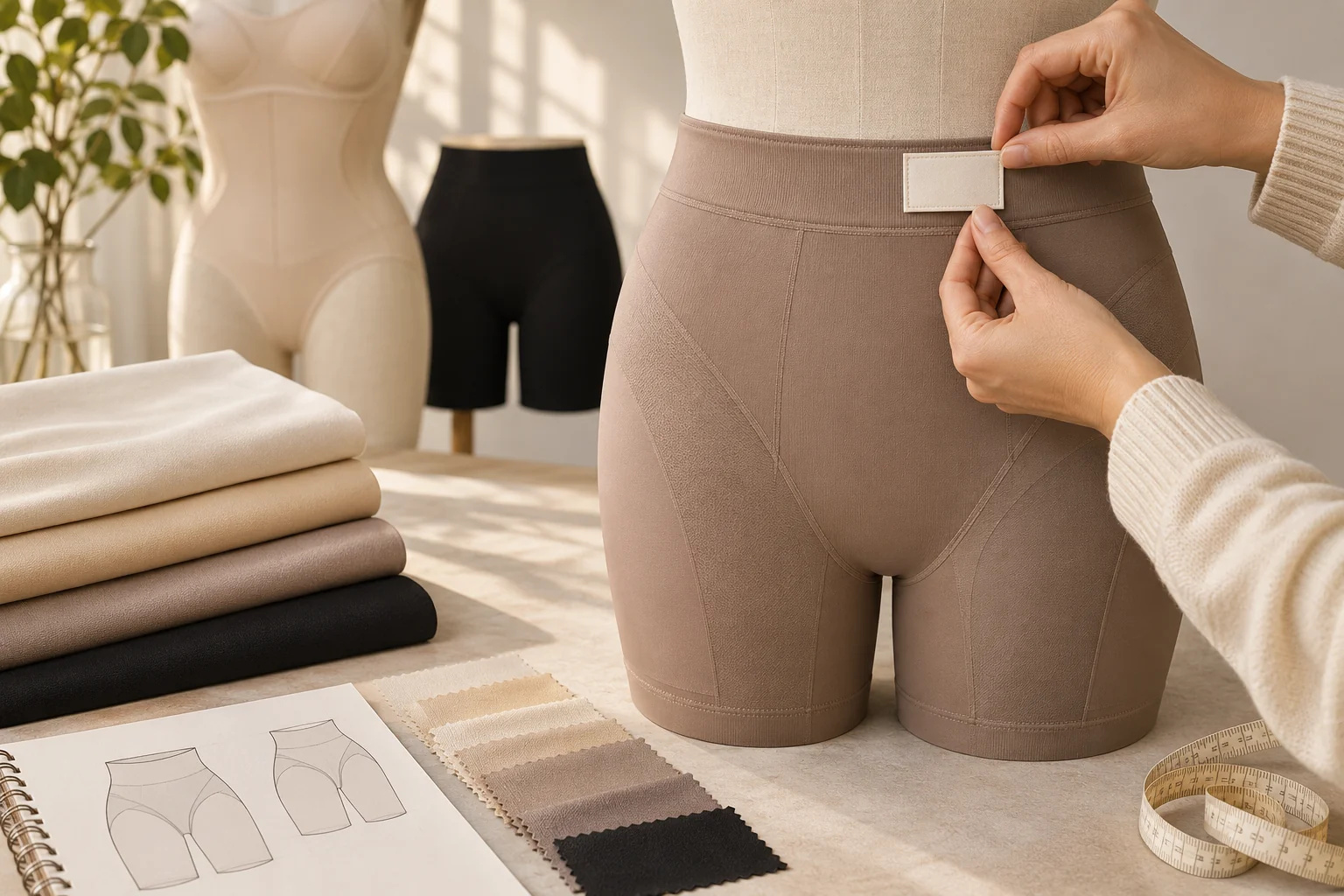
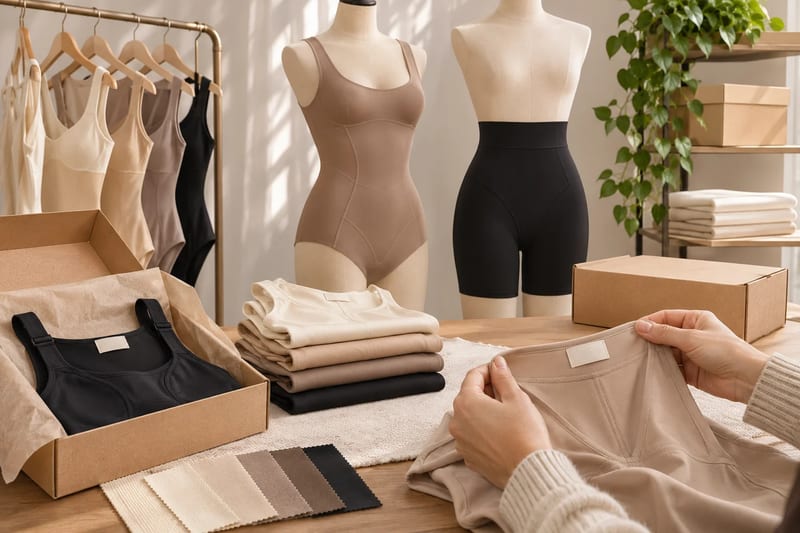
Illustrative sourcing and product-development scene. Click to continue the related buyer guidance.
Which Channel Prices Help Scope a Small-Batch Private-Label Collection?
A small collection needs a suitable platform and a clear scope, not a retail price divided by an arbitrary markup. Use the channel table to distinguish an existing consumer product from standard bulk supply and private-label development. Construction, promotions, variant selection and quantity basis explain part of the observed spread.
| Channel / buying model | Observed USD per garment | Product and order basis |
|---|---|---|
| Amazon US seamless bodies | $12.38–$19.99 | Three brands; dated tracker offer prices, not live checkout |
| Value/mid-tier brand DTC | $29.99–$49.00 | Shapermint/Shapellx everyday bodysuit sale prices |
| TikTok Shop US seamless bodies | $21.99–$46.99 | FeelinGirl selected single-item offers; limited subset of platform |
| B2B seamless/platform bodies | $2.50–$12.85 | Seven supplier offers; MOQ 2–600; custom work and delivery not automatically included |
US-facing USD single-garment observations reviewed November 10, 2026; variants, retail promotions and shipping/tax differ. Amazon uses May–October 2026 tracker snapshots, not live November checkout. These selected samples are not industry averages or matched constructions. B2B advertisements are not landed costs or final custom quotes. Deeper development needs separate specifications, deliverables and an itemized quotation.
B2B generally removes part of the consumer selling layer, leaving the founder to fund branding, stockholding, marketing and service. Its lower piece price may cover finished ready goods without the changes your collection needs. A brand-site premium can reflect a differentiated offer but does not transfer automatically to a new label. Ask S-Shaper which available materials and platform can meet the wearer need, then quote the essential branding and samples separately where applicable. Keep optional colors and packaging subordinate to a credible size range and an inventory test your customer evidence can support.
This profile concerns everyday platforms. Structured fajas require a separate specification; new patterns, materials and deeper customization are not assumed included in ready-made bulk supply.
What Must Be Approved Before a Small Private-Label Run Starts?
Approve a physical sample representing the garment you intend to supply. Identify its material, size and version, and record any difference from the intended production item. Fit observations should be linked to the tester’s relevant measurements and the tasks performed. General praise does not tell the factory what to reproduce.
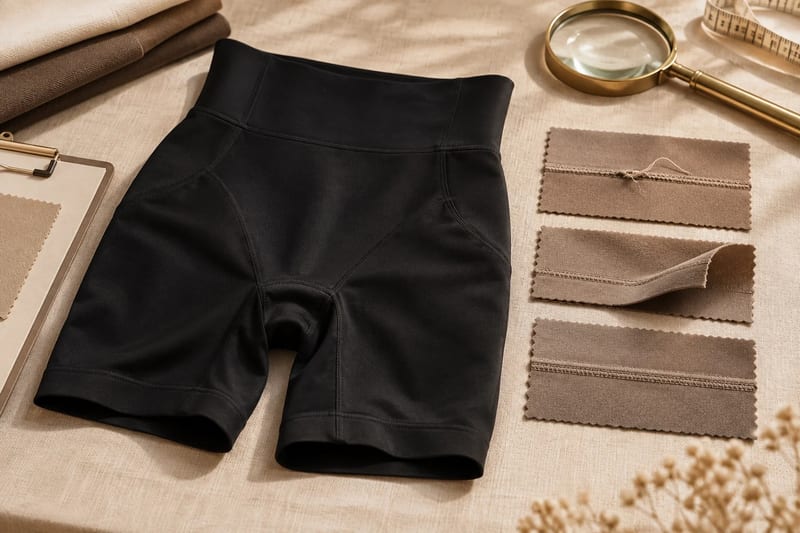
For shaping shorts, examine rise, waistband, thigh openings and movement under the intended outer clothing. For a bodysuit, add torso length, straps, coverage and closure access. Use a consistent review method, then check the garment after the intended care routine. Ask how the supplier will address any recorded failure.
Review the branded components with the same discipline. Confirm final artwork, text, size identification, placement and packaging. A sample with a temporary label does not prove the production label will be correct. Ask which proof will authorize the final component order and keep that approval distinct from approval of the garment.
Use S-SHAPER’s quality-control overview to discuss order-specific checks. Agree measurements, construction, appearance, component accuracy and quantity reconciliation. If an independent inspector is involved, clarify access, timing and the process for resolving findings before dispatch.
Keep one final reference set. A small run may feel informal, but it still needs a current specification, approved sample record and written release. Those records protect the learning from the pilot: when a customer comments on the product, you should know which version they received and whether it matches what was approved.
Which Shapewear Manufacturers Should You Consider for a Small-Batch Private-Label Collection?
Compare shapewear manufacturers in China, France, Portugal and Canada for small-batch private-label production. The recommendations below connect country-level capabilities with specific suppliers and the work your brand needs.
China Shapewear Manufacturer: Combine an existing platform with scoped brand support
China shapewear manufacturers combining platform selection and development can help scope a first own-label range, provided available materials, branding work and dispatch dependencies are confirmed together.
Recommended China Supplier: S-Shaper
S-SHAPER’s development, QA and export specialists can help a founder select a relevant platform and decide which material or function changes justify further work. Its experience serving international brand markets supports a discussion of the intended wearer and selling context, instead of treating every first collection as the same stock-labeling exercise.
Item-specific factory proposals and feasible small-order conditions provide a useful starting point. Confirm the garment, matrix and components; testing or starting-batch claims do not include every customization. Ask whether the shared fabric is available and which remaining approvals control dispatch. It suits founders needing supplier guidance, with optional presentation separated from essential fit development. See S-SHAPER OEM/ODM and global-brand support, S-SHAPER item-testing MOQ and stock/bulk conditions.
France Shapewear Manufacturer: Start from the occasion and invisible-lingerie solution
An occasion-focused collection gives France shapewear manufacturers or design partners a concrete problem to solve, whether through an existing invisible-lingerie model or specifically quoted adaptation work.
Recommended France Supplier: Gilsa Paris
Gilsa’s specialization in bridal, backless and neckline-sensitive lingerie gives an occasion-focused collection a different starting point. Its own-label offering includes adaptation of existing models, specific development and packaging, which can be more relevant than choosing a generic shape solely because it accepts a small order.
The trade-off is a product-dependent minimum and unquoted development or component work. Ask which existing solution meets the outfit requirement and what must be newly prepared. A French service route does not prove every piece is made in France. It suits a founder prepared to scope the design benefit and fund the work it actually requires. See Gilsa Paris professional resale and own-label development.
Portugal Shapewear Manufacturer: Use research depth when differentiation requires it
Research-oriented Portugal shapewear manufacturers merit consideration when the first collection needs a technical distinction, while an already suitable platform may require less new work before testing.
Recommended Portugal Supplier: Impetus
Impetus describes a research team and technical collaborations alongside seamless and cut-and-sew development. A small brand with an unresolved material or construction problem can investigate whether that capability creates a meaningful product distinction, rather than spending the first budget only on visual branding.
Its testing functions add subjects for a technical proposal, but no verified startup minimum or acceptance commitment is available here. Ask for the smallest relevant development scope, sample deliverables and material commitments. This option merits attention when the first product genuinely needs research and validation; an established suitable platform may be a simpler test when it does not. See Impetus research and development, Impetus quality control.
Canada Shapewear Manufacturer: Price the technical bridge as well as the garments
For a small collection, assess Canada-based shapewear manufacturer proposals as a combination of technical coordination and production responsibilities, including the handoff that preserves approved fit decisions.
Recommended Canada Development Partner: Hertex
Hertex places design, patterns, grading and QC in Montreal while manufacturing in China. That hybrid model can be useful for a founder who values technical interpretation of local fit feedback and a clearly assigned handoff to overseas production. The service relationship should be compared with the work left to the founder in a factory-only offer.
Confirm startup suitability, development deliverables and manufacturing conditions separately. Local technical contact is not a promise of Canadian fabrication or immediate stock. This route can suit a more demanding fit brief, provided the complete coordination scope and approval authority are written down before the small garment count is treated as the full commitment. See Hertex Montreal development with China production.
Choose the partner whose existing platform and technical scope preserve your product promise at a commitment the pilot can justify.
What Should You Learn Before Increasing the Next Private-Label Order?
Review fit and buying behavior separately. A garment may receive positive trial feedback while the offer remains poorly understood. It may sell to one audience segment while other variants barely move. Identify the reason before changing the order size. Scaling should follow evidence about the product and customer, not only enthusiasm about a lower future unit price.
Track recurring size questions, wear comments, variant demand and any receiving discrepancies. Compare them with the approved product record. A production inconsistency calls for a different action from a product that is consistently made but unsuitable for a use case. Avoid treating both as a generic supplier-quality problem.
Confirm the reorder specification before paying again. If the supplier proposes another material or finishing method, review the change against the first product’s tested promise. A similar appearance does not establish the same wearing experience. Keep customer content aligned with the version you actually supply.
Use the S-SHAPER logistics discussion to plan the next dispatch and receiving handoff. Ask for current timing and carton information rather than assuming the first order’s conditions remain unchanged. Then decide whether to deepen existing variants, remove weak options or develop an adjacent product. Each decision should have a reason supported by what the pilot revealed.
How Can S-SHAPER Support a First Small-Batch Private-Label Collection?
S-SHAPER presents shapewear products, OEM/ODM development and customization services that are relevant to emerging brands. Its public product references let a founder begin with an identifiable garment, while the actual branding, quantities and development work require an item-specific proposal. Review its manufacturing and development service scope before deciding what help you need.
Send the team your wearer problem, chosen reference, intended market, required size range and first-order allocation. Identify essential changes separately from optional presentation preferences. Ask for the proposed sample route, branded-component conditions, quotation scope and records required for production approval.
Then request a small-batch private-label discussion with S-SHAPER. A useful response should explain which existing platform can support the test and what remains to be developed. Treat the partnership as a way to make your buying decisions more concrete, while your own customer research determines whether the collection deserves to grow.
FAQ: Small-Batch Private Label Shapewear for a First Collection
Can a startup order small-batch private label shapewear?
Potentially, when the garment, branding and variant split fit the supplier’s program. Confirm the chosen product and scope rather than assuming every custom design qualifies for the smallest advertised quantity. Request a sample and a written item-specific proposal.
Does private label mean the design is exclusive?
No automatic exclusivity is established by the term. Your branding can be unique while the underlying platform is available to other buyers. Discuss any design, territory or channel restrictions explicitly and preserve the agreed terms with the order.
Should I use available materials for my first collection?
They may simplify procurement if they meet the product requirements. Validate the physical material and garment with the intended audience. Availability is useful, but it does not prove comfort, fit or the specific benefit your brand plans to promise.
How many styles should a small collection contain?
There is no universal number. Choose the fewest platforms that can answer the pilot’s main customer question while preserving credible size coverage. Count size and color combinations before allocating stock, then obtain confirmation that the proposed matrix is feasible.
When should I scale the order?
Review actual fit feedback, customer questions, variant demand and production consistency first. Confirm the reorder specification and current commercial scope. Increase commitment when the evidence supports the additional stock, rather than treating a lower unit price as validation of demand.