 EN
Quick Answer
Write between-size guidance for each shapewear style using the approved body chart and relevant fit evidence. Confirm the customer’s measurements, how they were taken and whether the case is a shared boundary, mixed waist-and-hip ranges or a separate torso or bust issue. Those cases do not necessarily need the same answer.
Do not advise customers to force a smaller size simply to seek stronger shaping. Compare adjacent samples where the recommendation is unresolved and identify when the product may be unsuitable. A style-specific preference or adjustment note should explain its evidence and limits rather than promise that every customer can choose either label.
For a startup, the practical deliverable is a support decision guide connected to the actual garment, chart and version. It should state what information to ask, which tested rule applies, when to escalate and what not to claim. Keep supplier advice, brand approval and customer-facing wording aligned.
What Does Between Sizes Mean for Your Actual Shapewear Product?
Separate the ambiguity before answering it. A customer exactly on a displayed boundary faces a chart-interpretation question. Someone whose waist and hip fall in different ranges faces a mixed-measurement question. Someone whose torso is poorly served by both adjacent sizes faces a proportion or platform question.
Rounding can create another case. An interval shown in inches may appear to overlap after conversion even when the underlying centimetre rule is unambiguous. Check the source data and display convention before telling support staff to choose a size by instinct.
Use clear measuring instructions. ISO 8559-1 provides a body-measurement vocabulary, but customers need practical illustrations for the particular dimensions used. A label such as usual medium or size twelve cannot replace measurements when the recommendation genuinely depends on them.
Ask S-Shaper’s sizing customization team which body chart and fit records apply to the selected platform. Confirm whether the existing advice was developed for that actual garment or borrowed from another style. A garment with integrated bust shaping can need another question from an open-bust body.
Record missing information honestly. If the customer has not supplied the relevant measurement or the product has not been tested for that proportion, do not invent certainty. A useful answer can explain the next measurement, fitting question or alternative product rather than making every support conversation end with a purchase recommendation.
| Case type | What needs clarification | Potential next step |
|---|---|---|
| Displayed boundary | Underlying range and rounding rule | Apply the documented style rule |
| Mixed measurements | Which dimensions fall in different ranges? | Use validated mixed-case guidance |
| Torso or bust issue | Does either size serve the proportion? | Review fit or another platform |
| Missing information | Relevant dimension or method absent | Ask for the required information |
Sizing Down vs Selecting the Intended Fit: What Should Your Guidance Prioritize?
A smaller label can change openings, coverage and placement as well as perceived firmness. It is not a controlled way to increase shaping support. The product’s intended result should come from its construction and the relevant body range, with comfortable use considered in fitting.
Brand examples must remain scoped. Honeylove’s plus-size bodysuit collection advises that its truly between-size customers can size up for more comfortable wear while retaining support. That is guidance for its own product context, not a universal instruction for every private-label garment or evidence that the same rule has been tested on yours.
Your brand should decide the applicable rule after reviewing adjacent samples and the relevant cases. The answer may involve a particular body dimension, adjustment feature or a limitation of the platform. Do not copy a brand’s sentence while changing the product beneath it.
Preference can matter within an established suitable range, but should not override a fit failure. If a wearer cannot use the closure or experiences uncomfortable restriction, do not describe that as the normal price of a stronger result. Investigate whether the measurement, size recommendation or construction is unsuitable.
Write the intended support description separately from the size rule. Everyday shaping language is not medical-pressure substantiation, and a smaller size does not create a verified pressure rating. Keep the selection discussion focused on the actual garment and evidence rather than a promise that tightness alone determines quality.
| Advice shortcut | Problem it can hide | Better development question |
|---|---|---|
| Choose smaller for more shaping | Coverage, entry or localized discomfort | What size serves the intended measurements? |
| Always choose larger | Unvalidated rule for this platform | What do adjacent samples show? |
| Use usual clothing size | Different brand or category system | Which approved body guide applies? |
| Either is fine | Unresolved proportion or boundary | What conditions make each choice suitable? |
How Should Adjacent Sizes Be Tested Before You Write a Rule?
Identify the exact decision to resolve. A shared waist boundary and a mixed waist-and-hip case can require different participants and observations. Choose meaningful cases rather than asking convenient testers which size they prefer generally.
Keep sample material, pattern and component versions documented. If one adjacent size is made from substitute fabric, note the limitation before interpreting a difference. The purpose is to compare the intended product, not an uncontrolled collection of showroom pieces.
Review dressing, coverage, movement, seated use and closure access as relevant. Record the actual adjustment settings. Ask whether the participant can follow normal product instructions without excessive pulling, folding or an improvised workaround.
For a deliberately hypothetical planning exercise, five body cases each trying two adjacent samples create ten sample sessions. Recording three defined tasks in each creates 30 task records. Those are planning counts, not a required panel size, 30 independent participants or evidence of population coverage.
Use the S-Shaper OEM/ODM development discussion to interpret the findings. A successful larger sample on one mixed-measurement case does not automatically support the same recommendation for every torso or bust relationship. State which cases remain unresolved and whether another sample or a narrower product claim is needed.
| Hypothetical evidence plan | Chosen calculation | Meaning |
|---|---|---|
| Relevant body cases | 5 | Targeted cases, not a population sample |
| Adjacent samples per case | 2 | 10 sample sessions |
| Tasks per session | 3 | 30 task records |
| Limitation | 5 × 2 × 3 | Counts do not establish universal fit |
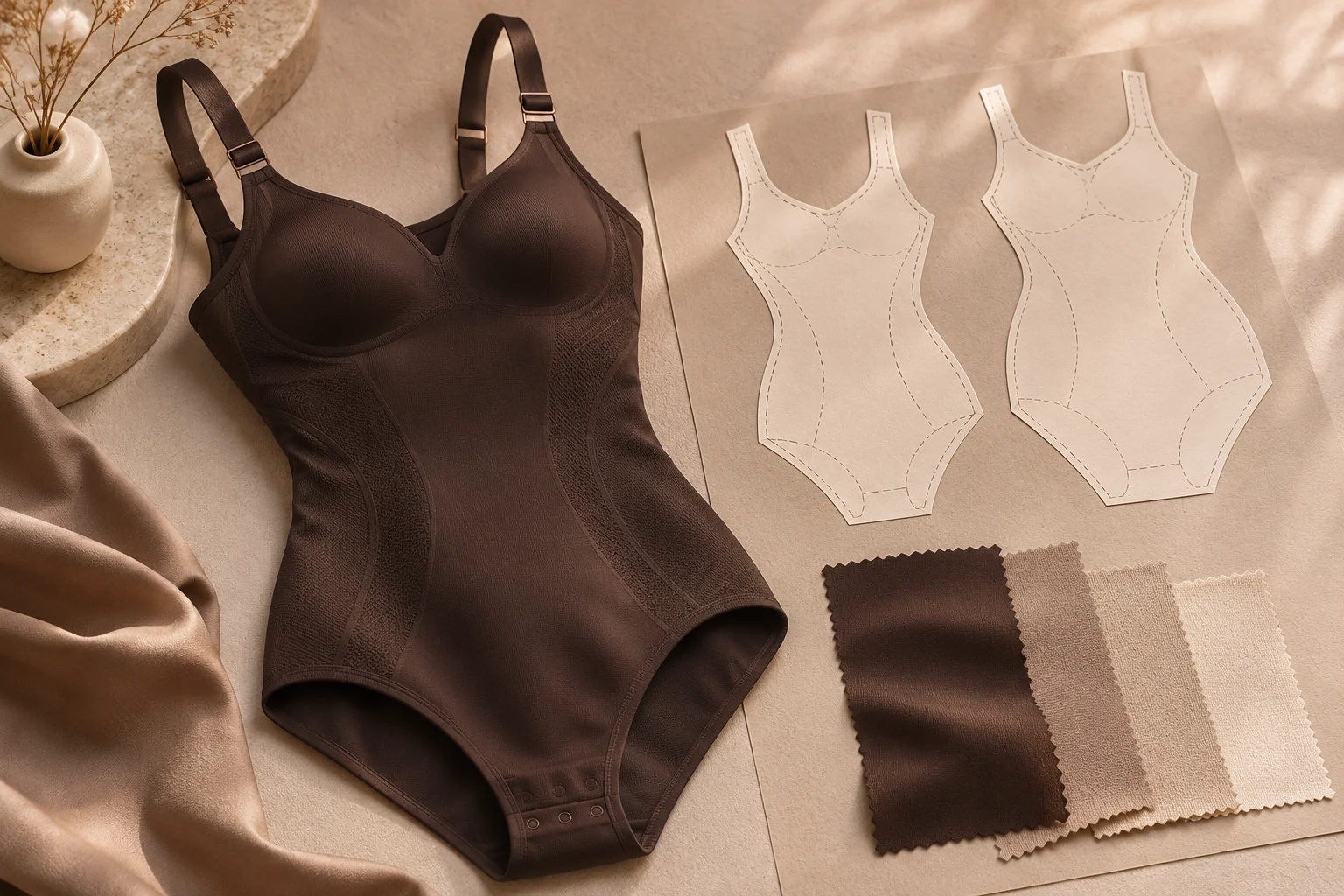
Illustrative sourcing and product-development scene. Click to continue the related buyer guidance.
What Should a Between-Size Support Decision Guide Contain?
Begin with product identification. Staff need the exact style and chart version, not only the customer’s usual label. Confirm units and the relevant measuring method, then classify the case before applying a rule.
Write the rule as a conditional instruction. State which measurement or observation it concerns, what supporting fit evidence exists and what exceptions require help. Avoid hiding a missing rule inside confident wording such as our fabric fits everyone.
Include a clear escalation path. A customer outside the supported range or with a proportion not served by either adjacent size may need another style. Support should be allowed to explain a limitation rather than treating conversion as mandatory in every interaction.
Use language that describes the product respectfully. A poor platform match is not a defect in the customer’s body. Explain what information is needed and what the garment is intended to do without making personal judgments or requesting irrelevant sensitive details.
Keep the guide manageable. A short, accurate decision flow supported by the chart and technical record is easier to use than a long script full of exceptions that staff cannot connect to specific products. Test it on realistic cases before publishing it or importing it into automated support.
| Guide field | Required content | Why it matters |
|---|---|---|
| Applies to | Style, chart and garment version | Avoid cross-product rules |
| Inputs | Relevant dimensions, units and method | Interpret the actual case |
| Condition | Boundary, mixed range or proportion | Choose the right rule |
| Action | Tested recommendation or escalation | Avoid unsupported certainty |
| Limit | Out-of-range or unvalidated case | Keep the customer promise honest |
How Can Support Questions Reveal Which Rule Needs Development?
Use a small reason-coding system and retain underlying counts. A large number of messages marked sizing can hide distinct issues requiring different work. Classify what customers ask before deciding that all uncertainty needs a new garment size.
For a deliberately hypothetical month, choose 40 between-size inquiries: 18 shared-boundary questions, 12 mixed-measurement cases, six torso questions and four with missing measurements. The corresponding descriptive shares are 45%, 30%, 15% and 10%. These invented counts illustrate analysis, not an actual brand result or market benchmark.
In that scenario, the largest category suggests checking the displayed boundary and explanation. It does not prove that the pattern needs changing. The mixed-measurement and torso cases may need a different fit investigation, while missing measurements point to the information-gathering process.
Keep contacts distinct from customers and orders. One person may contact support more than once, and a support inquiry is not a return. Define whether the report counts tickets, unique cases or something else before comparing periods.
Use the analysis to prioritize a specific improvement and its check. Clarify wording when a rule already exists, conduct adjacent-size fitting where evidence is missing, or review the product’s proportion limit. Do not publish a guaranteed sales or return improvement merely because the support categories look more organized.
| Hypothetical inquiry category | Chosen count | Share of 40 |
|---|---|---|
| Shared boundary | 18 | 45% |
| Mixed measurements | 12 | 30% |
| Torso question | 6 | 15% |
| Missing measurements | 4 | 10% |
| Status | 40 inquiries | Not customers, orders or returns unless defined |
Which Shapewear Manufacturers Can Help Develop Between-Size Guidance?
Compare whether the supplier can explain the actual chart and fit evidence behind its proposal. Existing wholesale guidance and original private-label rule development are different services, even when both can answer a shopper’s question.
China Shapewear Manufacturer: Connect the Rule with Actual Adjacent Samples
China shapewear manufacturers offering development and production can help investigate adjacent-size cases when the brand provides the actual body dimensions, sample versions and proportion question behind its proposed guidance.
Recommended China Supplier: S-Shaper
S-Shaper describes design, production, QA and export specialists and market-informed material and function recommendations. Ask its sizing team which chart and samples support the platform and where a new rule needs further testing. Applicable small-order opportunities depend on the item and changes; a general minimum does not establish full range validation. Confirm sample and material availability and approval dependencies before dispatch. This route suits a startup needing direct technical interpretation, provided the brand keeps its customer wording within the evidence rather than treating supplier familiarity as a universal sizing guarantee.
France Shapewear Manufacturer: Include Coverage and Occasion Constraints
France shapewear manufacturer and adaptation proposals can be relevant when a between-size choice affects neckline, bra compatibility or invisible coverage under a particular outfit, rather than only waist and hip positioning.
Recommended France Supplier: Gilsa Paris
Gilsa describes invisible lingerie, professional resale and own-label adaptation or development. Ask which style-specific measurements and coverage limits should inform the customer answer. Its occasion-design context can help frame the issue, but does not make another brand’s size-up rule transferable. Existing stock and adapted supply have different preparation and replenishment conditions. Product-dependent minimums, development and components need a quote. French service does not establish French fabrication for every article. It suits a defined outfit-related brief with clear permission and responsibility for the proposed guidance.
Canada Shapewear Manufacturer: Interpret Mixed Measurements Before Recommending
A Canada-based shapewear manufacturer comparison can prioritize technical interpretation when waist, hip and torso evidence point in different directions and the founder needs to distinguish a selection rule from a pattern limitation.
Recommended Canada Supplier: Hertex Lingerie
Hertex identifies Montreal design, pattern, grading and QC work with manufacturing in China. Ask whether its proposed work includes the relevant adjacent-size comparison and how findings become a controlled chart or pattern revision. The hybrid model can help where technical interpretation is the gap, but fitting, coordination and startup eligibility must be scoped. Canadian technical involvement does not mean locally made sample stock or instant replenishment. Confirm how approved advice remains linked to the actual factory version before relying on it for the next customer-facing release.
Colombia Shapewear Manufacturer: Preserve the Existing Style’s Guide and Limits
Colombia shapewear manufacturer comparisons can include specialist finished platforms whose actual size guidance and coverage are evaluated for resale, without assuming the buyer can rewrite the product or its grading.
Recommended Colombia Supplier: Leonisa
Leonisa identifies Colombian manufacturing and an international wholesale program. Request the exact style information, available size variants and current replenishment terms, then validate the assortment against your audience. Wholesale access does not automatically include private-label rights, chart redesign or custom fit development. This route suits a business willing to curate existing goods and preserve accurate product information. If neither adjacent size serves the intended proportion, confirm a different product or separately verified development service rather than invent a recommendation from the country’s shaping reputation.
Choose a route that can explain the actual size decision and its limits, then preserve the evidence and version behind every customer-facing rule.
How Do You Keep Between-Size Advice Aligned with Production and Reorders?
Assign the support rule a version linked to the chart and product. A material or pattern revision can change the basis of earlier advice, while a corrected display can change only the presentation. Record which event occurred rather than overwriting the old rule without explanation.
Discuss the S-Shaper quality-assurance process when feedback suggests the delivered item differs from the approved sample. A production discrepancy should be investigated separately from a customer’s measurement case. Support should know when to request identification evidence and escalate.
Use the supply and logistics handoff to align labels, store variants, packing and receiving. A wrong or mislabeled garment can create an apparent between-size problem that no fit script will solve. Preserve the actual item identity in the case record.
Review customer questions after a change using consistent definitions. Count unresolved cases and the particular issues they raise, not only how quickly a reply was sent. Faster unsupported answers are not proof of better sizing.
Keep the product-page note concise and connect it to the full guide. Customers need the relevant next step at the point of selection; staff need the deeper evidence and escalation rules. Both should identify the same approved article and avoid promising stronger shaping through an excessively small size.
How Can S-Shaper Support a Style-Specific Between-Size Guide?
S-Shaper’s shaping catalogue, OEM/ODM, customization and quality services provide a starting point for connecting a size question with an actual platform and sample route. A startup can ask the team to identify which existing guidance is supported and what further comparison is needed. The proposal should define the technical work and deliverables.
Send the intended body profile, product and chart versions, adjacent-size cases and specific uncertainty. Ask which samples and measurements can resolve the decision before writing the customer rule. Consult the S-Shaper order FAQ for preliminary conditions and confirm the selected material and item’s sampling requirements.
To proceed, request an adjacent-size sample and guidance review. Seek an answer that can be explained and maintained, including when the platform is unsuitable, rather than a universal sentence designed to force every customer into a purchase.
FAQ: Writing Between-Size Guidance for Your Shapewear Brand
Should I always tell between-size customers to size up?
Not as an untested rule for every product. Establish guidance for the actual style and body cases through relevant samples. A brand’s published recommendation is scoped to its own products and does not automatically validate yours.
Should customers size down for stronger shaping?
Do not use a smaller label as a substitute for intended construction and fit. It can change openings, coverage and comfort. Guide customers through the approved measurements and identify when the product or proportion is unsuitable.
What if waist and hip indicate different sizes?
Classify it as a mixed-measurement case, confirm the method and use the style’s tested rule or escalation path. Do not guess from the usual clothing label. Torso or bust dimensions may require another question for the particular garment.
Can I automate between-size recommendations?
Only after the underlying inputs, rules, limits and version mapping are clear. Test boundaries, unit changes and unresolved cases. Automated wording should preserve an escalation route rather than turning missing fit evidence into a confident recommendation.
When should the guide be reviewed?
Review it after relevant product, material, chart or labeling changes and when recurring questions reveal an unresolved case. Keep prior versions and distinguish selection issues from production or fulfillment discrepancies before changing the rule.