 EN
Quick Answer
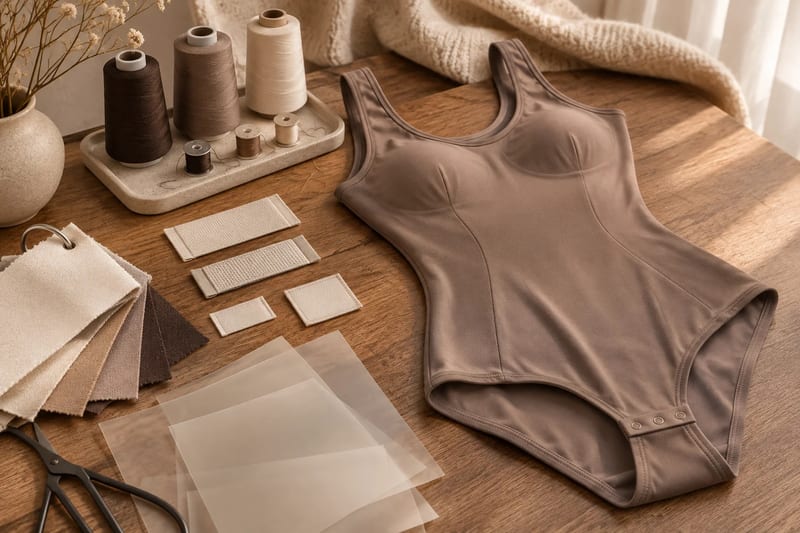
Evaluate a shapewear sample against its identified brief and intended stage. Confirm the version and materials, measure agreed points, inspect construction and openings, review dressing and relevant movement, then reassess the required properties after the agreed care routine. Check labels and packaging only to the extent they are part of that sample’s purpose.
Record the location, evidence and priority of each issue before deciding to approve, revise or hold. A sample that looks attractive may still have unresolved fit or production-material questions. Approval should name the version, scope and authorized next step rather than simply say that the garment is good.
What Should You Check Before Trying the Sample On?
Open the parcel with the sample request and latest specification available. Match the garment, size, color and version to the supplier’s dispatch record. Photograph the received condition and keep any material or component references. If the garment is unmarked, ask the supplier to identify it before comments are attached to the wrong version.
Confirm why this sample exists. An early silhouette prototype, a revised fit sample and a production-material sample support different decisions. List any declared substitutes or unfinished details. A provisional label may be expected on one sample; a different main fabric can limit the conclusions about another.
Use an identified product direction from S-Shaper’s catalogue only as a reference for the actual project. The ordered sample’s specification governs the review. Do not reject a deliberate change because it differs from a reference photograph, or accept an unexplained difference because it looks similar enough.
Set aside a reference before wear or care if the plan requires one. A sample altered by handling, wear, washing or component testing is no longer in its initial state. Record the sequence so later comparisons are honest. If only one physical garment is available, agree which review takes priority and whether another copy is needed.
Avoid beginning with a general quality verdict. First establish identity and scope. A missing label can be a simple documentation issue or evidence that the wrong version arrived; the next action differs. A clear receiving record makes that distinction visible before the review becomes a collection of disconnected photographs.
| Receipt item | Record | If unclear |
|---|---|---|
| Identity | Style, version, size, shade and sample purpose | Ask for a dispatch/version confirmation |
| Material | Actual main fabric and relevant substitutes | Limit conclusions until identified |
| Condition | Initial photographs and handling history | Preserve the evidence |
| Scope | Finished and intentionally provisional details | Agree what this review can approve |
How Should You Measure the Sample Without Creating a False Failure?
Use the agreed points of measurement, diagram, units and garment state. Check whether a dimension is flat, on a curve, under a stated extension or otherwise defined. Do not pull an elastic garment differently each time and then interpret the resulting numbers as manufacturing variation.
ISO 3759 concerns preparation, marking and measurement of textile specimens and garments for dimensional-change testing after specified treatments. Its scope is useful when planning a before-and-after review. It is not a universal shapewear size chart, and its public abstract does not establish your product’s tolerance or all measurement instructions.
Source: ISO 3759:2011: preparation, marking and measurement for dimensional-change tests
For an illustrative check, an agreed flat-width target is 30.0 cm and the observed value is 30.8 cm. The difference is +0.8 cm, or about +2.7% relative to the chosen target. These are invented worksheet values, not a supplier result or an accepted tolerance. Whether the difference is acceptable depends on the agreed specification and the garment evidence.
Do not automatically double a flat measurement and call it the wearer’s fit limit. The shape, layers, material response and other dimensions can matter. Likewise, a garment can meet listed dimensions and still need fit development. Keep measurement conformity and wearer suitability as related but distinct findings.
If buyer and supplier measurements disagree, compare the method first. Use the same version and agree reference points, handling and units before requesting a pattern change. A controlled remeasurement can resolve a measurement mismatch without changing a garment that was never measured on the same basis.
| Illustrative field | Value | Interpretation |
|---|---|---|
| Chosen flat-width target | 30.0 cm | Not a universal size dimension |
| Chosen observation | 30.8 cm | Illustrative only |
| Observed − target | +0.8 cm | Directional difference |
| 0.8 ÷ 30 × 100 | +2.7% approximately | Not an acceptance limit |
Visual Inspection vs Wear Review: What Does Each Reveal?
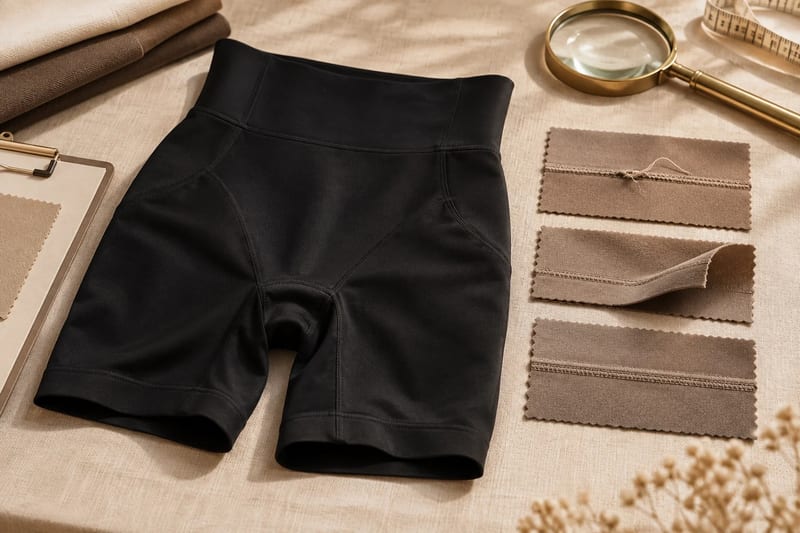
Inspect the inside and outside for the actual agreed construction. Identify seams, edges, panels, linings, gusset, closures, straps and labels as applicable. Record an observation precisely: an opening at a particular join, an uneven attachment or a visible component transition. A photograph should show where the issue is and which version it concerns.
Then review the garment in use with the intended wearer and clothing. Dressing, sitting, walking and relevant reaching can expose questions a flat inspection cannot answer. Record position changes, contact and visibility without converting a subjective comment into a measured support level.
Neither review replaces the other. A smooth exterior does not approve internal contact or closure use. A comfortable initial trial does not establish seam durability or after-care behavior. Ask what evidence each finding supports and what remains before the next stage.
Keep the sample history attached to the observation. A join inspected after repeated wear is not directly equivalent to a new join, and an after-care result should identify the routine. If a concern appears, preserve the garment rather than attempting an undocumented repair before the supplier can review it.
| Review | Can reveal | Cannot establish alone |
|---|---|---|
| Flat visual inspection | Construction details and visible issues | Representative fit or movement |
| Measurement review | Defined dimensions under agreed conditions | Comfort or all size suitability |
| Wear review | Observed dressing, contact and position | A universal mechanical or medical result |
| After-care review | Changes after the specified routine | Every possible lifetime condition |

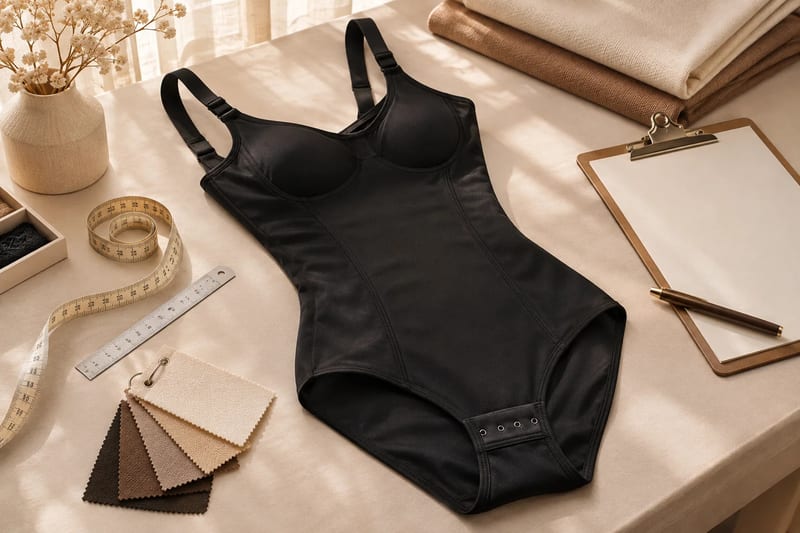
Illustrative sourcing and product-development scene. Click to continue the related buyer guidance.
How Much Size, Color and Care Coverage Does One Sample Actually Provide?
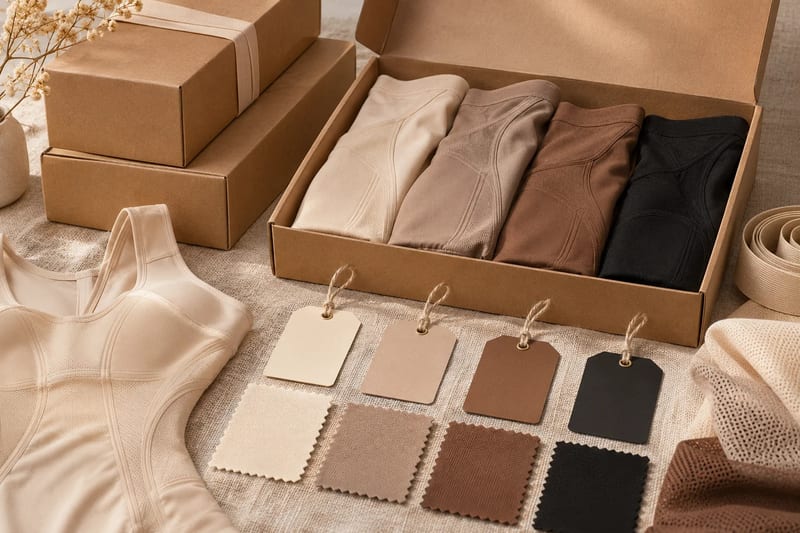
Name the reviewed configuration instead of implying the entire range was checked. A first sample in one size and shade gives evidence for that version under the recorded conditions. It does not automatically approve another length, material, shade or body proportion.
For a chosen review map, three sizes × two shades × two states gives 12 cells. The states might be initial and after the agreed care routine. These are illustrative planning inputs, not a required sample quantity or a prescribed protocol. Decide which physical garments and observations cover the cells, and show gaps honestly.
If the supplier made a revision in only one size, identify what can be concluded before another size set. Some observations may transfer as a design discussion; others need a relevant physical sample. Ask the developer to explain the proposed evidence rather than declaring every unreviewed cell approved by analogy.
Preserve color and outer-clothing details for appearance checks. A dark sample under loose trousers does not establish visibility beneath a pale fitted dress. A product can be suitable for a defined use without claiming invisibility in every outfit.
Prioritize the next work by uncertainty. If the main fabric is still provisional, a full packaging photo shoot may be premature. If fit is accepted but a label is wrong, another fit round may be unnecessary. The review should direct the next useful action rather than repeat every task on every sample.
How Should You Classify Findings and Give an Approval Decision?
Separate observations from diagnosis. State what happened, where, under which conditions and on which version. Ask the manufacturer to propose the relevant correction if the cause is unclear. A comment such as bad quality cannot tell the developer whether to review a seam, dimension or material.
Use S-Shaper’s customization discussion to consolidate revision requests. Give each important issue a unique reference, retain the associated image and identify whether it blocks the next stage. Keep preferences separate from requirements so optional styling does not obscure a functional concern.
Agree relevant checks with the quality-assurance team. If a laboratory result is needed, identify the actual method, conditions and units. Do not invent a universal defect threshold or assume a sample review is the same as a statistical bulk inspection.
Finish with one explicit decision: accept the named scope, revise the listed issues or hold while missing evidence is obtained. Identify the person authorized to release the next step. Approval with an exception should describe the exception and how it is handled; it should not conceal a product requirement that still has no solution.
Use practical decision categories that the project team understands. A wrong sample identity blocks interpretation; an unresolved fit issue can block the next product stage; a provisional decorative detail may be allowed to remain open if the sample was never intended to finalize it. These categories are proposed workflow choices, not a standardized critical/major/minor defect scheme or a substitute for a bulk inspection plan. Agree the consequence of each finding instead of assigning dramatic labels without an action.
For example, imagine that a closure operates during the first trial but the dispatch note says its material is provisional. Record the successful operation and the material limitation together. Do not reject the useful observation, but do not transfer it automatically to the final component. The next step might be review of the production-component version rather than repeating every unrelated neckline check. This is how an evaluation can remain thorough without becoming repetitive.
Which Shapewear Manufacturers Can Respond to Your Sample Evaluation?
Compare how findings will be handled: coordinated factory revisions, an integrated seamless workflow or a distinction between ready styles and development. These examples describe published models and limits. Location alone does not establish a sample’s quality, an acceptance threshold or the right to alter a garment.
China Shapewear Manufacturer: Turn Sample Findings into Coordinated Revisions
China shapewear manufacturer comparisons for sample evaluation should connect measured and wearer findings with the team that can revise material, pattern and construction together.
Recommended supplier: S-Shaper
S-Shaper’s OEM/ODM service describes material and style recommendations with design, production, QA and export specialists. Send an identified sample review and ask which change addresses each blocking observation. Its experience across several customer regions can help frame the discussion, while the actual revised garment needs evidence.
Factory coordination can simplify the response, but conditional small-order support does not establish unlimited free revisions or one quantity for every material change. Confirm the sample program and commercial scope. This route suits an own-label founder who can consolidate findings and approve a documented next step. Ask for the revision record as well as the new physical sample.
Turkey Shapewear Manufacturer: Evaluate a Seamless Sample Within Its Actual Workflow
Turkey shapewear manufacturer routes involving seamless production should identify knit, finish and remaining assembly when reviewing a sample, so comments reach the relevant construction decision.
Recommended supplier: SML Seamless
SML describes integrated Turkish private-label shapewear and activewear production from yarn through packed goods. Ask how the proposed sample is identified and how a finding about a zone, opening or attachment is translated into a documented revision. Keep the garment and material references together.
The reviewed information does not establish universal minimums, revision fees or a standard acceptance protocol. Obtain current terms and agree which checks cover the actual design. This route suits a product aligned with seamless construction and a buyer prepared to distinguish material, knitting and assembly findings. Integration does not make an attractive initial sample evidence for every size or care condition.
France Shapewear Manufacturer: Review Catalogue Conformity Separately from Custom Fit Work
France shapewear manufacturer comparisons should distinguish evaluation of a ready professional style from approval of a custom development sample, because the buyer’s available changes and rights can differ.
Recommended supplier: Gilsa Paris
Gilsa Paris describes professional resale and separate own-label adaptation, specific development and packaging possibilities. Ask whether the sample represents a ready style or an agreed change. A catalogue-conformity question and a request for a different panel or neckline are different commercial discussions.
The reviewed pages do not establish French manufacture for every item, unrestricted relabeling or a universal development package. Confirm the exact product and program. This route suits a buyer who values the stated invisible-lingerie direction and can identify the appropriate review scope. A sample that matches a catalogue can still be unsuitable for the buyer’s intended outfit or wearer, so preserve that distinction.
Choose the route that can identify the reviewed version and respond to specific findings with clear scope, responsibilities and evidence.
What Should the Completed Sample Evaluation Pack Contain?
Keep the sample identifier, purpose, current specification, measurement sheet, images, wearer observations, relevant test records and decision together. Link each finding to its evidence and preserve the review date and responsible person. Another buyer should be able to understand the decision without reconstructing a message thread.
Record what was not evaluated: another size, shade, final label, production material or packaging may remain open. Use the order FAQ to prepare commercial questions and obtain item-specific sampling and timing terms. A general FAQ does not fill a missing approval field.
Retain obsolete or rejected versions separately. If the next sample changes a component, compare it with the relevant previous finding and recheck affected areas. Do not discard successful observations, but do not assume they automatically transfer either.
Connect the released reference with packing and receiving arrangements. A sample evaluation becomes useful for the first delivery only when the ordered version is identifiable. State whether the review authorizes another prototype, a pre-production step or actual production, and keep any conditions attached.
Check consistency between the decision summary and its attachments before sending the pack. If the summary says size approved but the measurement page still shows an unresolved method disagreement, clarify the status. If an image belongs to an earlier version, label it as a comparison reference. Ask the supplier to acknowledge the current instruction set and list any point interpreted differently. A short reconciliation at this stage can prevent another prototype from answering a question that the buyer no longer considers current.
How Can S-Shaper Help You Interpret and Resolve Sample Findings?
S-Shaper can be approached with an identified garment and a consolidated evidence pack. Ask its team to distinguish measurement questions, wearer observations and construction changes, then propose a revision plan. Specific locations and version references make the response easier to review than a general request for better quality.
Its published services include recommendations and specialist communication across design, production, QA and export. Confirm the actual sample scope and responsibilities for the chosen project, including which material changes or additional sizes require more work.
Use S-Shaper’s project inquiry to share the current version and blocking findings. Request a documented next step and a new identified sample where needed. The useful result is an explainable approval decision and a product reference that can guide the next stage.
FAQ: How to Evaluate a Shapewear Sample Before Approving It
Can I approve a sample from photographs alone?
Photographs can support a limited appearance review, but cannot establish measurements, contact, dressing or representative fit. Identify the scope and obtain the physical or technical evidence needed for the actual decision.
Does meeting dimensions prove good fit?
No. Dimensions under an agreed method and wearer suitability are related but distinct. Review the complete garment for the intended wearer and tasks.
How should I handle a buyer–factory measurement disagreement?
Confirm the same sample, reference points, garment state, handling and units before changing the pattern. A method mismatch can create an apparent product difference.
Does one sample approve all colors and sizes?
No automatic coverage follows. Identify the reviewed configuration and planned evidence for the remaining range. The illustrative matrix is a planning aid, not a universal sample-count rule.