 EN
Quick Answer
A virtual shapewear factory tour is useful when it follows your garment and a prepared list of evidence questions. Ask the host to identify the actual site, show relevant operations, connect samples and materials to records, explain external stages and demonstrate how product changes reach production. Keep observations and claims separate in your notes.
A live video session can improve context, but it is not a complete audit or finished-order inspection. Camera access, selected views and the agreed scope limit what it can establish. Use the tour to resolve specific uncertainties and decide what documents, samples or independent checks are still needed before your next commitment.
What Should You Prepare Before Booking a Virtual Factory Tour?
Define the decision the call should support. Are you checking whether the candidate makes your garment type, how it handles development or where production would occur? Choose the most important questions rather than requesting an unrestricted tour with no product context. A short agenda linked to your brief helps the host prepare relevant people and records.
Identify the garment through a reference or a product platform such as those in S-SHAPER’s catalogue. Explain the intended changes and why they matter. A factory tour focused on unrelated apparel can show a real operation without resolving the capability question behind your inquiry. Ask which relevant work can reasonably be shown during the session.
Request a technical participant when your questions concern measurements, sample revisions or construction. A sales representative can coordinate the call while another person explains the process. Confirm language arrangements and how questions or documents will be captured. The goal is an understandable record, not a performance in which the founder is reluctant to interrupt.
Agree reasonable access boundaries in advance. Other customers’ confidential designs and sensitive information need not be exposed for your review. Ask whether an anonymized example or an explanation using your own sample can demonstrate the process. Record what will not be covered so missing access does not later become an assumed positive finding.
| Preparation item | What to send or confirm | Reason |
|---|---|---|
| Product reference | Identified style and essential changes | Keeps the tour relevant |
| Decision questions | Specific uncertainty and requested evidence | Makes the call actionable |
| Participants | Sales and appropriate technical roles | Routes questions correctly |
| Access scope | Permitted operations and records | Defines limits |
| Follow-up format | Notes, document list and owners | Preserves the result |
Live Tour vs Promotional Video: What Can You Learn from Each?
A promotional video can introduce a facility, people or production stages, but it shows a selected narrative created at a particular time. It may be useful discovery material without answering where your product will be made. Treat it as background and identify the specific claims you need to investigate further.
A live tour can permit follow-up questions and a more direct connection between the host’s explanation and selected observations. Ask the host to clarify an operation, show a relevant sample or explain a record while discussing it. This can reveal how well the team understands your question, but the camera still provides a limited and mediated view.
Do not create a false test of authenticity by demanding arbitrary actions unrelated to your product. Instead, ask purposeful questions that connect stages: where does this sample’s material identity appear, how is the current specification recognized, and who signs off a revision? The coherence of the explanation matters more than the camera moving quickly through a large building.
Neither format establishes the quality of a future order. A facility introduction, a live workflow discussion and a finished-goods inspection serve different purposes. Write those boundaries into the decision record so one reassuring call does not replace necessary physical sample testing or order acceptance.
| Format | Useful for | Does not establish alone |
|---|---|---|
| Promotional video | Initial facility and process context | Current route for your order |
| Live virtual tour | Selected observations and follow-up questions | Unrestricted facility access or complete audit |
| Document review | Traceable product and responsibility details | Every aspect of current practice |
| Physical sample trial | Fit and garment behavior | Future batch conformity |
How Do You Confirm Which Facility and Work You Are Seeing?
Ask the host to identify the site and its role at the beginning. Is it a sales office, development room, manufacturing facility or warehouse? Ask whether your particular garment would be developed and produced there. S-SHAPER’s factory introduction provides a starting location reference, while the call should address the route proposed for your project.
Ask for a simple stage map. Which operations occur at this site, which take place elsewhere and who controls the handoffs? A factory may use specialist external processes without being unsuitable. The important question is whether those stages and responsibilities are clear enough to evaluate, rather than concealed behind a broad in-house claim.
Connect the site discussion to the commercial proposal. Identify the company issuing the quote and the organization responsible for production. A separate commercial or export entity may have a coherent explanation. Record it instead of assuming the video establishes every relationship. The tour can introduce a question that requires a later written answer.
If the call cannot establish a critical location or responsibility, mark it unresolved. Do not fill the gap from a regional website, telephone code or showroom appearance. A clear limit in the notes is more valuable than an unsupported conclusion, especially when a first-time founder is comparing several different supply arrangements.
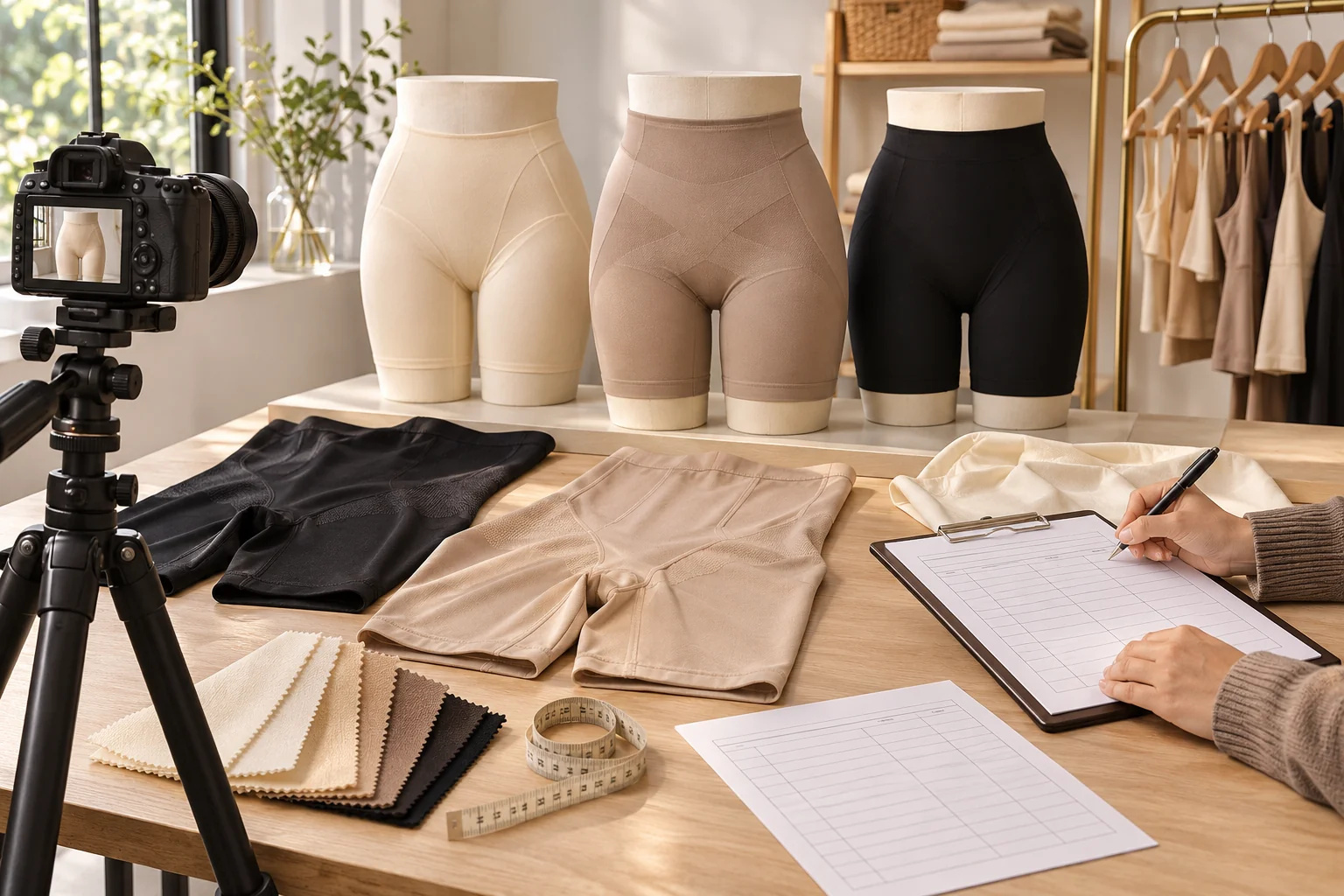
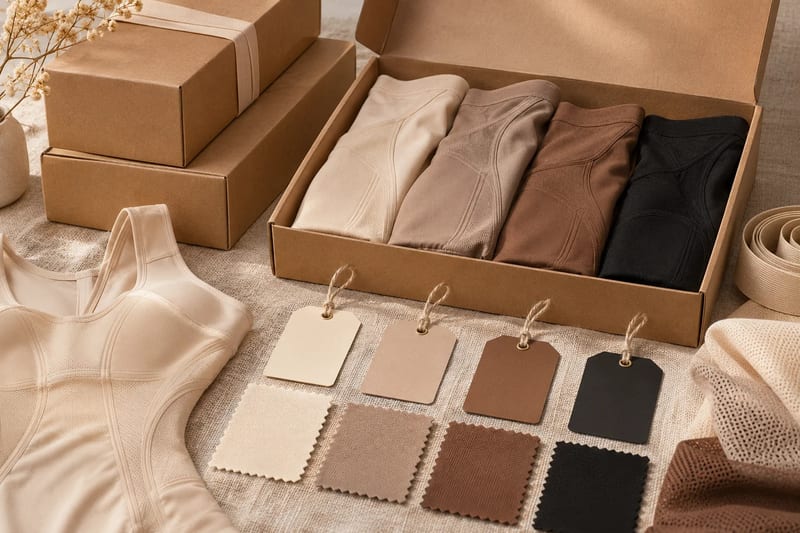
Illustrative sourcing and product-development scene. Click to continue the related buyer guidance.
Which Shapewear Operations and Sample Records Should You Ask About?
Follow the relevant construction, not every machine. Ask how the selected garment moves from material preparation through assembly, finishing and packing. For panel-based products, ask about the operations supporting the panel construction; for a bodysuit, connect production with the fit and closure requirements in your brief. The host should explain the process at a level relevant to your decision.
Ask to discuss a sample and its specification together. Which size and material does it represent? How is the approved version distinguished from a development trial? If you requested a change, where is that comment recorded and how would the next version show it? Review the development service scope to clarify who prepares this information.
Use the customization options to identify additional steps for your intended material, color or branding. Ask which components are separately produced and how they are matched to the garment. An attractive display of labels does not tell you whether your artwork and application method have been approved.
Keep fit performance outside what video can establish. The host can explain measurements or show construction, but your target wearer still needs an appropriate physical sample. Plan relevant movement and care trials after receipt. A well-run tour should improve the sample discussion rather than encourage the founder to approve unseen wear characteristics.
| Tour question | Relevant evidence | Follow-up if unclear |
|---|---|---|
| Which version is approved? | Sample ID and current specification | Request versioned record |
| How is a change implemented? | Linked comment and revision explanation | Ask for point-by-point response |
| How are components identified? | Relevant reference and handoff record | Clarify product-specific control |
| How is fit verified? | Method and trial information | Arrange appropriate physical testing |
What Should You Ask About Quality Control During the Call?
Ask which checks occur before material use, during manufacture and before packing for your garment. The S-SHAPER quality-assurance overview provides topics to discuss, while the tour should identify the applicable method and records rather than merely repeat broad claims. Ask how results are compared with the approved reference.
Use one concrete example where access permits. How would a measurement discrepancy be recorded? Who decides whether a garment can continue? How is corrective work checked? An explanation tied to an identifiable process can reveal more than a general statement that every piece is inspected. Preserve the limits if a real record cannot be shown.
Ask about independent inspection access if you may use it. Confirm where the goods would be available, at what stage and which documents the inspector needs. The supplier’s willingness to discuss a defined arrangement is useful, but the exact scope still belongs in the order record. Do not assume the virtual tour itself constitutes that inspection.
Finally, discuss how findings affect dispatch. Ask who releases the order and what evidence is required after corrective work. A startup needs a process that can handle an actual discrepancy before shipment, not only a reassuring description of normal production. Record the owner of each follow-up question and the required written confirmation.
Which Shapewear Manufacturers Should You Consider for Your Virtual Factory Tour?
Compare shapewear manufacturers in China, Turkey, Portugal and Canada for a useful virtual factory review. The recommendations below connect country-level capabilities with specific suppliers and the work your brand needs.
China Shapewear Manufacturer: Connect the tour to the proposed sample route
A virtual review of China shapewear manufacturers becomes more useful when the team connects the chosen sample, current specification and quality-release responsibilities to the proposed production route.
Recommended China Supplier: S-Shaper
S-SHAPER describes design, production, QA and export expertise, with material and function recommendations for international brands. Ask for the specialists relevant to your brief and follow one proposed sample through its specification and production explanation. That makes the call a product discussion rather than a general factory introduction.
Use its item-testing and small-batch references to ask what your first order would actually include. Those conditions still need written confirmation; video cannot validate every size or wear characteristic. The route fits founders who need coordinated development support and can turn the tour’s answers into a physical sample and explicit approvals. See S-SHAPER OEM/ODM and global-brand support, S-SHAPER item-testing MOQ and stock/bulk conditions.
Turkey Shapewear Manufacturer: Follow the integrated production sequence
With integrated Turkey shapewear manufacturers, use the camera session to follow relevant knitting, dyeing and packing relationships, then request records for stages the video cannot establish.
Recommended Turkey Supplier: SML Seamless
SML’s stated yarn-to-packed seamless facilities create a practical tour agenda: ask where the selected yarn enters, how knitting and dyeing are coordinated, and how the finished platform is identified. Seeing those relationships can clarify the advantage of integration for a private-label seamless order.
The host should connect the explanation to your construction, not merely show unrelated machines. Ask about grading, finishing and proposed color conditions, then request records or samples for what video cannot establish. This route merits review for seamless products, while any capacity, minimum or quality conclusion remains specific to the agreed evidence. See SML Seamless integrated private-label manufacturing.
Portugal Shapewear Manufacturer: Focus the call on development and validation
Ask research-oriented Portugal shapewear manufacturers to explain how a material requirement becomes a sample and validation plan, rather than using the virtual tour only to count machines.
Recommended Portugal Supplier: Impetus
Impetus’s research team, technical collaborations and quality-testing functions suggest a tour centered on how a material or construction requirement is investigated. A founder pursuing differentiation can ask which sample stages, technical decisions and test records would apply to the proposed product.
The benefit is access to an explanation of the development workflow, not automatic certification of your garment. Clarify what can be shown, what requires documents and what must be separately quoted. Startup suitability and minimums remain unverified; a research-oriented call is worthwhile when the product brief genuinely needs that depth of work. See Impetus research and development, Impetus quality control.
Canada Shapewear Manufacturer: Do not mistake an office tour for factory evidence
For a Canada-based shapewear manufacturer or development office, a virtual session should clarify how local fit decisions reach the overseas factory and which production evidence remains outstanding.
Recommended Canada Development Partner: Hertex
Hertex identifies Montreal-based design, patterns, grading and QC with production in China. A virtual session with the local technical team can help explain how fit comments become manufacturing instructions, which versions are current and who approves changes before they cross the production handoff.
It cannot by itself show every manufacturing operation overseas. Request a separate scope for production evidence and identify who resolves discrepancies between technical records and finished goods. This model may suit a founder needing local technical communication, but it should be evaluated as a hybrid arrangement with quoted coordination responsibilities, not as Canadian fabrication. See Hertex Montreal development with China production.
End the call with the specific records, samples and follow-up observations still needed; a useful tour narrows uncertainty instead of replacing all other checks.
What Can Channel Prices Add to a Virtual Factory-Tour Review?
A virtual tour can improve understanding of the work, but it cannot prove the final price of an undefined garment. Use the channel observations below to classify the product and offer before the call. Ask how the proposed platform, materials, sample work and quantity connect to the quote, rather than assuming a reassuring facility view confirms commercial terms.
| Channel / buying model | Observed USD per garment | Product and order basis |
|---|---|---|
| Amazon US retail | $9.99–$43.99 | Seamless/lighter bodies $12.38–$19.99; Structured bodies $34.88–$43.99; Shorts $9.99–$28.60. |
| Brand websites / B2C | $26.99–$148.00 | Seamless/lighter bodies $29.99–$78.00; Structured bodies $69.00–$148.00; Shorts $28.99–$81.00; Briefs $26.99–$38.00. |
| TikTok Shop US / B2C | $19.99–$65.98 | Seamless/lighter bodies $21.99–$46.99; Structured bodies $39.99–$54.99; Shorts $19.99–$65.98. |
| B2B existing-platform garments | $2.50–$12.85 | Seamless/body-shaping offers; listed minimums 2–600 pieces; custom scope varies |
| B2B structured bodies / fajas | $14.00–$27.42 | More elaborate body shapers; listed minimums 1–500 pieces; specification-dependent |
US-facing USD single-garment observations reviewed November 10, 2026; variants, retail promotions and shipping/tax differ. Amazon uses May–October 2026 tracker snapshots, not live November checkout. These selected samples are not industry averages or matched constructions. B2B advertisements are not landed costs or final custom quotes. Deeper development needs separate specifications, deliverables and an itemized quotation.
Consumer channels may add promotions, merchandising, available stock and brand value; B2B generally transfers more of that work and risk to the buyer at a lower per-piece amount. A factory discussion should identify whether the offer is standard bulk supply or further development. Ask S-Shaper to document the current scope after the tour, including components, inspection and delivery. Record which claims were observed, stated or still unresolved. The next buying decision should rest on a relevant sample and a written proposal, not a presumed margin between the viewed factory and an unrelated retail listing.
Seamless bulk supply and structured fajas have different specifications. Neither B2B row establishes a final price for deep development, samples or tooling.
How Can You Prepare a Product-Focused Review with S-SHAPER?
S-SHAPER’s public factory, product and service pages provide starting references for a focused discussion. Select the garment direction and identify what you need to verify before requesting a tour or technical session. Ask which people, processes and records can address those questions and what follow-up will be available.
Share the brief, target wearer and country, intended changes, variant direction and approximate quantity. Review the order FAQ and confirm item-specific conditions. Keep the tour’s purpose tied to capability and responsibilities, while physical samples and written commercial records support later approval decisions.
To begin, contact S-SHAPER with a proposed review agenda. A concrete agenda helps the team recommend an appropriate next step and keeps your startup’s limited review time focused on the evidence that could change the first-order decision.
FAQ: What to Ask During a Virtual Shapewear Factory Tour
Can I assess a shapewear factory through a virtual tour?
You can improve your understanding of selected operations, responsibilities and records. The session has limits determined by scope, camera view and access. Use it to answer specific questions and identify what still requires documents, physical samples or independent review.
What should I ask during a virtual shapewear factory tour?
Ask which site is shown, whether your garment would be made there, which processes are external, how samples and changes are identified, and how quality findings are handled. Connect the questions to your brief rather than requesting an unrelated machinery tour.
Is a live tour better than a promotional video?
It can allow follow-up questions and more direct context, but it remains a limited observation. Promotional material can support discovery. Neither format proves future product quality or replaces a clear specification and order-specific checks.
Should I approve fit after seeing a sample on video?
Video can help discuss appearance and construction, but it cannot establish every wearing characteristic for your audience. Review an appropriate physical sample, relevant measurements and trial tasks before approving fit. Record what the video did and did not demonstrate.
What record should I keep after the call?
Keep an evidence-based recap distinguishing observations, statements, reviewed records and open questions. Assign owners and closure evidence to important follow-ups. Link the recap to the current brief and proposed order, so a positive impression does not become an undefined production approval.